
Executive Overview
In an era where the prefix "AI" is routinely appended to consumer software to inflate market valuations, the field of digital vocal pedagogy has remained a battleground of skepticism. Voice teachers have long argued that the human voice—an instrument housed entirely within the biological confines of the throat, chest, and sinuses—defies algorithmic correction. However, newly released empirical data from Singing Carrots, an industry-leading digital vocal training platform, presents a compelling counter-narrative.
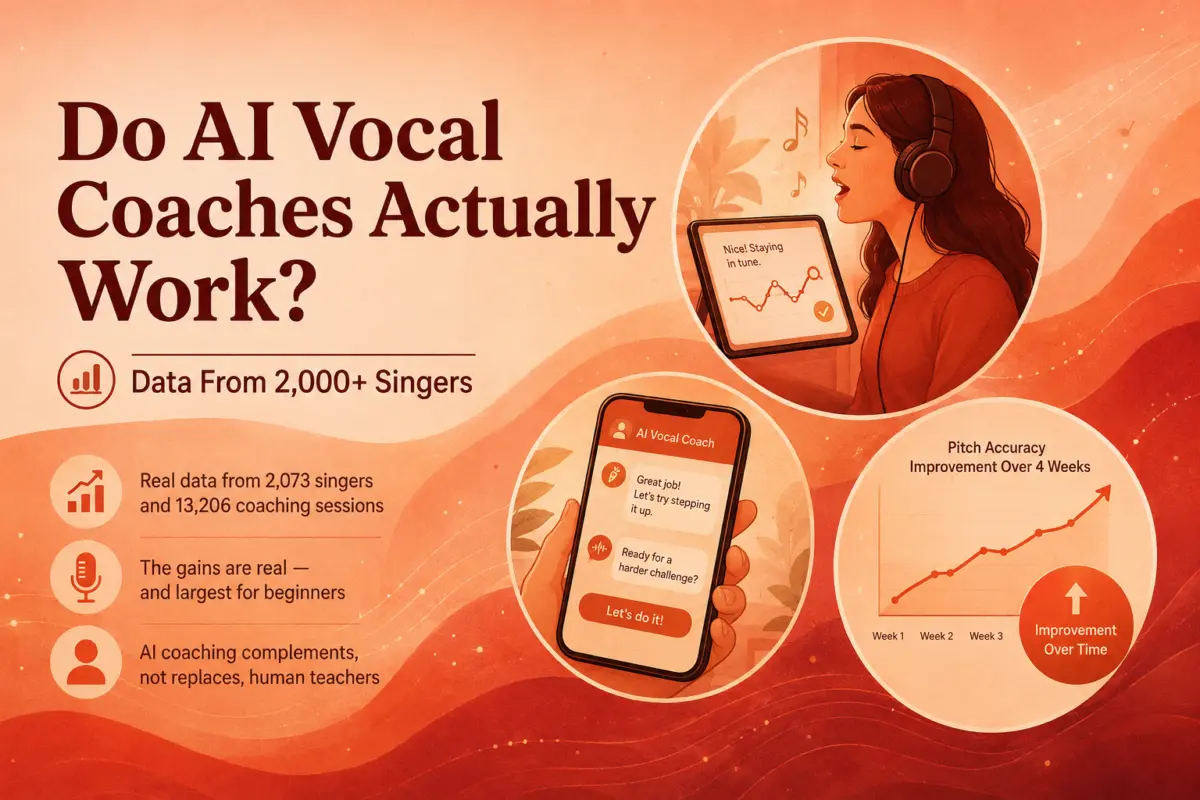
By analyzing a massive dataset of 2,073 singers across 13,206 discrete coaching sessions over a seven-month period, researchers have demonstrated a quantifiable, statistically significant improvement in vocal execution. The headline metric is striking: overall pitch accuracy improved by an average of 5.9 percentage points within a four-week window of structured interaction with an AI vocal coach. More remarkably, for self-identified beginners starting with baseline pitch accuracy below 75%, the improvement surged by 16.5 percentage points.
Vocal Improvement Metrics (4-Week Training Cycle)
===========================================================
Cohort                  Baseline Accuracy    Gain (pp)
-----------------------------------------------------------
All Singers             Mixed                +5.9%
Beginners               <75%                 +16.5%
Advanced Singers        >92%                 Minimal (<1.0%)
===========================================================
*pp = percentage points
This investigative report evaluates these claims, cross-referencing them with decades of independent psychoacoustic research, behavioral science, and physiological data. While the numbers confirm that AI tools are highly effective at accelerating fundamental motor-coordination skills in beginners, they also highlight a stark pedagogical boundary: no application can currently replace the nuanced, holistic guidance of a human vocal instructor when it comes to advanced artistic interpretation, vocal health, and stylistic expression.
Detailed Chronology: From Analog Feedback to Algorithmic Coaching
To understand how software evolved from a simple visual tuner into an adaptive AI vocal coach, one must trace a timeline that spans nearly four decades of academic inquiry and technological convergence.
Developmental Timeline of Visual Pitch Feedback Technology
==================================================================================
Year    Milestone                                    Pedagogical Impact
----------------------------------------------------------------------------------
1989    Welch, Howard, & Rush study published        First academic proof of visual
                                                     pitch feedback efficacy.
2012    Hutchins & Peretz motor-control paper        Identified "poor singing" as a
                                                     neuromuscular coordination gap.
2015    Classroom integration studies (Paney & Kay)  Proven gamified software benefits
                                                     young/novice learners.
2025    Singing Carrots releases 7-month dataset     First large-scale validation of
                                                     adaptive AI voice coaching.
==================================================================================
The Era of Static Feedback (1989–2000s)
The foundational science underlying AI vocal coaching is not a product of the modern Silicon Valley boom. It began in 1989 when researchers Graham Welch, David Howard, and Cynthia Rush published a landmark study investigating the development of vocal pitch accuracy. Using primitive computer displays that rendered real-time visual representations of frequency, they discovered that students receiving instantaneous visual feedback improved their pitch accuracy significantly faster than control groups who relied solely on auditory memory. Crucially, this research proved that the skills acquired with visual aids transferred successfully to unaccompanied singing once the technology was removed.
The Gamification and Digitalization Wave (2010s)
By the mid-2010s, personal computing and mobile hardware could easily process fast Fourier transform (FFT) algorithms to track pitch in real-time. Academic studies, such as those conducted by Aaron Paney and Amy Kay in 2015, began integrating concurrent-feedback computer games into primary education. These studies demonstrated that gamified, real-time feedback loop systems outperformed traditional, purely auditory instruction for children learning pitch-matching. However, these systems remained static; they could display a singer’s pitch, but they could not adapt the curriculum to the singer’s physiological limits.
The Rise of the Adaptive AI Coach (2020s)
The current era represents a shift from static measurement to dynamic adaptation. Rather than merely showing a pitch line on a screen, platforms like Singing Carrots introduced algorithms capable of evaluating a singer’s vocal range, identifying comfortable tessituras, and generating personalized exercises on the fly.
The launch of the Singing Carrots AI Vocal Coach marked a critical milestone in this evolution. Over a seven-month period, the platform gathered telemetry from thousands of global users, culminating in the publication of the largest empirical dataset on digital vocal instruction to date.
Supporting Context & Metrics: Deconstructing the Data
To determine whether AI vocal coaching actually "works," we must dissect the metrics published by Singing Carrots and contextualize them within established psychoacoustic frameworks.
The Core Results: Replication and Reliability
In scientific research, a single positive result is often a fluke; replication is the benchmark of truth. The Singing Carrots dataset demonstrates robust consistency:
- The Four-Week Paired Analysis: In a cohort of 358 tightly tracked singers, pitch accuracy improved by +5.9 percentage points over four weeks.
- The Four-Month Benchmark: This result closely mirrored an earlier, smaller study on the same platform that showed a +6.1 percentage point gain at the four-month mark.
- The Longitudinal Hold: Among 94 singers who were tracked for three months or longer, the average improvement remained stable at +6.1 percentage points compared to their baseline week. This indicates that the improvement is not a temporary "honeymoon spike" driven by initial novelty, but rather a permanent neuromuscular adaptation.
Long-Term Skill Retention (Pitch Accuracy Gain over Time)
   Gain (pp)
     ^
+10% |
     |
 +5% |   o-----------------------o-----------------------o (Stable at +6.1pp)
     |  [Week 4]               [Month 2]               [Month 3+]
  0% +------------------------------------------------------------> Time
The Beginner’s Edge: Why Novices Excel
The data reveals an inverse relationship between initial skill level and rate of improvement. Singers who entered the program with a pitch accuracy below 75% experienced an average jump of +16.5 percentage points. Conversely, advanced singers—those already operating above 92% pitch accuracy—showed negligible statistical movement on this metric.
This dramatic disparity is explained by the neurological mechanics of singing. In 2012, researchers Sean Hutchins and Isabelle Peretz published a paper in the Journal of Experimental Psychology investigating the root causes of poor singing. They discovered that the vast majority of inaccurate singers do not suffer from a lack of pitch perception (hearing impairment). Instead, they suffer from a motor-coordination deficit.
The Neuromuscular Vocal Loop (Untrained vs. Trained)
-----------------------------------------------------------------
Untrained:  [Ear Hears Note] --> (Broken Connection) --> [Larynx Fails to Replicate]
Trained:    [Ear Hears Note] --> [Real-Time Visual Feedback] --> [Rapid Laryngeal Adjustment]
Untrained singers can easily hear when a note is flat or sharp, but they have not yet built the neural pathways linking the auditory cortex to the laryngeal muscles. Real-time visual pitch feedback acts as an external prosthesis for this broken loop. By showing the singer exactly how many cents they are off-pitch in real-time, the software allows them to make instantaneous micro-adjustments, rapidly accelerating the formation of muscle memory.
Dismantling the "Tone-Deaf" Myth
The data also challenges the common cultural belief in "tone deafness." True clinical tone deafness, known scientifically as congenital amusia, is a rare neurological impairment affecting pitch perception itself. According to a 2017 study by Isabelle Peretz and Dominique Vuvan, amusia affects only about 1.5% to 4% of the global population.
For the other 96%+ of the population, "not being able to sing" is simply an untrained motor skill. The steep trajectory of improvement seen in beginners using AI tools confirms that targeted, feedback-rich practice can quickly bridge this coordination gap.
Inside the Algorithmic Engine: Beyond the Pitch Meter
Skeptics frequently accuse modern educational apps of using "AI" as a marketing buzzword for what is essentially a basic digital tuner. However, the Singing Carrots operational data reveals a highly dynamic, responsive system:
- Tessitura Safety Guardrails: Across 349,000 analyzed vocal exercises, the AI placed 91.5% of them within each singer’s demonstrated comfortable vocal range. This is critical for vocal health, preventing strain in the delicate thyroarytenoid and cricothyroid muscles.
- Dynamic Difficulty Adjustment: The system behaves like a responsive human tutor. Following a successful exercise, the algorithm increases the difficulty for the next exercise 31.5% of the time. Conversely, if a singer struggles, the system lowers the difficulty, prompting a harder challenge only 3% of the time—a 10-fold difference in progression logic that prevents user frustration and vocal fatigue.
Official Statements & Critical Analysis
While the quantitative data paints an optimistic picture, a balanced journalistic assessment requires addressing the structural limitations of the research and the boundaries of automated instruction.
Transparency and Statistical Caveats
In their public documentation, the creators of Singing Carrots maintain a commendable level of scientific humility, explicitly outlining the limitations of their study:
- The Control Group Deficit: The study lacks a true randomized control group. While coached singers improved, the researchers cannot definitively prove how much of that gain was driven by the AI coach itself versus the simple act of regular, self-directed practice.
- Self-Selection Bias: The longitudinal data (the three-month retention metrics) inherently suffers from survival bias. Users who do not see rapid improvement or who lack intrinsic motivation naturally drop off the platform, meaning the long-term data reflects the outcomes of highly motivated individuals.
- Regression to the Mean: Some portion of the massive +16.5 percentage point gain observed in beginners can be attributed to statistical regression to the mean. Novice singers who perform exceptionally poorly in their initial session are statistically likely to score closer to the average in subsequent sessions, regardless of intervention.
What the AI Cannot Coach
Professional vocal instructors emphasize that pitch accuracy is merely the entry fee for singing; it is not the performance itself. Experienced human coaches identify several critical areas where software remains completely blind:
"An AI tool can tell you if you are hitting a C4, but it cannot tell you how you are hitting it," notes a veteran operatic soprano and vocal coach. "It cannot detect if you are holding tension in your jaw, if your soft palate is dropped, if your tongue is retracted, or if you are unsafely constricting your false vocal folds. These physiological errors can lead to vocal nodules and permanent damage over time."
Furthermore, singing is an act of emotional communication. Elements such as vibrato control, stylistic phrasing, dynamics (crescendo/decrescendo), timbre modification, and stage presence require human-to-human empathy and artistic judgment that algorithms cannot replicate.
Future Outlook: The Emergence of the Hybrid Vocal Studio
The future of vocal training does not lie in a binary choice between human teachers and digital applications. Instead, the industry is moving toward a highly efficient, hybrid pedagogical model.
The Hybrid Pedagogical Matrix
==================================================================================
Training Domain             Primary Instructor    Method of Delivery
----------------------------------------------------------------------------------
Pitch Accuracy & Drill      AI Vocal Coach        Daily, self-guided app practice
Vocal Range Expansion       AI / Human Hybrid     Algorithmically safe exercises +
                                                  teacher supervision
Vocal Health & Posture      Human Teacher         In-person or high-res video analysis
Artistic Interpretation     Human Teacher         Masterclasses, emotional coaching
==================================================================================
Democratization and Accessibility
For decades, high-quality vocal instruction has been a luxury reserved for those who can afford private lesson rates, which often range from $50 to $200 per hour. This financial barrier has locked out millions of aspiring singers, particularly those in underserved communities or remote geographic locations.
AI vocal coaches act as an affordable, entry-level utility. They democratize access to basic musical training, allowing beginners to build confidence, establish fundamental motor-coordination pathways, and master basic pitch-matching at a fraction of the cost.
Enhancing the Human Teacher’s Workflow
Rather than viewing AI as a competitor, progressive vocal studios are integrating these platforms into their curriculum. A human teacher can assign specific algorithmic exercises for homework, using the app’s dashboard to track a student’s practice volume and pitch accuracy between weekly lessons. This frees up valuable lesson time, shifting the focus from tedious pitch-matching drills to advanced artistry, performance technique, and vocal health.
Conclusion
The empirical evidence is clear: AI vocal coaches are highly effective tools for mastering the measurable, physical fundamentals of singing. For the beginner struggling to match pitch, the visual feedback loops provided by these platforms deliver rapid, durable improvements that are fully supported by modern cognitive science.
However, the algorithm remains a complement, not a replacement. As a singer progresses past the baseline of pitch accuracy and enters the realm of artistic expression, the guidance of an experienced human ear remains irreplaceable. The future of song belongs to those who can masterfully harmonize the precision of the machine with the soul of the human voice.