
Executive Overview
The opening weeks of any academic school year in music education share a familiar, high-stakes rhythm: names are memorized, instrument rental logistics are ironed out, and the chaotic din of disparate players slowly converges into a unified ensemble sound. Yet, as the initial dust settles, music educators face a perennial, complex challenge: accurately gauging individual student comprehension, technical proficiency, and practice habits before the first grading period closes and the relentless pressure of fall concert preparation takes over.
In a traditional classroom, diagnosing these individual nuances is often bottlenecked by time. Directors cannot simultaneously watch every flutist’s hand position, listen to every cellist’s intonation, and verify that every percussionist understands a complex key signature change. However, as the school year gets underway—still early enough to establish enduring routines—digital instructional tools are offering a paradigm shift.
Platform innovations from digital music learning environments like MakeMusic are moving beyond standard catalog performance assessments. By integrating flexible tools such as Audio/Video-Only Assignments and Multiple Choice Assessments, educators now possess a multifaceted toolkit to evaluate student progress holistically. This report examines how these two assessment modalities are transforming middle and high school music programs, providing actionable lesson frameworks, exploring the pedagogical theory behind balanced weekly routines, and analyzing the broader implications of digital gradebook integration for contemporary music education.
Detailed Chronology: Navigating the First Grading Period
To understand the strategic deployment of digital assessments, one must examine the critical timeline music educators navigate during the fall semester.
Phase 1: The Onboarding Window (Weeks 1–2)
The immediate focus centers on logistics. Students receive instruments, music folders are distributed, and fundamental classroom management protocols are established. Assessment during this phase is largely informal—quick visual checks of posture, basic sound production, and attendance records.
Phase 2: The Standardization Challenge (Weeks 3–5)
As ensemble rehearsals begin in earnest, directors typically lean on standard repertoire-based performance assignments pulled from a music catalog. While effective for testing whether a student can play a specific line of notation, these traditional playing tests present a blind spot: they reveal the output, but rarely illuminate the process. A student might submit a passable audio recording, but it remains unclear whether they achieved that result through mindful, deliberate practice or through hours of frustrating, error-ridden repetition.
Phase 3: The Intervention Threshold (Weeks 6–8)
As the first grading period draws to a close, educators face the urgent need for comprehensive data. This is the precise moment when directors must pivot from reactive troubleshooting to proactive skill development. Introducing diverse assessment types—specifically, qualitative audio-visual check-ins and theoretical multiple-choice pre-practice checks—bridges the gap between rehearsal-room instruction and independent home study. By establishing these routines early, directors can identify foundational misconceptions before they calcify into bad habits.

Supporting Context & Metrics: The Mechanics of Modern Music Assessment
Integrating non-traditional digital assessments into a band, orchestra, or vocal ensemble routine requires a clear understanding of why and how these tools function. Below is an in-depth breakdown of the two primary assessment types expanding the modern music curriculum.
1. Audio/Video-Only Assignments: Unlocking the Home Practice Environment
For decades, home practice has remained a black box for music educators. Teachers assign thirty minutes of daily practice, but the actual execution is obscured. Did the student practice with a metronome? Are they collapsing their wrist while shifting on the violin? Are they breathing from the chest rather than the diaphragm?
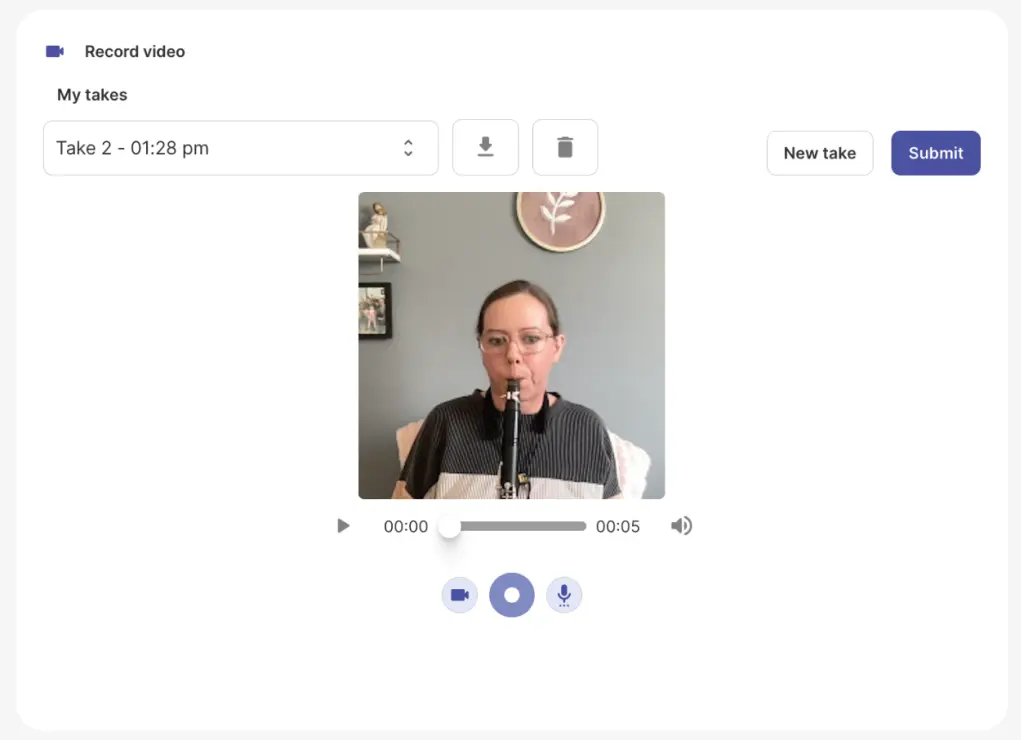
Audio/video-only assignments dismantle this opacity. By requiring students to record short segments of their practice sessions, educators gain direct insight into physical technique and ergonomic habits. More importantly, the act of recording forces metacognition upon the student. When a young musician watches and listens to themselves playback, they frequently catch posture and intonation errors that they failed to notice in real-time.
- The Homework Paradigm: Record, Watch, Fix (Band or Orchestra, 15 minutes at home).
- Core Pedagogical Goal: Students learn to independently catch and correct their own posture, embouchure, bow hold, and hand-position habits during home practice.
- Implementation Strategy: Rather than grading solely on tonal perfection, the rubric evaluates the student’s awareness. Can the student identify a physical tension point in their video recording and articulate a strategy to fix it? This shifts the psychological burden from performing for a grade to problem-solving for self-improvement.
2. Multiple Choice Assessments: Theory Meets Practice
Historically, music theory and performance have often been treated as siloed disciplines. Students might play a piece brilliantly by ear or through repetitive muscle memory while remaining entirely blind to the theoretical architecture underlying the notes.
MakeMusic’s incorporation of multiple-choice written assessments changes this dynamic. Educators can construct tailored questions incorporating text, custom images, key signatures, rhythmic excerpts, and dynamic markings. This serves as a vital practice-prep tool. When students are forced to parse theoretical elements before they ever pick up their instrument, their subsequent home practice becomes infinitely more targeted. Instead of using valuable practice time to decode basic rhythms, they arrive at the instrument with a cognitive map of the piece.
- The Homework Paradigm: The Pre-Practice Check (Any Ensemble, 5 minutes at home).
- Core Pedagogical Goal: Students identify key signatures, problematic rhythms, accidentals, and expressive markings in a new concert piece before executing it on their instrument.
- Implementation Strategy: A five-question digital quiz assigned prior to handing out a new movement ensures cognitive readiness. Questions might ask students to identify the measure containing a syncopated rhythm, select the relative minor of a given key signature, or define an unfamiliar Italian tempo marking.
Building a Balanced Weekly Routine
Transitioning to a multi-modal assessment strategy does not require rewriting an entire curriculum. In fact, sustainability is the cornerstone of successful music instruction. By weaving different assignment types throughout a typical school week, directors can comprehensively cover performance, theoretical understanding, and physical technique without burning out.
A sample balanced weekly framework for a secondary ensemble includes:
- Monday (Theoretical Foundation): Issue a brief Multiple-Choice Pre-Practice Check focusing on the structural landmarks of the upcoming week’s repertoire. This primes the cognitive faculties of the ensemble.
- Wednesday (Rehearsal Application): Address the concepts identified in Monday’s assessment during in-class sectional rehearsals, turning identified theoretical weaknesses into active rehearsal points.
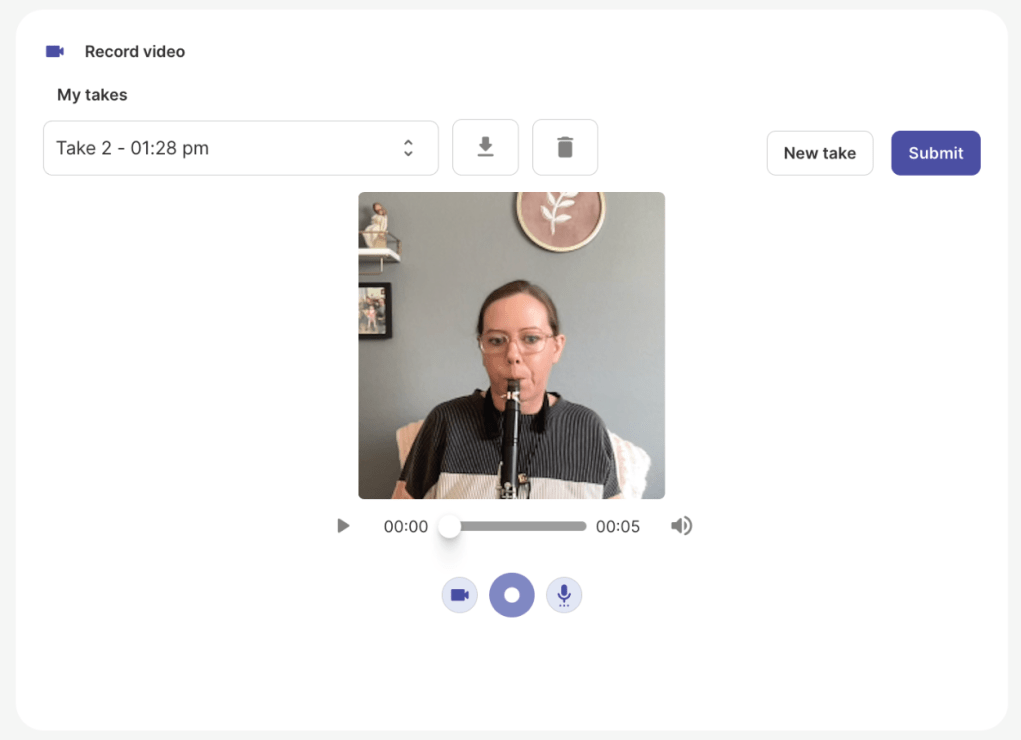
- Friday (Technical & Ergonomic Review): Assign an Audio/Video-Only practice check. Students submit a short clip demonstrating proper posture and self-correction on a challenging technical passage.
Administrative Efficiency and Gradebook Integration
A common apprehension among music educators regarding digital assignments is the administrative overhead: grading dozens or hundreds of audio files and quizzes can easily consume an entire weekend.
Modern platforms mitigate this friction through automated ecosystem integrations. Utilizing features like Google Grade Passback, student scores and completion metrics sync directly into existing learning management systems like Google Classroom. This seamless data transfer slashes administrative hours, allowing directors to focus their energy where it matters most: artistic instruction and student mentorship.
Future Outlook: The Evolution of Data-Driven Music Education
As educational technology continues to mature, the landscape of music pedagogy is undergoing a quiet revolution. The integration of audio-visual diagnostics and cognitive pre-assessments points toward a future where music instruction is increasingly personalized.
By capturing granular data on student performance, practice habits, and theoretical comprehension early in the academic year, educators are no longer flying blind. They can identify at-risk students—those struggling with fundamental mechanics or notation literacy—weeks before a poor concert performance or a failing grade makes the issue glaringly obvious.
Furthermore, platforms are expected to incorporate more advanced diagnostic capabilities, potentially leveraging automated feedback loops to help students self-correct basic rhythmic and pitch inaccuracies before a human educator even opens the file. Yet, the irreplaceable core of music education will always remain human: the mentorship, expressive interpretation, and communal joy of ensemble playing.
Tools like MakeMusic’s expanded assessment types do not replace the podium; rather, they clear away the administrative and diagnostic fog, giving directors the clarity they need to lead their ensembles toward artistic excellence. For educators looking to refine their approach, the mandate is clear: start small, experiment with a single new assignment type next week, and let the data illuminate the path forward.