
PHILADELPHIA, PA — For over half a century, The Voice Foundation has stood as the global epicentre for multidisciplinary vocal science, medicine, pedagogy, and performance. As the organization continues to chart the evolution of vocal health and artistry into the digital age, its flagship publication has taken a deeply reflective turn. The November 2023 special investigative issue of The Voice—expertly curated under the banner "Then & Now"—offers a rare, intimate look at the driving forces, foundational passions, and enduring motivations of the organization’s principal leaders.
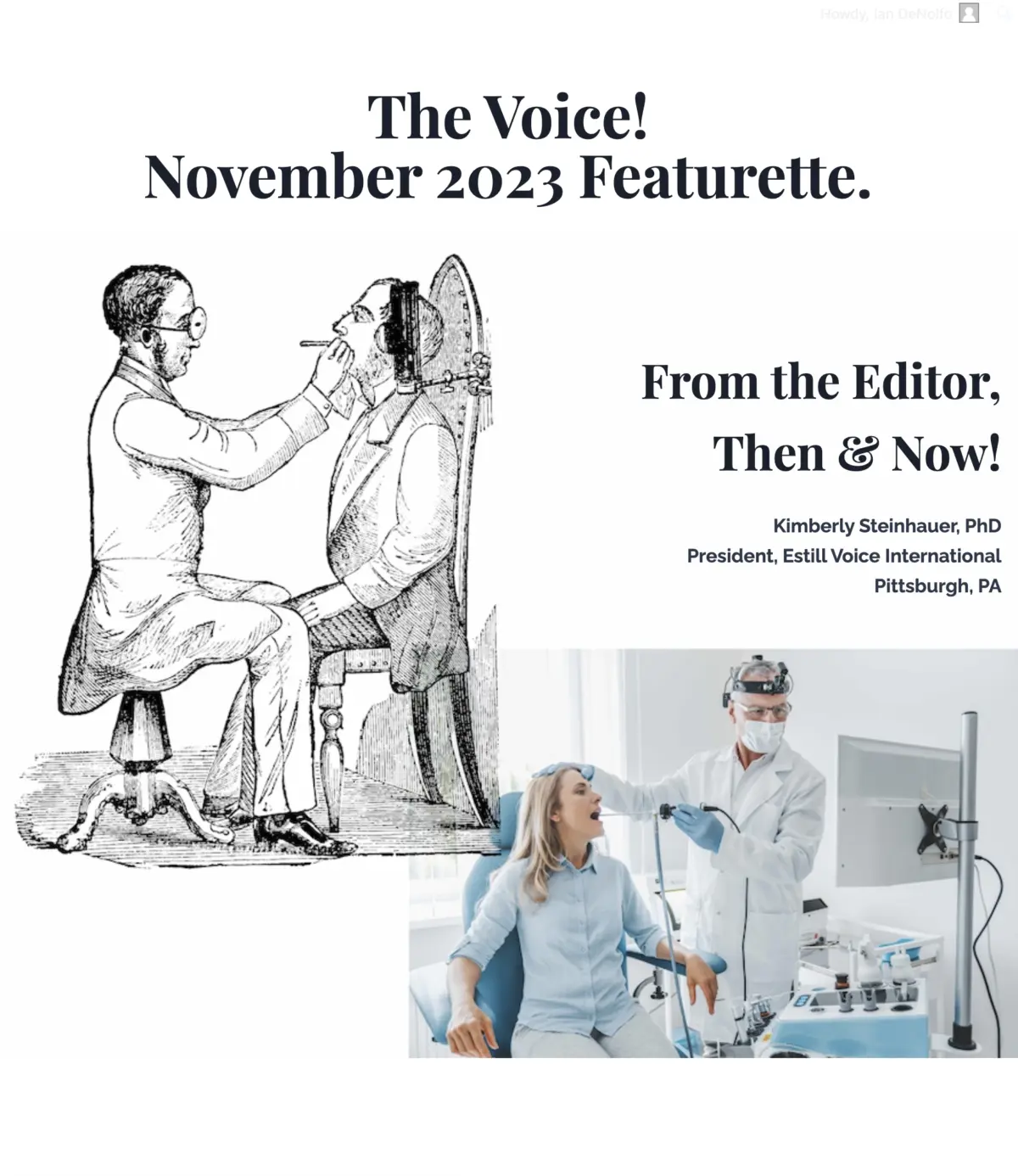
Spearheaded by Kimberly Steinhauer, Ph.D., President of Estill Voice International and a prominent voice in the Pittsburgh vocal pedagogy community, this special edition bridges the personal histories of the foundation’s leadership with their current monumental roles. Drawing inspiration from contemporary cultural phenomena, Dr. Steinhauer framed the issue around the ubiquitous social media "Then/Now" meme, transforming a playful internet trend into a profound exercise in institutional introspection.
Executive Overview
The genesis of this commemorative editorial framework can be traced directly to the 2023 Annual Symposium, specifically the prestigious G. Paul Moore Lecture delivered by Margaret Baroody, M.M. Baroody’s address celebrated the deep institutional knowledge and historical continuity that have sustained The Voice Foundation through decades of rapid medical and technological advancement.
Inspired by the lecture’s homage to the foundation’s legacy, Dr. Steinhauer launched a probing, multi-part survey entitled "Ten Questions for our Leaders." The resulting issue brings readers face-to-face with the architects of the modern Voice Foundation:
- Dr. Kimberly Steinhauer, Guest Editor and President of Estill Voice International;
- Ian DeNolfo, Executive Director of The Voice Foundation;
- Dr. Michael Johns III, Chairman of the Advisory Board; and
- Dr. Robert T. Sataloff, Chairman of the Board of Directors.
Through personal retrospectives, professional milestones, and candid acknowledgments of the countless unseen hands guiding the organization, this special issue explores how early aspirations converge with mature leadership, reinforcing the unbreakable triad of science, art, and education that defines vocal studies today.
Detailed Chronology: From Early Aspirations to Modern Leadership
To fully appreciate where The Voice Foundation stands today, one must trace the developmental arcs of the individuals steering its course. The "Then & Now" issue functions almost as an oral history project, capturing the pivotal junctures where personal passion transformed into institutional stewardship.
Dr. Kimberly Steinhauer: Harmonizing Science and Pedagogy
Reflecting on her early years—the "Then" of her professional journey—Dr. Steinhauer recalls a tripartite ambition: she wanted to simultaneously explore her profound love of music, satisfy an intellectual curiosity regarding the hard sciences, and experience the pure joy of teaching others.
"Back then, I hoped to combine my love of music with my interest in science and my joy of teaching," Dr. Steinhauer shares in her editorial opening.
That early triad of interests was not merely a passing phase. Steinhauer pursued rigorous academic pathways across undergraduate and graduate levels, ultimately forging a professional career that successfully integrated all three disciplines. Today (now), her professional identity remains resolutely anchored in vocal advocacy. Whether performing as a singer, conducting clinical-adjacent research, or educating the next generation of voice professionals as President of Estill Voice International, her mission has remarkably remained the same.
Furthermore, Steinhauer’s relationship with The Voice Foundation itself reflects a full-circle narrative. "I aspired to be part of The Voice Foundation community then, and I am happy editing for the newsletter now," she remarks, adding with self-effacing humor: "(Although, I must confess that my ‘now’ photo is a bit ‘then!’)"
The Genesis of the Leadership Survey
The catalyst for the issue’s investigative deep-dive was Margaret Baroody’s G. Paul Moore Lecture at the 2023 Symposium. Baroody’s exploration of institutional memory illuminated a critical truth: organizations do not survive for generations merely on scientific breakthroughs; they endure because of the institutional knowledge passed down through dedicated leadership.
Intrigued by this concept, Dr. Steinhauer devised the "Ten Questions for our Leaders" survey. The project sought to strip away the formal titles and academic accolades of the foundation’s top executives, probing instead into their core motivations: What drove them to the vocal arts initially? What challenges did they foresee? And how has their dedication evolved alongside the explosive growth of laryngology, speech-language pathology, and vocal pedagogy?
Supporting Context & Metrics: The Evolution of The Voice Foundation
To understand the weight of the leadership insights published in the "Then & Now" issue, one must examine the operational and historical context of The Voice Foundation. Founded in the early 1970s by Dr. Van L. Lawrence, the Foundation has grown from a fledgling grassroots assembly of otolaryngologists, speech pathologists, and voice teachers into an international powerhouse.

| Era / Milestone | Focus & Scientific Paradigm | Leadership & Community Scale |
|---|---|---|
| The 1970s–1980s (Then) | Foundational laryngeal microsurgery, early acoustic analysis, establishing multidisciplinary dialogue. | Small, pioneering groups of visionary otolaryngologists and pedagogical purists. |
| The 1990s–2010s (Expansion) | Integration of advanced stroboscopy, voice therapy protocols, and molecular voice research. | Growing international symposia, expansion of peer-reviewed journals, formal board structures. |
| The Present Day (Now) | AI-assisted voice analysis, regenerative medicine, tele-pedagogy, and globalized access. | Multi-thousand-member global network overseen by Executive, Advisory, and Board leadership. |
The metrics of the Foundation’s reach today are staggering. The Annual Symposium on Care of the Professional Voice attracts hundreds of clinicians, scientists, singing teachers, and performers from dozens of countries annually. The transition of media—from print-only newsletters to sophisticated digital hubs, interactive webinars, and open-access research repositories—has exponentially amplified the organization’s educational footprint.
Official Statements and Insights from the Core Leadership Team
While Dr. Steinhauer curated the narrative, the beating heart of the investigative issue lies in the responses provided by the executive leadership. Although each leader was quick to deflect individual praise onto the vast network of volunteers, researchers, and clinicians working quietly behind the scenes, their personal reflections reveal the emotional and intellectual bedrock of The Voice Foundation.
Ian DeNolfo, Executive Director
As Executive Director, Ian DeNolfo sits at the operational nexus of the Foundation, balancing the fiscal, administrative, and programmatic demands of a world-class non-profit organization. In his survey responses, DeNolfo highlighted the shifting landscapes of arts administration and scientific communication.
The transition from traditional, localized administrative frameworks to a hyper-connected, digital-first operational model has required a delicate balance: preserving the warm, collegial, family-like atmosphere of early Voice Foundation gatherings while scaling up to meet the demands of a global digital membership. DeNolfo’s insights in the "Then & Now" issue underscore the logistical ingenuity required to keep an interdisciplinary juggernaut running smoothly, ensuring that researchers and artists alike have the institutional backing they need to innovate.
Dr. Michael Johns III, Advisory Board Chairman
Dr. Michael Johns III, a luminary in laryngology and Chairman of the Advisory Board, brings a distinctly clinical and strategic lens to the conversation. His reflections in the survey bridge the gap between medical breakthroughs and practical vocal pedagogy.
Throughout his career, Dr. Johns has witnessed paradigm shifts in how vocal injuries are diagnosed and treated—moving from reactive, surgical interventions to proactive, preventative vocal health maintenance. His participation in the "Then & Now" survey emphasizes the indispensable role of the Advisory Board in forecasting future trends in voice science, ensuring that the Foundation remains at the cutting edge of medical technology while staying firmly grounded in the needs of working artists.
Dr. Robert T. Sataloff, Chairman of the Board
No discussion of The Voice Foundation is complete without acknowledging Dr. Robert T. Sataloff, whose decades-long leadership as Chairman of the Board has shaped the very contours of modern voice care. A world-renowned otolaryngologist, conductor, and author, Dr. Sataloff’s inclusion in the survey anchors the issue in historical authority.
Dr. Sataloff’s reflections offer a sobering yet inspiring reminder of the Foundation’s early struggles and triumphs. From fighting for the legitimacy of voice care as an independent multidisciplinary specialty to establishing the world’s premier academic symposia, Dr. Sataloff’s journey mirrors the trajectory of the field itself. In his responses, he underscores a persistent theme: that the human voice is not merely a physiological instrument, but the profound vehicle of human identity, emotion, and culture.
Future Outlook: Sustaining the Momentum of Voice Science
As the November 2023 issue of The Voice demonstrates, looking backward is not an act of nostalgia, but a strategic necessity for charting the future. By examining where its leaders began—their youthful aspirations, initial cross-disciplinary curiosities, and early career hurdles—The Voice Foundation reinforces a powerful pedagogical and scientific philosophy: institutional longevity is fueled by personal passion.
Looking ahead, the Foundation faces new frontiers that would have seemed like science fiction back then:
- Artificial Intelligence and Vocal Diagnostics: Machine learning models are beginning to assist in the early detection of laryngeal pathologies through acoustic analysis alone.
- Regenerative Medicine: Stem cell research and bioengineering promise revolutionary treatments for vocal fold scarring and paralysis.
- Globalized Digital Pedagogy: Cross-continental virtual collaborations are democratizing access to elite voice science and training, breaking down geographic barriers that once isolated performers and clinicians.
Yet, as Dr. Steinhauer’s investigative issue so eloquently reminds us, behind every technological innovation, every peer-reviewed study, and every breakthrough symposium are human beings driven by a fundamental love for the voice.
The "Then & Now" issue serves as an invitation to the entire global community: to remember why we started, to honor those who laid the groundwork, and to step boldly into an interconnected future where science and art continue to sing in perfect harmony.