
Executive Overview
In an era where houses of worship strive to cultivate environments of radical inclusivity, the acoustic accessibility of religious services remains a critical yet frequently overlooked frontier. For millions of congregants globally, hearing loss acts as an invisible barrier, transforming what should be spiritually uplifting gatherings into exercises in frustration and isolation. Traditional sanctuary acoustics—often characterized by soaring ceilings, hard reflective surfaces, and complex sound reinforcement systems—frequently create reverberation and speech intelligibility issues that alienate aging populations and individuals with auditory impairments.
To combat this challenge, modern faith communities are increasingly turning to advanced Assistive Listening Systems (ALS). However, the successful integration of these technologies requires far more than a simple equipment purchase. It demands a strategic, multi-phase approach encompassing congregation assessment, financial planning, rigorous staff training, and proactive community outreach.
This report provides an authoritative, in-depth blueprint for religious leaders, facility managers, and AV technicians aiming to implement or upgrade an assistive listening infrastructure. Drawing on industry best practices and insights from auditory accessibility advocates, we examine the four foundational pillars of ALS deployment: assessing specific demographic needs, evaluating technical and budgetary options, preparing operational teams for seamless execution, and fostering widespread awareness. By bridging the acoustic divide, houses of worship can ensure that every spoken word, sermon, and musical arrangement is delivered with crystal-clear fidelity to every member of the congregation.
Detailed Chronology: The Four-Step Implementation Framework
Implementing an Assistive Listening System is a transformative operational project. To ensure a high return on investment and maximum congregational impact, facilities should follow a structured, sequential methodology.
[Phase 1: Needs Assessment]
       │
       ▼
[Phase 2: Option & Budget Evaluation]
       │
       ▼
[Phase 3: Operational Preparation]
       │
       ▼
[Phase 4: Awareness & Community Outreach]
Step 1: Understand Your Needs Through Data-Driven Assessment
The foundational misstep in acoustic upgrades is purchasing hardware before diagnosing the unique auditory profile of the congregation. Congregational demographics vary widely; a traditional liturgical service with a pipe organ and spoken liturgy presents different acoustic challenges than a contemporary service featuring high-decibel modern instrumentation and spoken-word multimedia presentations.
The most effective, reliable method to establish baseline requirements is conducting a comprehensive, congregation-wide survey. This diagnostic tool should be distributed broadly—via both physical bulletins and digital platforms—to capture responses from active attendees, infrequent visitors, and homebound members who may have stopped attending due to hearing difficulties.
Key diagnostic metrics to capture in the survey include:
- Subjective Service Experience: How well can the respondent hear the sermon, scriptural readings, and prayers during a standard worship service?
- Hearing Aid Utilization: What percentage of the congregation currently utilizes hearing aids or cochlear implants?
- Telecoil (T-Coil) Integration: Among those utilizing hearing aids, how many devices are equipped with telecoil receivers? This metric is critical when choosing between FM, infrared, and audio induction loop technologies, as t-coils allow users to stream audio directly from a loop system into their personal hearing devices without needing a separate receiver.
By aggregating this data, facility leaders transition from guesswork to an empirical understanding of their demographic landscape, ensuring that subsequent investments precisely target user needs.
Step 2: Fully Understand Your Technical and Financial Options
Once congregational requirements are mapped, the focus shifts to evaluating available hardware, estimating total project costs, and aligning expenditures with organizational budgets. The market offers several distinct types of Assistive Listening Systems, each with unique operational footprints:
- Audio Frequency Induction Loop Systems (AFILS): These systems transmit audio signals via a copper wire loop installed around the perimeter of the worship space. The magnetic field generated is picked up directly by hearing aids equipped with a telecoil. Advantage: Users require no extra equipment, preserving their dignity and comfort.
- FM Radio Frequency Systems: These broadcast audio over specific radio frequencies to portable bodypack receivers worn by the user, who then connects standard headphones or neckloops. Advantage: Highly versatile, offering extensive range and reliability across large architectural layouts.
- Infrared (IR) Systems: Utilizing invisible light waves to transmit audio, IR systems offer high-security audio transmission contained strictly within the room. Advantage: Ideal for spaces with multiple rooms where signal spillover must be prevented.
Navigating these technological choices requires balancing upfront capital expenditures, ongoing maintenance costs, and user experience. Houses of worship do not need to navigate this procurement landscape alone. Specialized audio-visual integrators—such as CCI Solutions—provide expert assistance, offering specialized consultations designed to help facility boards evaluate expenses, explore budgeting frameworks, and optimize purchasing decisions. Furthermore, churches can explore targeted fundraising campaigns, grants, and dedicated ministry donations specifically earmarked for accessibility initiatives to offset capital outlay.
Step 3: Prepare for Operational Success and Staff Readiness
The finest audio hardware will fail to achieve its purpose if frontline staff and volunteers are unprepared to operate and distribute the devices. The rollout of an Assistive Listening System is as much a human resources and hospitality initiative as it is a technical one.
Staff members, ushers, and welcome desk volunteers must be designated as "Assisted Listening Ambassadors." Comprehensive training sessions should cover:

- Hardware Operation: How to power on transmitters and receivers, adjust volume levels, sanitize earpieces, and troubleshoot common connectivity issues.
- User Instruction: When checking out devices to congregants, ambassadors must take a few moments to patiently explain how to wear and adjust the equipment, ensuring the user feels confident before entering the sanctuary.
- Visual Reference Tools: To eliminate operational friction during high-traffic Sunday mornings, facilities should maintain a laminated, step-by-step FAQ sheet at the distribution desk or welcome counter. This provides volunteers with quick answers to technical questions under pressure.
Step 4: Create Awareness and Drive Adoption
Even a flawlessly installed and operated system will languish if the community remains unaware of its existence. Deploying an ALS necessitates a robust internal and external marketing strategy designed to normalize its use and invite participation.
- Signage and Wayfinding: Install clear, internationally recognized signage at sanctuary entrances and welcome desks indicating that Assisted Listening Devices are available and showing precisely where to acquire them.
- Multi-Channel Reminders: Integrate consistent reminders into weekly printed bulletins, digital slide presentations prior to services, and verbal announcements from the stage.
- Dedicated Training Events: Consider hosting a live, interactive demonstration or workshop where congregants can familiarize themselves with the technology in a low-pressure environment. This demystifies the equipment and reduces any lingering social stigma associated with wearing assistive devices.
- Community Outreach: Broaden the advertising radius to the surrounding geographical community. Publicizing accessibility upgrades via local media, community boards, and digital channels signals to unchurched individuals or those with sensory impairments that the congregation actively values and welcomes them.
Supporting Context & Metrics: The Human Impact of Hearing Loss
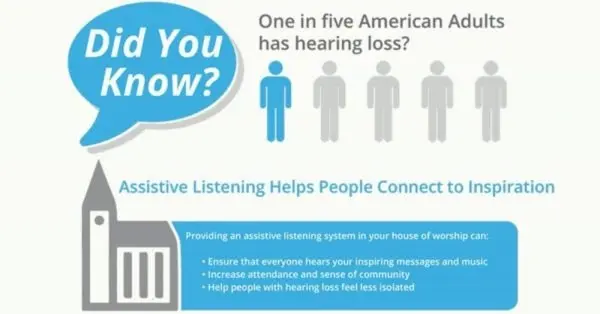
To fully appreciate the urgency of deploying Assistive Listening Systems, decision-makers must examine the broader socio-acoustic context of modern religious gatherings. According to data from the World Health Organization (WHO) and public health institutions, over 1.5 billion people globally experience some degree of hearing loss, a figure projected to rise significantly over the coming decades due to aging populations and environmental factors.
Within religious communities, the impact of untreated hearing loss extends far beyond physical acoustics:
- Psychological Isolation: Individuals struggling to comprehend spoken words during communal worship frequently report feelings of embarrassment, exhaustion, and detachment, eventually leading to withdrawal from corporate religious life.
- Cognitive Fatigue: Straining to decipher speech in reverberant architectural spaces diverts cognitive resources away from spiritual engagement, fellowship, and worship.
- The ADA and Legal Frameworks: In many jurisdictions, public assembly spaces—including houses of worship that host community events or operate as public gathering points—are encouraged or legally mandated under accessibility acts to provide equal access to audio communication.
Metrics from accessibility case studies reveal that houses of worship implementing comprehensive ALS solutions experience an immediate uptick in engagement among senior demographics and individuals with acquired hearing impairments. When attendees realize their sensory needs are actively accommodated, loyalty deepens, and volunteerism increases.
Official Statements and Industry Insights
Industry leaders and architectural acoustic engineers emphasize that inclusivity is an active, ongoing commitment rather than a passive architectural afterthought.
"Reaching out to those who feel disconnected from your community due to hearing loss is central to sharing the message of inclusion. Genuinely compassionate service involves being aware of and caring for the needs of everyone, especially those dealing with impairments. Make sure they are able to hear the beauty and emotion of the spoken word in your church by providing them with the equipment they need to stay connected."
— Industry Accessibility Directive
Technical specialists underscore that modern audio distribution has evolved to become remarkably user-friendly. Manufacturers are increasingly prioritizing ergonomic designs, lightweight materials, and direct smartphone integration via Wi-Fi and Bluetooth protocols. This modernization removes historical barriers—such as bulky, stigmatizing headsets—replacing them with sleek, discreet solutions that integrate seamlessly into the user’s daily life.
Furthermore, organizations like Listen Technologies provide extensive resources to guide religious administrators through every phase of deployment. Comprehensive toolkits—including sample congregation surveys, standardized signage templates, and bulletin announcement drafts—are publicly available to streamline the administrative burden on pastoral staffs. Facility managers are encouraged to download resources such as the Listen Technologies Church Assistive Listening Toolkit to accelerate their planning cycles.
Future Outlook: The Next Generation of Acoustic Accessibility
As audio engineering and digital signal processing continue to advance, the future of Assistive Listening Systems in houses of worship points toward hyper-personalized, software-driven accessibility.
Emerging Trends on the Horizon:
- BYOD (Bring Your Own Device) Integration: Future systems are increasingly leveraging local Wi-Fi networks to stream ultra-low-latency audio directly to congregants’ personal smartphones or tablets. Users simply download a dedicated app, plug in their personal headphones or earbuds, and adjust real-time audio equalization to match their unique audiogram profiles.
- Artificial Intelligence in Room Correction: Advanced DSP (Digital Signal Processing) units utilizing AI algorithms are beginning to dynamically adjust for sanctuary acoustics in real-time, filtering out ambient HVAC noise and reflective reverberations while boosting speech clarity before the audio is even broadcast to assistive receivers.
- Universal T-Coil and Auracast™ Adoption: Emerging Bluetooth LE Audio standards, such as Bluetooth Auracast, promise to revolutionize public audio distribution, allowing multi-channel audio broadcasts to be picked up simultaneously by hearing aids, earbuds, and smartphones without pairing hurdles.
Strategic Recommendations for Leadership
House of worship leadership boards must view acoustic accessibility not as a line-item expense or a peripheral ministry, but as a core component of pastoral care. By proactively budgeting for, implementing, and promoting modern Assistive Listening Systems, faith communities demonstrate tangible compassion and fulfill their mandate of radical hospitality.
Facility managers and AV directors should initiate the process today by auditing current audio infrastructure, downloading comprehensive industry toolkits, and engaging with specialized consultants to evaluate the ideal technological path forward. Ensuring that every congregant can hear the spoken word, share in the liturgy, and connect deeply with the community is an investment that resonates across generations.