
Executive Overview
In an era where houses of worship strive to foster environments of radical inclusion, community engagement, and spiritual connection, one critical demographic is frequently overlooked: individuals experiencing hearing loss. For many congregants, attending a traditional church service can be an isolating experience. Despite the presence of high-powered audio amplification systems and line-array speakers, reverberant acoustics, background noise, and varying degrees of hearing impairment often render the spoken word—and the emotional nuance of a sermon or musical performance—muffled and incomprehensible.
To combat this invisible barrier, modern religious organizations are increasingly turning to Assistive Listening Systems (ALS). However, the successful integration of these technologies requires far more than a simple equipment purchase. It demands a strategic, methodical approach that begins with deep congregational assessment and extends through comprehensive staff training and community-wide awareness campaigns.
This report provides an exhaustive blueprint for church leadership teams, AV technicians, and ministry directors looking to implement or upgrade an assistive listening infrastructure. By examining the foundational steps—understanding congregational needs, evaluating financial options, preparing staff for operational success, and driving engagement—this article serves as an authoritative guide to ensuring that no member of the congregation is left straining to hear the message.
Detailed Chronology: A Four-Phase Implementation Strategy
Transitioning a worship facility into an acoustically accessible space requires a structured roadmap. Drawing from industry best practices and insights provided by audio-visual solution providers like CCI Solutions and Listen Technologies, the implementation process can be systematically broken down into four distinct chronological phases.
[Phase 1: Needs Assessment] ──► [Phase 2: Technical & Financial Planning] ──► [Phase 3: Operational Preparation] ──► [Phase 4: Awareness & Community Outreach]Phase 1: Understand Your Needs
The genesis of any successful accessibility initiative must be rooted in data, empathy, and direct communication. Assumptions about who needs help within a congregation are often wildly inaccurate; many individuals quietly struggle with mild-to-moderate hearing loss without ever formally requesting accommodations.
The most effective preliminary step is the deployment of a comprehensive congregational survey. This instrument should be distributed both digitally (via email newsletters and church apps) and physically (inserted into Sunday bulletins) to ensure maximum reach across all age demographics. Key data points to capture include:
- Personal Experience: How would congregants rate their current ability to hear and comprehend the spoken word, Scripture readings, and music during services?
- Device Utilization: Do members currently utilize hearing aids or cochlear implants?
- Technological Capabilities: Are their hearing aids equipped with telecoils (t-coils), which allow them to receive audio signals directly into their devices?
By analyzing the survey results, church leadership can accurately gauge the scale of the challenge. This data prevents the facility from over-investing in unused features or, conversely, under-delivering on a technology that a significant portion of the flock desperately requires.
Phase 2: Fully Understand Your Options
Once the congregation’s specific requirements have been quantified, the focus shifts to hardware selection and budgetary alignment. The audio market offers several assistive listening technologies—including Radio Frequency (RF) systems, Infrared (IR) systems, and Audio Induction Loop systems—each with distinct advantages depending on the architecture of the worship space.
Estimating the cost of these systems can be daunting for church administrators balancing tight operational budgets. Fortunately, specialized integrators such as CCI Solutions offer expert assistance and complimentary consultations to help facilities navigate equipment tiers, installation logistics, and long-term financial planning.
Furthermore, churches should not view budgetary constraints as an insurmountable hurdle. Proactive leadership teams often leverage targeted fundraising campaigns, memorial gifts, or capital improvement grants specifically earmarked for accessibility upgrades to offset acquisition costs.
Phase 3: Prepare for Success
Hardware is only as effective as the people operating it. A common pitfall in houses of worship is the purchase of advanced assistive listening devices, followed by storing them in a closet where staff and volunteers remain unsure of how to deploy them.
To guarantee operational success, comprehensive training must be mandated for all front-of-house staff, welcome team members, ushers, and audio-visual volunteers. These individuals should be framed as "Assisted Listening Ambassadors." Their role goes beyond simply handing out a receiver; they are the human bridge between the technology and the user.
When a congregant requests a device, ambassadors should take the time to offer a brief, polite orientation on how to adjust the volume, secure the lanyard or earphone, and troubleshoot basic connections. Additionally, operational friction can be minimized by placing a laminated, easy-to-read "Frequently Asked Questions" (FAQ) sheet directly at the welcome desk or device distribution counter, ensuring ambassadors always have immediate answers to technical queries.
Phase 4: Create Awareness
An exceptional assistive listening system yields zero return on investment if the congregation does not know it exists. The final operational phase focuses on aggressive, multi-channel internal marketing and community outreach.

- Signage: Install clear, universally recognized international symbols for accessibility at all major entrances, guiding visitors directly to the location where Assisted Listening Devices (ALDs) are distributed.
- Print & Digital Reminders: Embed brief, welcoming notices regarding the availability of listening assistance in every weekly bulletin, digital newsletter, and pre-service multi-media slide presentation.
- Live Demonstrations: Consider hosting a dedicated orientation or live training session after a service, allowing curious congregants to test the technology firsthand and familiarize themselves with the equipment without the pressure of a live service.
- Community Advertising: Extend awareness beyond the current membership. Local senior centers, retirement communities, and audiologist clinics should be informed of the church’s new accessibility features. Many individuals drop out of active church attendance due to hearing degradation; broadcasting that a facility is fully equipped to accommodate hearing loss can be a powerful catalyst for drawing visitors back through the doors.
Supporting Context & Metrics: The Scale of Hearing Loss in Worship Spaces
To understand why assistive listening integration is an urgent imperative rather than a mere "nice-to-have" amenity, one must examine the broader public health context surrounding hearing impairment.
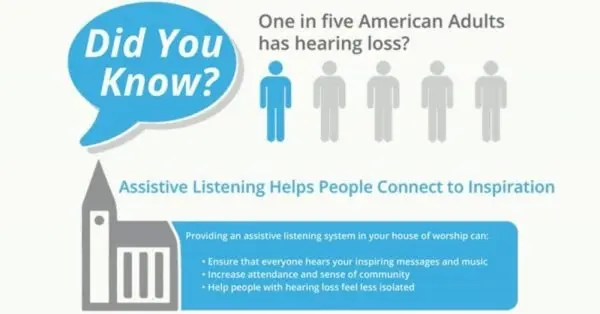
According to data from the World Health Organization (WHO) and the Centers for Disease Control and Prevention (CDC), hearing loss is one of the most common chronic physical conditions affecting adults globally. In the United States alone, approximately 15% of American adults (roughly 37.5 million people) report some trouble hearing. The prevalence of hearing loss increases dramatically with age: while only a small percentage of middle-aged adults are affected, nearly 25% of individuals aged 65 to 74 and 50% of those aged 85 and older experience disabling hearing loss.
[Demographic Breakdown of Hearing Loss Prevalence]
Ages 20-64:  ██ 8-10%
Ages 65-74:  ██████ 25%
Ages 85+:    ████████████ 50%
Given that houses of worship traditionally skew toward an older demographic, the statistical likelihood that a significant percentage of any given congregation is struggling to hear is exceedingly high.
Acoustic challenges within modern worship architecture further exacerbate these demographic realities. Contemporary church design often favors sleek, hard surfaces—such as concrete floors, exposed steel beams, glass walls, and minimalist drywall—which create high reverberation times. While these architectural choices provide modern aesthetic appeal and clean musical acoustics for amplified contemporary bands, they create a acoustically chaotic environment for the human ear. Reverberation blurs consonant sounds, making speech intelligibility drop sharply, even for individuals with normal hearing. For those with hearing aids, competing background noise and echo can make distinguishing a pastor’s voice nearly impossible without direct transmission technologies.
Official Statements and Industry Insights
Industry leaders and accessibility advocates emphasize that providing assistive listening is fundamentally an issue of equity, dignity, and spiritual hospitality.
Representatives from Listen Technologies, a premier global provider of advanced wireless listening solutions, emphasize that the true measure of a community’s warmth is how it treats its most vulnerable members. In their corporate literature, including the House of Worship Assistive Listening Toolkit, experts note:
"Reaching out to those who feel disconnected from your community due to hearing loss is central to sharing the message of inclusion. Genuinely compassionate service involves being aware of and caring for the needs of everyone, especially those dealing with impairments. Make sure they are able to hear the beauty and emotion of the spoken word in your church by providing them with the equipment they need to stay connected."
Furthermore, audio engineers and AV integration specialists point out that compliance with the Americans with Disabilities Act (ADA) represents only the legal baseline. The ADA mandates that places of public assembly—including houses of worship—provide assistive listening systems under specific capacity thresholds. However, compliance should not be viewed merely as a legal checkbox. Forward-thinking ministries recognize that proactive accessibility transforms passive attendees into deeply engaged participants who can fully absorb scripture, fellowship, and pastoral guidance.
Future Outlook: The Evolution of Acoustic Inclusion
As audio technology continues to advance at a rapid pace, the future of assistive listening in houses of worship points toward greater integration with personal consumer electronics.
While traditional FM and infrared systems utilizing dedicated beltpack receivers and headphones remain standard, the horizon is dominated by technologies like Auracast™ broadcast audio—a new capability built on Bluetooth® Low Energy (LE) Audio standards. Auracast is poised to revolutionize how public spaces deliver audio accessibility. Rather than requiring a user to check out a specialized facility receiver at a welcome desk, Auracast will allow any compatible personal smartphone, hearing aid, or cochlear implant to tune directly into the church’s broadcast audio stream simply by selecting a network, much like logging onto a Wi-Fi network.
[Traditional vs. Next-Gen Audio Distribution]
Traditional: [Church Soundboard] ──(RF/IR Signal)──► [Facility Receiver + Headphones] ──► [User]
Next-Gen:    [Church Soundboard] ──(Auracast/BLE)────► [User's Personal Smartphone / Smart Hearing Aid]
This technological evolution will drastically reduce the friction of adoption. Users will no longer have to navigate the social stigma sometimes associated with asking for a specialized device at a public counter; instead, they will experience seamless, discreet, and high-fidelity audio access directly through the devices they already carry in their pockets or wear in their ears.
However, regardless of whether a facility utilizes legacy RF systems, contemporary induction loops, or cutting-edge Bluetooth broadcasts, the foundational human element remains unchanged. Technology alone cannot foster community.
Houses of worship must continue to pair hardware upgrades with intentional pastoral care, thorough staff training, and transparent communication. By embracing a holistic strategy—understanding needs, evaluating options, preparing operational ambassadors, and driving community awareness—religious organizations can ensure that their doors, hearts, and messages remain truly open to all.
For more detailed information on choosing the right Assistive Listening System, along with practical tools to ensure implementation success—including sample surveys, ready-to-print signage templates, and bulletin announcements—leadership teams are encouraged to download the comprehensive Listen Technologies Church Assistive Listening Toolkit.