
Executive Overview
For fans of Studio Ghibli, Hayao Miyazaki’s 2001 cinematic triumph Spirited Away occupies a rare, almost sacred tier in the pantheon of animated history. As the first—and for a long time, only—hand-drawn, non-English-language film to win the Academy Award for Best Animated Feature, the movie transcended the boundaries of traditional children’s entertainment to become a universal parable on memory, identity, capitalism, and environmentalism.
Now, more than two decades after its theatrical debut, the magic of the bathhouse realm is once again crossing cultural and physical boundaries. The celebrated Japanese-language stage adaptation, Spirited Away: Live on Stage, is making a triumphant return to American movie theaters as a crown jewel of this year’s annual Ghibli Fest lineup.
Brought to domestic audiences through a collaborative partnership between GKIDS and Fathom Entertainment, this encore cinematic run offers US audiences a rare opportunity to witness the theatrical marvel that has captured the hearts of international theatergoers. Captured live during its acclaimed run in Tokyo, the production will be screened nationwide with English subtitles for two nights only: October 1 and October 8.
Unlike previous cinematic events that relied on straightforward recordings, this release highlights the intricacies of a massive theatrical enterprise. Helmed by Tony Award-winning director John Caird (Les Misérables) and co-adapted by Caird and Maoko Imai, the production merges traditional Japanese theatrical techniques, West End musical grandeur, and breathtakingly inventive puppetry designed by Toby Olié. Featuring a cast of 32 performers, stunning live musical accompaniment, and dual-cast rotating leads, the production represents a masterclass in cross-cultural artistic collaboration.
Beyond its brief return to American cinema screens, this theatrical journey stands at an important cultural crossroads. Having originated at Tokyo’s prestigious Imperial Theatre in 2022, followed by extensive touring across Japan, the production is now looking toward an even grander horizon: an ambitious 2026–2028 world tour that will take its dazzling puppets and mesmerizing set pieces to major global hubs, including Taipei, Toronto, Los Angeles, and London.
Detailed Chronology: From Celluloid to the Imperial Stage
The journey of Spirited Away from a 2001 cinematic milestone to a live theatrical entity is a narrative of meticulous planning, artistic risk-taking, and unprecedented creative synergy.
The Genesis of an Adaptation
When Studio Ghibli first allowed its intellectual property to be adapted for the live stage, the stakes could not have been higher. Miyazaki’s film is dense with fantastical elements: a young girl’s parents transformed into gluttonous pigs, a towering multi-armed boiler man composed of soot and magic, a towering stinking spirit cleansed by herbal baths, a terrifying six-armed sorceress who can transform into a giant bird, and a river spirit composed of urban waste and ancient divine power. Translating these visions from fluid 2D animation to a physical stage demanded revolutionary theatrical techniques rather than cheap cinematic tricks.
Producer Koji Hoshino of Studio Ghibli, alongside Toho Co., Ltd.—Japan’s premier film and theatrical production titan—approached British director John Caird with the daunting assignment. Caird, renowned for his monumental work on Les Misérables and Nicholas Nickleby with the Royal Shakespeare Company, immediately recognized the universal humanity at the core of Miyazaki’s script. Teaming up with Japanese writer and translator Maoko Imai, Caird set out to preserve the distinct emotional cadence of the Japanese original while reinventing its pacing for a live audience.
The 2002 World Premiere in Tokyo
The world premiere of Spirited Away: Live on Stage opened on March 2, 2022, at Tokyo’s historic Imperial Theatre (Teikoku Gekijō), operated by Toho. The production was an immediate, unmitigated critical and commercial success. Tickets sold out within minutes, prompting fans to clamor for digital access. To accommodate the overwhelming demand, Toho and Hulu Japan partnered to stream performances later that same year, allowing home audiences across the archipelago to experience the theatrical wizardry firsthand.
Following its initial Tokyo engagement, the production embarked on a rigorous, highly celebrated national tour through major Japanese cultural centers, including Osaka, Fukuoka, Sapporo, and Nagoya, concluding its initial wave of performances on April 29, 2022. The production’s ability to faithfully replicate the atmospheric wonder of the spirit world using tangible, analog stagecraft earned it rave reviews from both mainstream theater critics and die-hard Ghibli aficionados.
Capturing the Magic for International Cinema
Recognizing that the physical production could not easily be transported to every corner of the globe simultaneously, Toho and GKIDS—the North American distributor for Studio Ghibli’s catalog—orchestrated high-definition captures of the performances. This resulted in Spirited Away: Live on Stage making its cinematic debut across US screens via GKids programs.
The upcoming Ghibli Fest encore presentation highlights the enduring demand for this unique cultural artifact. By utilizing two distinct filmed performances, GKIDS and Fathom Entertainment are treating American audiences to the subtle nuances brought by the production’s double-cast lead heroines, offering a masterclass in theatrical interpretation.
Supporting Context & Metrics: The Craft Behind the Spectacle
To understand why Spirited Away: Live on Stage has achieved such legendary status, one must examine the staggering logistical and artistic metrics that power the production.
+-----------------------------------------------------------------+
|              PRODUCTION METRICS & SCALE AT A GLANCE             |
+-----------------------------------------------------------------+
| • Cast Size: 32 world-class performers                          |
| • Puppets Utilized: Over 50 distinct, hand-crafted puppets      |
| • Lead Roles: Double-cast (Kanna Hashimoto & Mone Kamishiraishi)|
| • Key Returnees: Mari Natsuki & Romi Park (Yubaba / Zeniba)     |
| • Creative Leadership: John Caird (Director), Maoko Imai (Co-   |
|   Adaptor), Toby Olié (Puppetry Design)                         |
| • Upcoming Milestone: 2026–2028 Global World Tour               |
+-----------------------------------------------------------------+
The Art of Animate Illusion: Puppetry and Practical Effects
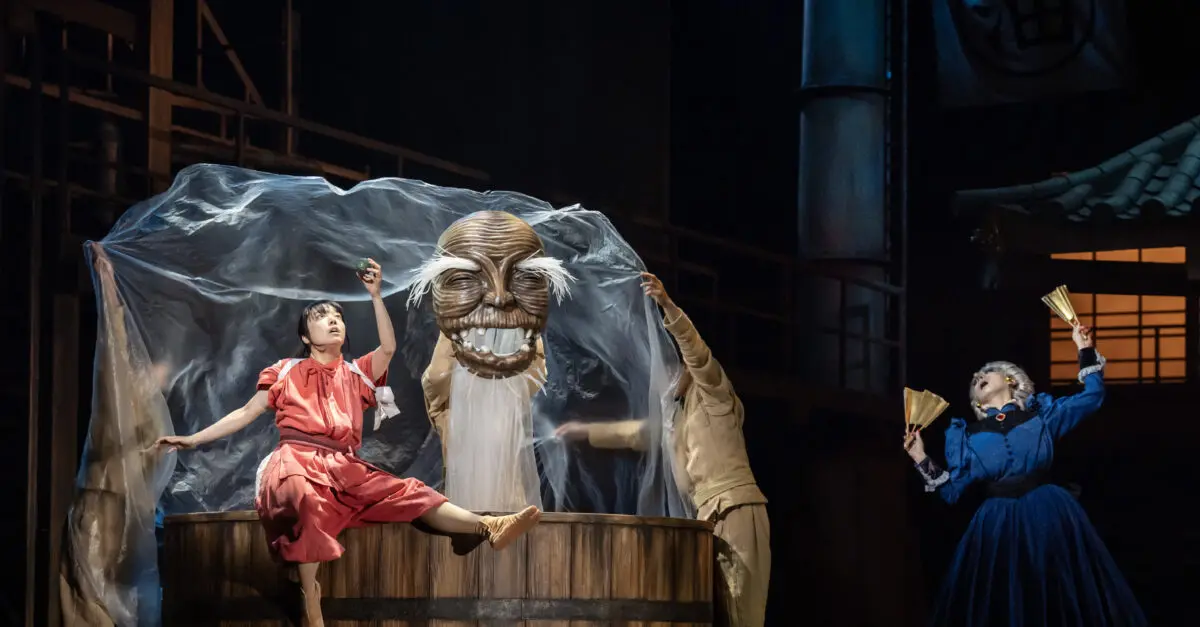
The most striking element of the stage adaptation is its wholesale rejection of heavy digital projections in favor of physical, analog puppetry. Under the guidance of puppet designer and director Toby Olié—whose credits include masterworks like War Horse—the production utilizes more than 50 distinct puppets to bring the denizens of the spirit world to life.
- No-Face (Kaonashi): The enigmatic, lonely spirit who consumes everything in his path is brought to life through intricate puppet mechanisms operated by handlers dressed in black kuroko-style stage ninja attire, blending traditional Japanese Bunraku puppetry techniques with modern Western movement styles.
- The Radish Spirit (Oshira-sama): The towering, awkward agricultural deity that shares an elevator ride with Chihiro is rendered with physical bulk and charming comedic timing, requiring multiple actors hidden within voluminous costuming and structural frameworks.
- Boh (Yubaba’s Giant Baby): A massive, toddler-sized infant prone to destructive tantrums is portrayed through a combination of puppetry and costumed performance, capturing the surreal, exaggerated proportions of Miyazaki’s animation.
- The Dragons and Soot Sprites: Even the microscopic Susuwatari (soot sprites) are given tangible form, manipulated by ensemble members who imbue inanimate objects with infectious, jittery life.
The Dual Heroines of the Bathhouse
At the emotional center of the narrative is Chihiro, a ten-year-old girl forced to grow up overnight when her parents are turned into swine after wandering into an abandoned theme park that serves as a gateway to a spirit realm.
In a testament to the rigorous physical demands of the role—which requires the lead actress to remain on stage for nearly the entirety of the three-hour runtime, running, crying, swinging, and interacting with complex puppets—the production employs a double-casting strategy.
- Kanna Hashimoto: Set to be featured in the October 1 screening, Hashimoto brings a youthful vulnerability and fierce emotional resilience to the role. A massive pop culture star in Japan, her performance anchors the psychological transformation of Chihiro from a petulant child into a brave, compassionate young woman.
- Mone Kamishiraishi: Featured in the October 8 screening, Kamishiraishi brings soaring vocal talents and profound dramatic depth to Chihiro. Having previously lent her voice to Makoto Shinkai’s global anime blockbuster Your Name, Kamishiraishi infuses the character with a grounded, empathetic gravity.
A Legacy Cast Connection
Adding profound emotional resonance to the theatrical endeavor is the inclusion of legendary actress Mari Natsuki. In Miyazaki’s 2001 original film, Natsuki provided the iconic, raspy, and terrifying voice for the greedy bathhouse owner Yubaba and her gentle twin sister, Zeniba. In a masterstroke of theatrical casting, Natsuki returns to her original role in the stage adaptation, anchoring the production in the rich history of the source material.
Natsuki shares the stage and alternates duties with celebrated voice actress Romi Park (known for iconic anime roles such as Edward Elric in Fullmetal Alchemist and Hange Zoe in Attack on Titan), creating a powerhouse combination of theatrical veterans and vocal royalty. They are supported by a sprawling ensemble of 32 of Japan’s finest stage and screen actors, backed by a live orchestra performing Joe Hisaishi’s transcendent, melancholy score.
Official Statements and Industry Reception
The convergence of Studio Ghibli, Toho, GKIDS, and Fathom Entertainment has generated widespread discussion among entertainment industry analysts and cultural commentators regarding the viability of capturing live theatrical events for global cinematic distribution.
In promotional statements accompanying the Ghibli Fest release, GKIDS executives emphasized the vital importance of bridging the gap between animation and live performance art. "To witness how John Caird, Toby Olié, and this incredible cast have reinterpreted Spirited Away without losing a single ounce of the film’s emotional soul is nothing short of miraculous," a GKIDS representative noted. "Bringing these filmed performances to US cinemas allows fans to experience the communal joy of theater combined with the timeless storytelling of Studio Ghibli."
John Caird, reflecting on the creative process during the show’s Tokyo premiere, spoke at length about the challenges of adapting Miyazaki’s work for a live audience:
"Hayao Miyazaki has created a universe populated by characters that are deeply human, regardless of how many arms, feathers, or scales they possess. Our goal was never to replicate the animation frame-for-frame, but to find the theatrical equivalent of Miyazaki’s imagination. By utilizing the physical presence of live actors, the weight of real wood and fabric in our puppets, and the collective heartbeat of an audience sitting in a dark theater, we found a way to make the spirit world breath."
Critics across the international press have been similarly laudatory. Following its initial run, the Japan Times praised the production as "a triumph of theatrical engineering that honors the beloved source material while forging a distinct, breathing identity of its own." Meanwhile, Western theater critics who caught the Tokyo streams highlighted how the production successfully merges Western musical theater discipline with traditional Japanese aesthetic sensibilities—a synthesis that has increasingly made Tokyo a major global destination for theatrical innovation.
Future Outlook: The 2026–2028 World Tour and Beyond
While the upcoming October screenings offer US audiences a temporary cinematic window into the phenomenon, the true future of Spirited Away: Live on Stage lies in its physical expansion across the globe.
Toho Co., Ltd. and its international booking partners have officially announced that the production is preparing for a landmark 2026–2028 world tour. This multi-year international initiative is designed to transport the massive physical infrastructure of the show—including its dozens of bespoke puppets, elaborate sliding bathhouse sets, and intricate lighting rigs—across international borders.
Scheduled and Anticipated Stops
While specific dates and venue confirmations continue to roll out, current planning for the world tour includes major cultural capitals:
- Taipei: Serving as the initial gateway to the international tour, bringing the production to enthusiastic audiences across East Asia.
- Tokyo: Periodic homecoming engagements at major theatrical venues to satisfy persistent domestic demand.
- Toronto: Marking a significant North American theatrical staging milestone, offering Canadian audiences their first live look at the production.
- Los Angeles: Establishing a West Coast theatrical anchor in the United States, giving Hollywood professionals and American theatergoers a chance to experience the production in person rather than through a cinema screen.
- London: Bringing the production directly to the heart of the West End, allowing the show to perform in a city renowned for its appreciation of high-concept puppetry (following in the footsteps of productions like War Horse and Life of Pi).
The Cultural Significance of Ghibli’s Theatrical Expansion
The success of Spirited Away: Live on Stage signals a major evolution in how Studio Ghibli manages its intellectual property. Historically protective of its animated creations, the legendary studio has entered a new era of global multimedia engagement—spanning theme parks, concert tours featuring composer Joe Hisaishi, and now, world-class theatrical adaptations.
For the theater industry at large, the production proves that language barriers are no match for inventive, physical storytelling. Performed entirely in Japanese with English supertitles during its international screenings, the play relies on universal physical acting, dynamic choreography, and unmistakable emotional stakes to communicate across linguistic divides.
As fans prepare to pack cinemas this October 1 and October 8 for the Ghibli Fest encore, and as theatergoers worldwide look ahead to the monumental 2026–2028 world tour, Spirited Away: Live on Stage stands as a testament to the enduring power of storytelling. It proves that whether rendered through ink and paint on celluloid, or through wood, fabric, and flesh upon a wooden stage, the journey of little Chihiro into the spirit world remains one of the most vital, enchanting myths of our modern era.
For detailed screening times, theater locations, and ticket availability for the October 1 and October 8 Ghibli Fest presentations of Spirited Away: Live on Stage, visitors are encouraged to consult official ticketing portals at GhibliFest.com and FathomEntertainment.com.