
Executive Overview
For decades, the visual history of jazz has been documented not merely through the detached lenses of corporate photojournalists, but through the deeply empathetic eyes of true insiders, cultural historians, and passionate fans. Among the most revered figures in this pantheon is Val Wilmer, a trailblazer whose photographic career spans more than half a century. Wilmer’s lens has captured the definitive moments of musical royalty, yet her work transcends the traditional boundaries of music photography. It is a profound socio-cultural archive that maps the roots of jazz, the African American experience, and the intersection of art, literature, and liberation.
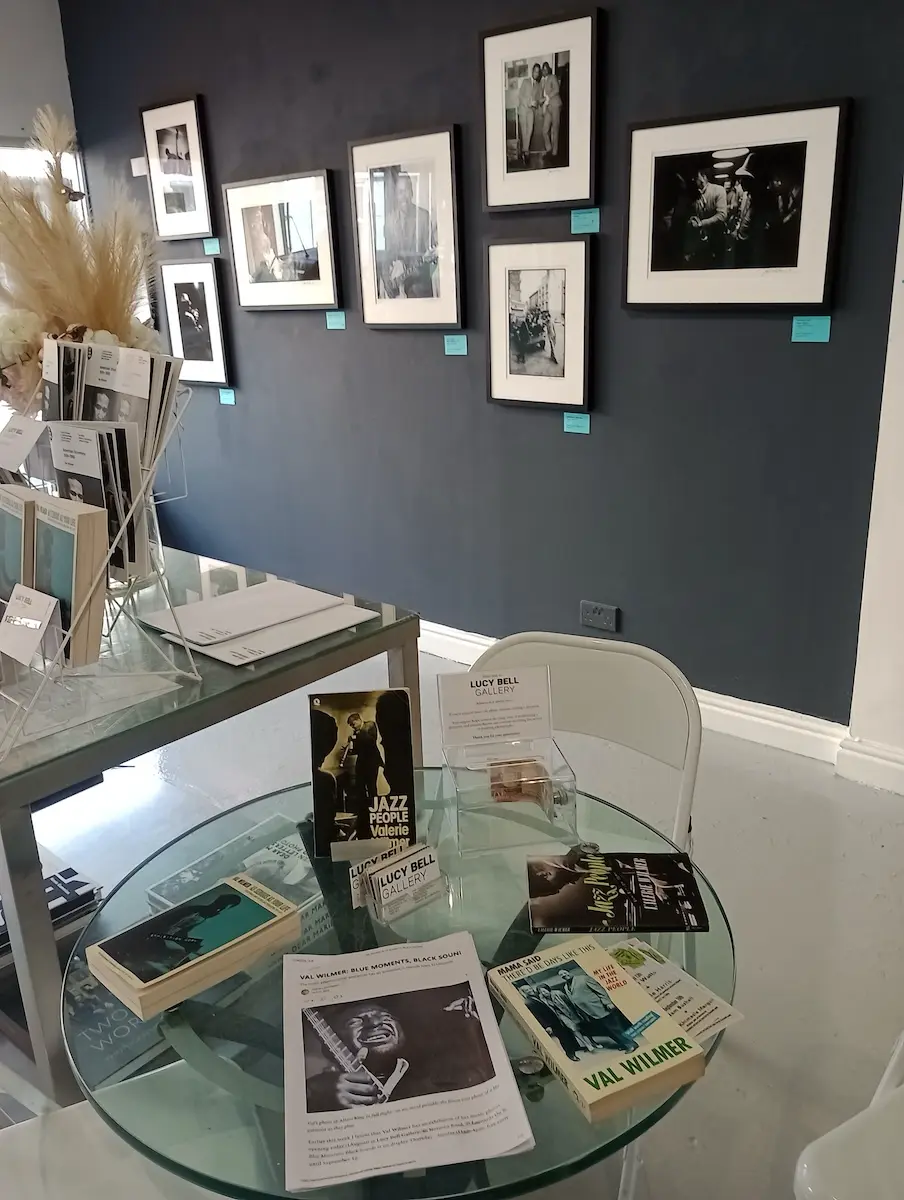
Following a critically acclaimed, highly successful exhibition at London’s Worldly Wicked and Wise Gallery, enthusiasts of both photography and jazz now have an extended opportunity to immerse themselves in her extraordinary portfolio. The Lucy Bell Gallery, nestled just moments from the picturesque seafront in St Leonards-on-Sea, East Sussex, is currently hosting Blue Moments, Black Sounds. Originally slated to close earlier, public demand and critical enthusiasm have successfully pushed the exhibition’s run through to October 4, 2026.
This comprehensive showcase offers a rare second chance for collectors, historians, and casual art lovers alike to witness the unmatched intimacy of Wilmer’s portfolio. Known for her light-filled, airy aesthetic and deep-seated commitment to her subjects, the Lucy Bell Gallery provides an ideal coastal sanctuary for a collection that radiates warmth, humanity, and fierce respect. This article provides an in-depth examination of the exhibition, a detailed chronology of Wilmer’s storied career, the socio-cultural context of her work, and an authoritative look at why this retrospective is being hailed as one of the most important photographic events of the year.
Detailed Chronology: From London Airport Tarmacs to Global Acclaim
To truly understand the weight and resonance of the photographs currently hanging on the walls of the Lucy Bell Gallery, one must trace the timeline of Val Wilmer’s remarkable journey—a career forged in curiosity, tenacity, and an uncompromising dedication to truth.
1956: The Genesis at London Airport
The origin story of Val Wilmer as a photographic chronicler is now a piece of jazz lore. In 1956, a teenage Wilmer, accompanied by her younger brother Clive, made her way to London Airport. Armed with youthful enthusiasm and a camera, she sought out none other than Louis Armstrong—the undisputed king of jazz.
This initial encounter was not merely a moment of celebrity star-gazing; it was the catalyst for a lifelong vocation. The resulting photographs of Armstrong captured a relaxed, unguarded humanity that standard press photography routinely missed. These early frames established the foundational ethos of Wilmer’s artistic philosophy: that the subject must always be treated as a complex, feeling human being first, and an icon second.
The 1960s and 1970s: Documenting the Vanguard
Throughout the tumultuous and culturally transformative decades of the 1960s and 1970s, Wilmer cemented her reputation as an essential documentarian of the global jazz avant-garde. While many British and European photographers remained insulated in their local markets, Wilmer traveled extensively, bridging the cultural divide between London and the United States.
She embedded herself within the burgeoning scenes of free jazz, bebop, and the blues. Her camera rolled film on legends such as John Coltrane, Thelonious Monk, Ornette Coleman, and Archie Shepp. Crucially, Wilmer’s lens did not stop at the edge of the bandstand. She ventured deep into the communities that birthed the music, capturing the social backdrops, systemic struggles, and everyday joys of Black musicians navigating a racially polarized world. Her framing was radical for its time: unapologetically political, deeply respectful, and entirely devoid of the exoticizing tropes often imposed by mainstream media.
The Evolution into Literature and Social Activism
As her career progressed into the 1980s and beyond, Wilmer’s artistic output naturally expanded. Recognizing that photography was only one tool for storytelling, she became a formidable author, oral historian, and journalist. Her seminal 1977 book, As Serious As Your Life: The Story of the New Jazz, remains a foundational text for anyone seeking to understand the socio-political imperatives driving the free jazz movement in America and Europe.
Wilmer’s visual archive grew to encompass not just musicians, but pioneering writers, visual artists, and activists. By framing jazz within a wider Pan-African and diaspora intellectual network, she positioned the music as a central pillar of modern global culture.
The Contemporary Era: Retrospective Recognition
In recent years, the art world has undergone a necessary reckoning regarding who gets canonized in the history of photography. This institutional awakening has brought Wilmer’s archive back into sharp focus. The 2023 exhibition at London’s Worldly Wicked and Wise Gallery served as a critical triumph, introducing her historical prints to a new generation of digital natives and contemporary art collectors.
Now, the migration of this material to the Lucy Bell Gallery in St Leonards-on-Sea marks the latest chapter in this ongoing renaissance. By extending the exhibition through October 2026, the gallery ensures that this vital chapter of cultural history remains accessible far beyond the metropolitan confines of central London.
Supporting Context & Metrics: Inside the Exhibition and Venue
To fully appreciate Blue Moments, Black Sounds, one must examine the physical and geographical context housing Val Wilmer’s prints, alongside the broader cultural metrics defining the current state of photography curation.
The Venue: Lucy Bell Gallery
Located at 46 Norman Road, the Lucy Bell Gallery has cultivated a stellar reputation within the British contemporary art scene. Originally founded as the Independent Photographers’ Gallery in nearby Battle, the institution relocated to St Leonards-on-Sea in 2009. Since its move, the gallery has established itself as a vibrant cultural hub, celebrated for its light, airy architectural spaces that breathe life into photographic exhibitions.
The gallery’s proximity to St Leonards Warrior Square Station makes it an accessible destination for art lovers traveling from London, Brighton, and across the South East. By pairing a coastal day trip with a world-class historical exhibition, the venue offers a holistic cultural experience.
Exhibition Metrics and Logistics
- Exhibition Blue Moments, Black Sounds
- Extended Dates: August 1 – October 4, 2026
- Opening Hours: Thursday, Friday, Saturday, and Sunday, 11:00 AM – 4:00 PM (or by private appointment).
- Location: Lucy Bell Gallery, 46 Norman Road, St Leonards-on-Sea, East Sussex, TN38 0EJ.
- Contact & Inquiries: [email protected] | www.lucy-bell.com | Tel: 01424 434828 / Mobile: 07979 407629.
The Curatorial Impact
The curation of Blue Moments, Black Sounds reflects a deliberate move away from sterile, museum-standard white cubes toward intimate, accessible engagement. The prints on display—spanning vintage silver gelatin developments to modern archival fine-art editions—highlight the tactile nature of analog photography. In an era dominated by transient digital imagery, viewing Wilmer’s physical prints serves as a powerful reminder of the patience, darkroom mastery, and profound emotional investment required to capture lightning in a bottle during the mid-20th century.
Official Statements & Critical Reception
The critical acclaim surrounding Val Wilmer’s recent exhibitions underscores the enduring relevance of her artistic output. Cultural commentators, jazz historians, and photography critics have universally praised her ability to humanize legends while capturing the raw electricity of a golden musical era.
In reviews published by leading arts publications, including Jazz Journal, critics have drawn attention to the distinct warmth that permeates Wilmer’s archive. Unlike many of her contemporaries who operated with a detached, fly-on-the-wall cynicism, Wilmer’s relationship with her subjects was built on mutual trust and solidarity.
"Val Wilmer’s photographs do not merely document musicians; they honor them. Every frame vibrates with an intrinsic understanding of the cultural and socio-political landscape from which the music emerged. To walk through her exhibitions is to step directly into the beating heart of jazz history." — Contemporary Arts Review
Gallery owner Lucy Bell has likewise emphasized the privilege of housing such an culturally significant collection:
"We are thrilled to extend ‘Blue Moments, Black Sounds’ through to October. The response from the public has been overwhelming. Visitors are not just looking at photographs; they are connecting with an era of profound artistic freedom and human resilience. Val’s work proves that photography can be an act of profound love and political statement simultaneously."
Future Outlook: Preserving a Legacy for Generations to Come
As Blue Moments, Black Sounds continues its extended run at the Lucy Bell Gallery through the autumn of 2026, art market analysts and institutional curators are already looking at the long-term preservation and future trajectory of Val Wilmer’s immense archive.
Institutional Acquisition and Archival Preservation
With the art market experiencing a surging demand for mid-century documentary photography—particularly works that center marginalized communities and vernacular music cultures—conversations regarding the permanent home of Wilmer’s master negatives and vintage prints have intensified. Cultural heritage organizations and national museums are increasingly recognizing that archives like Wilmer’s are national treasures that require state-of-the-art conservation strategies.
Inspiring the Next Generation
Beyond the gallery walls, Wilmer’s enduring legacy serves as a vital blueprint for contemporary documentary photographers. In an age where image saturation often breeds superficiality, her body of work stands as a testament to the power of immersion, patience, and ethical storytelling. Young photographers visiting the exhibition in St Leonards-on-Sea are challenged to look beyond the surface, to understand the roots of their subjects, and to approach their craft with the same unwavering humanity that defined Val Wilmer’s pioneering career from the moment she raised her camera to Louis Armstrong at London Airport seventy years ago.
“Blue Moments, Black Sounds” remains on view at the Lucy Bell Gallery until October 4, 2026. Whether you are a lifelong devotee of the jazz idiom or a newcomer to the transformative power of documentary photography, this exhibition is an unmissable cultural pilgrimage.