
Executive Overview
The contemporary jazz landscape continues to thrive on boundary-pushing reinterpretations of historical narratives, personal ancestry, and classical masterworks. In recent months, two significant live and studio releases have captured the critical imagination by bridging disparate musical worlds: pianist and composer Zoe Rahman’s Hull Suite Live, recorded at London’s esteemed Vortex Jazz Club, and Swiss pianist Michael Arbenz’s Bach Suite III: A Living Organism, which bridges the baroque genius of J.S. Bach with contemporary jazz improvisation and string arrangements.
Both projects exemplify a broader movement within modern jazz where artists use historical foundations not merely as nostalgic reference points, but as living, breathing catalysts for spontaneous creative expression. Rahman’s work transforms deeply personal family histories and maritime migration into a sweeping, emotionally resonant jazz suite, buoyed by long-standing collaborators Alec Dankworth and Gene Calderazzo. Simultaneously, Arbenz—alongside his brother Florian Arbenz and Poland’s acclaimed Atom String Quartet—reimagines Bach’s Orchestral Suite No. 3 in D major, proving that the structural rigor of the 18th century and the swinging ethos of modern jazz share a profound, symbiotic DNA.
This article provides an in-depth examination of both releases, exploring their historical underpinnings, structural compositions, critical reception, and their broader implications for the trajectory of contemporary acoustic jazz. Through rigorous analysis and critical contextualization, we dissect how these artists honor the past while forcefully charting the future of improvised music.
Detailed Chronology
Zoe Rahman: Hull Suite Live at the Vortex Jazz Club
The genesis of Hull Suite Live traces back to World Piano Day 2024, when the Hull Jazz Festival commissioned Zoe Rahman to compose a suite originally envisioned exclusively for solo piano. Known for her distinctive artistic voice—shaped by her classical training and her multicultural Bengali and Irish heritage—Rahman quickly realized the material demanded a broader sonic palette. She subsequently expanded the composition, integrating sophisticated bass and drum parts designed for a piano trio.
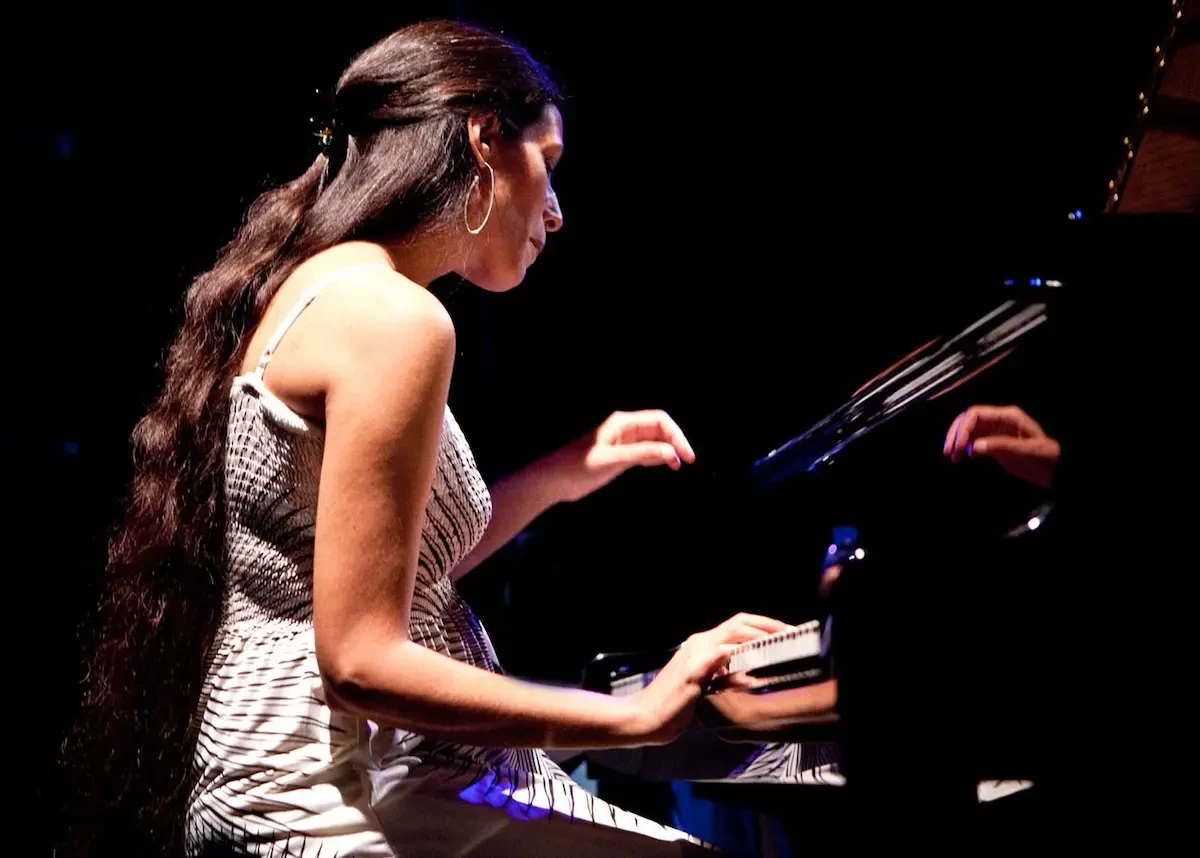
On June 21, 2025, Rahman brought this fully realized iteration to London’s legendary Vortex Jazz Club. Joined by her long-standing collaborators, bassist Alec Dankworth and drummer Gene Calderazzo, Rahman performed the suite framed by three of her other celebrated compositions. The performance was meticulously captured, resulting in the Hull Suite Live album released on Manushi Records (MANUCD008).
The concert opened with the vigorous, blues-inflected composition Synergy, immediately establishing a high-energy rapport driven by intricate bass lines. This lively prelude was seamlessly matched by the spirited Fresh Start and Red Squirrel. The latter track serves as a charming, musical depiction of a disgruntled woodland creature—a thematic choice made all the more poignant given the endangered status of red squirrels in the British Isles.
As the performance transitioned into the core Hull Suite, the music unfolded organically. The suite draws profound inspiration from two distinct historical monuments located in Hull:
- A memorial commemorating the 2.2 million emigrants who departed from the port of Hull bound for the United States between 1836 and 1914.
- A monument honoring the fishermen, seafarers, and historical trade networks shared between Iceland and Britain.
Furthermore, the suite deeply reflects Rahman’s familial lineage. Her writing was profoundly influenced by her father’s arduous migration journey from Bengal to Australia, her mother’s migration from England to New Zealand, and a heartbreaking historical anecdote: an occasion when, after her father made a trip home to Bengal, her mother was forced to sell her beloved piano so her husband could prove to Australian immigration authorities that the family possessed sufficient financial self-sufficiency.
These rich, overlapping narratives permeate movements such as Piano Story, Voyage, and Waves, culminating in the sprightly, optimistic energy of East Coast.
Michael Arbenz: Bach Suite III – A Living Organism
Moving from personal genealogy to European classical heritage, Swiss pianist Michael Arbenz unveiled his latest visionary project, Bach Suite III: A Living Organism. Released independently in early 2026, the album represents the second major Bach-inspired jazz release to capture critical attention, following closely on the heels of the Neil Cowley Trio’s Built On Bach.
Recorded at Hammerstudios in Basel, Switzerland, on March 27, 2026, the project centers on J.S. Bach’s monumental Orchestral Suite No. 3 in D major (BWV 1068). Rather than performing direct, note-for-note transcriptions of Bach’s original score, Arbenz uses the structural and harmonic frameworks of the suite as a launchpad for contemporary jazz improvisation.
The recording session opens with a faithful, elegant reading of the original overture performed by Poland’s cutting-edge Atom String Quartet—comprising violinists Dawid Lubowicz and Mateusz Smoczynski, violist Michal Zaborski, and cellist Krzysztof Lenczowski. Following this classical introduction, the rhythm section—featuring Michael Arbenz on piano and Florian Arbenz on drums—injects explosive rhythmic vitality into the proceedings.
Throughout tracks like Upbeat Bounce (derived from the original Gavotte), the Atom String Quartet demonstrates a remarkable ability to swing effortlessly, proving that classical string arrangements can seamlessly integrate with the vernacular of modern jazz. Rather than serving a merely ornamental or accompanimental function, the string quartet drives the rhythmic and harmonic engine of the music, contributing bold, funky textures that redefine traditional chamber jazz boundaries.
Supporting Context & Metrics
To fully appreciate the weight and artistic merit of these releases, one must examine the quantitative and qualitative metrics defining their production, curation, and reception within the global jazz ecosystem.
Production and Compositional Metrics
| Release Title | Artist(s) | Primary Inspiration | Recording Venue & Date | Label | Total Runtime |
|---|---|---|---|---|---|
| Hull Suite Live | Zoe Rahman, Alec Dankworth, Gene Calderazzo | Family migration history, Hull emigration & maritime monuments | Vortex Jazz Club, London (June 21, 2025) | Manushi Records (MANUCD008) | 47:06 minutes |
| Bach Suite III: A Living Organism | Michael Arbenz, Florian Arbenz, Atom String Quartet | J.S. Bach’s Orchestral Suite No. 3 in D major (BWV 1068) | Hammerstudios, Basel (March 27, 2026) | Independent | 41:42 minutes |
Cultural and Structural Analysis
Both albums highlight a sophisticated understanding of form and narrative arc. Hull Suite Live runs for a tightly paced 47 minutes and 6 seconds across nine distinct tracks (Energy; Hull Suite: Across The Humber; Out To Sea; Piano Story; Voyage; Waves; East Coast; Fresh Start; Red Squirrel). The sequencing is deliberately designed to balance socio-historical gravity with light, spirited optimism. By opening with Synergy and closing the suite’s narrative trajectory with East Coast, Rahman avoids artistic self-indulgence, ensuring that the audience remains anchored in an engaging, dynamic listening experience.
In contrast, Michael Arbenz’s Bach Suite III compresses its conceptual journey into 41 minutes and 42 seconds across five movements (Sonic Prelude; Upbeat Bounce; Inner Engine; Respire; Final Spin). The track Respire cleverly weaves the instantly recognizable melody of the famous Air on the G String (derived from the Air movement of Bach’s third suite) through violinist Dawid Lubowicz’s phrasing, serving as a subtle yet powerful bridge between baroque familiarity and improvisational abstraction.
Official Statements and Critical Reception
The critical response to both albums has been overwhelmingly positive, cementing the reputations of Zoe Rahman and Michael Arbenz as master craftsmen capable of honoring historical archives while pushing acoustic jazz into uncharted territory.
Zoe Rahman: Critical Acclaim
Reviewers have consistently praised Rahman’s technical brilliance and emotional resonance. Long recognized as a formidable force in British jazz, her ability to synthesize disparate cultural threads has earned her widespread acclaim.
"Rahman plays with her customary blend of elegance and passion sustained by considerable pianistic panache and rooted in a musical background incorporating classical music and Bengali and Irish traditions… Various live performances and recordings over the years have led me to have high expectations of any new venture by Rahman, and this album meets those expectations outstandingly. If I were given to such pronouncements, I might dub her a national jazz treasure." — Jazz Journal Critical Review
Furthermore, the rhythm section’s contribution has been singled out for praise. The synergy between Rahman, bassist Alec Dankworth, and drummer Gene Calderazzo provides an organic, responsive cushion that allows the complex narratives of displacement, family sacrifice, and maritime heritage to unfold without heavy-handed theatricality.
Michael Arbenz: Reimagining Baroque Masterworks
Michael Arbenz’s approach to J.S. Bach has drawn favorable comparisons to historical performance practices paired with modern sensibilities. Baroque composers were notorious for rearranging, re-scoring, and recycling their own compositions for varying patronage and performance contexts. Arbenz taps directly into this historical precedent.
"Reportedly a great improviser himself, like other baroque composers Bach was not averse to rejigging his own (and others’) compositions, re-scoring and rearranging them for different occasions, so he would probably have little objection to this set… The Atom String Quartet demonstrates that they can swing like the proverbials when required, moving far beyond a purely accompanying role to generate genuinely funky elements." — Critical Musicological Assessment
By treating Bach’s compositions as raw material rather than untouchable museum pieces, Arbenz successfully avoids the stiff academicism that often plagues classical-jazz crossover projects.
Future Outlook
The success and critical reception of Hull Suite Live and Bach Suite III: A Living Organism point toward exciting future directions for contemporary acoustic jazz. As artists increasingly look to personal ancestry, socio-political migration histories, and classical European repertoires for inspiration, the boundaries separating genres continue to dissolve.
The Evolution of Narrative Jazz
Zoe Rahman’s success with Hull Suite Live demonstrates that audiences possess an immense appetite for narrative-driven, deeply personal jazz compositions. By anchoring her music in historical monuments (such as the Hull emigration memorials) and raw family trauma (the sale of her mother’s piano), Rahman has established a powerful template for how artists can translate non-musical historical archives into compelling auditory experiences. Future projects in the contemporary jazz sphere are likely to follow this multidisciplinary blueprint, integrating oral histories, local heritage archives, and cross-cultural collaborations.
Chamber Jazz and Cross-Genre Fertilization
Michael Arbenz’s collaboration with the Atom String Quartet highlights the viability of expanding jazz rhythm sections with classically trained string ensembles. The ability of string players to execute complex counterpoint while simultaneously swinging with deep, rhythmic groove opens up vast compositional horizons. As recording technologies and cross-border artistic residencies proliferate, we can anticipate an increase in high-level collaborations between European classical chamber musicians and improvising jazz artists.
Conclusion
Both Hull Suite Live and Bach Suite III remind us that jazz is, at its core, an art of synthesis and reinvention. Whether exploring the turbulent maritime histories of the British coastline or deconstructing the mathematical and emotional rigor of Johann Sebastian Bach, Rahman and Arbenz prove that tradition and innovation are not opposing forces. Instead, when handled by visionary artists, they are two sides of the same coin—propelling improvised music boldly and brightly into the future.