
EXECUTIVE OVERVIEW
For many pianists, the act of opening a new piece of sheet music brings a familiar, quiet dread. Despite years of formal lessons, dedicated practice, and a genuine love for music, countless musicians find themselves stumbling over basic measures, unable to translate notes on a page into fluid sound. It is a paradox deeply embedded in the traditional music education ecosystem: millions of students spend a decade or more learning the piano, yet many remain functionally illiterate at the keyboard, struggling to read fluently even from introductory-level method books.
Lara Mirinjian, an accomplished pianist, dedicated piano educator, and founder of larasmusic.com, knows this frustration intimately. Reflecting on her own formative years, Mirinjian admits, "Over ten years of lessons and I still couldn’t read fluently from a level one book. It was ridiculous. How was this possible?"
This sentiment is echoed by practice rooms around the world. Whether plagued by focus-related challenges like ADD, intimidated by the sheer visual complexity of complex notation, or simply left behind by fragmented curricula, generations of students have accepted poor sight-reading as an inevitable flaw. However, recent insights from music education researchers and veteran pedagogues reveal a transformative truth: the deficiency does not lie in the student’s natural aptitude, but rather in a systemic failure of traditional music instruction.
Sight-reading—the ability to read and perform music at sight without prior preparation—is universally acknowledged by educators as one of the most vital components of musicianship. Yet, empirical studies demonstrate that it is largely omitted from standard lesson plans. By shifting the pedagogical focus from isolated "methods" to foundational "principles," educators and students are discovering a reliable roadmap to literacy. This article explores the root causes of the sight-reading crisis, examines the foundational philosophy of effective instruction, and details a step-by-step practical framework designed to elevate pianists of all skill levels to true musical fluency.
The Pedagogical Gap: Why Traditional Training Fails Sight-Readers
To understand why so many advanced or intermediate instrumentalists struggle to read elementary sheet music, one must examine how music education is typically structured. In most standard piano curricula, students learn pieces by rote, imitation, and slow, painstaking repetition. They spend months memorizing a handful of recital pieces, perfecting dynamics, phrasing, and touch. While this develops deep repertoire mastery, it inadvertently bypasses the cognitive processing required for spontaneous reading.
The disconnect between repertoire building and sight-reading acquisition was highlighted in a landmark study conducted by Dr. Dianne Hardy, Assistant Professor of Music Education and Piano at Dickinson State University. Investigating how sight-reading is taught across institutional and private studios, Dr. Hardy uncovered troubling trends within the pedagogy community.
"The majority of teachers in my study said that sight-reading was not included in their program because they didn’t know how to teach it," Dr. Hardy explained in her research findings. "Many cited the reason being that instruction in teaching the skill is not included in the method book series that they use. Some did not even recognize it as a skill apart from the acquisition of repertoire and just said that students would get better with more years of lessons. A few teachers said they wouldn’t attempt to teach it because they were rotten sight-readers themselves."
This systemic vacuum leaves students stranded. When sight-reading is treated as a secondary byproduct of time spent playing rather than a distinct, trainable cognitive skill, learners develop artificial crutches. They rely heavily on muscle memory, ear training, and visual memorization to fake fluency. The moment they are handed a truly unfamiliar piece, their processing speed collapses.
Mirinjian’s breakthrough occurred only after years of struggle, when she finally encountered a mentor who understood the mechanical and psychological mechanics of reading music. "Since then," Mirinjian notes, "I have seen exponential growth in myself and in my students’ sight-reading abilities." Crucially, this instructional framework is not reserved exclusively for novices; it offers profound breakthroughs for intermediate players, advanced performers seeking to sharpen their technical reflexes, and instructors searching for a reliable pedagogical anchor.
Principles Over Methods: The Philosophical Foundation of Fluency
In the realm of music instruction, the marketplace is flooded with a staggering array of "methods," flashcards, apps, and proprietary curriculums. Yet, progress often remains elusive. To break this cycle, educators must look beyond rigid procedural steps and embrace core instructional principles.
As the American essayist and philosopher Ralph Waldo Emerson famously observed:
"As to methods there may be a million and then some, but principles are few. The man who grasps principles can successfully select his own methods. The man who tries methods, ignoring principles, is sure to have trouble."
When applied to sight-reading, this philosophical distinction is paramount. A method might dictate what book to open on Tuesday, but a principle dictates how the brain processes visual symbols and translates them into physical kinetic action.
The bedrock principle of effective sight-reading training relies on material selection and execution constraints:
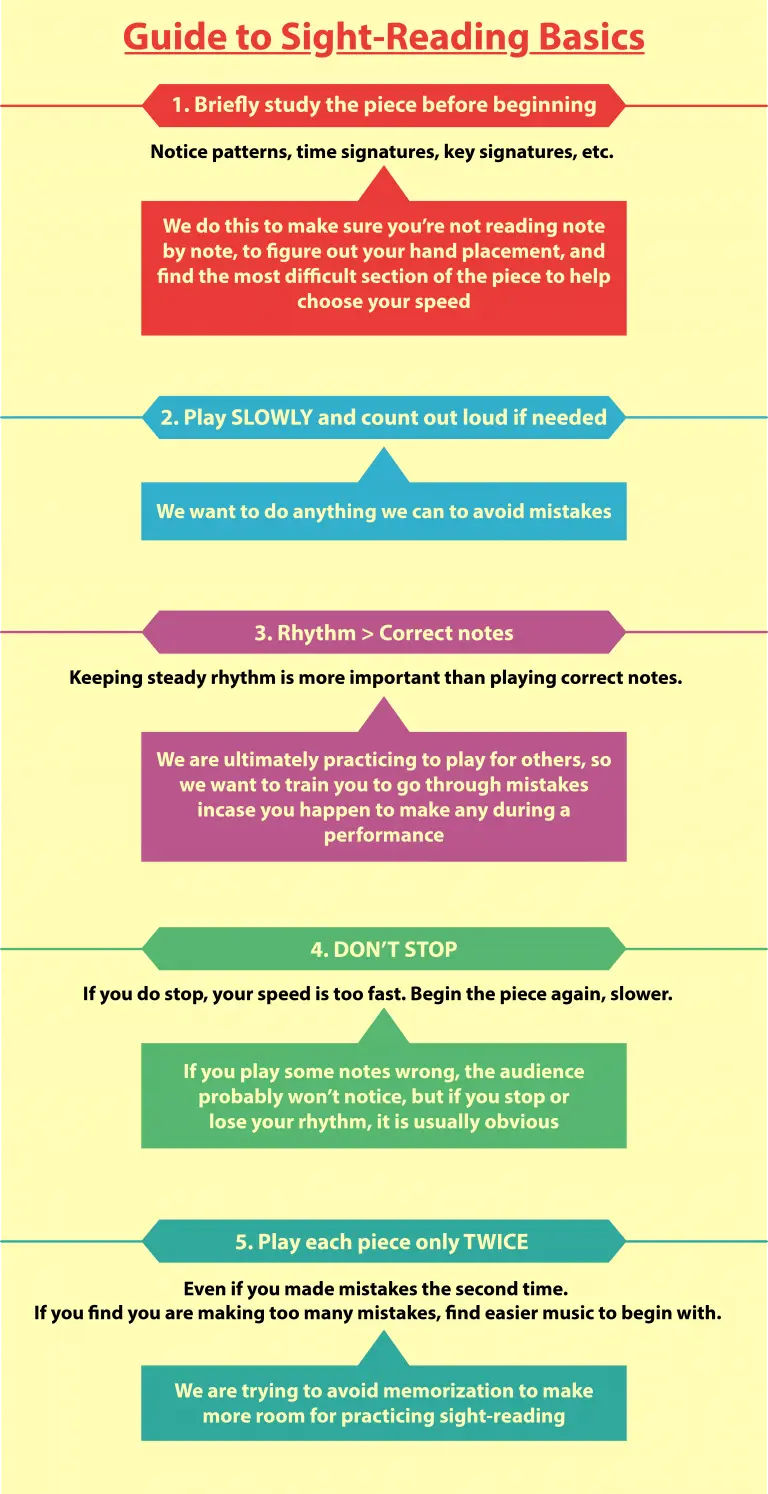
- Begin with Radically Simple Material: Even advanced pianists must drop down to rudimentary levels—material far below their technical execution capacity—to free up cognitive bandwidth for reading.
- The Two-Read Rule: Each exercise or piece should be read only twice. Over-rehearsing turns a sight-reading exercise into a memory exercise, defeating the entire psychological purpose of the drill.
- Uncompromising Continuity: The student must never stop playing due to a mistake. Rhythm and momentum take precedence over absolute pitch accuracy.
- Rhythmic Primacy: Internalizing and vocalizing the pulse before a single note is depressed anchors the performance in time.
Once these principles are fully internalized, students no longer need to rely on memorized gimmicks. Their practice habits naturally adapt to reinforce continuous, real-time decoding.

Step-by-Step Chronology: Putting Sight-Reading Principles into Action
Transforming abstract theory into daily practice requires a disciplined, structured approach. Assuming a foundational knowledge of basic note values (such as quarter and half notes) and treble clef landmarks (like middle C, D, and E), any instrumentalist can apply Mirinjian’s step-by-step framework to unlock immediate progress.
Phase 1: Preparation and Environmental Setup
- Step 1: Material Selection and Placement. Print out an ultra-simple micro-composition (or display it clearly on a tablet) and place it securely on the music stand. For this walkthrough, we begin with a foundational piece titled “Middle C.”
- Step 2: Pattern Recognition (Pre-Reading Scan). Before playing a single note, scan the score visually. Look for recurring motifs and geometric shapes on the staff. In our sample piece, notice that the note middle C appears, repeats twice, ascends one step to D, repeats five times, steps back down to C, and repeats three times. Recognizing these patterns shifts the brain from reading isolated letters to recognizing entire "words."
- Step 3: Rhythmic Assessment and Count-Aloud. Examine the time signature. Establish the tempo mentally and commit to counting out loud (1, 2, 3, 4, 1, 2, 3, 4…) as you play. Vocalization forces the brain to maintain a rigid temporal framework.
- Step 4: Physical Positioning. Place your hand comfortably on the keys with your thumb resting directly on middle C.
Phase 2: Execution and the Two-Read Rule
- Step 5: The Mental Commitment to Continuity. Prepare to play with one unbreakable rule: Do not stop. Even if you strike an incorrect note, keep the momentum moving forward. If a reading block forces a complete halt, stop, return to the beginning, and restart at an even slower tempo.
- Step 6: The First Run-Through (Ultra-Slow Motion). Begin playing at an exceptionally slow, meditative pace. Depress the key for middle C while vocalizing, "One… Two… Three… Four…" Ensure the physical motion matches the steady inner pulse.
- Step 7: The Second and Final Run-Through. Having successfully navigated the piece once, apply the magic of the second read. Play the piece one final time, consciously incorporating the visual data gathered during the first attempt, correcting any accidental misreads, and maintaining the slow, steady pulse.
- Step 8: Progressive Iteration. Immediately move on to the next miniature piece (e.g., “Stepping Up and Down”) and repeat Steps 2 through 7.
Supporting Context and Metrics: Evaluating Progress
How does a musician know if this system is working? The metrics of sight-reading success are distinct from traditional repertoire metrics.
If your practice session is producing music that sounds very slow, highly deliberate, but completely unbroken by sudden stops, you are on the exact right track. The initial product should not sound virtuosic or polished; it should sound measured, complete, and structurally sound by the conclusion of the second reading.
Conversely, if your playing is plagued by abrupt pauses, frantic searches for upcoming notes, or erratic tempos, the diagnostic solution is simple: drop the difficulty level lower.
For more advanced players who feel their sight-reading has plateaued, the prescription remains rooted in simplicity, but with an added layer of artistic refinement. Advanced readers should source vast quantities of genuinely easy music and challenge themselves to integrate micro-details—such as subtle dynamic contrasts, articulation markings, and expressive phrasing—on the very first pass.
As Lara Mirinjian emphasizes, seeking out extremely simple material is crucial at every tier of musicianship:
"Whether we realize it or not, there are still so many ‘cracks’ to fill over the months or years that we have been playing that can be done with the simplest music!"
Official Statements and Pedagogical Insights
The broader music education community is increasingly recognizing that technical proficiency at the instrument must be matched by cognitive literacy on the page. Traditional academies and university conservatories are slowly reassessing their curricula to integrate sight-reading as an active, daily discipline rather than a passive byproduct of studio lessons.

Pedagogues stress that overcoming sight-reading anxiety is primarily a psychological breakthrough. When students abandon the pressure of perfectionism on the first read, the physiological "fight or flight" response—often triggered by unfamiliar notation—dissipates. By framing the exercise as an exploration rather than a test, learners cultivate an environment where neural pathways can rapidly form.
Furthermore, the integration of digital tools and tablets in modern practice rooms has revolutionized how musicians access sight-reading material. Students are no longer constrained by the physical library of a single method book; they have instant, infinite access to thousands of leveled micro-pieces specifically designed to test and expand reading agility.
Future Outlook: The Resurgence of Literacy-First Musicianship
As the music education landscape evolves into the mid-2020s, a notable shift is underway. Teachers and self-taught musicians alike are moving away from the "memorize-to-survive" model of piano instruction. The demand for well-rounded, versatile musicians—accompanists, collaborative artists, and intuitive performers who can walk into a rehearsal, look at a score, and play it down with confidence—is higher than ever.
The adoption of foundational principles, championed by educators like Lara Mirinjian and supported by empirical research from institutions like Dickinson State University, points toward a brighter, more literate future for piano students. By dismantling the intimidation factor, embracing radical simplicity, and respecting the strict boundaries of the two-read rule, pianists of all ages can finally heal the chronic disconnect between their hands and the page.
Action Steps for Immediate Implementation:
- Audit Your Library: Gather elementary-level method books or free online sight-reading samples that are several grades below your current technical level.
- Commit to the Rule of Two: Dedicate just 5 to 10 minutes at the beginning of every practice session to read 3 to 5 micro-pieces, strictly adhering to the two-read maximum per piece.
- Count Out Loud: Never skip vocalizing your rhythm; it is the vital anchor that keeps your cognitive processing aligned with physical execution.
Information without execution remains dormant. By taking these actionable steps today, you can transform sight-reading from an intimidating roadblock into one of the most rewarding and empowering aspects of your musical journey. Happy playing!