
Executive Overview
The intersection of history, opera, and cinema forms a unique cultural phenomenon—one that has consistently captured the fraught relationship between political power, societal unrest, and artistic expression. Across centuries, the operatic stage has served as a mirror for imperial ambition, regicide, revolution, and moral decay. From the 13th-century political assassination of Queen Gertrude in Ferenc Erkel’s Bánk bán to modern narratives of conflict like Maxim Kolomiiets’s The Mothers of Kherson, art has continually grappled with the violent machinery of statecraft.
Nowhere is this cinematic-operatic lineage more potent or politically charged than in the shifting interpretations of Modest Mussorgsky’s masterpiece, Boris Godunov. Composed in 1874, the opera captures the late-16th-century chaos of the Russian Tsardom, tracking the psychological unravelling of Tsar Boris Godunov amid whispers of usurpation, peasant uprisings, and divine retribution.
In this third installment of our four-part series exploring opera-film adaptations—following previous analyses of Stanisław Moniuszko’s Halka and Giuseppe Verdi’s Rigoletto—we turn our lens toward the three major cinematic adaptations of Boris Godunov produced across a 57-year span. Through the directorial visions of Vera Stroyeva (1954), Andrzej Żuławski (1989), and Vladimir Mirzoev (2011), alongside the grand epic of Sergei Bondarchuk (1986), Mussorgsky’s work has transformed from a vehicle of socialist realism into a subversive critique of authoritarianism and a contemporary mirror for modern geopolitical turmoil.
Detailed Chronology: From Pushkin and Mussorgsky to the Silver Screen
To understand the cinematic legacy of Boris Godunov, one must first examine its literary and musical origins. The narrative traces the late-16th-century Interregnum in Russia, a period known as the Time of Troubles. Boris Godunov, the final voice of the Rurik Dynasty, ascends to the throne amid public suspicion regarding his complicity in the mysterious death of Dmitry, the rightful heir.
The Operatic Framework
Mussorgsky’s libretto, adapted from Alexander Pushkin’s 1825 play and Nikolai Karamzin’s History of the Russian State, operates through a series of stark, fragmented tableaux:
- Act I: The opera opens with the manufactured grief of the peasant crowd at the Novodevichy Convent, manipulated into begging Boris to accept the crown. This establishes a central motif: the volatile relationship between populist fanaticism and institutional violence. In the Chudov Monastery, the elder monk Pimen records history and denounces Boris for regicide, while the young monk Grigory conceives a plan to usurp the throne, eventually fleeing to become the historical "False Dmitry I."
- Act II: Boris attempts to balance political survival with domestic life. Plagued by guilt over the murdered Dmitry, he is haunted by hallucinations of the dead prince, crying out that the public—not he—demanded the deed.
- Act III: Shifting to the Polish border, the geopolitics of Muscovy and the Grand Duchy of Lithuania are brought to the fore. Grigory gains the backing of the Polish nobility and the manipulative Marina Mniszech, leveraging foreign ambition for domestic conquest.
- Act IV: As revolution brews, the state cracks down on dissent. A poignant encounter occurs between the Tsar and a yurodivy (Holy Fool), who refuses to pray for "King Herod," symbolizing the moral clarity of society’s most vulnerable. The opera culminates in Boris’s agonizing death amidst religious delirium, leaving the path open for the triumphant, unchecked advance of the Pretender.
The Cinematic Transformations
The journey from stage to screen has yielded distinct ideological interpretations:
- The Soviet Epic (1954) – Directed by Vera Stroyeva: Produced in the post-Stalinist era, Stroyeva’s adaptation adhered closely to the traditional operatic aesthetic. It functioned within the bounds of cinematic realism expected of Soviet state-sponsored art, emphasizing mass choruses and epic scale to reinforce historical determinism. Stroyeva would later helm a 1959 adaptation of Mussorgsky’s Khovanshchina, cementing her role as a primary cinematic interpreter of the composer’s nationalist historical canvases.
- The Monumental Traditionalism (1986) – Directed by Sergei Bondarchuk: Coming at the precipice of perestroika, Bondarchuk’s lavish production utilized a score by Vyacheslav Ovchinnikov. While visually staggering, it was viewed by contemporaries as a culmination of the heavy, academic style of Soviet filmmaking—a monument to an expiring state ideology.
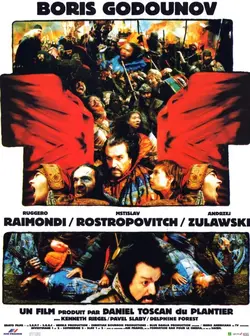
- The Avant-Garde Subversion (1989) – Directed by Andrzej Żuławski: Polish auteur Żuławski shattered traditionalist expectations with an aggressively expressionistic, anachronistic adaptation. His avant-garde approach utilized exposed film crews, self-referential theatricality, and visceral displays of madness to critique totalitarian systems. The production proved so culturally explosive that conductor Mstislav Rostropovich famously sued Żuławski over artistic disagreements, a testament to the film’s provocative disruption of sacred operatic texts.
- The Contemporary Realist Mirror (2011) – Directed by Vladimir Mirzoev: Mirzoev bypassed the operatic score entirely to return to Pushkin’s original 1825 play, transposing the narrative into present-day Moscow. By framing the power struggles within modern Russian sociopolitical aesthetics, Mirzoev transformed the historical drama into an urgent morality play, echoing the civil unrest of the 2011–2013 Russian protests.
Supporting Context & Metrics: The Geopolitics of Russian Opera-Film
The persistent adaptation of Boris Godunov is not an isolated phenomenon within Russian and East European culture. It belongs to a broader tradition wherein 19th- and early 20th-century operas serve as coded polemics against autocratic overreach.
| Work | Composer | Premiere Year | Primary Adaptation(s) | Thematic Focus |
|---|---|---|---|---|
| Halka | Stanisław Moniuszko | 1854 | Various Cinematic Reels (Part 1 of Series) | Social stratification, rural exploitation, and Polish national identity. |
| Rigoletto | Giuseppe Verdi | 1855 | Italian Opera-Film Adaptations (Part 2 of Series) | Moral corruption, paternal tyranny, and institutionalized power. |
| Boris Godunov | Modest Mussorgsky | 1874 | Stroyeva (1954), Bondarchuk (1986), Żuławski (1989), Mirzoev (2011) | Usurpation, collective guilt, state-sponsored paranoia, and false exceptionalism. |
| The Golden Cockerel | Nikolai Rimsky-Korsakov | 1909 | Stage/Film Cross-Media Interventions | Satire of Tsardom, nationalist religiosity, and the collapse of empires. |
| The Nose | Dmitry Shostakovich | 1930 | Andrey Khrzhanovsky (Animated Adaptation) | Bureaucratic absurdity, state paranoia, and anti-formalist critique. |
The Evolution of Aesthetic Resistance
As scholar Simon Morrison observed regarding Sergei Diaghilev’s 1914 Paris staging of Rimsky-Korsakov’s The Golden Cockerel, Russian art has frequently danced on the precipice of cultural reckoning—moving away from archaic nationalist isolationism toward critical neo-nationalism. While works like Sergei Rachmaninoff’s All-Night Vigil (1915) sought spiritual refuge in historical continuity, modernist iterations of Boris Godunov did the opposite: they exposed the rotten foundations beneath the myth of righteous autocracy.
This lineage finds its modern echo in international diplomacy and cultural programming. The decision by Milan’s prestigious La Scala to open its 2022/2023 opera season with Boris Godunov sparked fierce international debate. Far from being a neutral artistic choice, the production was widely interpreted by cultural critics as a commanding, uncomfortable symbol of contemporary geopolitical ambitions, proving that Mussorgsky’s 19th-century indictment of unchecked power remains painfully relevant in the 21st century.
Official Statements and Critical Reception
The friction between traditionalist preservation and avant-garde reinterpretation has defined the discourse surrounding Boris Godunov on screen for decades.
- On the Avant-Garde Rupture: Defending his radical 1989 departure, Polish director Andrzej Żuławski noted in retrospective interviews that classical masterpieces must be dragged into the present through violent theatricality to prevent them from becoming museum pieces. His vision—which treated the stage and camera not as windows into the 16th century, but as active participants in political psychoanalysis—drew fierce condemnation from traditionalists.
- The Rostropovich Controversy: Conductor Mstislav Rostropovich’s legal action against Żuławski remains one of the most high-profile clashes between musical purism and cinematic auteurism. Rostropovich argued that altering the temporal and narrative framework of Mussorgsky’s score violated the integrity of the composer’s nationalist-historical intentions.
- On Modern Realism: Reflecting on his 2011 contemporary adaptation, Vladimir Mirzoev emphasized that Pushkin and Mussorgsky were writing about eternal political archetypes rather than historical relics. "The mechanisms of power do not change," Mirzoev suggested in promotional interviews. "The paranoia of the ruler and the silence of the herd are just as visible on the streets of Moscow today as they were in the Kremlin centuries ago."
Future Outlook
As geopolitical tensions continue to reshape the global cultural landscape, the role of canonical opera-film adaptations undergoes continuous re-evaluation. The journey of Boris Godunov—from a late-Imperial musical experiment to a Soviet cinematic epic, an avant-garde weapon of dissent, and finally a modern mirror for contemporary authoritarianism—demonstrates the infinite adaptability of masterworks when placed in the hands of visionary filmmakers.
In contemporary discourse, Ukrainian history and artistic production have increasingly asserted their distinct identity against centuries of imperial framing, as seen in recent cinematic and operatic milestones like Maxim Kolomiiets’s The Mothers of Kherson and modern stagings of Mykola Lysenko’s heritage works. As these narratives reframe Eastern European cultural history, canonical works like Boris Godunov are no longer viewed merely as monuments of Russian cultural hegemony, but as cautionary tales about the universal dangers of populist demagoguery and political violence.
Ultimately, Boris Godunov endures because it refuses to offer easy absolution. In its sordid universe—where the lowliest fool retains the sole clear-eyed vision of reality, where religious piety is weaponized to justify brutality, and where truth is entirely subordinate to state survival—audiences across generations continue to recognize the unsettling contours of their own political realities. Whether encountered in the grand opera houses of Milan or through the daring lens of an auteur filmmaker, the ghosts of Boris Godunov and Dmitry the Pretender will continue to haunt the screen, reminding us that the price of unbridled ambition is eternal instability.