
Executive Overview
In an era where houses of worship strive to cultivate environments of radical hospitality, inclusivity, and spiritual connection, one critical demographic is frequently overlooked: individuals experiencing hearing loss. For millions of congregants globally, attending a traditional church service can be a frustrating and isolating experience. Despite the presence of powerful sound reinforcement and modern line-array speaker systems, acoustic challenges such as reverberation, background noise, and architectural anomalies often render the spoken word—and the emotional nuance of a sermon or musical performance—muffled and unintelligible.
Addressing this silent barrier is no longer merely an optional enhancement; it is a fundamental component of accessible ministry. Assistive Listening Systems (ALS) bridge the gap between the pulpit and the pew, ensuring that every member of the congregation can engage fully in worship, fellowship, and community life.
Implementing an effective ALS, however, requires a strategic, multi-phase approach. It extends far beyond the simple procurement and installation of hardware. From accurately diagnosing a congregation’s specific acoustic and medical needs to training staff, educating users, and promoting the availability of devices, church leadership must navigate several operational hurdles to guarantee success.
This comprehensive report examines the strategic imperatives of deploying Assistive Listening Systems within houses of worship. Drawing on industry best practices, expert consultations, and deployment toolkits provided by audio innovators like Listen Technologies and CCI Solutions, this article outlines a rigorous four-step framework designed to help religious organizations evaluate, purchase, deploy, and promote listening solutions that foster true inclusivity.
Detailed Chronology: A Four-Step Implementation Framework
Successfully integrating an Assistive Listening System into an existing ministry requires methodical planning. Rhaing technology into a sacred space without proper groundwork often leads to underutilization, wasted budgets, and continued frustration among congregants. Industry experts recommend a structured, chronological four-step methodology to ensure seamless adoption.
[Phase 1: Needs Assessment] ──> [Phase 2: Financial & Technical Planning] ──> [Phase 3: Operational Training] ──> [Phase 4: Community Awareness]Phase 1: Understand Your Needs (The Diagnostic Stage)
The foundational misstep many leadership teams make is purchasing audio equipment based on assumptions rather than empirical data. Every congregation possesses a unique demographic and architectural profile. Consequently, the first and most critical step when considering an Assistive Listening System is to conduct a thorough audit of your congregation’s actual needs.
The most effective mechanism for accomplishing this is a comprehensive congregational survey. Church administrators should distribute physical and digital questionnaires designed to capture quantitative and qualitative data regarding hearing health and sanctuary experiences. Key inquiries should focus on:
- The individual’s overall listening experience during standard worship services.
- Specific architectural or acoustic pain points within the sanctuary (e.g., dead zones, excessive echo).
- The utilization of personal hearing aids or cochlear implants.
- The technical specifications of those hearing aids—specifically, whether they are equipped with telecoils (t-coils), which allow direct interfacing with induction loop systems or neck loops.
By gathering this data, church leadership can move away from guesswork and build a precise profile of how many individuals require assistance, what frequency of use to expect, and which specific technologies will yield the highest return on investment.
Phase 2: Fully Understand Your Options (The Budgeting & Procurement Stage)
Once the congregation’s needs are clearly mapped, the next phase involves translating those requirements into a tangible technical and financial strategy. The market offers a variety of assistive listening technologies, including Radio Frequency (RF) systems, Infrared (IR) systems, Wi-Fi-based streaming solutions, and Audio Induction Loops (hearing loops). Each option carries distinct cost implications, installation requirements, and user experiences.
Estimating the cost of equipment that best matches the congregation’s profile can be complex. Fortunately, specialized AV integration partners, such as CCI Solutions, offer expert guidance and complimentary consultations to help administrative teams navigate expense reports and develop realistic capital budgets.
Furthermore, churches should explore creative financing and fundraising initiatives to offset capital expenditures. Dedicated special offerings, grant programs from disability advocacy foundations, or donations designated for community accessibility projects can transform an intimidating budget line item into an achievable capital campaign.
Phase 3: Prepare for Success (The Internal Readiness Stage)
Procuring state-of-the-art equipment is meaningless if the technology sits uncharged in a closet or if staff members do not know how to operate it. Preparing for success requires internal operational readiness, focusing heavily on staff and volunteer training.
Ushers, welcome desk personnel, and audio-visual technicians must receive comprehensive instruction on how to handle, maintain, distribute, and troubleshoot the assistive listening devices. Think of these frontline volunteers as your Assisted Listening Ambassadors. Their demeanor, knowledge, and efficiency will dictate whether a congregant feels welcomed or stigmatized when requesting a device.
Best practices dictate that when checking out a receiver to a user, staff members should take a moment to provide a friendly, step-by-step demonstration of the device’s basic functions—such as volume control, power operation, and earphone positioning. To ensure consistency, ministries should place a laminated copy of Frequently Asked Questions (FAQs) directly at the distribution counter, giving volunteers immediate access to troubleshooting steps during the pre-service rush.
Phase 4: Create Awareness (The Outreach & Communication Stage)
The final phase of implementation is bridging the gap between availability and utilization. Countless churches invest thousands of dollars in high-end listening systems, only to find that utilization rates remain near zero simply because the congregation does not know the technology exists.
A robust communication strategy must be deployed across multiple channels:
- Signage: Prominently display the International Symbol of Access for Hearing Loss at all primary entrances, welcome desks, and sanctuary doors, indicating clearly that Assistive Listening Devices are available and where to acquire them.
- Print and Digital Media: Provide a consistent, recurring reminder in the weekly printed bulletin, digital newsletters, and pre-service multi-media projection slides.
- Live Demonstrations: Consider hosting a dedicated live training session or orientation during a fellowship hour, allowing congregants to handle the equipment, test the audio clarity, and familiarize themselves with the technology in a low-pressure environment.
- Community-Wide Advertising: Extend your outreach beyond the existing membership. Advertise your accessibility efforts to the surrounding geographic community. Many individuals with age-related or congenital hearing loss have stopped attending church entirely because they assume houses of worship are acoustically hostile environments. Publicizing your ALS capabilities serves as a powerful beacon, drawing visitors who long to feel included in a worship community.
Supporting Context & Metrics: The Societal and Economic Impact of Hearing Loss
To truly appreciate the urgency of deploying Assistive Listening Systems, one must examine the broader epidemiological and sociological context of hearing loss within modern society.

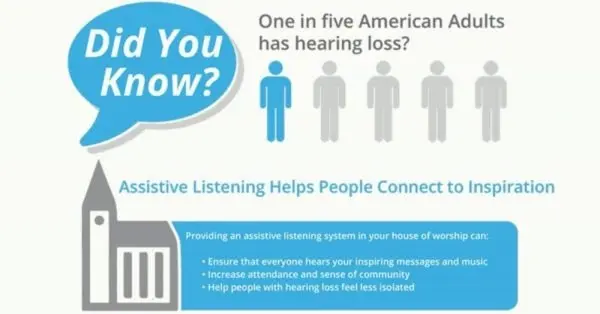
According to data from the World Health Organization (WHO) and the Centers for Disease Control and Prevention (CDC), hearing loss is one of the most prevalent chronic health conditions affecting adults. In the United States alone, approximately 48 million people experience some degree of hearing loss. As populations age, this number is projected to climb steadily, making age-related hearing loss (presbycusis) a near-universal challenge for congregations with mature demographic profiles.
[Prevalence of Hearing Loss in the US] ~ 48 Million Individuals
[Impact on Social Interaction]         ~ Increased Risk of Isolation & Depression
[Acoustic Challenge in Sanctuaries]    ~ Reverberation Times > 2.0 Seconds
The sociological ramifications of unmanaged hearing loss extend far beyond physical audiology; they strike directly at the core of psychological well-being. Studies consistently link untreated hearing loss to:
- Social isolation and withdrawal from community groups.
- Heightened rates of clinical depression and anxiety.
- Cognitive decline and accelerated memory loss.
For a house of worship, the sanctuary is designed to be a place of supreme connection—a sanctuary of shared prayer, spoken scripture, communal singing, and pastoral counseling. When a congregant can no longer decipher the spoken word due to poor acoustics or hearing impairment, they experience a profound sense of disenfranchisement. They stop participating in congregational life not because they have lost faith, but because the physical architecture of the service has inadvertently locked them out.
Financially and operationally, investing in an ALS yields substantial community dividends. While capital expenditures vary depending on sanctuary size and technology type, the cost per capita is remarkably low when measured against the lifetime value of keeping a faithful member engaged, active, and spiritually nourished within the body of Christ.
Official Statements & Expert Insights
Industry leaders and accessibility advocates have long championed the integration of assistive listening technologies as a moral and operational imperative for modern religious institutions.
"Reaching out to those who feel disconnected from your community due to hearing loss is central to sharing the message of inclusion. Genuinely compassionate service involves being aware of and caring for the needs of everyone, especially those dealing with impairments."
— Audio Engineering and Ministry Development Consortium
Experts emphasize that accessibility should never be treated as an afterthought or a reactive concession to federal regulations (such as the Americans with Disabilities Act). Instead, it should be viewed as an active, compassionate extension of pastoral care. When a church provides clear, intelligible audio to every seat in the house, it sends an unambiguous theological message: Every individual is valued, every story matters, and every soul is welcome.
Furthermore, auditory specialists note that modern technological advancements have made assistive listening more discreet and user-friendly than ever before. Gone are the days of bulky, stigmatizing headsets that singled out users in a crowd. Today’s systems integrate seamlessly with personal smartphones via Wi-Fi audio apps, utilize sleek Bluetooth-compatible neck loops, or transmit directly into modern hearing aids equipped with telecoil receivers. These innovations remove the psychological barrier of self-consciousness, encouraging higher adoption rates among hesitant congregants.
Future Outlook: The Next Generation of Sanctuary Accessibility
As we look toward the future of ecclesiastical design and audio engineering, the landscape of assistive listening is poised for radical transformation. Several emerging trends and technological shifts will shape how houses of worship approach acoustic inclusivity in the coming decade:
-
The Rise of Auracast™ and Bluetooth LE Audio:
The introduction of Bluetooth Low Energy (LE) Audio and Auracast™ broadcast audio technology represents a massive paradigm shift. Rather than requiring specialized receivers handed out by ushers, Auracast allows audio from the soundboard to be broadcast directly to an unlimited number of personal smartphones, wireless earbuds, and hearing aids within range. This consumer-driven technology will drastically reduce equipment management overhead for churches while offering unprecedented audio fidelity to the end user. -
AI-Powered Acoustic Optimization and Real-Time Transcription:
Artificial Intelligence is rapidly entering the audio-visual market. Future sanctuary sound systems will increasingly feature AI-driven ambient noise suppression and real-time speech-to-text transcription displayed on sanctuary screens or mobile devices. This dual-modal approach—combining enhanced audio signals with visual text feeds—will provide an invaluable safety net for individuals with severe or profound hearing impairments. -
Holistic Universal Design:
Architectural acoustics will no longer treat accessibility as a retrofit add-on. New church construction projects are increasingly implementing "Universal Design" principles from the ground up—combining strategic acoustic paneling, optimized speaker dispersion modeling, and integrated induction loop wiring directly into architectural blueprints.
Conclusion and Next Steps
The integration of an Assistive Listening System is a transformative step for any house of worship committed to authentic community engagement. By methodically assessing congregational needs, evaluating financial and technical options, training staff to act as compassionate ambassadors, and aggressively promoting system availability, churches can tear down the invisible walls of acoustic isolation.
For religious leaders seeking actionable tools to begin this journey, comprehensive resources are readily available. Organizations can download specialized implementation guides, such as the Listen Technologies Church Assistive Listening Toolkit, which provides sample surveys, printable signage templates, and bulletin announcements designed to streamline the deployment process.
Ensuring that every congregant is able to hear the beauty, power, and emotion of the spoken word is not merely an audio engineering challenge—it is a profound act of grace.
If you believe your worship facility could benefit from an upgraded or newly installed assistive listening system, reach out to an AV integration specialist today to schedule your complimentary consultation and take the first step toward universal acoustic inclusion.