
Executive Overview
In the modern educational landscape, teaching music remains a profound paradox. It is universally celebrated as one of the most intellectually and emotionally rewarding professions in the world, yet it routinely ranks among the most exhausting. Educators face a relentless daily marathon: managing large ensemble rehearsals, tracking granular student progress, planning differentiated assignments, grading technical assessments, and juggling administrative burdens that stretch far beyond the traditional school day. For many music teachers, the profession feels like an endless race against the clock.
Recognizing these systemic pressures, the educational technology sector has increasingly turned its focus toward a fundamental human solution: collaboration. By breaking down the traditional silos that have isolated music classrooms for decades, platforms are discovering that when educators share the heavy lifting—whether partnering with a co-teacher down the hall, mentoring a student teacher, or exchanging curriculum across a district—the cognitive load lightens, burnout decreases, and student outcomes improve.
Enter MakeMusic and its suite of collaboration-focused updates. Designed to address the realities of modern music pedagogy, these new features—specifically the robust Co-Teaching functionality and intra-organization Assignment Sharing—aim to redefine how educators interact with their peers and their classes. Far more than mere digital conveniences, these tools represent a structural shift toward a more connected, efficient, and sustainable approach to music education. This report examines the mechanics of these new tools, their impact on diverse teaching environments, and the broader implications for the future of music pedagogy.
Detailed Chronology: The Evolution of Connected Music Education
To understand the significance of MakeMusic’s latest offerings, it is helpful to trace how digital music education has evolved over the past decade.
Phase One: Digitization and Isolation (Early 2010s)
In the early days of digital sheet music and practice software, the focus was almost entirely transactional. Programs were built for a singular user: a teacher assigning a piece to a student, and that student practicing in isolation. While these platforms revolutionized at-home practice tracking and automated assessment, they inadvertently reinforced the "lone wolf" syndrome common among music educators. Band directors, choir masters, and orchestra leaders operated within their own digital islands, maintaining separate class rosters, duplicating administrative efforts, and rarely interacting within the software ecosystem.
Phase Two: The Shift Toward Assessment and Customization (2020–2023)
As remote and hybrid learning reshaped education, the demand for versatile assessment tools surged. Educators required more than just repertoire playback; they needed ways to evaluate foundational knowledge. Earlier this year, MakeMusic responded to this demand by introducing Multiple Choice Assessments. This feature provided a quick, flexible method for checking student understanding on complex topics such as music theory, aural dictation, rhythm notation, and listening comprehension.
However, a new bottleneck quickly emerged. While teachers appreciated the ability to build sophisticated quizzes, the process of creating these assessments from scratch was labor-intensive. If three different teachers instructed parallel concert band sections, each educator spent valuable planning periods building identical or nearly identical theory quizzes. The software lacked a seamless mechanism for internal peer-to-peer distribution.
Phase Three: The Collaborative Paradigm (Present)
Recognizing that modern music programs are increasingly team-taught and interdisciplinary, MakeMusic shifted its development roadmap toward genuine institutional synergy. The recent rollout of the Co-Teaching feature and Multiple Choice/Written Assignment Sharing marks the culmination of this evolution. By bridging the gap between individual accounts and enabling shared administrative access, the platform has transitioned from a solitary instructional aid into a collaborative ecosystem.
Supporting Context & Metrics: The Reality of the "Solo" Educator
The necessity for these collaborative tools is underscored by demographic and structural realities within K-12 and collegiate music departments.
The Department of One
While large high school programs often feature multi-director staffs—such as a primary band director, an assistant director, and a percussion specialist—a significant percentage of music educators operate as a "department of one." In many elementary and middle schools, a single music teacher is responsible for every student in the building, spanning vocal, instrumental, and general music curricula.
Data from education associations consistently highlight that solo educators experience disproportionately high rates of burnout. Without a colleague in the same room to bounce ideas off, share grading duties, or cross-check concert repertoire, the mental tax of maintaining quality instruction multiplies.
Bridging the Gap: Community as Infrastructure
For educators flying solo, informal networks have historically served as a critical lifeline. Online ecosystems, such as the Teaching with MakeMusic Cloud Facebook group, have grown into massive, active communities where thousands of music educators share troubleshooting tips, arrange virtual mentorships, and crowdsource repertoire ideas.
MakeMusic’s strategy leverages this innate desire for community by pairing these organic, macro-level networks with micro-level, institutional collaboration tools. By allowing teachers to connect not just globally via social media, but locally within their own school districts and software dashboards, the platform creates a multi-layered safety net for the profession.
Official Features & Operational Breakdown
The newly expanded collaboration toolkit centers around two core functionalities designed to eliminate redundant labor and foster shared accountability: Co-Teaching and Assignment Sharing.
1. Two Conductors, One Vision: The Co-Teaching Framework
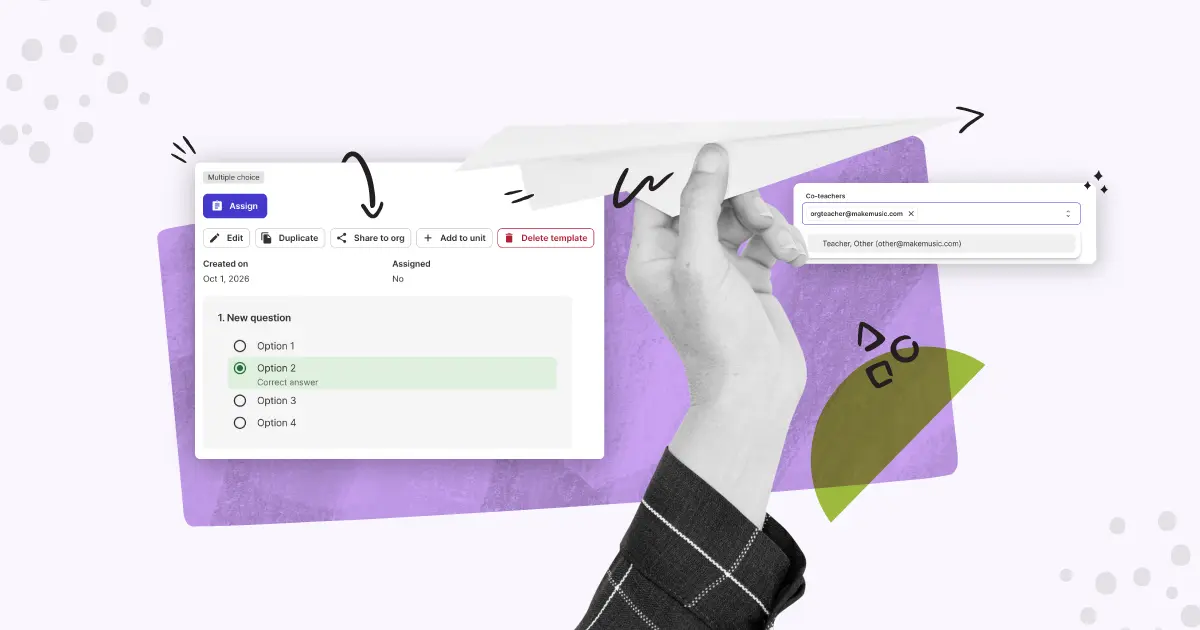
The Co-Teaching feature breaks down the rigid administrative walls historically built into learning management systems. In the past, a single teacher account owned a class, creating friction in shared environments. Today, primary educators can seamlessly invite a co-teacher into their MakeMusic class via a simple email invitation accessed directly through Class Settings.
Once the invitation is accepted, the collaborative benefits extend across several critical educational scenarios:
- Large Ensembles and Marching Bands: Programs with massive student rosters—such as marching bands or symphonic concert programs—often employ multiple directors who share instructional duties. Co-teaching ensures that both directors operate from a single, unified source of truth. There is no longer a need to reconcile disparate grading notes, duplicate rosters, or share a single, vulnerable login password.
- Student Teacher Mentorship: For university education majors completing their clinical practice, stepping into a live classroom can be daunting. The MakeMusic co-teaching integration allows student teachers to move from passive observers on the sidelines to active participants. They can assign repertoire, evaluate student submissions, and manage class workflows under the direct guidance of a veteran mentor.
- Special Education and Support Integration: Modern inclusive classrooms frequently feature special education co-teachers or paraprofessionals who support students with diverse learning needs. By embedding these support specialists directly into the MakeMusic platform, they gain immediate access to the same assignments, scores, and context as the primary music director, enabling targeted, equitable intervention.
2. Sharing Is Caring: Intra-Organization Assignment Distribution
The introduction of assignment sharing addresses one of the most persistent complaints among educators: "reinventing the wheel." With the ability to share multiple-choice assessments and written assignments within a designated school or district organization, the pedagogical workflow is radically streamlined.
The mechanics of this feature are designed for maximum efficiency:
- Creation: An educator builds a comprehensive multiple-choice quiz on rhythm notation or a specialized listening assessment in their personal library.
- Publication: Via the assignment’s settings menu, the creator selects the option to share the asset with their organization.
- Adoption: Colleagues within the same organizational umbrella can instantly locate the assessment in the shared library and save a direct copy to their own accounts.
This simple workflow change yields profound systemic benefits across a department:
- Curricular Alignment: High school and middle school instrumental tracks can achieve absolute consistency in theory and technical standards.
- Vocal-Instrumental Synergy: Choir directors can easily share solfège identification exercises with musical theater instructors, while band directors can cross-pollinate rhythm studies.
-
Onboarding New Staff: When a new music educator joins a district mid-year, they are no longer forced to build a curriculum from scratch. They inherit a robust, tested
library of resources waiting for them on day one.
Future Outlook: The Sustainable Future of Music Pedagogy
As educational technology continues to mature, the definition of a "smart classroom" is expanding. It is no longer just about high-fidelity audio playback, automated pitch-detection algorithms, or digital sheet music rendering. The true frontier of ed-tech lies in ecosystem integration and human sustainability.
The investments made by platforms like MakeMusic in collaborative infrastructure point toward a future where administrative friction is minimized, allowing the artistic and human elements of music education to take center stage. When teachers spend less time building duplicate quizzes, managing separate roster spreadsheets, or troubleshooting login credentials, they reclaim the energy necessary for what truly matters: inspiring students, refining musical expression, and fostering a lifelong love of the arts.
The message to the educational community is clear and resonant: Teaching music does not have to be a solitary endeavor. By harnessing the power of co-teaching, intra-departmental resource sharing, and professional communities, music educators can build resilient, interconnected programs that withstand the pressures of modern schooling.
For educators seeking to modernize their department workflows and explore a more connected approach to instruction, platforms like MakeMusic continue to offer pathways forward, including accessible trial programs designed to demonstrate these collaborative capabilities in real-world classrooms.