
Milan’s storied Teatro alla Scala recently welcomed back its traditional Progetto Accademia initiative to open the 2025–2026 theatrical season with a production of Gaetano Donizetti’s perennial masterpiece, L’Elisir d’Amore. Designed explicitly as a bridge between rigorous academic training and the unforgiving pressures of the professional operatic stage, the project features promising young artists from the theatre’s academy. However, while the musical components and breathtaking visual design largely delivered, the overarching production proved to be a sobering lesson in the perils of over-conceptualized staging.
Directed by Maria Mauti, the production leaned heavily into symbolic, semiotic interventions—such as floating apples, theatrical work clothes, and an undefined Wild West aesthetic—while systematically ignoring the fundamental dramatic needs of the characters. The resulting performance was heavily criticized for static acting, a lack of cohesive theatrical intent, and glaring omissions of crucial plot elements explicitly mandated by the libretto. Despite these heavy-handed directorial missteps, competent musical leadership from conductor Marco Alibrando, a stellar performance by seasoned baritone Misha Kiria, and the raw, earnest vocal commitments of the young cast ultimately saved the evening, earning a warm, enthusiastic ovation from an international audience.
Detailed Chronology and Production Analysis
The Genesis and Evolution of a Masterpiece
Composed in the white heat of 1832, L’Elisir d’Amore was born out of sheer administrative necessity. Alessandro Lanari, the enterprising impresario who had recently assumed management of Milan’s Teatro alla Canobbiana, approached Gaetano Donizetti with a commission for a new comic opera for the ongoing season. Facing a severe time crunch, Lanari suggested that Donizetti adapt an existing French libretto: Le Philtre, written by Eugène Scribe for an opéra-comique by Daniel Auber that had recently triumphed in Paris.
Donizetti set to work with his characteristic breakneck speed, delivering a score that premiered on May 12, 1832, to a reception that caught even the composer off-guard. This triumph was historically significant. In the wake of Vincenzo Bellini’s Il pirata at La Scala in 1827, Italian musical tastes had rapidly shifted toward tragic subjects and the heightened emotional states of emerging Romanticism. Yet, as musicologist Claudio Toscano notes, Elisir shares with Bellini’s La sonnambula—which had premiered in Milan just eleven months earlier—a deeply felicitous melodic vein and a sophisticated conception of the Romantic idyll that completely sidestepped simplistic Arcadian stylization. Just as Bellini’s pastoral masterwork transcended the serious genre, Donizetti’s comedy effortlessly transcends the boundaries of traditional comic opera.
The Scala 2025–2026 Season Opener: Concept Versus Execution
Returning from the traditional summer hiatus, La Scala’s Progetto Accademia selected L’Elisir d’Amore for its educational weight. Yet, despite the opera’s inherently irresistible comic appeal, the staging under review proved curiously leaden, dry, and excessively academic.
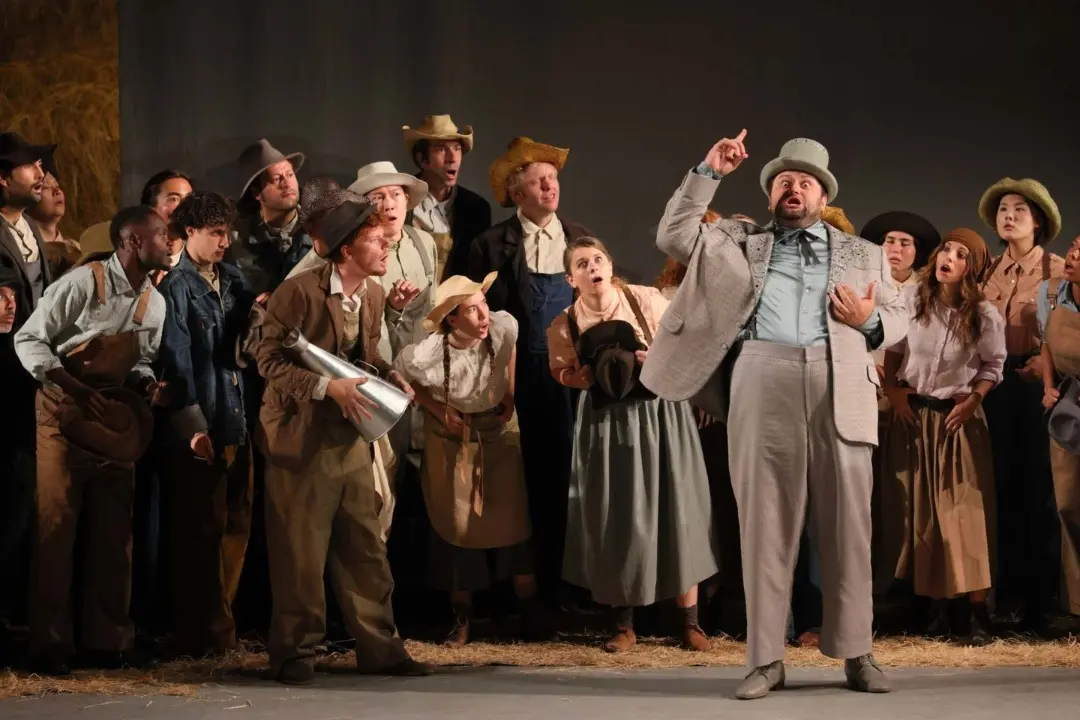
Director Maria Mauti’s vision prioritized spatial geometry and visual spectacle—fostered by an exceptionally talented design team—over the inner lives and dramatic motivations of the characters. The stage was crowded with symbolic props laden with heavy-handed semiology: a recurring apple motif, performers shifting between theatrical work clothes and period costumes, and symbolic gasoline lamps. Yet, these intellectualized layers consistently overshadowed the human element, leaving the student performers stranded.
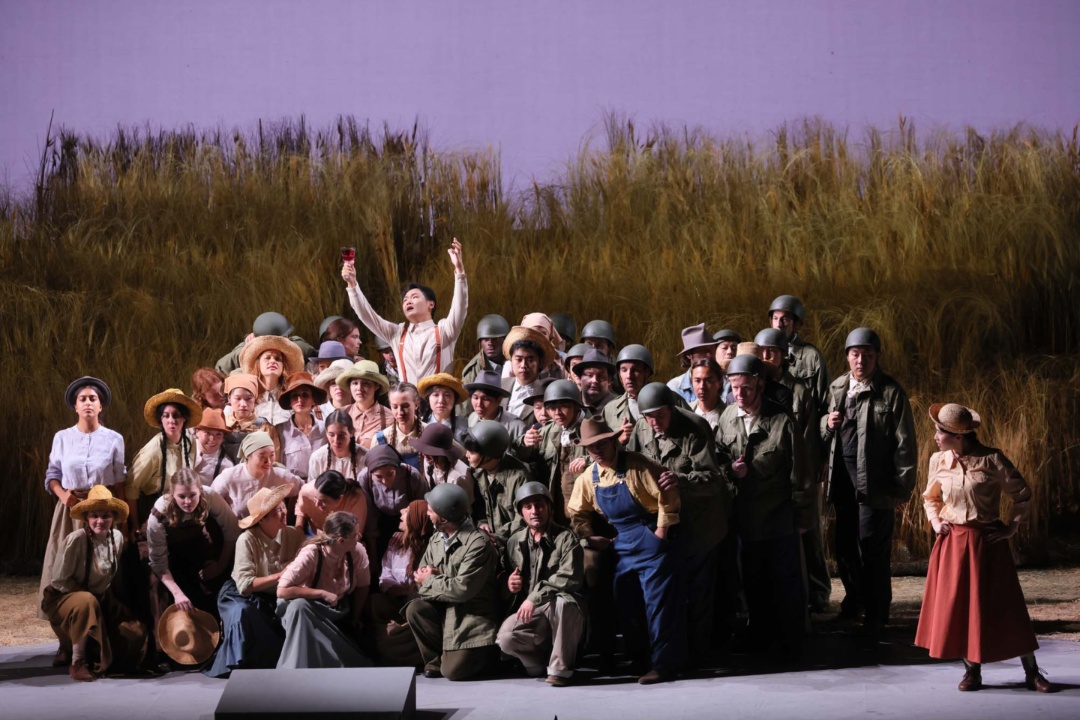
Placed in exceptionally difficult circumstances by a lack of actionable stage direction, the young cast frequently resorted to static, park-and-bark singing, bereft of clear theatrical objectives. Rather than enhancing the comedy, the staging occasionally veered into ironic detachment, undercutting Donizetti’s carefully calibrated wit. More bafflingly, the direction omitted several physical props explicitly commanded by Felice Romani’s libretto. Dulcamara’s legendary bottle of wine, the physical anchor of his famous elixir, never materializes during his star-making aria. Similarly, the contract that Belcore demands Adina sign with a cross is entirely absent, rendering impossible Adina’s subsequent act of returning it in her final aria.
Visual Splendor and Choreographic Missteps
While the dramatic direction faltered, the visual and physical architecture of the production was genuinely impressive. Marco Rossi constructed Act I around an immense, windswept wheat field, anchoring the production in a deliberately ambiguous Wild West setting. Peter Van Praet’s lighting design provided a fluid, highly atmospheric sky that mirrored the natural progression of the day, while Nicoletta Ceccolini’s costumes offered a poetic, meticulously executed visual vocabulary.
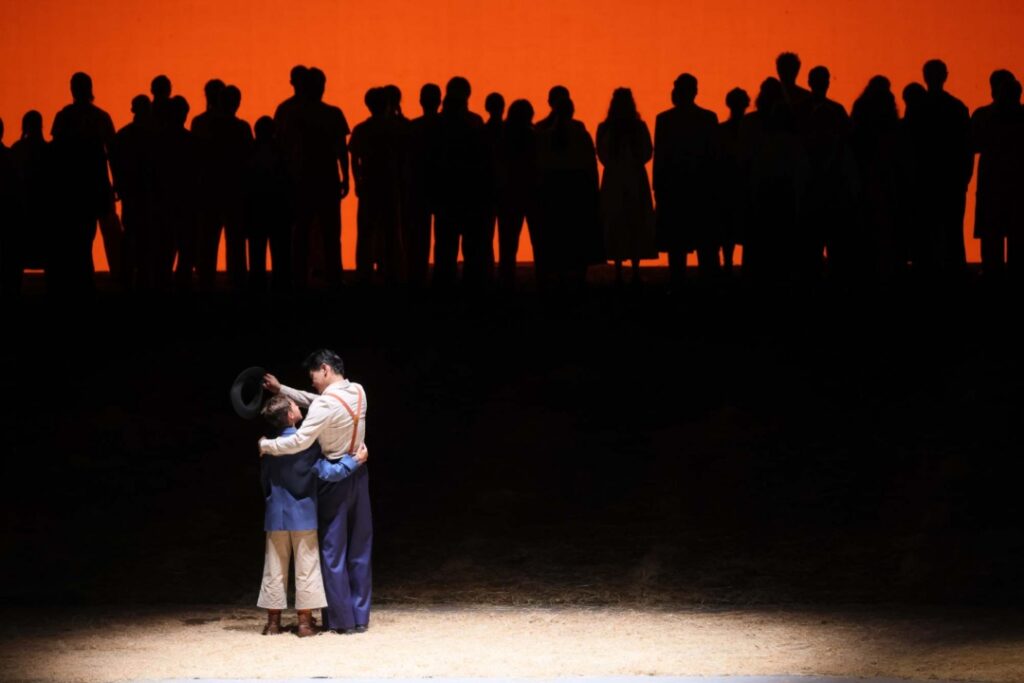
The choreography by Stefania Ballone, however, struggled to find its footing. It frequently lapsed into broad caricature, attempting to inject a forced, uncomfortable comedic dimension that felt out of sync with the musical phrasing. The use of mimes injected some much-needed kinetic energy into the space, and Act II’s communal scene—featuring Giannetta and the chorus gathered around a ribbon-adorned pole in the dead of night—achieved a charming, picturesque aesthetic. The evening was capped by a masterfully executed final tableau, featuring Nemorino watching the stage close in the company of his child alter ego.
Supporting Context and Metrics
Comparative Context within Recent Scala Academy Projects
When evaluated against the backdrop of previous Progetto Accademia installments over the past half-decade, this iteration of L’Elisir d’Amore exhibited some of the most pronounced theatrical and vocal shortcomings in recent memory. Critics and seasoned operagoers could not help but draw unfavorable comparisons to the sparkling, tightly integrated successes of Gioachino Rossini’s La Cenerentola in 2025 or Nino Rota’s Il cappello di paglia di Firenze in 2024. Where those productions successfully challenged their young casts while maintaining narrative clarity, Elisir occasionally felt like a misfire of pedagogical ambition.
The Musical Forces: Orchestra, Chorus, and Pit
In stark contrast to the staging, the musical supervision led by Sicilian conductor Marco Alibrando offered a masterclass in stylistic fidelity and technical rigor. Alibrando’s reading was academic in the best sense of the word: structurally sound, texturally clean, and respectful of the score’s intrinsic proportions. While he occasionally favored brisk tempi and dramatic pauses, he never lost sight of the vital relationship between text and melody. His management of ensemble passages was exemplary, securing a high degree of rhythmic precision and dynamic equilibrium.
The Orchestra dell’Accademia Teatro alla Scala responded with professional maturity, delivering a crisp, responsive accompaniment. Though moments of the grand choral finales might have benefited from an even greater sonic weight, the overall execution was secure. Meanwhile, the Coro dell’Accademia, expertly prepared by Salvo Sgrò, provided a compact, vibrant, and flexible vocal wall of sound that infused the proceedings with infectious energy.
Official Statements and Cast Evaluations
Vocal Profiles and Character Portraits
Nemorino: Cristóbal Campos Marin
Chilean tenor Cristóbal Campos Marin brought a clear, highly pleasant timbre and abundant natural vocal material to the role of the love-struck peasant Nemorino. Though his initial stage entry was marred by physical stiffness, his nerves gradually dissipated, allowing his phrasing to expand with greater freedom. Vocally secure, Campos Marin unfortunately tightened up precisely when Nemorino’s emotional vulnerability was meant to peak. Operating largely on a uniform expressive plane, his portrayal lacked a deep, palpable connection to Adina, keeping the comedy at arm’s length. Nevertheless, his rendition of the touchstone aria “Una furtiva lagrima” was delivered with exquisite stylistic awareness, highlighted by a gorgeous legato on the high B-flat and an elegant, tasteful cadenza.
Adina: Sabrina Sanza
Neapolitan soprano Sabrina Sanza displayed a rich, harmonically complex vocal timbre, supported by generous volume and crystalline high notes. Her legato line was consistently well-sustained, her Italian diction pristine, and her high register handled with absolute assurance. Like her tenor counterpart, however, Sanza’s stage presence suffered from a distinct lack of chemistry. Their shared duet, “Chiedi all’aura lusinghiera,” felt emotionally disconnected, and her handling of the aria “Benedette queste carte” missed a golden opportunity to bridge the gap between vocal security and dramatic expression. Vocally robust—even interpolating charming vocal variations—her execution of the demanding final cabaletta, “Prendi, per me sei libero,” confirmed that while her raw talent is undeniable, her upper-register agility requires further artistic consolidation.
Belcore and Giannetta: Supporting Standouts
Baritone Geunhwa Lee imbued the swaggering Sergeant Belcore with a strikingly rich lower register and clear Italian diction. While his projection occasionally wavered in the cavernous spaces of La Scala, his vocal material showed immense promise. Dramatically, however, Lee remained confined to a single coloristic dimension, bypassing the broader comedic palette required to flesh out the pompous sergeant. As Giannetta, soprano Aigerim Altynbek delivered a thoroughly competent, well-projected performance, navigating her brief stage time with admirable vocal and dramatic poise.
The Masterclass of Misha Kiria’s Dulcamara
The undisputed focal point of the production was seasoned Georgian baritone Misha Kiria in the role of the charismatic quack, Doctor Dulcamara. A graduate of the Academy who has since carved out a major international career, Kiria provided an invaluable masterclass for his younger colleagues simply by sharing the stage. His Dulcamara was irresistibly engaging, warm, and humorous without ever resorting to cheap theatrical vulgarity. His vis comica was so naturally developed that it inadvertently laid bare the inexperience of the student cast around him. Vocally, Kiria dominated the hall with a full, resonant tone; his rapid-fire sillabati in the tour-de-force aria “Udite, udite, o rustici” and his duets with Adina were executed with flawless technical precision and deeply intelligent phrasing.
Future Outlook
As the Teatro alla Scala 2025–2026 season pushes forward, the mixed reception of L’Elisir d’Amore serves as a timely reminder of the delicate equilibrium required in educational performance formats. The Progetto Accademia remains one of Europe’s most vital breeding grounds for operatic talent, offering emerging artists an irreplaceable crucible in which to test their mettle against the historic standards of Milan.
However, the production underscores a growing critical consensus across major European opera houses: conceptual ambition must never eclipse theatrical clarity, particularly when dealing with developing artists who require strong narrative frameworks to anchor their vocal interpretations. While the students survived the evening’s directorial roadblocks through sheer vocal grit and musical discipline—rewarded heartily by an appreciative international audience—future iterations of the academy project would do well to lean less on heavy-handed semiotic symbolism and more on the timeless, human truths embedded in the lyric theatre canon.