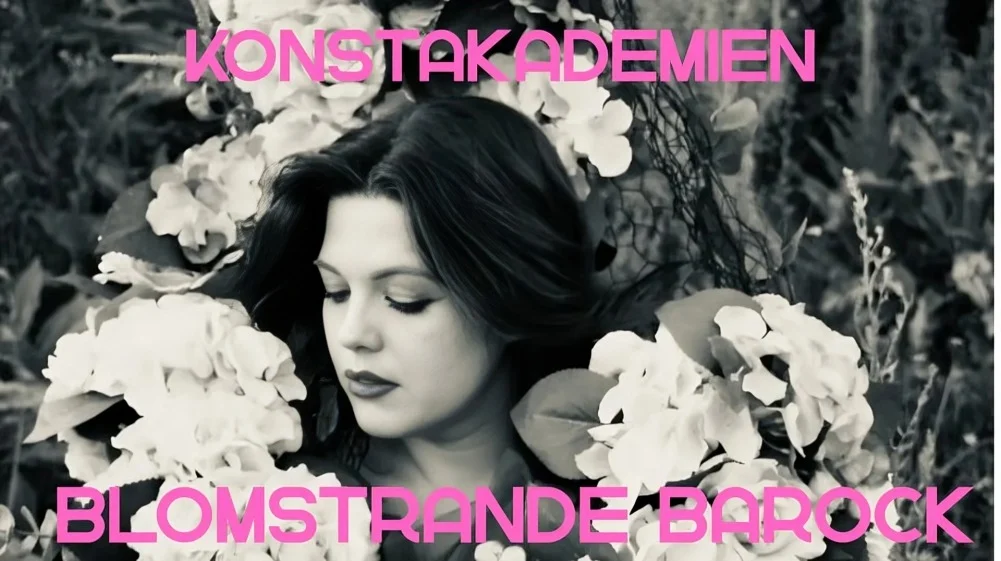

On a blustery, grey Saturday afternoon in Stockholm, the newly minted initiative Opera på Konstakademien (Opera at the Art Academy) successfully broke melodious ground, transforming the makeshift Parisian salon of the Royal Art Academy’s auditorium into a portal of 18th-century aesthetic revival. Beneath the ambiguous yet all-consuming gaze of a knitted Christ on the cross, an unadorned harpsichord and a minimalist performance arrangement set the stage for an afternoon of historical performance practice.
The inaugural concert featured an esteemed ensemble: the husband-and-wife early-music luminaries Dan Laurin (recorder) and Anna Paradiso Laurin (harpsichord), alongside the dynamic vocal pairing of Alexandra Linde (soprano) and Mårten Wåhhlström (baritone). Dressed in period-inspired attire accented with delicate floral flourishes, these four masters delivered a "greatest hits" tour of the early-to-middle Baroque and Rococo eras.
Spanning 14 artfully organized duets and arias across six diverse composers—including George Frideric Handel, Jean-Philippe Rameau, Claudio Monteverdi, Joseph-Hector Fiocco, Antonio Sartorio, and Christoph Willibald Gluck—the event transcended a standard chamber music recital. It served as a cultural time capsule, resurrecting the jovial buoyancy, decorous passions, and intimate communal engagement of the 19th-century salon. For the packed house of spectators, the experience was nothing short of transformative, offering a rare encounter with the doctrine of the affections—the Baroque philosophy governing the physical and emotional projection of specific passions through musical art.
Detailed Chronology of the Performance
Part I: Foundations, Fiocco, and Handel’s Heroics
The afternoon commenced with a delicate flourish, opening with two shimmering jewels from Joseph-Hector Fiocco’s Premiere suite from Pièces de clavecin (Op. 1). Anna Paradiso Laurin’s harpsichord dexterity and Dan Laurin’s fluid, highly articulated recorder playing immediately established a textural clarity that would define the afternoon.
Transitioning swiftly into the operatic realm, the ensemble turned to George Frideric Handel’s 1724 masterwork, Giulio Cesare. The opening duet, "Caro, bella," proved to be an immediate high point. Soprano Alexandra Linde captivated the audience with her spinning resonance, fluid lyricism, and natural dramaturgical intuition. Her voice complemented baritone Mårten Wåhlström’s velvety tone quality, unmanufactured flow, and grounded expressive approach.
The sequence continued with consecutive arias that allowed the vocalists to outline their individual technical profiles: Wåhlström’s delivery of "L’empio, sleale" followed by Linde’s luminous rendition of "Tu la mia stella sei." While Wåhlström’s rich timbre was undeniable, "L’empio, sleale" initially bypassed the opportunity to showcase his robust competence in traversing complex registration shifts, passaggio-head voice mixing, and melismatic dexterity—qualities that would emerge with full force in the concert’s second half.
The first half concluded with a poignant rendering of the Monteverdi-attributed duet "Pur ti miro" (frequently associated with L’incoronazione di Poppea), arranged here for soprano and baritone. Though executed with exquisite harmonic blend, purists might argue that alternative historical gems—such as selections from Élisabeth Jacquet de La Guerre’s 1694 Céphale et Procris—could have introduced an even more adventurous stylistic flavor.
Following a majestic, structurally pristine traversal of Handel’s Recorder Sonata in F major, HWV 369, by Dan and Anna Laurin, Linde and Wåhlström returned for a softly choreographed presentation of "Forêts paisibles" from Jean-Philippe Rameau’s Les Indes galantes (1735). Both vocalists sang with a sophisticated, unified pathos, presenting an elegant yet restrained dynamic appropriate to the courtly repertoire, though the theatrical staging could have benefited from more polished choreography.
Part II: Virtuosity, Transformation, and Culmination
The second half of the program shifted toward alternating solos, allowing each artist to stretch their interpretative boundaries. Alexandra Linde initiated this segment with "Quando voglio" from Antonio Sartorio’s 1676 setting of Giulio Cesare—a work frequently overshadowed by Handel’s later iteration of the same libretto. Though not structurally designed as a hyper-virtuosic showpiece, its pensive suspensions and dotted rhythmic pulses across an octave ambitus were executed with steadfast cleanliness and unaffected malleability by Linde.
Wåhlström responded with "Pensa a chi geme" from Handel’s Alcina (1735). Here, the baritone’s artistry truly came alive. As he crested through his upper tessitura, clear hints of a bel canto sensibility at the core of his vocal production became apparent, leaving listeners longing to hear his take on Mozart’s Count Almaviva.
Linde then returned to Rameau’s Les Indes galantes with the soaring soprano aria "Régnez, plaisirs." This performance served as a masterclass in vocal technique and stylistic refinement. Her invigorating trills and effortless phrasing—executed without a hint of vocal pressure—caressed the acoustic space of the academy hall. Navigating the demanding da capo structure, she introduced subtle, tastefully judged ornamentation that acted as a coup de grâce to a marvelous display of Baroque art.
Not to be outdone, Wåhlström unleashed his full technical arsenal in "Sibilar gli angui d’Aletto" from Handel’s Rinaldo (1711). Demonstrating a remarkable mastery of upper-tessitura onsets, breath control, and weightless agility, he seamlessly bridged expressive dramaturgy with absolute technical stability.
The afternoon reached its spiritual climax with the concluding duet: "Trionfi amore e il mondo serva intiero" from Christoph Willibald Gluck’s 1762 masterpiece, Orfeo ed Euridice. Choosing the opera’s celebratory finale was an inspired curatorial decision. As all four musicians united to honor the triumph of love, the auditorium resonated with a collective, palpable joy. The almost full house responded with enthusiastic applause, instantly demanding an encore of the finale.
Supporting Context & Metrics
Architectural and Curatorial Framework
+-----------------------------------------------------------------+
|               OPERA PÅ KONSTAKADEMIEN: INAUGURAL RECITAL          |
+-----------------------------------------------------------------+
| Venue:            Royal Art Academy Auditorium, Stockholm       |
| Setting:          Mock Parisian Salon (Minimalist Staging)      |
| Ensemble:         Dan Laurin (Recorder)                         |
|                   Anna Paradiso Laurin (Harpsichord)            |
|                   Alexandra Linde (Soprano)                     |
|                   Mårten Wåhlström (Baritone)                   |
| Repertoire Span:  Late 17th Century to Late 18th Century        |
| Total Works:      14 Artfully Organized Duets and Arias         |
| Core Composers:   Handel, Rameau, Monteverdi, Fiocco,           |
|                   Sartorio, Gluck                               |
+-----------------------------------------------------------------+
The success of Opera på Konstakademien relies heavily on a paradigm shift in performance presentation. By stripping away the heavy, often hyper-theatrical machinery of modern opera houses, the organizers returned to a chamber-scale aesthetic where acoustic intimacy reigns supreme.
Musically, the program was anchored by the Doctrine of the Affections (Affektenlehre), an aesthetic theory widely embraced during the Baroque era positing that musical compositions could—and should—arouse specific physical and emotional responses in the listener (such as joy, anger, love, or sorrow) through the manipulation of rhythm, harmony, and rhetorical gestures. The seamless transitions between the pensive melancholy of Sartorio and the ecstatic triumph of Gluck illustrated this theoretical framework in real time.
Official Statements and Critical Reflections
While formal institutional press releases for independent chamber series often lean toward generic superlatives, the artistic intent behind Opera på Konstakademien was articulated clearly through the curators’ structural choices and execution.
"What Opera på Konstakademien has introduced to Stockholm is a radically new approach towards musical art—one where the bounds of the medium are broken and one can step back into the Baroque sensibility of the unknown, the transcendent, the divine, and a humanist desire for metaphysical articulation of that which lies beyond perception."
Critics in attendance noted that the initiative’s refusal to pander to contemporary minimalism or avant-garde shock tactics was its greatest asset. By trusting the intrinsic emotional architecture of early-to-mid 18th-century compositions, the performers bridged the chronological chasm separating modern audiences from pre-Enlightenment philosophies of art.
To fully encapsulate the philosophical weight of the afternoon, one must return to the theoretical musings of Theodor W. Adorno, whose writings on the convergence of fine art and music provide a mirror to the ensemble’s methodology:
"Music and painting become writing through their renunciation of the communicative, which is precisely the element, in both media, that is in truth unlinguistic, because it suggests what is merely subjectively desired… If art is the recollection of nature in the midst of domination over nature, then it cannot be adequate to both in a pure, unbroken way; hence its imperfection."
— Theodor W. Adorno, On Some Relationships between Music and Painting (1995)
In this light, the performance at the Royal Art Academy was an intentional rejection of postmodernist irony. It sought to rekindle the pre-modern impulse: unifying the arts through pure emotion, historical integrity, and expressive means that transcend the limitations of spoken language.
Future Outlook
The resounding success of Opera på Konstakademien‘s inaugural concert marks a critical milestone for Stockholm’s classical music ecosystem. In a landscape frequently dominated by standard-repertory symphonic programming and conventional opera house productions, this initiative has carved out a vital niche for historically informed, intimate chamber opera.
Key Takeaways & Projections for the Series:
- Expansion of Repertoire: Given the enthusiastic reception of lesser-performed composers like Fiocco and Sartorio, future installments are expected to delve deeper into the unmined archives of 17th-century Venetian opera and French courtly ballets.
- Acoustic and Spatial Innovation: The utilization of non-traditional performance spaces—such as the academy’s makeshift Parisian salon—proves that audiences are hungry for immersive, salon-style environments over rigid proscenium-arch distancing.
- Collaborative Synergy: The artistic chemistry demonstrated between the Laurins’ instrumental precision and Linde and Wåhlström’s vocal elasticity establishes a high benchmark for subsequent collaborative programming within the series.
As Opera på Konstakademien looks toward its upcoming season, it carries the momentum of a packed hall demanding encores. If their inaugural afternoon is any indication, the initiative is well-positioned to redefine how Scandinavian audiences experience the transcendent, metaphysical architecture of the Baroque world.