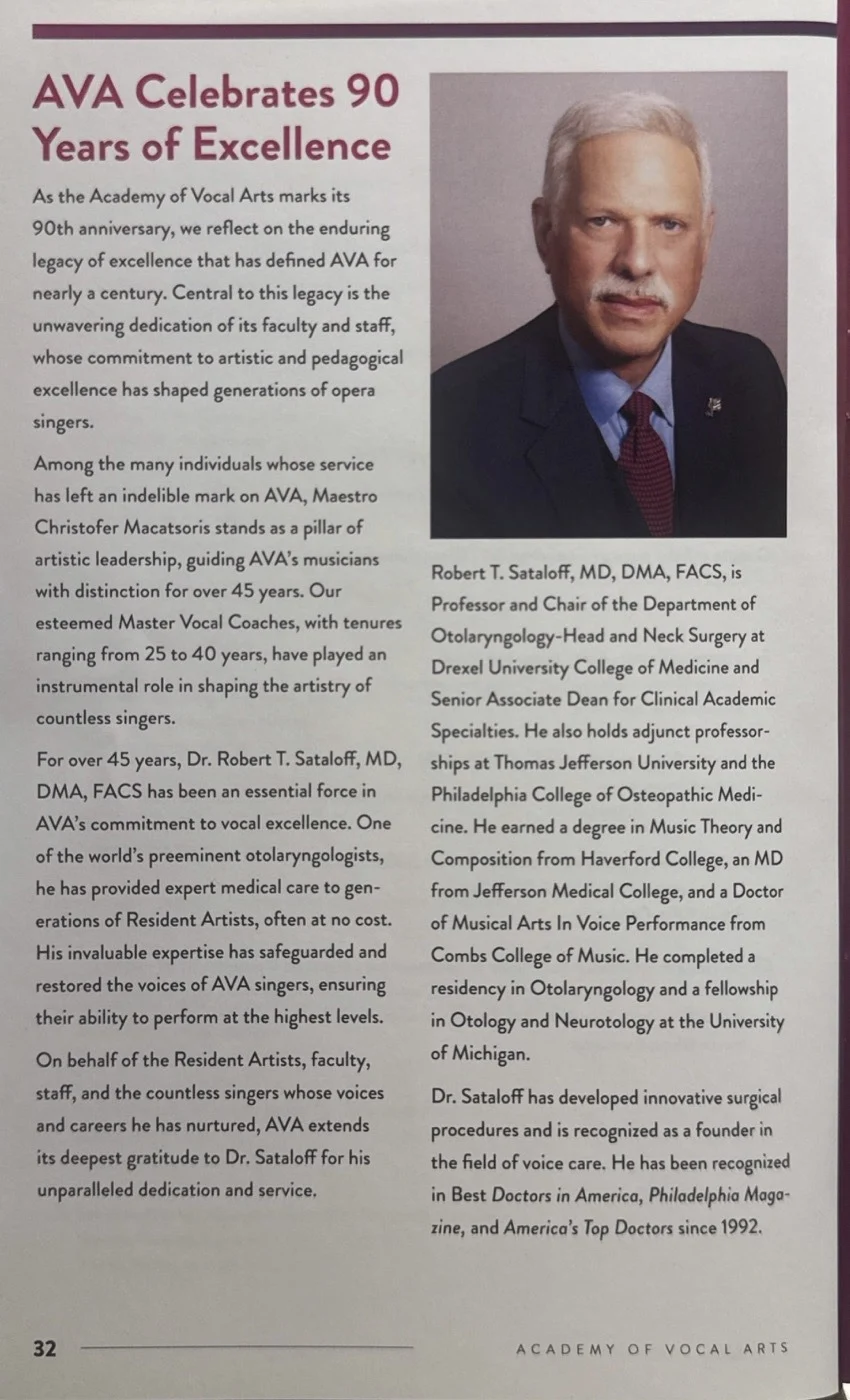
Last Friday evening, the prestigious Kimmel Center in Philadelphia played host to a momentous celebration of artistry, medical dedication, and operatic history. The occasion was the annual Gala for the Academy of Vocal Arts (AVA), an institution globally recognized for cultivating some of the finest operatic talent of our time. Among the luminaries and supporters gathered to celebrate the future of vocal arts, a very special tribute was paid to a man whose behind-the-scenes contributions have sustained the voices of the classical music world for over forty years: Dr. Robert Sataloff, Chairman of The Voice Foundation.
Dr. Sataloff was officially honored at the gala in recognition of his extraordinary, multi-decade commitment to the health, preservation, and optimization of the human voice. For more than forty years, Dr. Sataloff has served as a trusted physician, mentor, and lifeline to generations of AVA’s young resident artists. Many of these singers have transitioned from the halls of the Academy into illustrious, international careers, gracing the stages of the Metropolitan Opera, La Scala, the Vienna State Opera, and countless other world-renowned houses.
This retrospective recognition is not merely a celebration of an individual medical career; it marks a profound intersection between world-class vocal pedagogy and otolaryngological science. Dr. Sataloff’s pioneering work has fundamentally shaped how the medical and musical communities understand vocal health. By combining rigorous scientific inquiry with profound artistic empathy, he has safeguarded the fragile instruments of countless performers, allowing the joy of opera to continue resonating across international audiences. This article explores the legacy of Dr. Sataloff’s tenure, the profound impact of his partnership with institutions like the Academy of Vocal Arts, the evolution of voice care over the past four decades, and the enduring blueprint he has established for future generations of performing arts medicine.
Detailed Chronology: Four Decades of Dedication at the Academy of Vocal Arts
To understand the magnitude of Dr. Robert Sataloff’s recent honor at the Kimmel Center, one must look back across a career that spans generations of operatic evolution. The relationship between Dr. Sataloff and the Academy of Vocal Arts is a cornerstone of modern vocal health history.
The Foundation Years (The Late 1970s to 1980s)
When Dr. Sataloff first began working with singers from the Academy of Vocal Arts in the late 1970s and early 1980s, the field of laryngology was drastically different. At the time, the specialized sub-specialty of care known today as "performing arts medicine" was in its infancy. Singers experiencing vocal strain, nodules, or hemorrhage often faced generalized medical advice that failed to appreciate the hyper-specialized physiological demands of operatic performance.
Dr. Sataloff recognized early on that the human singing voice is an extraordinarily complex, delicate acoustic instrument that requires a diagnostic approach far beyond standard clinical observation. During these formative decades, he established himself not only as a brilliant otolaryngologist but as an empathetic listener who understood the psychological toll that vocal issues take on young artists. As AVA continued to recruit top-tier global talent into its tuition-free resident artist program, Dr. Sataloff became the invisible anchor for the school, stepping in whenever a young soprano, tenor, baritone, or bass showed signs of fatigue or injury.
Expansion and Institutional Leadership (The 1990s to 2000s)
As the decades progressed, Dr. Sataloff’s influence expanded globally alongside his leadership roles, notably with The Voice Foundation. Throughout the 1990s and 2000s, the operatic landscape grew increasingly demanding. Productions became more visually and physically demanding, touring schedules grew grueling, and the acoustic expectations placed on young voices intensified.
During this era, Dr. Sataloff’s clinic became a sanctuary for AVA artists. He pioneered advanced strobovideolaryngoscopy and other diagnostic tools that allowed him to visualize vocal fold vibration in high-definition slow motion. This technological leap enabled him to diagnose microscopic pathologies long before they permanently damaged a singer’s career. Scores of AVA artists who would go on to win prestigious competitions—such as the Metropolitan Opera National Council Auditions—owe their sustained longevity directly to timely interventions, preventative education, and surgical precision provided by Dr. Sataloff during these crucial developmental years.
The Milestone Tribute at the Kimmel Center (Present Day)
The culmination of this forty-plus-year journey was celebrated in high style last Friday at the Kimmel Center for the Performing Arts. Surrounded by current AVA resident artists, alumni who have achieved global stardom, civic leaders, and passionate patrons of the arts, Dr. Sataloff received a standing ovation.
The gala performance showcased the dazzling vocal firepower that AVA is universally known for, but the emotional climax of the evening centered on gratitude. Speakers recounted personal anecdotes of crises averted—singers saved from the brink of vocal loss just days before major debuts, rehabilitation regimens meticulously crafted, and an unwavering, compassionate bedside manner that has defined Dr. Sataloff’s professional life. The tribute served as a powerful reminder that behind every world-class high C is a complex ecosystem of medical science, psychological support, and institutional dedication.
Supporting Context & Metrics: The Intersection of Medicine and Operatic Artistry
To fully appreciate the scope of Dr. Sataloff’s contributions, it is essential to examine the unique pressures faced by singers at institutions like the Academy of Vocal Arts, as well as the quantitative and qualitative impact of specialized voice care on the performing arts industry.
The Vulnerability of the Elite Voice
The human singing voice is produced by two mucosal folds located within the larynx, which vibrate at frequencies ranging from roughly 64 Hz for deep basses up to over 1,500 Hz for high coloratura sopranos. During professional operatic singing, these tissues collide hundreds of times per second under immense subglottic air pressure.
+-------------------------------------------------------------------------+
|                  THE VULNERABILITY OF THE OPERATIC VOICE                |
+-------------------------------------------------------------------------+
|  • Tissue Collision: Vocal folds collide hundreds of times per second.  |
|  • High Pressure: Immense subglottic air pressure during projection.    |
|  • Environmental Stress: Dry travel air, fluctuating temperatures,      |
|    and rigorous rehearsal schedules.                                    |
|  • Stakes: Microscopic trauma can threaten multi-million dollar careers.|
+-------------------------------------------------------------------------+
For young artists at AVA, the transition from student to professional involves pushing these physiological boundaries to their absolute limits. They must master languages, style, phrasing, and unamplified projection over a full symphony orchestra. In this high-stakes environment, minor illnesses—such as acute laryngitis, vocal fold edema, or benign mucosal lesions—can be catastrophic.
Pioneering Performing Arts Medicine
Dr. Sataloff’s career has been instrumental in establishing performing arts medicine as a respected, rigorous scientific discipline. Prior to his widespread advocacy, teaching, and extensive publishing (including hundreds of peer-reviewed articles and standard textbooks such as Professional Voice: The Science and Art of Clinical Care), singers often feared consulting physicians. Many worried that doctors would prescribe treatments—such as inappropriate voice rest, harsh medications, or unnecessary surgery—that could permanently alter or ruin their vocal timbre.
Dr. Sataloff bridged the chasm between medicine and music. He educated otolaryngologists on the subtle acoustic nuances required by professional singers, while simultaneously educating singers, voice teachers, and conductors on vocal physiology and hygiene. His integrative approach incorporates:
Multidisciplinary Teams: Working hand-in-hand with speech-language pathologists, singing voice specialists, and voice teachers.
Non-Surgical Interventions: Emphasizing voice therapy, hydration management, and medical treatment of reflux and allergies before considering surgical options.
Precise Phonosurgery: When surgery is unavoidable, utilizing microscopic techniques designed to preserve the delicate layered structure of the vocal fold lamina propria, safeguarding vibrational pliability.
The Academy of Vocal Arts: A Global Incubator
Founded in 1934, the Academy of Vocal Arts in Philadelphia is unique: it is the only dedicated international institution devoted solely to the training of young opera singers. Accepting only a tiny fraction of applicants each year, AVA provides tuition-free, intensive, individualized training.
Because AVA produces such an extraordinary concentration of elite talent, the health of its student body is of paramount importance to the global opera ecosystem. By serving as the medical guardian for AVA artists across four decades, Dr. Sataloff has directly protected the pipeline of talent feeding premier opera houses worldwide. The longevity of artists who trained at AVA and passed through Dr. Sataloff’s care stands as a testament to the efficacy and necessity of proactive, specialized voice medicine.
Official Statements and Tributes
The gala at the Kimmel Center was punctuated by heartfelt tributes from leaders in the artistic and medical communities, all eager to honor Dr. Sataloff’s monumental legacy.
In a statement released by The Voice Foundation following the event, leadership emphasized the profound humanitarian and cultural impact of Dr. Sataloff’s work:
"Dr. Robert Sataloff’s dedication to the Academy of Vocal Arts is a shining example of his lifelong mission to protect and elevate the human voice. For over forty years, his brilliant medical expertise has been matched only by his deep compassion for artists. He has saved careers, restored confidence, and allowed countless young singers to share their God-given gifts with global audiences. We are profoundly proud to celebrate our Chairman and his extraordinary legacy of service."
Colleagues and alumni from the Academy of Vocal Arts shared similar sentiments, noting that Dr. Sataloff’s impact extends far beyond clinical diagnoses. One notable AVA alumnus, now singing leading roles on international stages, reflected on their time under his care:
"When you are a young singer facing vocal trouble, it feels like the end of the world. Dr. Sataloff didn’t just look at my vocal cords through a scope; he looked at me as a whole artist. He gave me hope, he gave me science, and most importantly, he gave me my voice back. Knowing he was in our corner gave us the psychological security to take artistic risks and soar."
Board members and administrators at AVA echoed these praises, emphasizing that the symbiotic relationship between the Academy’s world-class vocal training and Dr. Sataloff’s world-class medical care has been one of the institution’s greatest secret weapons for over forty years.
Future Outlook: Legacy, Education, and the Next Generation of Voice Care
While the gala was an evening of well-deserved reflection and celebration, it also served as a looking glass toward the future of performing arts medicine and operatic education.
Training the Next Generation of Specialists
One of Dr. Sataloff’s most enduring contributions is his commitment to education. Through his extensive academic appointments, authorship, and leadership with organizations like The Voice Foundation, he has trained hundreds of medical students, residents, fellows, and speech pathologists. As performing arts medicine continues to evolve, the methodologies pioneered by Dr. Sataloff will remain the gold standard for clinical care.
The future of voice care relies heavily on the integration of cutting-edge technology—such as high-speed digital imaging, advanced acoustic analysis, and regenerative medicine for vocal fold tissues. As these tools emerge, the foundational philosophy championed by Dr. Sataloff—that medical science must serve the artistic expression of the patient—will continue to guide the field.
Ensuring the Future of Operatic Artistry
As the global cultural landscape shifts, institutions like the Academy of Vocal Arts face new challenges, from economic pressures on the arts to changing audience demographics. However, the fundamental human desire for live, unamplified, emotionally resonant vocal performance remains immutable.
By ensuring that AVA’s artists have access to the finest preventative care and medical treatment available anywhere in the world, Dr. Sataloff has helped future-proof the art form itself. Young singers stepping onto the stage today do so with the security of knowing that their health is protected by a medical discipline that Dr. Sataloff helped invent and refine.
Conclusion
The celebration at the Kimmel Center was more than a plaque presentation or a ceremonial nod; it was a profound cultural acknowledgment of an unsung hero of classical music. For over forty years, Dr. Robert Sataloff has stood quietly in the wings, ensuring that the fragile, magnificent instruments of opera’s brightest stars remain healthy, vibrant, and resilient. As these artists travel the globe, bringing joy, catharsis, and beauty to countless audiences, they carry with them the legacy of a physician who understood that protecting the voice means protecting the soul of human expression.