
Executive Overview
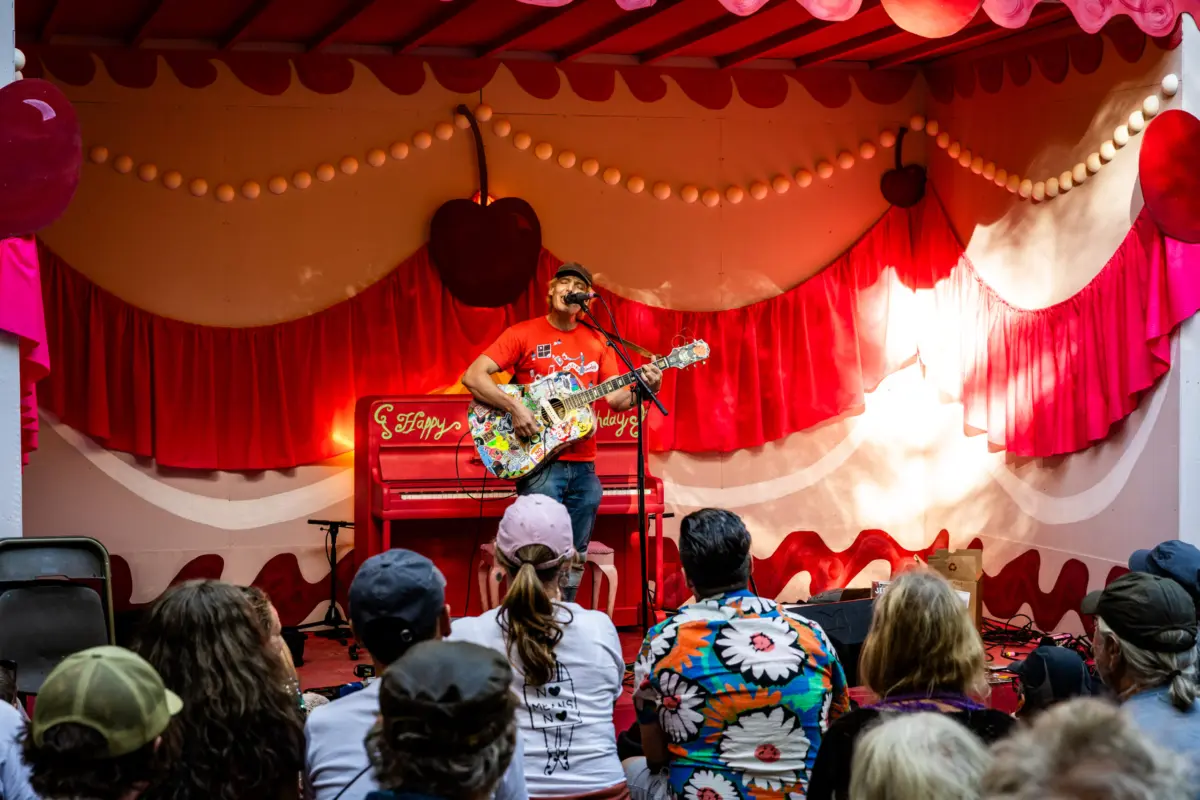
In the hazy, unpredictable ecosystem of contemporary music festivals, secret sets have long served as a vital currency. They offer a unique bargain between artist and audience: the promise of intimacy, unscripted spontaneity, and a momentary suspension of the rigid scheduling that defines the modern live music circuit. Yet, when cult anti-folk hero Jeffrey Lewis took to the stage for a covert performance at the esteemed End of the Road Festival, he managed to subvert this dynamic entirely. Balancing self-deprecating humor, sharp social satire, and a surprisingly heartfelt public plea to the festival’s booking agents, Lewis delivered a masterclass in festival performance art.
The performance—a four-song secret set organized by The Line of Best Fit—served as a microcosm of Lewis’s enduring career: clever, deeply personal, politically irreverent, and unmistakably idiosyncratic. From lamenting a decade-long hiatus from the festival’s main billing to playfully dodging a cover song cliché after being preempted by indie rock royalty Yo La Tengo, Lewis proved why he remains one of American underground music’s most enduringly brilliant lyricists.
This comprehensive report examines the anatomy of Lewis’s secret performance, exploring the intersection of festival culture, the rich history of the New York anti-folk movement, and the complex relationship between independent artists and the promoters who hold the keys to the stages. Through detailed chronologies, contextual analysis of the anti-folk genre, and a look ahead at the evolving landscape of boutique music festivals, we unpack an afternoon that will long be remembered by those lucky enough to witness it.
Detailed Chronology: Anatomy of a Secret Set
The afternoon sun beat down on the festival grounds as whispers of an unscheduled performance began to circulate through the festival grapevine. In the digital age, keeping a secret set genuinely secret is an uphill battle, yet an air of exclusivity still clung to The Line of Best Fit session space. For the dedicated attendees who managed to track down the coordinates, the reward was an unvarnished, up-close encounter with Jeffrey Lewis, armed with little more than his quick wit and acoustic guitar.
The Near-Miss with Michael Hurley
Lewis stepped up to the microphone with the easy confidence of a troubadour well-accustomed to the eccentricities of festival scheduling. Launching immediately into the narrative that would frame his finale, Lewis revealed the inner monologue that preceded his set.
“I was like, it’s End of the Road and this is a great opportunity to play Michael Hurley’s song ‘The End of the Road’. It would be perfect,” Lewis explained to the intimate gathering while introducing his final song.
However, the spontaneity of the live music ecosystem often relies on a delicate hive-mind among touring musicians—one that occasionally results in great minds thinking alike, much to the chagrin of the performer who goes on second.
“But then I noticed Yo La Tengo already did that exact same thing on the same stage. They think of all the great ideas first. So that just leaves me with this option,” he continued, signaling a sharp pivot.
The Boyz II Men Pivot and the On-Stage Monologue
With his original plan preempted by indie rock icons Yo La Tengo, Lewis audibled to an unexpected piece of 1990s pop-R&B history: the classic 1991 smash hit “End of the Road” by American vocal group Boyz II Men.
What followed was not a straightforward acoustic cover, but a uniquely Lewis-esque deconstruction of the track. Midway through the performance, Lewis injected an ironic, deadpan spoken-word break that instantly dissolved the barrier between performer and audience:
“End of the Road, I love you even though you haven’t booked my band in ten years. I wish you’d think of Jeffrey Lewis & the Voltage every once in a while… cos I still think of you.”
The playful reprimand carried an undercurrent of genuine professional history. While Lewis had indeed performed earlier in the weekend at End of the Road—heading up a full-band set on the Woods stage—that appearance marked the breaking of a drought that stretched all the way back to 2016. For an artist of Lewis’s critical stature and cult longevity, a decade-long gap between main-stage bookings is a stark reminder of the precarious economics facing mid-tier independent acts in the post-pandemic festival market.
A Repertoire of the Unreleased and the Unconventional
Before the Boyz II Men finale, Lewis used the platform to debut and test-drive a sampling of his characteristically cerebral new material. The setlist functioned as a state-of-the-union address for the songwriter, blending neurosis, absurdist humor, and sharp historical satire.
- “What the Living Hell is Up with Me and Sex?” — A signature piece of self-examining tragicomedy, marrying anxious personal introspection with infectious melodic hooks.
- “Just Fun” — A lighter, deceptively upbeat track showcasing Lewis’s knack for straightforward folk storytelling wrapped in wry observations.
- An Untitled Revisionist History Satire — Perhaps the most politically charged moment of the afternoon, the song offered a darkly comedic alternate timeline in which a historical assassination attempt goes awry for civil rights leader Malcolm X—who escapes with merely a grazed ear—while modern political figures face absurdly poetic, cartoonish retribution.
Supporting Context & Metrics: The Anti-Folk Legacy and the Festival Ecosystem
To understand the weight of Jeffrey Lewis’s playful grievances, one must contextualize his place in the broader tapestry of American alternative music. Born and raised in New York City, Lewis emerged during a fertile creative epoch in the city’s underground scenes, becoming a cornerstone of the late-90s and early-2000s "anti-folk" movement.
The Roots of Anti-Folk
Anchored by the legendary Sidewalk Cafe on the Lower East Side of Manhattan, the anti-folk movement was a direct reaction against the pristine, overly earnest, and gatekept traditions of 1960s folk revivals. Artists like Jeffrey Lewis, The Moldy Peaches (Kimya Dawson and Adam Green), Regina Spektor, and Lach injected punk rock nihilism, suburban neurosis, and unvarnished lo-fi aesthetics into traditional acoustic instrumentation.
Lewis’s discography—spanning dozens of albums released through Rough Trade and various independent labels—is defined by:
- Bitingly witty, plainspoken lyricism that treats everyday mundane anxieties with the epic narrative weight usually reserved for historical dramas.
- DIY comic book artistry, with Lewis frequently creating elaborate, hand-drawn comic books to accompany his albums and visual live performances.
- A steadfast refusal to pander to commercial pop structures, resulting in a fiercely loyal international cult following.
The Economics of Boutique Festivals
Lewis’s on-stage remarks regarding his ten-year absence from End of the Road (punctuated only by his recent Woods stage appearance and this secret session) highlight a broader structural reality in the festival industry. Boutique festivals—celebrated for their curated lineups, independent ethos, and familial atmospheres—face severe economic pressures.
| Metric / Factor | Description / Impact on Independent Touring |
|---|---|
| Curatorial Density | Bookers must balance heritage acts, rising buzz bands, and festival mainstays within tight financial parameters. |
| The "Booking Drought" | Mid-tier cult acts often cycle through multi-year gaps as promoters seek fresh faces or cycle through different stylistic waves. |
| Secret Set Economics | Intimate sessions (like those hosted by The Line of Best Fit) act as vital pressure valves, allowing overlooked or under-booked veterans to reclaim face-time with dedicated fans. |
For artists who operate outside major label machinery, festivals like End of the Road are critical lifelines for merch sales, international exposure, and community building. Lewis’s comedic call-out, while wrapped in irony, touched on the very real precarity of sustaining a multi-decade underground career in an increasingly consolidated live music market.
Official Statements and Industry Reactions
While festival bookers and management teams rarely issue formal press statements regarding individual booking timelines, the reception to Lewis’s performance across music journalism and social media was overwhelmingly celebratory.
Music critics and festival attendees alike praised Lewis for using his platform to bridge the gap between performer and promoter transparency. In an era where festival sets are increasingly sanitized, corporate-sponsored, and tightly choreographed, Lewis’s unfiltered stage banter provided a refreshing dose of human vulnerability.
A spokesperson for The Line of Best Fit noted following the performance:
"The beauty of these secret sessions is that they strip away the artifice. You don’t just get the songs; you get the artist’s unfiltered personality, their neuroses, and their immediate reactions to the festival environment. Jeffrey Lewis embodies the exact spirit of independence and intellectual curiosity that these sessions were built to celebrate."
Fellow musicians and festival-goers took to digital platforms to share clips of the Boyz II Men cover and the tongue-in-cheek monologue, generating widespread discussion regarding the invisible labor and booking politics that dictate festival lineups.
Future Outlook: The Road Ahead for Jeffrey Lewis and Festival Culture
As the final chords of The Line of Best Fit secret sessions drew to a close, with five more diverse artists slated to take the secret stage the following morning from 11:30 AM onward, the ripple effects of Lewis’s performance lingered across the festival grounds.
For Jeffrey Lewis & the Voltage, the immediate future points toward the refinement and eventual release of the unreleased tracks debuted during the set—including “What the Living Hell is Up with Me and Sex?” and his provocative satirical compositions. With a relentless touring schedule that spans independent venues across North America and Europe, Lewis continues to prove that genuine artistic integrity has a permanent, if occasionally precarious, home in modern music.
What Lies Ahead for Boutique Festivals?
The incident also serves as a subtle bellwether for the evolving relationship between festival bookers and independent artists. As economic pressures mount across the live events sector, festivals must increasingly rely on deep curation, genuine community engagement, and moments of unscripted magic—such as secret acoustic sessions—to justify ticket prices and maintain cultural relevance.
If bookers are wise, they will take Jeffrey Lewis’s playful musical ultimatum to heart. After all, waiting another ten years to bring one of the anti-folk movement’s most vital storytellers back to a primary stage would be missing the point entirely. Until then, Lewis remains precisely where he has always been: on the fringe, speaking truth to power, armed with an acoustic guitar, a stack of comic books, and an unbeatable punchline.