
Executive Overview
In the sultry summer of 1958, a young, ambitious New York photographer sent out a modest, tentative invitation to the heavyweights of the American jazz scene. His simple request: show up for a group photograph. To his absolute astonishment and profound delight, roughly 60 of the most revered jazz musicians on the planet answered the call, assembling at the seemingly unearthly hour of 10:00 AM on a Harlem street corner. That single morning resulted in an iconic tableau that would later be immortalized in an Academy Award-nominated documentary, cementing itself permanently in the hallowed archives of global cultural history.
Decades later, the spirit of that historic gathering crossed the Atlantic. British jazz enthusiast and organizer Ray Bolden conceived an audacious tribute: a homegrown British recreation featuring the titans and foot soldiers of the UK jazz community. Settling on the historic grounds of St Anne’s Church on Wardour Street, London, for an event christened "The Great Day in Soho," Bolden hoped to capture a fraction of the magic that Art Kane had bottled in New York.
What transpired on the morning of June 24 was a brilliantly chaotic manifestation of community spirit. Drawing an estimated attendance of nearly two hundred musicians, the London gathering mirrored its American predecessor in its joyous disorder, generational mingling, and sheer historical significance. This feature investigates the mechanics of that ambitious undertaking, comparing the transatlantic counterparts, examining the logistical triumphs and tribulations of gathering creative egos in a confined churchyard, and preserving the enduring legacy of a snapshot that encapsulated a golden era of modern music.
Detailed Chronology: From Art Kane’s Harlem to Ray Bolden’s Soho
The Genesis: Harlem, Summer 1958
To understand the gravity of what transpired in London, one must first look back to the humid New York morning that started it all. In July 1958, freelance photographer Art Kane was working on an assignment for Esquire magazine. He envisioned a portrait of jazz musicians that bypassed the typical smoky club aesthetic in favor of natural daylight and architectural context.
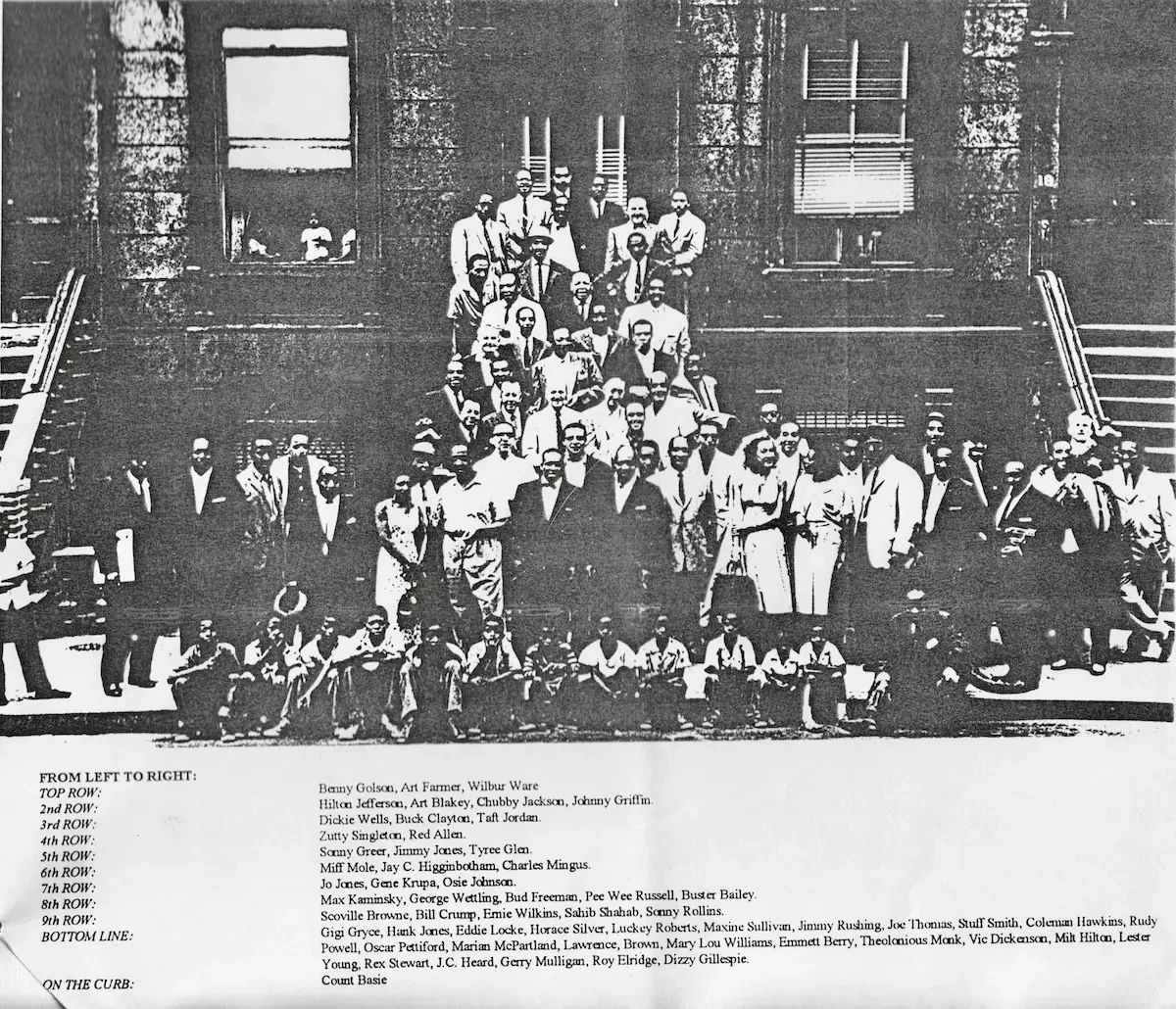
Kane mailed out casual invitations to agents, publicists, and musicians themselves, hardly expecting a significant turnout. Yet, against all odds—and defying the notoriously nocturnal habits of jazz artists—roughly 60 musicians converged on 126th Street between Fifth and Madison Avenues in Harlem.
The resulting photograph, famously featuring giants like Count Basie, Thelonious Monk, Dizzy Gillespie, and Mary Lou Williams standing on a brownstone stoop, became a monumental document of mid-century cool. It proved that jazz was not merely an entertainment medium, but a high art form anchored in community, mutual respect, and shared heritage.
Crossing the Atlantic: The Conception of "The Great Day in Soho"
Decades later, British jazz enthusiast Ray Bolden found himself captivated by the mythology of Kane’s photograph. The UK jazz scene of the era possessed its own rich, vibrant, and fiercely independent ecosystem, yet it rarely received the broad visual cataloging afforded to its American counterpart. Bolden resolved to change that, setting out to orchestrate a British equivalent that would gather the key players of the UK movement into a single frame.
Logistical planning required meticulous coordination, a sharp eye for location, and an unyielding passion for the genre. Bolden eventually selected the historic grounds of St Anne’s Church on Wardour Street, London—a fittingly central, historic backdrop nestled in the heart of Soho, an area pulsing with the lifeblood of Britain’s post-war music and nightlife culture.
The Morning of June 24: Chaos, Camaraderie, and Canvassing
The call sheet for "The Great Day in Soho" was set with British precision: arrival requested between 11:15 AM and 11:30 AM. However, jazz musicians, it appeared, operated on a universal frequency that defied standard timekeeping—often arriving early out of sheer enthusiasm or late due to the unpredictable nature of London transit.
By 11:00 AM—a full fifteen minutes before the official call—the old churchyard of St Anne’s was already bustling. Musicians trickled in, transforming the gravel courtyard into a vibrant reunion of old friends, rivals, mentors, and protégés. The air was thick with enthusiastic greetings, laughter, and the unmistakable crackle of creative energy.

However, translating a spontaneous gathering of creative spirits into a structured photograph proved to be an exercise in herding cats. With participants continually arriving, departing, and mingling, the environment quickly grew unruly. Adding to the delightful pandemonium were local neighborhood children—much like the Harlem kids who peered into Kane’s frame decades prior—wandering into the churchyard to witness the spectacle firsthand.
Organizing a crowd of this magnitude from ground level was virtually impossible. To regain control, organizers utilized a dramatic tactical tool: a vintage loudhailer of the "Come out Dillinger, we know you’re in there" variety. Bellowing instructions through the megaphone, organizers managed to corral the musicians into rough sonic and instrumental sections—grouping reed players, brass players, and drummers together—before hastily snapping the shots from the precarious vantage point of a first-floor window in the church tower.
Supporting Context & Metrics: By the Numbers
While initial estimates of the crowd varied wildly in the immediate aftermath of the event, subsequent headcounts and photographic analysis provided a clearer picture of the scale of "The Great Day in Soho."
- The Call Time: 11:15 for 11:30 AM, June 24.
- Early Arrivals: The churchyard was visibly crowded by 11:00 AM.
- Total Attendance Estimates: While initial buzz suggested numbers reaching three hundred, a more sober, verified assessment placed the final count at closer to two hundred musicians.
- Comparative Scale: While Art Kane’s Harlem shoot captured roughly 60 musicians, the Soho recreation nearly tripled that turnout, reflecting the deep, expansive bench of talent operating within the British jazz circuit.
- Photographic Documentation: The definitive wide-angled shot of the gathering was captured by Peter Symes. While the frame could not physically encompass every single attendee who cycled through the churchyard that morning, it successfully documented the sheer mass of the assembly, with the historic Archer Street visible in the top right-hand corner.
Official Statements and Archival Reflections
The aftermath of the event generated considerable correspondence within the jazz community, most notably documented in the pages of specialist publications.
In the September issue of Jazz Journal, the "One Sweet Letter" section featured a heartfelt missive penned by organizer Ray Bolden. In his letter, Bolden expressed profound gratitude for the overwhelming turnout, acknowledging the dedication of the musicians who traveled from far and wide to participate in the historical experiment.
Nomenclature regarding the event also sparked minor historical footnotes among archivists and editors. While Bolden’s original letter and proposal bore the title "Swinging Day In Soho," and photographer Peter Symes’ corresponding files in the archives utilized the same designation, the event universally cemented itself in the community consciousness under its bolder, more definitive moniker: "The Great Day in Soho."
In reflecting on the visual record, editors noted that Symes’ wide-angle photograph served as a vital time capsule. It caught not only the musicians in moments of candid interaction but also captured the architectural and topographical landscape of Soho in transition—most notably framing the historic Archer Street, a legendary hub for London musicians and orchestral fixers, in the upper right quadrant of the image.
Future Outlook: The Enduring Legacy of Transatlantic Jazz Portraits
The replication of Art Kane’s masterpiece in the heart of London raises broader questions about the preservation, celebration, and documentation of musical heritage in the modern era. As the foundational generations of mid-century jazz slowly pass into history, events like "The Great Day in Soho" assume an invaluable archival importance. They serve as physical manifestations of community—reminding contemporary audiences that jazz has never been a solitary pursuit, but a communal dialogue rooted in shared spaces, spontaneous collaboration, and mutual admiration.
Looking forward, jazz historians and cultural archivists emphasize the need for continued support and documentation of localized music scenes. Just as Jean Bach’s acclaimed 1994 documentary A Great Day in Harlem brought global cinematic attention to the stories behind Art Kane’s photograph, the legacy of the Soho gathering calls for ongoing digital preservation of British jazz history.
As urban landscapes continue to modernize and historic community hubs like Soho face relentless commercial pressures, the photographs of June 24 stand as a defiant testament to a time when a churchyard could be transformed, if only for an hour, into the beating heart of the transatlantic jazz world. The echoes of that morning—projected through a vintage loudhailer and captured from a church tower window—will continue to resonate through the annals of jazz history for generations to come.