
Executive Overview
The boundary-pushing, fully immersive theatrical production Masquerade—a bold re-envisioning of Gaston Leroux’s gothic classic The Phantom of the Opera through the iconic lens of Andrew Lloyd Webber’s legendary 1986 musical score—has announced a sweeping wave of new casting additions. Playing to packed houses at 218 West 57th Street (formerly home to Lee’s Art Shop), the production has firmly established itself as a cornerstone of New York City’s experiential theater scene. Buoyed by overwhelming commercial and critical demand, the runaway hit has enjoyed multiple extensions, locking in an open-ended run currently scheduled through January 31, 2027.
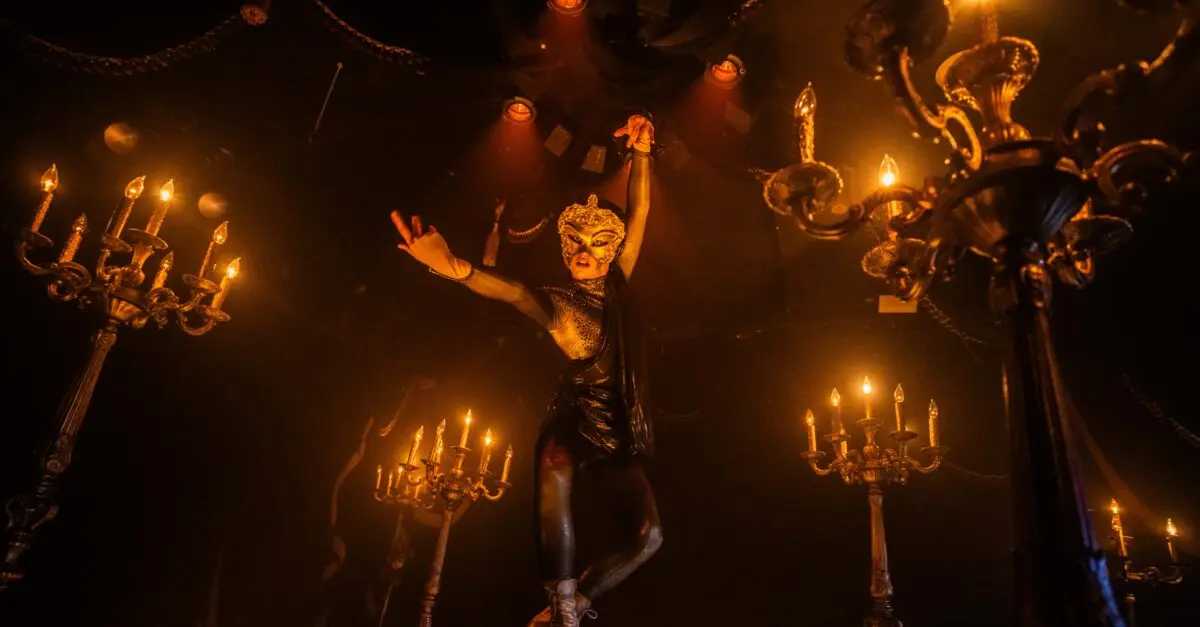
Modeled structurally after pioneering immersive mainstays such as Sleep No More, Masquerade fundamentally upends traditional theatrical conventions. Rather than sitting passively in a proscenium-arch auditorium, audiences are thrust directly into the machinery of the Paris Opera House. Attendees step across the threshold to retrace the harrowing footsteps of the Opera Ghost, an enigmatic and disfigured maestro terrorizing the building’s administrative management and resident performers alike. The narrative unfurls in real-time, mapping the chilling descent of the Phantom’s obsessive mentorship over the young, aspiring soprano Christine Daaé.
Because of its radically decentralized staging model, which splits each evening’s audience into six distinct groups of approximately 60 people traversing a multi-floor, highly detailed labyrinth, the sheer magnitude of the production requires a massive, rotating ensemble. In fact, Masquerade boasts a principal and supporting cast considerably larger than its historic Broadway predecessor.
This latest casting update infuses the sprawling ecosystem with fresh talent, welcoming acclaimed stage actors into key roles alongside returning fan favorites. As Masquerade continues to redefine what commercial musical theater can achieve outside traditional bounds, this infusion of fresh blood signals an exciting new chapter for a production that has captured the theatrical imagination of both purists and avant-garde seekers alike.
Detailed Chronology: The Evolution and Expansion of Masquerade
To fully appreciate the gravity of the current casting announcements, one must examine the meticulous trajectory that brought Masquerade to life at 218 West 57th Street. The journey from conceptual blueprint to a multi-year Off-Broadway tenant represents a masterclass in modern theatrical adaptation, combining site-specific environmental design with the soaring, operatic melodies that defined a generation of musical theater.
Conception and Aesthetic Foundation
The genesis of Masquerade lay in a desire to strip away the physical and psychological distance separating audiences from the dramatic action of The Phantom of the Opera. While Lloyd Webber’s original production relied on magnificent spectacle—the crashing chandelier, the subterranean lake, the descending stage elevators—Masquerade internalizes these elements. Instead of watching the chandelier fall, audience members feel the reverberations of the opera house around them. They walk the boards of the stage, peer into dressing rooms, and descend into painstakingly recreated Paris catacombs.
The creative team, spearheaded by Tony Award-winning director Diane Paulus (Waitress, 1776), recognized that translating a mega-musical into a decentralized immersive format required an army of visionary designers, choreographers, and dramaturgs. Alongside Paulus, collaborators such as Hunter Bird, Sidi Larbi Cherkaoui, set designer Scott Pask, costume designer Emilio Sosa, and lighting designer Ben Stanton labored to transform a former retail space into a living, breathing 19th-century opera house.
From Opening Night to Extended Runs
Upon its initial premiere, Masquerade immediately disrupted the theatrical conversation. Critics and audiences alike praised its audacious scope, noting how it forced patrons to actively choose their narrative pathways. By dividing the audience into small, intimate cohorts of 60, the production ensures that no two people experience the exact same show. One patron might tail the volatile diva Carlotta, while another follows the tragic, lovesick Raoul, and a third shadows the Phantom through his shadowy subterranean lair.
The production’s early success triggered a domino effect of extensions. Originally slated for a limited engagement, overwhelming ticket demand and unprecedented word-of-mouth momentum forced producers to continuously push back the closing date. The current booking horizon, stretching all the way to January 31, 2027, makes Masquerade one of the most stable and long-running immersive undertakings in New York theatrical history.
The Current Casting Expansion
The latest operational phase introduces a major roster update designed to maintain the production’s high artistic caliber over its historic run. Among the marquee announcements is the introduction of Travis Keith Battle and Joe Caskey, who join Dan Hoy to share the pivotal, romantic role of Viscount Raoul de Chagasi. Meanwhile, Nick Cartell steps into the legendary, multi-layered title role of the Phantom, anchoring a rotating roster of vocal powerhouses that includes Quentin Earl Darrington, Derrick Davis, Kyle Scatliffe, Ryan Vona, and Nik Walker.
Noah Lytle joins the company as the Young Phantom, while ensemblists Jordan Goodsell and Annie Sherman step into the ensemble ranks. Crucially, the production also welcomes back familiar faces who helped build the show’s foundational mythology, including Addie Morales returning to the role of Christine Daaé and Phumzile Sojola reprising his performance as the booming opera bass, Piangi.
Supporting Context & Metrics: Inside the Machine
Operating an immersive production of this scale requires logistical wizardry, precise scheduling, and a staggering human resource network. The numbers behind Masquerade illustrate a monumental theatrical enterprise that operates more like a theme park than a traditional Broadway house, yet retains the artistic integrity of a high-end chamber opera.
The Cast and Creative Ecosystem
Because multiple audience tracks unfold simultaneously across distinct physical zones within 218 West 57th Street, the production requires an expansive bench of performers. The core company features multiple rotating actors for nearly every major role.
- The Phantom: Shared by Nick Cartell, Quentin Earl Darrington, Derrick Davis, Kyle Scatliffe, Ryan Vona, and Nik Walker.
- Christine Daaé: Shared by Addie Morales, Haile Ferrier, Claire Leyden, Francesca Mehrotra, Riley Noland, and Kaley Ann Voorhees.
- Raoul, Vicomte de Chagny: Shared by Travis Keith Battle, Joe Caskey, and Dan Hoy.
Beyond the leads, the production maintains a robust ensemble and a comprehensive safety net of swings and covers—including Lee H. Alexander, Courtney Balan, Annelise Baker, Baby Burns, Jacob Burns, Saman De Silva, Nicole J. Ferguson, Joshua Ike, Nathan Keen, Alan Kelly, Deven Kolluri, Michael Kuhn, Audrey Logan, Sami Merdinian, Stephanie Reuning-Scherer, Paul Adam Schaefer, Hannah Shealy, Kita St. Cyr, Jack Sullivan, Olivia Tarchick, Schyler Vargas, David Wright, and Nikita Yermak—ensuring that every performance runs with clockwork precision regardless of illness or fatigue.
The Creative and Production Brain Trust
The artistic vision is guided by a towering collection of theatrical talent. Diane Paulus’s directorial framework is supported by movement direction from Sidi Larbi Cherkaoui and choreographic contributions from James Fluhr, Jessie Flynn, Marc Kimelman, and Lee McCutcheon. The physical world of the show is sculpted by Scott Pask (Scenic Design), Emilio Sosa (Costume Design), Ben Stanton (Lighting Design), and an extensive sound and acoustic engineering team led by musical director William Waldrop.
Furthermore, the behind-the-scenes operational infrastructure involves dozens of stage managers, technical directors, fight directors (such as Alicia Rodis), and intimacy coordinators, ensuring that the intense physical choreography and close-quarters audience interaction remain safe for all involved.
Audience Protocols and the Immersive Environment
Attending Masquerade is an active, participatory ritual. Upon booking, patrons receive a direct briefing from "their host," establishing strict environmental and stylistic guidelines:
- The Dress Code: Attendees are strongly encouraged to dress "extravagantly" in monochromatic palettes of black, white, or silver.
- The Mask: A masquerade mask is mandatory. Guests may bring their own or receive one upon entry.
- Footwear Advisory: Given that portions of the experience simulate the damp, uneven terrain of the Paris catacombs, high heels are strictly discouraged to prevent injury.
- Accessibility: Despite the labyrinthine, multi-level nature of the historic space, the venue is fully ADA-compliant, with specialized accommodations coordinated directly through the production’s accessibility team.
Official Statements and Artistic Insights
The cultural resonance of Masquerade stems from its unique ability to honor Andrew Lloyd Webber’s lush musical vocabulary while completely upending traditional staging paradigms. In recent interviews, members of the creative and performing cohorts have opened up about the unique challenges—and profound rewards—of inhabiting the "Brotherhood of the Phantoms."
Stage veterans who have stepped into the legendary mask often speak to the psychological weight of the role. Unlike a traditional proscenium staging where the actor plays to the balcony, Masquerade actors frequently find themselves performing mere inches away from audience members. This proximity demands a granular, hyper-realistic vulnerability. The Phantom is no longer a distant silhouette looming above a stage; he is a breathing, suffering human being standing right beside a patron in a dimly lit corridor.
Similarly, returning artists like Addie Morales and Phumzile Sojola have noted how the immersive medium allows them to discover new psychological dimensions in characters they may have previously approached through a more conventional lens. The removal of the fourth wall creates a symbiotic energy exchange between the actor and the spectator, where an audience member’s gasp, hesitation, or tears can actively inform the pacing and emotional intensity of a scene.
Director Diane Paulus has frequently emphasized that Masquerade was never intended to be a mere replication of the original Broadway run, but rather an exploratory love letter to the themes of obsession, voyeurism, and music that run through Leroux’s original text. By decentralizing the narrative, the production invites the audience to become co-conspirators in the unfolding tragedy, transforming passive ticket-holders into active witnesses of the Opera Ghost’s tragic legacy.
Future Outlook: What Lies Ahead for Masquerade
As Masquerade settles comfortably into its extended residency—with performances locked in through the beginning of 2027—the production stands as a bellwether for the future of commercial theater in New York City. In an era where post-pandemic theatergoing habits have shifted, and audiences increasingly crave experiential, high-impact entertainment that cannot be replicated via home streaming, Masquerade offers a compelling blueprint for how classic intellectual property can be successfully re-engineered.
The continuous influx of top-tier talent, evidenced by the high-profile additions of Nick Cartell, Travis Keith Battle, and the return of foundational players like Addie Morales, proves that the production is not resting on its early laurels. Producers are acutely aware that keeping the ecosystem vibrant requires a constant rotation of fresh interpretations, vocal colors, and acting choices from its principal players.
Looking forward, industry analysts are closely watching Masquerade to see whether its commercial longevity might inspire similar immersive treatments for other beloved musical theater properties. For now, however, the focus remains firmly fixed on 218 West 57th Street. Night after night, as the doors swing open, the masked hosts welcome new waves of eager initiates into the shadows, proving that the Phantom’s haunting allure is as potent today as it was when he first materialized on the London stage nearly forty years ago.
Tickets, casting schedules, and detailed accessibility protocols for the current block of performances through January 2027 are available now at MasqueradeNYC.com.