
Executive Overview
From November 11, 2026, to May 5, 2027, London’s prestigious Saatchi Gallery will host a landmark cultural reckoning: BEYOND THE STREETS II. Among its vast curatorial landscape, the exhibition will feature a dedicated room curated by the pioneering British electronic music artist, visual designer, and subcultural icon, Goldie. This immersive installation will offer a sweeping, three-decade retrospective of his work, screening short films and music videos across a towering architectural grid of 30 vintage television stacks. Alongside this visual narrative, the space will house a functioning pop-up iteration of Metalheadz—the legendary drum and bass record label Goldie co-founded in 1994. Furthermore, the installation will trace his formative artistic roots back to the spray-painted train lines and concrete underpasses of the West Midlands.
The announcement of Goldie’s involvement in BEYOND THE STREETS II—which runs concurrently with a major career-spanning live performance at the Royal Festival Hall on November 14, 2026—serves as a critical juncture for contemporary art history. It forces a complex, necessary dialogue regarding the institutionalization of counter-culture. For decades, street art, graffiti, and underground electronic music genres like jungle and drum and bass existed entirely outside the sanitized parameters of the contemporary fine art establishment. They were viewed by municipal authorities and mainstream cultural gatekeepers as acts of vandalism, public nuisance, and fleeting youth deviance.
Today, as these movements are embraced by premier international galleries, the tension between authenticity and institutional validation has never been more acute. Goldie’s own career acts as a living bridge across this dichotomy. From an aerosol-wielding teenager in Wolverhampton to an internationally celebrated polymath collaborating with avant-garde icons, his trajectory maps the journey of urban subculture from the margins to the mainstream. This article explores the depth of the Saatchi Gallery retrospective, contextualizes Goldie’s monumental contributions to British sonic and visual culture, evaluates the extensive roster of creative visionaries sharing the exhibition space, and examines the socio-political implications of bringing the radical aesthetics of the street into the white cube.
Detailed Chronology: From the West Midlands to the Global Avant-Garde
To fully comprehend the magnitude of the upcoming retrospective at Saatchi Gallery, one must trace the evolutionary arc of Clifford Price—globally known as Goldie—from his precarious working-class origins to his status as an undisputed godfather of UK electronic music and street art.
The Crucible of the West Midlands (1965–1986)
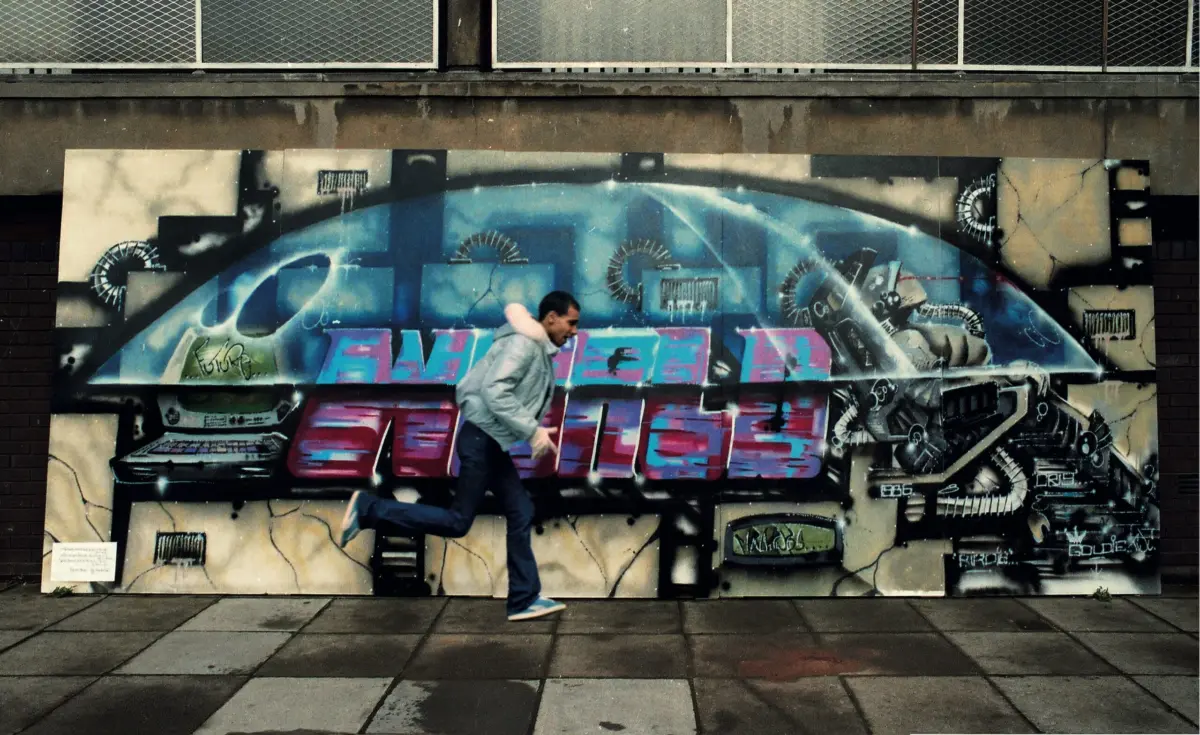
Raised in the industrial heartlands of Wolverhampton, Goldie’s early life was marked by the shifting socioeconomic landscape of post-industrial Britain. As traditional manufacturing declined, inner-city youth turned to expressive, high-energy counter-cultures imported from the United States and adapted through a distinctively British lens. During his teenage years, Goldie immersed himself in the burgeoning UK breakdancing and graffiti scenes. Armed with spray cans and an insatiable desire to leave a mark on a landscape that often rendered working-class youth invisible, he quickly gained a reputation for his intricate aerosol burners across Birmingham and Wolverhampton.
This era of raw, unregulated creativity was vividly captured for posterity in the 1987 Channel 4 documentary Bombin’. The film provided a rare, unvarnished look at the early days of British graffiti culture, showcasing the clandestine operations of writers working under the cover of night on railway sidings and inner-city brickwork. For Goldie, graffiti was not merely a hobby; it was an exercise in spatial reclamation and visual defiance against an oppressive urban environment.
The New York Interlude and the Birth of Jungle (1987–1993)
Seeking broader horizons, Goldie spent time in New York City during the late 1980s, where he was exposed to the intersecting worlds of early hip-hop, the city’s legendary subway graffiti network, and the burgeoning American house and techno scenes. This transatlantic exchange proved transformative, expanding his visual lexicon and sharpening his ear for emerging electronic cadences.
Upon returning to the UK, the nascent rave culture was sweeping across the nation, driven by the ecstasy-fueled hedonism of the Second Summer of Love. Goldie quickly pivoted toward music production, channeling his visual sense of rhythm into auditory composition. In 1992, he released the foundational jungle single "Terminator" under the moniker Rufige Kru. The track was nothing short of a seismic shift for electronic music, widely credited by musicologists and producers alike with pioneering the revolutionary use of "time stretching"—a digital audio manipulation technique that allowed drum loops to be radically stretched across time without altering their pitch. "Terminator" laid the foundational blueprints for what would evolve into drum and bass, injecting a dark, metallic, atmospheric weight into the syncopated breakbeats of the early 90s rave underground.
Timeless and the Golden Era of Metalheadz (1994–1999)
In 1994, alongside producer Kemistry & Storm and associates, Goldie cemented his legacy as a cultural entrepreneur by founding Metalheadz. Operating out of its spiritual home at the Blue Note club in Hoxton, London, the Metalheadz Sunday sessions became an epicenter for cutting-edge electronic experimentation, drawing a fiercely dedicated community of dancers, musicians, and artists.
The crowning achievement of this era arrived in 1995 with the release of his debut studio album, Timeless, on London Records. A sprawling, cinematic masterpiece of electronic music, the album shattered the prevailing commercial constraints placed upon dance music. Anchored by the haunting, soulful vocals of Natalie Williams and Cheyenne Giles on the breakout masterpiece "Inner City Life," Timeless proved that electronic music could possess deep emotional resonance, symphonic ambition, and high artistic worth. The album peaked at number 7 on the UK Albums Chart, proving that underground subcultures could achieve commercial critical acclaim without compromising their sonic integrity.
Cross-Disciplinary Collaborations and Fine Art Integration (2000–Present)
As his musical legacy solidified, Goldie returned to his roots in the visual arts, exhibiting paintings and sculptures that drew heavily from his graffiti origins, abstract expressionism, and the intricate geometries of drum and bass programming. His multidisciplinary approach naturally attracted high-profile collaborators across the creative spectrum. Over the decades, he has worked closely with legendary figures including the art-rock chameleon David Bowie—who recognized a kindred spirit in Goldie’s restless reinvention—and modern grime pioneer Skepta.
Now, with the announcement of his immersive installation at the Saatchi Gallery in late 2026 and the concurrent career-spanning orchestral performance at the Royal Festival Hall, Goldie’s journey comes full circle. It represents the ultimate institutional validation of a creator who refused to choose between the street and the gallery, the dancefloor and the concert hall.
Supporting Context & Metrics: The Anatomy of BEYOND THE STREETS II
BEYOND THE STREETS II is not merely an exhibition; it is an exhaustive, encyclopedic survey of contemporary counter-culture. Spanning the Saatchi Gallery’s expansive exhibition halls from November 11, 2026, to May 5, 2027, the show brings together an extraordinary constellation of artists, photographers, activists, and publishers who have shaped the visual and political landscape of the past half-century.
Curatorial Scope and Participating Visionaries
The sheer breadth of BEYOND THE STREETS II underscores its status as a definitive museum-grade exploration of street and counter-culture. Alongside Goldie’s immersive room—featuring its 30 stacks of vintage televisions screening three decades of visual history and the working Metalheadz record shop—the exhibition features a formidable roster of international talent:
- Sonic and Subcultural Pioneers: Pauline Black, frontwoman of the legendary 2-tone ska revival band The Selector, whose fierce advocacy for racial integration and working-class solidarity defined the late-70s British music scene.
- Archival Powerhouses: The complete historical archive of The Big Issue, the iconic street paper dedicated to eradicating poverty and homelessness through self-help, showcasing decades of hard-hitting investigative journalism and powerful cover art.
- Documentary Photography Masters: Normski, whose seminal lens captured the soul of the Hip-Hop, Soul II Soul, and Public Enemy movements; Janette Beckman, renowned for immortalizing the raw energy of early hip-hop pioneers and The Specials; and Neil Kenlock, whose photographic chronicle of Black British life in the 1970s remains an invaluable historical record.
- Visual Artists and Activists: Shepard Fairey, globally recognized for his iconic "OBEY" campaign and the Hope poster; KAWS, whose subverted pop-culture characters bridge the gap between street art and high-end luxury collectibles; legendary conceptual artists Jenny Holzer and the Guerilla Girls, who use text and institutional critique to expose gender and racial inequality; and pioneering graffiti masterminds FUTURA 2000, Zephyr, Lady Pink, and GG the Illustrator.
- Political Dissidents: Nadya Tolokonnikova, founder of the radical feminist protest art collective Pussy Riot, whose high-profile actions against authoritarian governance echo the defiant spirit of foundational street culture.
The Metrics of Scale
The physical footprint of the exhibition matches its conceptual ambition. Occupying the sprawling galleries of the Saatchi Gallery in Chelsea, London, BEYOND THE STREETS II utilizes thousands of square feet to recreate the vernacular environments from which these movements emerged—subway cars, urban brick walls, pirate radio shacks, and underground record stores. Goldie’s specific contribution—comprising 30 distinct stacks of vintage televisions looping 30 years of archival footage—creates an overwhelming, multi-sensory environment that mimics the sensory overload of modern urban existence and the relentless evolution of electronic music culture.
Official Statements and Ideological Tensions
The transition of counter-culture from the illicit shadows of urban railway lines to the climate-controlled galleries of elite institutions like the Saatchi Gallery invariably generates intense debate regarding co-optation, commercialization, and institutional hypocrisy. It is a tension that Goldie himself directly confronts.
Reflecting on the historical hostility faced by graffiti writers and rave organizers from state authorities, Goldie offered a defiant assessment of the exhibition’s cultural importance:
"As much as the governments try to erase us, BEYOND THE STREETS proves there is enough interest in and documentation of this culture to allow us to rise up."
This statement cuts to the core of the paradox inherent in BEYOND THE STREETS II. For decades, municipal budgets across the globe were funneled into zero-tolerance policing strategies designed to scrub urban centers clean of graffiti, while moral panics were whipped up by tabloid newspapers demonizing illegal warehouse raves and pirate radio stations. Governments and law enforcement agencies systematically attempted to criminalize, marginalize, and ultimately erase the cultural expressions of working-class youth.
Yet, by staging these very practices within the hallowed halls of the Saatchi Gallery—one of the world’s most prominent contemporary art spaces—the establishment performs a profound about-face. It acknowledges that the energy, aesthetic innovation, and political urgency required to drive contemporary art forward have rarely originated within the bourgeois confines of traditional art academies. Instead, they were forged in the crucible of council estates, underground clubs, and concrete underpasses.
Critics may argue that institutionalizing street culture strips it of its subversive edge, transforming radical acts of civil disobedience into high-priced commodities for elite collectors. However, proponents of exhibitions like BEYOND THE STREETS II counter that documentation and preservation are vital acts of historical defense. By archiving these movements on a grand scale, creators ensure that future generations understand that culture is not passively handed down by elite institutions, but actively fought for, carved out, and sustained from the bottom up.
Future Outlook: The Convergence of Sound, Vision, and Live Performance
The opening of BEYOND THE STREETS II in November 2026 is timed to coincide with another monumental milestone in Goldie’s career. Just days after the Saatchi Gallery exhibition opens its doors, Goldie will take over the prestigious Royal Festival Hall on November 14, 2026, for a once-in-a-lifetime live performance.
This concert represents the culmination of his lifelong mission to elevate electronic music into the realm of high art. Performing alongside a full live band, a classical orchestra, and a curated roster of special guest artists, Goldie will bridge the gap between the synthetic, hard-edged breaks of jungle and the rich, emotive dynamics of acoustic orchestration. It is a format that demands the listener reconsider the boundaries between classical composition and electronic production, proving that the raw energy born in the rave can command the finest concert halls in the world.
The Legacy of a Polymath
As we look ahead to the five-month run of BEYOND THE STREETS II stretching from late 2026 into the spring of 2027, the exhibition stands as a testament to the endurance of radical creativity. It signals a permanent shift in how cultural institutions view the contributions of street artists, musicians, and underground visionaries.
Through his multifaceted contribution—spanning 30 years of moving images, a functioning Metalheadz record shop, and a visceral homage to his West Midlands graffiti origins—Goldie has ensured that the voice of the underground cannot be silenced or forgotten. Whether viewed through the glowing phosphor screens of his vintage television stacks, heard echoing through the strings of an orchestral arrangement at the Royal Festival Hall, or read upon the sprayed brickwork of a Wolverhampton railway bridge, his message remains clear: subculture is not a fleeting trend, but an enduring, unyielding force that continues to reshape the world on its own terms.
Exhibition Summary
- Exhibition BEYOND THE STREETS II
- Location: Saatchi Gallery, Duke of York’s HQ, King’s Rd, London SW3 4RY
- Dates: 11 November 2026 – 5 May 2027
- Associated Event: Goldie Live at Royal Festival Hall (14 November 2026)
- Ticketing & Information: Available via saatchigallery.com