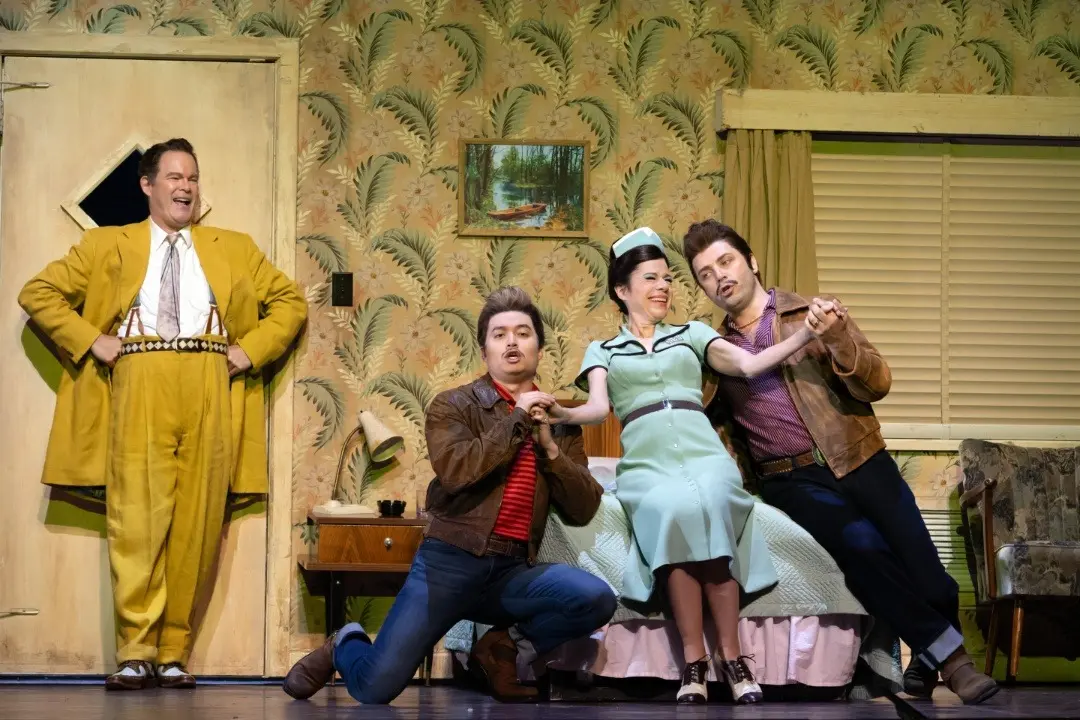
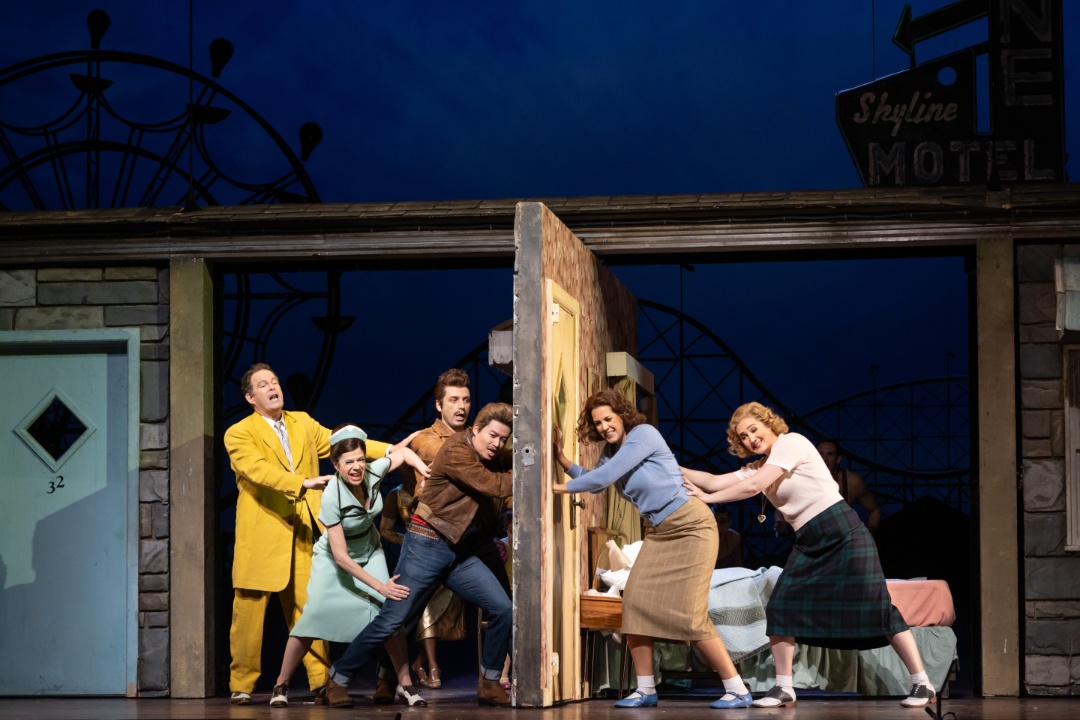
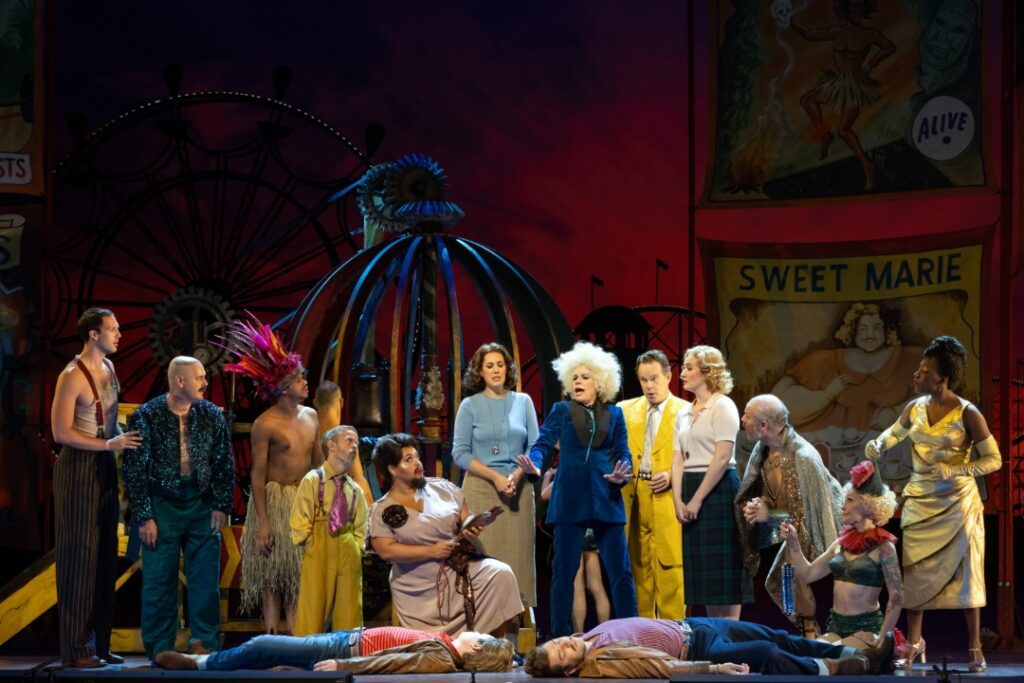
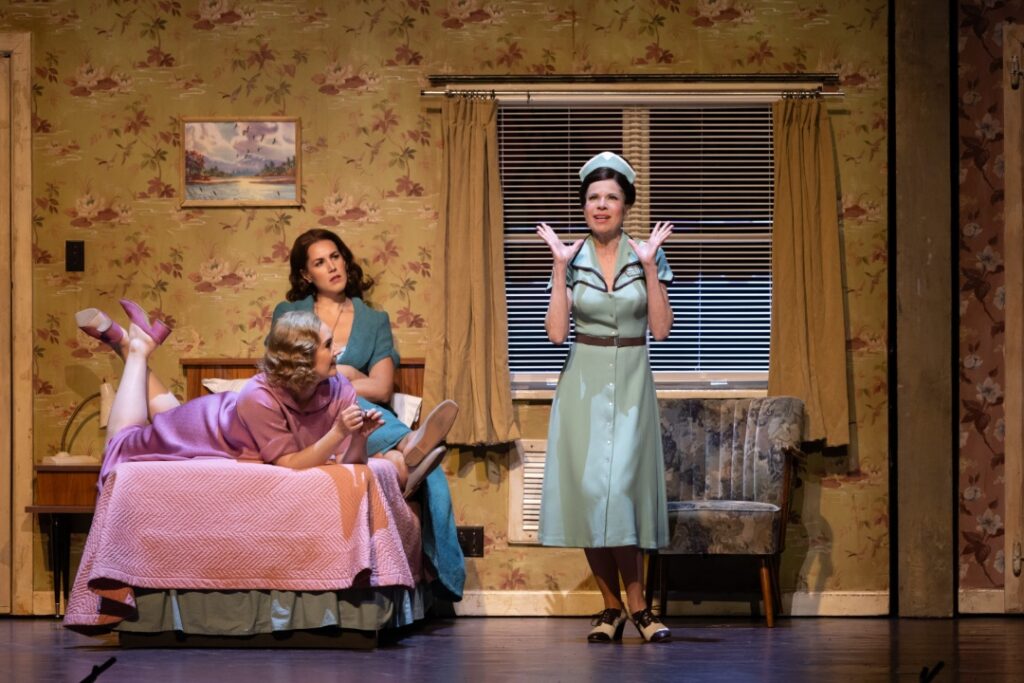
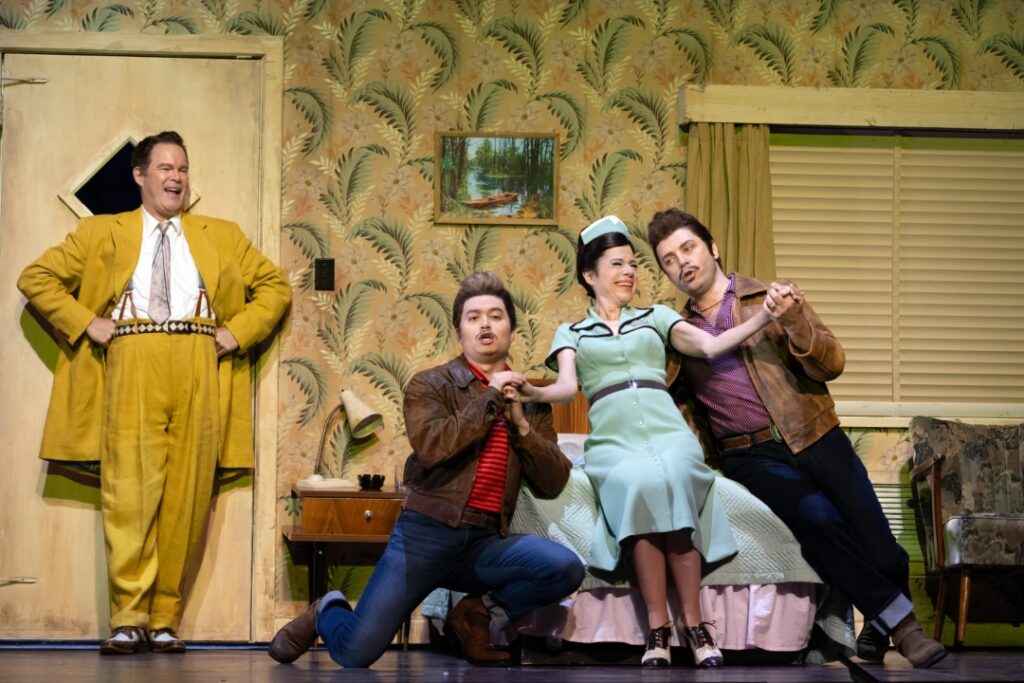
The Metropolitan Opera has officially kicked off its theatrical calendar for the 2026–27 season with a dazzling, high-octane revival of Wolfgang Amadeus Mozart’s classic comic opera, Così fan tutte. Originally premiered by the company in 2020 to widespread critical acclaim, director Phelim McDermott’s vibrant, visually arresting staging returns with renewed vigor. Transported from its traditional eighteenth-century Neapolitan setting, this iteration reimagines Lorenzo Da Ponte’s intricate libretto against the colorful, sun-drenched backdrop of New York City’s iconic Coney Island boardwalk during the 1950s.
Under the baton of conductor Nimrod David Pfeffer, the musical direction anchors an otherwise whimsical production with crisp precision and emotional depth. While OperaWire’s initial 2020 reviews extensively documented the staging’s dramatic peaks, structural pacing, and comedic mechanics, this season’s revival evaluation pivots toward an exhaustive look at the evening’s exceptional musical and vocal architecture. Featuring an all-star cast comprising Federica Lombardi, Samantha Hankey, Duke Kim, Andrey Zhilikhovsky, Ana María Martínez, and Gerald Finley, the Met’s latest mounting proves that Mozart’s ultimate "school for lovers" remains as psychologically piercing, musically unforgiving, and universally relevant as ever.
Così fan tutte has long occupied a complex, contested space within the operatic canon. Throughout the nineteenth and early twentieth centuries, the work faced severe moral backlash; Goethe famously expressed personal distaste for its cynical premise, while Beethoven reportedly sought to compose Fidelio as an antidote to its perceived levity and moral ambiguity. Structurally, it is an outwardly simple two-act comic opera wherein Da Ponte’s libretto details a tit-for-tat unraveling of two young, idealistic couples put to the test by a cynical philosopher. Yet, Mozart’s music acts as a psychological mirror, matching the plot’s surface-level lightness while concealing a treacherous undercurrent.
From the opening eight bars of the Overture, followed immediately by the initial trio (La mia Dorabella featuring the men) and the paired duet between the sisters (Ah! guarda sorella), the musical architecture establishes an unforgiving baseline. In Mozart, there is nowhere for an underprepared performer to hide. The standard set in the opening moments inevitably dictates the trajectory of the entire night.
Act I: The Sisters and the Seduction
The backbone of the evening rested squarely upon the shoulders of soprano Federica Lombardi as Fiordiligi and mezzo-soprano Samantha Hankey as Dorabella. Their Act I duet, Ah! guarda sorella, set an impossibly high standard, characterized by pristine tonal blending and deeply refreshing vocal nuances.
Lombardi operated on a plane of vocal exquisiteness that consistently defied expectations. Her rich, sumptuous vowels served as a natural resonator, projecting her expansive timbre across the cavernous Metropolitan Opera House without a hint of strain, leaving audiences spellbound. Hankey matched this intensity stroke for stroke. Her warm, intricately complex mezzo-soprano grounded the piercing brightness of Lombardi’s soprano. Hankey transformed Dorabella—a role frequently overshadowed by her sister—into the ultimate litmus test of vocal technique. Her searing interpretations of Ah! scostati and Smanie implacabili che m’agitate captured Dorabella’s emotional volatility without sacrificing structural beauty, mapping out the vulnerabilities that ultimately fuel the opera’s central conflicts.
Lombardi returned to center stage in Act I with Come scoglio immoto resta, delivering a masterclass in vocal flexibility. The cavernous depths of her chest register, contrasted seamlessly against the soaring heights of her crystalline falsetto, offered a breathtaking display of technical mastery.
Meanwhile, soprano Ana María Martínez assumed the role of the sharp-witted maid, Despina. Taking absolute command of the stage during Una donna a quindici anni, Martínez deployed a tight, spinning vibrato that pierced the hall with immaculate agility. Her sharp physical comedy and breakneck pacing matched her vocal prowess step for step.
Act II and the Men of Miscalculation
The male principals—tenor Duke Kim as Ferrando, baritone Andrey Zhilikhovsky as Guglielmo, and bass-baritone Gerald Finley as Don Alfonso—formed a trifecta of institutionalized chauvinism and misguided confidence. Da Ponte’s libretto leans heavily into the follies of masculine pride, and Mozart responds in kind with buoyant melodies designed to keep the psychological stakes suspended in mid-air.
Kim, Zhilikhovsky, and Finley blended seamlessly in their early numbers, their individual vocal timbres instantly telegraphing their character traits. Kim’s youthful naivety and Zhilikhovsky’s slick, self-assured swagger provided a perfect foil to Finley’s intellectualized, deeply cynical theories on human nature. Finley, an artist incapable of delivering a superficial performance, stripped away the crude edges of Don Alfonso’s misogyny to reveal a masterclass in dark comedic relief. His aria, Vorrei dir e cor non ho, featured hilariously exaggerated inflections on Ho di voi, di lor pietà, while his contribution to the sublime trio Soave sia il vento alongside Lombardi and Hankey achieved a state of divine vocal unity.
Kim and Zhilikhovsky’s duet, Al fato dan legge, showcased a thick veneer of psychological manipulation wrapped in honeyed tones. Zhilikhovsky’s rendition of Non siate ritrosi highlighted Mozart’s deceptively simple approach to accessible comedy, while Kim’s interpretation of Un’aura amorosa stood out as a premier vocal highlight of the night, driven by immaculate intonation and a gossamer-light pianissimo.
Supporting Context & Metrics
Historical Performance Metrics at the Metropolitan Opera
Così fan tutte has historically been a cornerstone of the Met’s Mozart repertory, though its performance frequency historically lagged behind works like Le nozze di Figaro and Don Giovanni due to its demanding vocal casting requirements.
Phelim McDermott’s 2020 production marked a radical visual departure from previous neoclassical stagings, integrating over 40 mid-century Coney Island props, custom neon signage, and dynamic rotating sets.
The 2026–27 revival run spans six strictly scheduled performances across September and October, drawing an estimated cumulative audience attendance of over 22,000 patrons to the Lincoln Center venue.
The Visual Metaphor: 1950s Coney Island
Director Phelim McDermott’s concept utilizes the nostalgic, slightly tacky, and transient environment of a 1950s boardwalk amusement park to mirror the ephemeral nature of the characters’ romantic attachments. The rotating doors of the set design underscored the inescapable trap of the wager engineered by Don Alfonso. Among the more whimsical visual flourishes returning for this revival were a functioning Ferris wheel frame and, memorably, a live albino boa constrictor that slithered in and out of select scenes, offering a literal nod to the serpent in the garden of love.
Official Statements
Reflecting on the return of the production to the Met stage, production and musical leadership emphasized the delicate balance between high-concept theatricality and Mozartian purity:
"When we first brought this physical world to the Met in 2020, our goal was to strip away the dust of eighteenth-century stiffness and find the raw, sweaty, sun-bleached human vulnerability in Da Ponte’s comedy," noted director Phelim McDermott during pre-season press commentary. "Coney Island gives us a playground of illusions—mirrors, bright lights, rides that spin you around and drop you back where you started. That is precisely what Don Alfonso does to these young lovers."
Conductor Nimrod David Pfeffer underscored the collaborative nature of navigating Mozart’s musical landscape:
"Mozart leaves zero margin for error. The orchestra and the singers must breathe as a single organism from the very first chord of the Overture. What makes this particular cast so formidable is their collective willingness to lean into the vulnerability of the music without losing the sparkling wit required to make the comedy land."
Future Outlook
The triumphant opening week of Così fan tutte sets an aggressive, high-water mark for the Metropolitan Opera’s 2026–27 season. By pairing a visually engaging, modern-day conceptual staging with a powerhouse vocal ensemble capable of navigating Mozart’s treacherous musical demands with absolute grace, the Met has reaffirmed its commitment to breathing new life into standard-repertory masterworks.
As the production wraps up its current run in the coming weeks, attention will inevitably turn toward the remaining highlights of the Met’s season, including upcoming new commissions and major Italian and German revivals. However, this Coney Island excursion will undoubtedly linger in the public consciousness as a masterclass in how to honor eighteenth-century masterpieces through twenty-first-century theatrical imagination. For audiences fortunate enough to secure tickets, the verdict remains unanimous: when it comes to staging Mozart with style, wit, and vocal majesty, così fan tutte.