
Executive Overview
Fifteen years after Colm Tóibín’s provocative theatrical monologue Testament first premiered at the Dublin Theatre Festival, the work has returned to the Irish capital transformed. Staged anew in 2026 as a full-scale opera by the Irish National Opera, this modern adaptation features a gripping score composed by Tarik O’Regan, drawing from Tóibín’s subsequent novella, The Testament of Mary.
At its core, the production dismantles centuries of theological conditioning to ask a singular, uncomfortable question: What if the Mother of God was, first and foremost, simply a grieving mother?
Free from the hagiographic silence of the biblical gospels, Tóibín’s Mary is elderly, traumatized, isolated, and fiercely resistant to the hagiography constructed around her son by his zealous followers. The opera—running at a taut, emotionally unrelenting 80 minutes—serves as both a psychological post-mortem and an intense political battlefield over who owns historical memory. With striking direction by Rachel Hewer, dynamic stagecraft, and a monumental central performance by mezzo-soprano Sharon Carty, the production sparked intense public discourse, even drawing organized protests from conservative groups outside the theater doors.
Detailed Chronology: From Spoken Word to Operatic Scale
The Genesis: 2011 to the Page
In 2011, the Dublin Theatre Festival introduced audiences to a radically humanized Mary. Conceived as a single-act play requiring only one actress, the original Testament presented the Virgin Mary looking back on the life, execution, and legacy of Jesus Christ. Eschewing the glowing radiance of traditional iconography, Tóibín portrayed a woman whose recollections diverged sharply from the canonical gospels.
Recognizing the expansive emotional weight and dramatic potential of the narrative, Tóibín expanded the material into a critically acclaimed novella, The Testament of Mary. This literary adaptation introduced a wider cast of characters, grounding Mary’s internal monologue in a tangible, though deeply distorted, historical landscape.
The 2026 Transformation
When the Irish National Opera announced it would adapt the novella into an opera for the 2026 Dublin Theatre Festival, it signaled a major evolution for the material. Working alongside librettist and author Tóibín, composer Tarik O’Regan crafted a sonic world capable of translating Mary’s fracturing psyche into vocal and instrumental terror and beauty.
The narrative chronology of the opera intentionally bends, warping time to reflect the cognitive degradation and trauma of an aging woman. It opens not with a serene nativity, but with the haunting aftermath of the raising of Lazarus—a miracle that leaves the resurrected man disheveled, mute, and deeply disturbed rather than joyful. From there, Mary’s memories skip fluidly between the Wedding at Cana (historically front-loaded in the gospels, but here placed out of order by a dislocated memory) and the brutal, agonizing climax of the crucifixion.
Rather than serving as passive witnesses to history, the audience is thrust into the mechanics of memory itself—where events morph, blur, and repeat, driven by emotional agony rather than chronological accuracy.
Supporting Context & Metrics: Production, Cast, and Musical Anatomy
Performance and Vocal Mastery
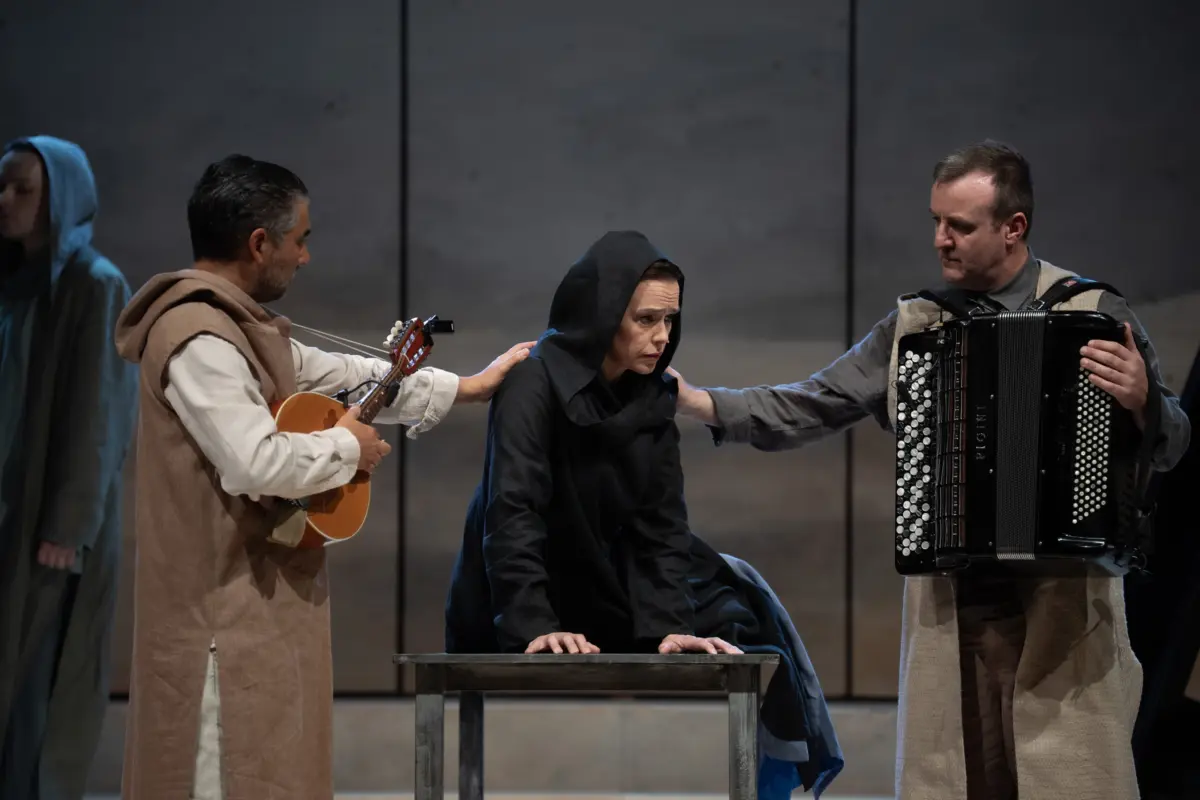
At the center of this operatic storm was Sharon Carty, whose portrayal of Mary demands both Olympian vocal endurance and intense dramatic vulnerability. Carty navigated the shifting tides of Mary’s trauma with astonishing precision, moving seamlessly between cold detachment, sharp irritability, physical reenactments of the crucifixion, and profound, isolated grief.
Surrounding Carty were six supporting characters: Lazarus, his sisters, and three of Jesus’s disciples.
- Lazarus (Maksym Lozovyi): A strictly non-speaking role, Lozovyi cut a tragic figure, wandering the stage in dirt and disheveled misery, embodying the profound alienation of a man dragged back from the peace of the grave against his will.
- Martha (Deirdre Higgins): Higgins delivered a soaring, emotionally piercing performance, utilizing a strong upper register to articulate her own internal turmoil.
- The Unnamed Sister (Sarah Luttrell): Luttrell provided a warm, grounded contrast, offering vocal beauty and a calm, expressively sensitive delivery.
- The Disciples (John, Paul, and Markus): Played by tenors Oisín Ó Dálaigh and Ben Escorcio, and baritone David Kennedy, the disciples formed an intimidating, aggressive ideological bloc. Kennedy stood out in particular, wielding a burnished, warm timbre that added rich complexity to the ensemble’s chilling harmonies.
Staging and Aesthetic Design
Director Rachel Hewer, scenographer Francis O’Connor, and costume designer Joan O’Clery achieved a striking balance between contemporary aesthetics and ancient antiquity.
Utilizing an inclined mirror suspended above the stage, the production distorted perspectives, culminating in a visually breathtaking crucifixion sequence. In a brilliant directorial subversion, Mary—not Jesus—was strapped to the cross, physically enacting her absolute identification with her son’s torment. Later, a black cross lying discarded in the corner of the stage flashed with the neon-like words "Son of God," serving as a stark physical manifestation of the dogma Mary spent her final years fighting.
The onstage presence of the seven-piece chamber ensemble (violin, viola, cello, flute/piccolo, clarinet, mandolin, and accordion), expertly driven from the pit by conductor Elaine Kelly, integrated the musicians directly into the dramatic architecture.
Musical Architecture
Tarik O’Regan’s score is a textbook example of modern dramatic scoring. Eschewing hummable, traditional operatic arias in favor of psychological landscaping, O’Regan utilized unsettling dissonances, jagged rhythms, and occasional electronic soundscapes to mirror Mary’s trauma. While the score occasionally invited criticism for leaning into a somewhat generic contemporary idiom, it undeniably succeeded in its primary objective: acting as a relentless, visceral vehicle for the drama unfolding onstage.
Official Statements and Public Reception
The production’s explosive thematic premise—separating the historical reality of a loving mother from the institutional machinery of the early Church—generated immediate public controversy.
The Church and the Public
Prior to the curtain rising on opening night, organized protests by conservative groups materialized outside the theater. Demonstrators condemned the opera as blasphemous, taking specific issue with the narrative’s refusal to validate the resurrection and its depiction of the disciples as aggressive, intimidating ideologues bent on spinning a specific theological narrative.
Colm Tóibín has consistently defended the work against charges of irreverence, maintaining in previous interviews and statements that his work explores human truths rather than dogmatic attacks.
"The Bible does not give Mary a voice," Tóibín has noted regarding the genesis of the character. "Despite her significance, she remains silent. We have absolutely no idea as to her thoughts, opinions, and emotions. But if she could speak, what would she have said?"
Director Rachel Hewer echoed these sentiments in production notes, emphasizing that the staging was designed to interrogate how narratives are weaponized by power structures:
"We are not merely looking at a woman remembering her son; we are looking at a woman whose personal tragedy was hijacked by history, and her desperate, heartbreaking attempt to reclaim ownership of her own life and loss."
Future Outlook: The Legacy of Testament
As the 2026 Dublin Theatre Festival run concludes, the resounding success—and cultural friction—generated by Testament points toward a vibrant future for the work on the international opera circuit.
By taking a localized literary adaptation and magnifying it through O’Regan’s tense, modern score and Hewer’s visionary staging, the Irish National Opera has proven that operatic art forms can still serve as a primary battleground for contemporary cultural and philosophical debates.
Testament does not offer comforting answers, nor does it seek to reinforce easy Sunday-school narratives. Instead, it challenges audiences to look beyond institutionalized dogma and confront the raw, unpalatable human cost of martyrdom. For future audiences fortunate enough to witness its revival, the production stands as a masterclass in modern opera: uncompromising, deeply empathetic, and entirely unforgettable.