
Executive Overview
For decades, the narrative surrounding K-12 music education has been romanticized: vibrant classrooms, the electric energy of a full ensemble locking in on a complex chord, and the profound satisfaction of a student finally mastering a challenging musical passage. Yet, beneath the surface of these rewarding moments lies a grinding, unglamorous reality that pushes countless passionate educators toward burnout. Music teachers did not spend years mastering their instruments and studying pedagogy to spend their Sunday nights buried in digital gradebooks, nor did they plan to start every single class period five minutes late because attendance systems refuse to sync while managing sixty restless students in a band hall.
Recent educator survey data underscores a systemic crisis: attendance tracking and manual playing-test grading consistently rank as the two administrative burdens music educators most desperately wish to automate. The hidden cost of this manual overhead is staggering. It robs teachers of preparation time, eats into precious instructional minutes, and siphons the creative energy necessary to inspire young musicians.
However, a cultural shift is underway across modern music departments. By rethinking classroom workflows, empowering student leadership, and leveraging advanced digital tools like MakeMusic, educators are beginning to reclaim their profession. This report examines how innovative schools are automating routine administrative tasks to eliminate teacher burnout, foster student accountability, and ultimately return the focus of music education to where it belongs: making music.
Detailed Chronology: The Evolution of the Modern Music Educator’s Workload
To understand the current crisis of administrative fatigue, it is helpful to trace how the responsibilities of the modern music director have multiplied over the past thirty years.
The Era of Paper and Podium (Pre-2000s)
Historically, the administrative load of a music teacher was tethered to physical paperwork. Attendance was taken via paper roll call, and grading consisted primarily of subjective observation during rehearsals, supplemented by occasional individual playing tests conducted live in front of the entire class (or hurriedly squeezed into a ten-minute lunch break). While these methods had their drawbacks, the boundary between the school day and personal time remained relatively intact. Grading was largely confined to the physical classroom, and once the bell rang, the workday was effectively over.
The Digital Disconnect (2000s–2010s)
As schools transitioned into the digital age, administrative demands skyrocketed under the guise of "efficiency." District-mandated learning management systems (LMS) required teachers to log daily attendance digitally—often via clunky, slow interfaces that demanded immediate attention at the exact moment rehearsal momentum needed to build. Concurrently, public education’s increased emphasis on metric-driven accountability meant that every ensemble director had to produce reams of quantitative data to justify student grades. Playing tests shifted from quick live check-ins to recorded audio files submitted by students. Overnight, music educators found themselves lugging home dozens—sometimes hundreds—of digital audio clips to grade on weekends.
The Breaking Point and the Rise of Smart Automation (Present Day)
By the early 2020s, post-pandemic educational strains brought music teacher burnout to an all-time high. Large ensemble sizes, coupled with shrinking budgets and administrative bloat, created an unsustainable ecosystem. Directors were spending up to thirty percent of their working hours on non-instructional tasks.
Recognizing that traditional methods were failing, forward-thinking educators began pioneering decentralized classroom management techniques. Schools like Rouse High School and Wiley Middle School began experimenting with paradigm-shifting workflows. Instead of viewing technology merely as a grading repository, these programs began utilizing interactive practice platforms as automated gatekeepers—shifting the burden of initial technical evaluation away from the human teacher and back onto the student. This chronological pivot from manual policing to automated facilitation has fundamentally transformed what a modern music rehearsal looks like.
Supporting Context & Metrics: The Anatomy of Teacher Burnout
The friction between administrative obligation and artistic instruction is not merely a matter of personal frustration; it is a measurable structural flaw in how performing arts education is supported.
The Logistics of the Large Ensemble
Consider the mathematical reality of running a standard high school concert band or orchestra. A single director is routinely tasked with managing between 60 and 100 adolescents in a acoustically loud, physically demanding environment.
- The Attendance Bottleneck: Taking roll call from the podium forces a false choice. A director can either stand silently clicking names on a screen while dozens of teenagers sit idle—instantly killing the room’s rehearsal energy—or they can push forward with the warm-up and attempt to remember who was absent later, inviting chronic inaccuracies in official district reporting.
- The Grading Mirage: In core academic subjects, a grade reflects a student’s mastery of a concept through written or digital assessments designed for rapid evaluation. In music, growth is iterative, deeply physical, and subjective. Yet, district gradebooks demand hard percentages. To satisfy this requirement, teachers resort to spending their weekends listening to fragmented recordings of scales and etudes, leading to profound cognitive fatigue.
The Shift Toward Effort-Based and Software-Assisted Grading
Progressive music departments are actively dismantling the punitive grading models of the past. Research in educational psychology indicates that students perform significantly better—and exhibit lower performance anxiety—when their intrinsic musical talent is decoupled from their grade.

By implementing an effort-based grading baseline (where genuine participation and iterative attempts guarantee a baseline passing grade), educators create psychological safety. When paired with automated software assessment tools, this philosophy empowers students to commit errors, experiment, and self-correct in private before they are ever asked to perform publicly.
Official Insights & Institutional Strategies
Several pioneering institutions have documented remarkable transformations by fundamentally altering how they approach classroom routines and digital integration.
Empowering Student Leadership for Seamless Attendance
One of the most effective yet underutilized strategies for reclaiming instructional time involves decentralizing classroom management. Rather than framing attendance and setup as purely teacher-owned duties, progressive directors are training student leaders to spearhead the first five minutes of class.
When student section leaders take charge of warm-ups, equipment checks, and initial roll-taking routines, the director is freed to handle administrative syncs without sacrificing the momentum of the rehearsal. While this requires a modest investment of instructional time during the first week of the school year to train student leaders, the long-term payoff is monumental. Classrooms begin to run like self-sustaining, well-oiled machines, and the dreaded "attendance not submitted" administrative notification becomes a relic of the past.
The "Minimum Score Requirement" Model
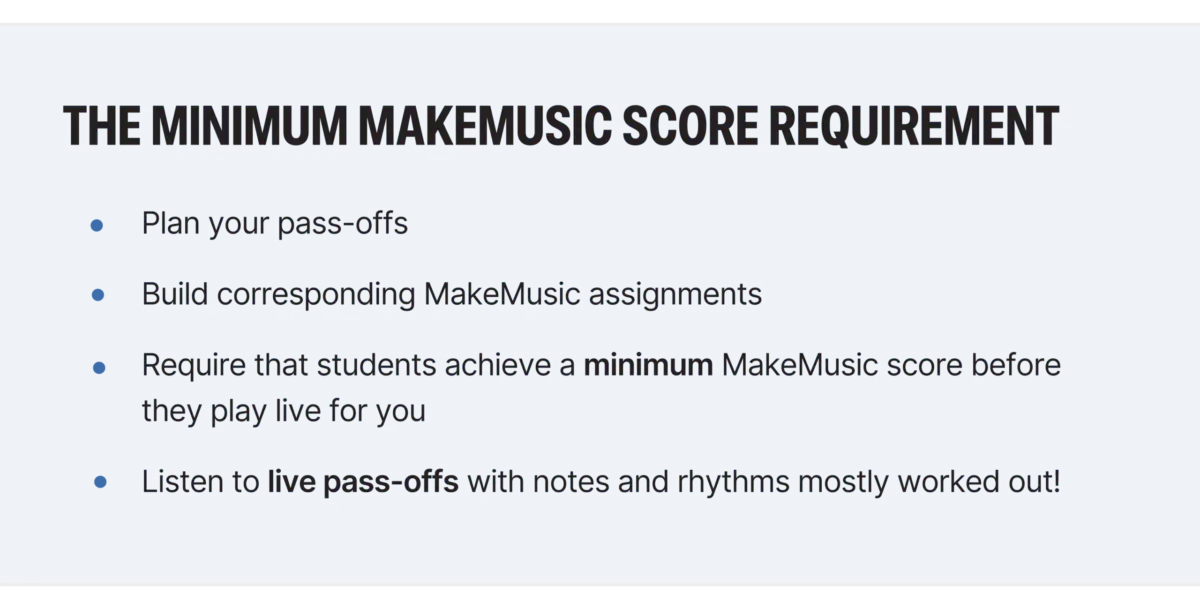
In pioneering districts such as those utilizing the strategies seen at Rouse High School and Wiley Middle School, the workflow for individual playing evaluations has been completely redesigned around the concept of a Minimum MakeMusic Score Requirement.
[Plan Pass-Offs] ──> [Build MakeMusic Assignments] ──> [Enforce Minimum Score] ──> [Live Pass-Offs with Polished Technique]Under this framework, the pedagogical pipeline operates as follows:
- Curriculum Planning: The director maps out upcoming pass-offs aligned with current ensemble repertoire.
- Digital Deployment: Corresponding assignments are built within a practice platform like MakeMusic.
- Automated Gatekeeping: Students are required to independently achieve a minimum accuracy threshold (assessing pitch, rhythm, and timing) within the software before they are permitted to sign up for a live "pass-off" with the director.
- Targeted Live Instruction: When the student finally steps up to play for the teacher live, the foundational note and rhythm errors have already been eradicated through independent software repetitions.
As a result, teachers no longer waste valuable lesson time—or weekend hours—listening to unprepared performances. Instead, live interactions are elevated into high-level artistic coaching sessions focused on musicality, phrasing, and emotional expression.
Future Outlook: The Horizon of Music Pedagogy
As we look toward the future of arts education, the integration of intelligent automation is poised to move from an innovative luxury to an absolute necessity.
The teacher shortage crisis currently impacting school districts nationwide makes workflow optimization a matter of programmatic survival. When music educators are relentlessly bogged down by clerical tasks, the risk of losing talented mentors to burnout multiplies. Conversely, when routine administrative friction is minimized through smart software and intelligent classroom design, retention rates soar.
The future of music education belongs to tools that act as true assistants rather than administrative hurdles. Platforms that can instantly parse student pitch accuracy, evaluate rhythmic precision, and seamlessly log data into district gradebooks will continue to redefine the boundaries of what a single teacher can accomplish.
Ultimately, automation is not about replacing the human element of teaching; it is about protecting it. By offloading attendance tracking, baseline technical grading, and scheduling logistics to smart systems, educators can return to the pure, unadulterated passion that drew them to the podium in the first place: sharing the transformative power of music with the next generation.