
VIENNA / PRAGUE / OSAKA — In a landmark achievement for early music scholarship and performance, the Czech-German period-instrument ensemble Ensemble Rýnský has released the first-ever complete recording of Ignazio Albertini’s Sonatinae XII Violino Solo. Distributed globally by the Italian independent label Da Vinci Classics, this comprehensive traversal brings to life a monumental collection of violin literature first published posthumously in Vienna in 1692.
Led by baroque violinist Vojtěch Jakl and backed by an expansive, richly hued basso continuo section, the album breathes fresh vitality into a rare artifact of seventeenth-century musical history. More than just an antiquarian exercise, this release offers contemporary listeners a profound window into an era when the violin was rapidly evolving from a folk-adjacent curiosity into the undisputed king of Western instrumental music.
Executive Overview
The release of Sonatinae XII Violino Solo on Da Vinci Classics represents a major milestone in baroque discography. Ignazio Albertini remains one of the most enigmatic figures of the seventeenth-century Habsburg court. While his contemporary Heinrich Ignaz Franz Biber achieved enduring fame for his virtuosic Mystery Sonatas, Albertini’s career was cut tragically short by an assassin’s blade, leaving behind a minuscule corpus of surviving works.
At the center of this new recording is Albertini’s only surviving collection: twelve sonatas for solo violin and basso continuo, published in Vienna five years after his violent death in 1685. For centuries, these works were treated largely as academic curiosities—demanding technical exercises preserved in amber. However, Ensemble Rýnský’s new interpretation recasts them as emotionally charged masterpieces that bridge the gap between the blazing, improvisatory theatricality of the Italian baroque and the intellectual rigor of Central European counterpoint.
Available now on physical compact disc and across all major digital streaming platforms—supplemented by detailed digital liner notes and scholarly essays via Da Vinci’s web portal—this recording reclaims Albertini from the footnotes of music history and places him squarely on the main stage of baroque performance practice.
Detailed Chronology: The Life, Death, and Legacy of Ignazio Albertini
To understand the weight of Ensemble Rýnský’s new recording, one must retrace the turbulent path of Ignazio Albertini’s life and the erratic survival of his music across more than three centuries.
The Italian Maestro in the Imperial City
Details regarding Albertini’s early life remain shrouded in obscurity. Born in Italy—likely around the middle of the seventeenth century—he absorbed the dazzling, idiomatic violin techniques pioneered by the early Italian masters. By the 1670s, Albertini had migrated northward, finding employment in the cosmopolitan musical ecosystem of Vienna, the glittering capital of the Holy Roman Empire under Emperor Leopold I.
Vienna in the late seventeenth century was a crucible of musical exchange. Italian opera, instrumental music, and vocal styles were deeply prized by the Habsburg court, yet they collided daily with the dense, polyphonic traditions favored by German-speaking musicians. Albertini positioned himself precisely at this intersection. His playing combined the flamboyant, pyrotechnic demands of the Italian school—double stops, sweeping scordatura tunings, rapid string crossings, and expressive affect—with an architectural grasp of counterpoint that resonated with Central European tastes.
A Mysterious Demise
Despite his rising stature in Vienna, Albertini’s life was abruptly terminated under dark circumstances. On September 22, 1685, Albertini was murdered in Vienna. Historical records offer frustratingly few details regarding the motive or the perpetrators of the crime, leaving modern biographers to speculate whether the killing was the result of a personal dispute, a duel, or court intrigue.
At the time of his death, Albertini left behind a wife, children, and a trove of unpublished manuscripts. Because solo and chamber repertoire for the violin was frequently disseminated in manuscript copies among courts and private collectors before finding its way to a printing press, much of his output was scattered or lost forever.
The 1692 Posthumous Publication
The primary reason Albertini’s name survived posterity is the devotion of those who valued his genius after his death. In 1692, seven years after his murder, a collection titled Sonatinae XII Violino Solo was published in Vienna.
This publication served as a monument to his artistry, capturing in print the twelve sonatas that constitute his entire surviving corpus. Yet, over the subsequent centuries, copies of the 1692 print became exceedingly rare. Surviving exemplars found their way into select European archives and university libraries, remaining accessible primarily to academic musicologists and elite specialists rather than concert violinists or the general public.
The Modern Revival and Ensemble Rýnský
Throughout the twentieth and early twenty-first centuries, individual sonatas from the set occasionally appeared on academic recital programs or specialized baroque anthologies. However, a unified, critically informed, complete recording of all twelve sonatas had remained an elusive ambition—until now.
Ensemble Rýnský’s painstaking preparation for the Da Vinci Classics project involved archival research, comparative source analysis, and extensive experimentation with historical instruments and tuning systems. The resulting album, recorded in high-resolution audio, marks the culmination of years of dedicated scholarship and artistic collaboration between Czech and German musicians.
Supporting Context & Metrics: The Musical and Historical Framework
To fully appreciate the achievement of Sonatinae XII Violino Solo, one must examine the technical, stylistic, and organological dimensions of Albertini’s writing and Ensemble Rýnský’s realization.
The Violin at the Crossroads of the Pre-High Baroque
In the late seventeenth century, the violin was undergoing a rapid technological and artistic transformation. No longer viewed merely as a dance instrument or an imitation of the human voice in vocal accompaniment, the violin was emerging as an autonomous vehicle for dramatic expression and supreme technical display.
Albertini’s sonatas occupy a fascinating transitional space:
- The Italian Influence: Characterized by stilo fantastico (fantastical style), these works feature sudden tempo shifts, recitative-like vocal declamations on the fingerboard, soaring melodic arcs, and expressive dissonance that mirrors human emotional states (affect).
- The Central European Influence: Unlike the pure monodic bravura found in some early Italian publications, Albertini’s textures frequently employ intricate imitative counterpoint. Voices chase one another between the solo violin and the upper lines of the basso continuo, demanding an intellectual rigor that recalls the North German organ school or Austrian church polyphony.
Instrumentation and the Basso Continuo Paradigm
A critical element of Ensemble Rýnský’s approach is the expansion and variation of the basso continuo group. While modern performances of seventeenth-century violin music often settle for a sparse combination of harpsichord and cello, Vojtěch Jakl and Ensemble Rýnský embrace the rich, colorful continuo practices documented in historical Viennese performance manuals.
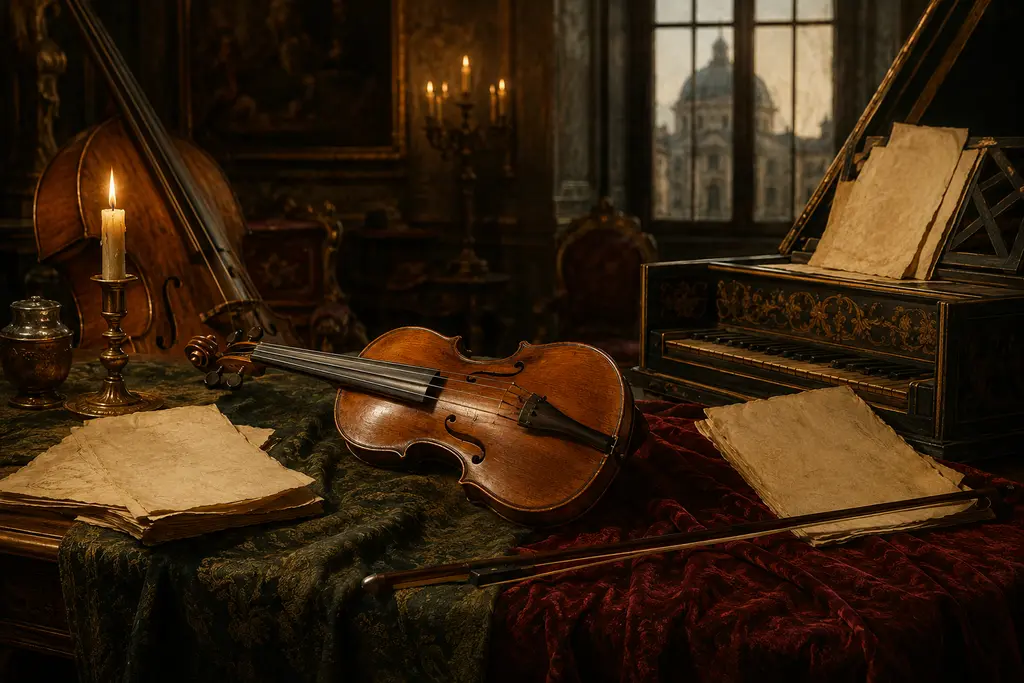
The recording features a dynamic palette of continuo instruments—including harpsichord, organ, theorbo, baroque guitar, and viola da gamba—rotated strategically across the twelve sonatas. This textural variety prevents listener fatigue across a two-disc-length traversal, allowing each sonata to establish its own distinct sonic world. One movement might be supported by the austere, sacred hush of an organ and a sustained viola da gamba, while the next explodes into life with the plucked, rhythmic punch of the baroque guitar and harpsichord.
Album Metrics and Production Details
- Release Date: July 22, 2026
- Label: Da Vinci Classics (Independent classical label based in Osaka/Rome)
- Artist: Ensemble Rýnský (Czech-German period-instrument ensemble)
- Lead Performer: Vojtěch Jakl (Baroque Violin)
- Format: Physical Compact Disc (CD) and High-Resolution Digital Audio (Streaming/Download)
- Ancillary Materials: Comprehensive digital booklet featuring musicological liner notes, instrument specifications, and archival context.
Official Statements and Critical Insights
The launch of the album has generated significant buzz within the international early music community. Representatives from Da Vinci Classics and members of Ensemble Rýnský have released statements outlining the artistic vision behind the project.
From the Label: Da Vinci Classics
In an official statement accompanying the release, Da Vinci Classics emphasized the cultural importance of rescuing marginalized baroque repertoires from obscurity:
"Da Vinci Classics has always been committed to shedding light on the hidden corners of musical history. Ignazio Albertini represents a crucial missing link between the Italian virtuoso tradition and the profound contrapuntal developments of the Habsburg lands. By supporting Ensemble Rýnský in this monumental complete recording, we are not merely preserving a historical artifact; we are offering contemporary audiences a thrilling, emotionally immediate listening experience that rivals the most celebrated masterpieces of the seventeenth century."
From Ensemble Rýnský and Vojtěch Jakl
Speaking on the interpretive challenges of approaching a composer with only a single surviving collection to his name, baroque violinist Vojtěch Jakl noted the unique freedom and responsibility felt by the ensemble:
"When you play Biber or Corelli, you are standing on well-trodden ground. When you play Albertini, you are walking through an unmapped forest. Every gesture, every articulation, and every choice of continuo instrumentation requires deep immersion in the aesthetic world of late-seventeenth-century Vienna. We wanted these twelve sonatas to feel like twelve distinct chapters in a novel—some introspective and deeply spiritual, others bursting with the theatrical swagger of the Italian piazza. Working with an expanded, varied basso continuo allowed us to paint with an extraordinary range of colors, ensuring that Albertini’s unique voice rings out with absolute clarity after more than three centuries of silence."
Music critics and early music scholars who have previewed the release have praised Jakl’s stylistic purity, noting his mastery of historical bow strokes, immaculate intonation in high-register passages, and rhetorical phrasing that treats the violin as a speaking, breathing orator.
Future Outlook: The Impact on Early Music Scholarship and Performance
The release of Sonatinae XII Violino Solo is expected to exert a lasting influence on baroque performance practice, academic research, and concert programming in several key ways.
Expanding the Standard Baroque Violin Repertoire
For decades, baroque violinists seeking to program late-seventeenth-century repertoire have gravitated toward predictable touchstones: Biber’s Mystery Sonatas, Johann Heinrich Schmelzer’s Sonatae unarum fidium, and Corelli’s Opus 5. Ensemble Rýnský’s definitive recording provides a ready-made treasure trove of alternative repertoire that concert artists can seamlessly integrate into recital programs.
Promoters of early music festivals across Europe and North America have already expressed interest in featuring Ensemble Rýnský in live concert series dedicated to the album, promising that audiences will soon experience Albertini’s sound world in the concert hall.
Catalyzing Further Scholarly Research
The renewed attention commanded by Da Vinci Classics’ release is likely to spur further musicological investigation into the Viennese imperial chapel and the broader network of Italian musicians working north of the Alps during the reign of Leopold I. Scholars are hopeful that fresh archival discoveries in Austrian, Italian, and Czech libraries may yet unearth additional manuscript fragments or letters shedding light on Albertini’s mysterious life and untimely death.
Digital Accessibility and Educational Outreach
By leveraging Da Vinci’s digital release platform, the ensemble has ensured that the accompanying textual materials—including scholarly essays, source commentaries, and high-resolution digital booklets—are immediately accessible to university music departments, conservatories, and student violinists. This democratization of rare musicological resources ensures that the recording will serve not only as a commercial success, but as an invaluable pedagogical tool for the next generation of historical performance specialists.
Conclusion
Ignazio Albertini’s Sonatinae XII Violino Solo no longer languishes as a forgotten footnote in seventeenth-century musicology. Thanks to the rigorous scholarship, artistic brilliance, and boundless curiosity of Vojtěch Jakl and Ensemble Rýnský—and the visionary commitment of Da Vinci Classics—this rare seventeenth-century treasure has been triumphantly restored to the living canon of classical music.
As listeners press play on the new album, they are invited to step back in time to the candlelit salons and imperial chambers of baroque Vienna, where an Italian virtuoso once dazzled his contemporaries with fire, grace, and unmatched compositional brilliance.