
Executive Overview
Forty years ago, in the October 1986 issue of Jazz Journal, critic Mark Gilbert penned an observation that would capture the essence of one of modern music’s most elusive figures. Describing the playing of soprano saxophonist Steve Lacy, Gilbert noted how the musician navigated the labyrinthine harmonies of Charlie Parker’s classic composition Donna Lee, "skirting around the harmony… in touch with the changes, but viewing them from some distant parallel."
This singular approach—simultaneously tethered to the foundational mechanics of jazz yet operating from an avant-garde dimension entirely its own—defines the legacy of Steve Lacy. To understand Lacy is to understand an artist who deliberately bypassed the dominant stylistic corridors of mid-century jazz. While his contemporaries busied themselves mastering the breakneck idioms of bebop and hard bop, Lacy charted an idiosyncratic course. He leaped directly from the traditional, roots-conscious idioms of Dixieland to the white-hot, intellectual frontiers of free jazz with visionaries like pianist Cecil Taylor.
At the epicenter of this journey was his instrument of choice: the soprano saxophone. In the 1950s and early 1960s, the soprano was widely regarded as a historical relic, an eccentric orchestral voice prone to intonation issues and largely abandoned by modernists following the swing era. By adopting it as his primary vehicle, Lacy claimed an unclaimed territory, transforming an overlooked horn into the standard-bearer for jazz modernism long before John Coltrane popularized it in the mainstream consciousness.
This retrospective analysis examines the landmark 1960 Candid recording session that crystallized Lacy’s radical philosophy, dissects his unconventional evolutionary trajectory, and evaluates the enduring impact of a musician who proved that sounding like nothing else in jazz was the ultimate artistic achievement.
Detailed Chronology: The Evolution of an Iconoclast
To trace Steve Lacy’s artistic development is to witness a rejection of linear musical history. His career unfolded through distinct phases that challenged the conventional orthodoxies of the jazz establishment.
The Formative Years: Embracing Dixieland and the Avant-Garde
Born in New York City in 1934, Lacy picked up the soprano saxophone as a teenager. Unlike many of his peers who began their formal training under the heavy influence of Lester Young, Coleman Hawkins, or Charlie Parker, Lacy’s early musical education was rooted in the archaic sounds of early jazz. He immersed himself in New Orleans revivalism and Dixieland, performing alongside veterans like trumpeter Max Kaminsky.
This baptism by fire in traditional idioms provided Lacy with a rigorous, foundational understanding of collective improvisation, counterpoint, and jazz architecture. However, rather than graduating organically into the prevailing bebop movement—the logical next step for most young musicians of the era—Lacy made a breathtaking stylistic leap. He bypassed bebop, cool jazz, and hard bop almost entirely, plunging headfirst into the outer reaches of the avant-garde.
His association with pianist Cecil Taylor in the mid-1950s placed Lacy at ground zero of the "New Thing." Playing with Taylor required an entirely new vocabulary. Harmonic structures were shredded, rhythmic pulses were fractured, and traditional song forms were replaced by structural elasticity. Through this crucible, Lacy forged an alliance with other brilliant eccentrics of the era, most notably pianist Thelonious Monk. Lacy became an obsessive devotee of Monk’s compositions, later forming a cooperative quartet with trumpeter Roswell Rudd dedicated almost exclusively to interpreting Monk’s angular, dissonant songbook.
The 1960 Candid Session: A Watershed Moment
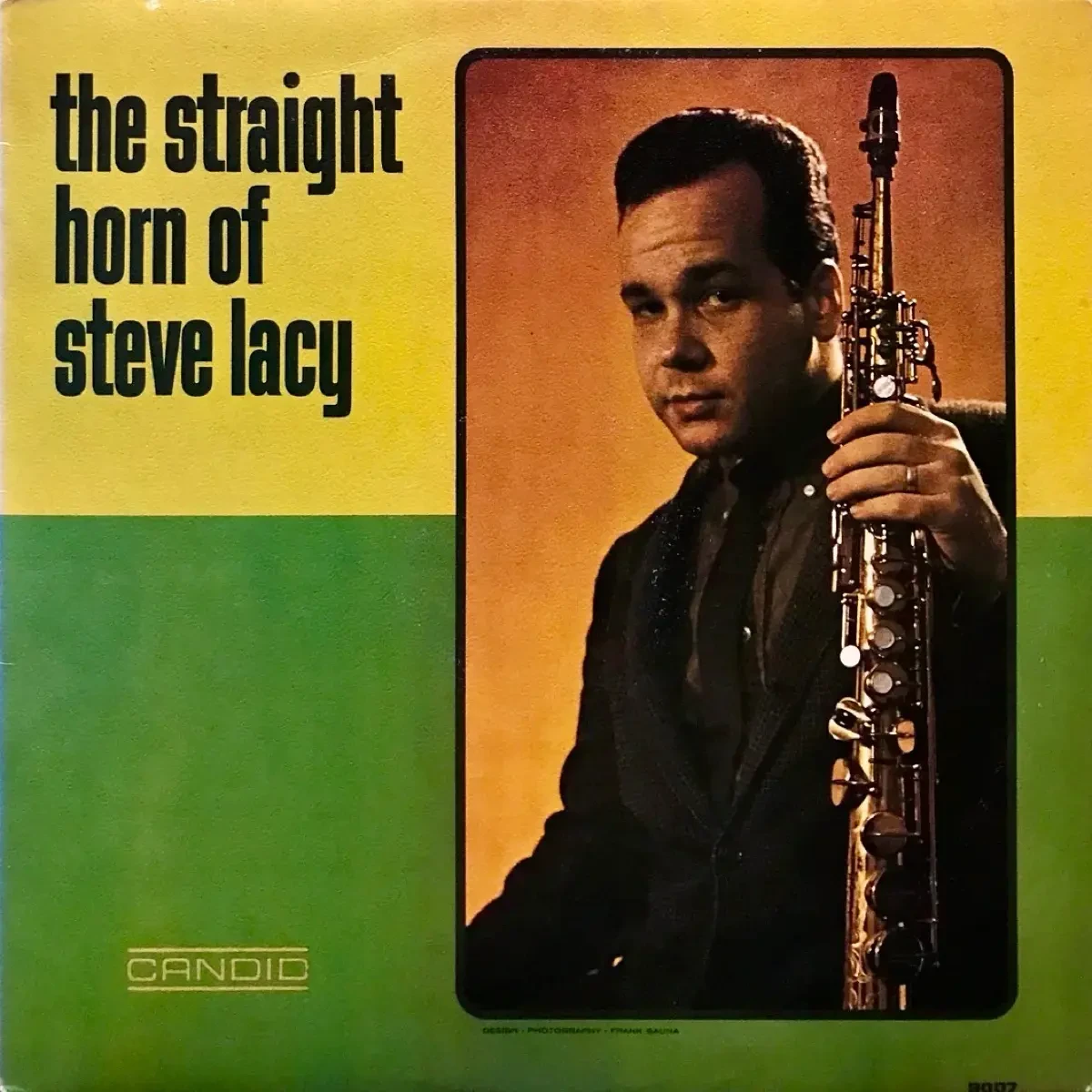
By 1960, Lacy was ready to document his radical aesthetic on record. The resulting session, captured for Candid Records (catalog number 9007), stands as a monumental achievement in the history of the soprano saxophone.
The personnel assembled for the date were crucial to the dynamic tension of the music. Joining Lacy was baritone saxophonist Charles Davis—a player whose approach provided a vital, conventional counterweight to Lacy’s idiosyncratic stylings. The rhythm section comprised bassist John Ore and drummer Roy Haynes, two masters of time and space who could anchor even the most abstract flights of melodic fancy.
The tracklisting for the session highlights Lacy’s eclectic yet focused vision:
- Louise
- Introspection
- Donna Lee (clocking in at 18:17 alongside the aforementioned tracks)
- Played Twice
- Air
- Criss Cross (totaling 17:48)
On this recording, the friction between conventional jazz grammar and Lacy’s radical syntax is palpable. Nowhere is this more evident than on his reading of Donna Lee. While baritonist Charles Davis navigates the bebop anthem with traditional, textbook precision—negotiating the rapid-fire chord changes with secure, linear phrasing—Lacy takes an entirely different route.
As Gilbert observed in his 1986 critique, Lacy treats the composition’s harmonic framework not as a roadmap to be followed slavishly, but as a distant landscape to be observed from an aerial perspective. He dances around the changes, touching upon them obliquely, hinting at the underlying tonal center while allowing his eccentric, reedy piping to dictate the emotional tenor of the performance.
As the album progresses, a profound realization dawns on the listener: traditional notions of theme and harmony are secondary. The ultimate structural glue of the music is Lacy’s uncompromising, unsentimental, and unapologetically unpretty tone. Viewed through the lens of mid-century convention, his playing could shock the uninitiated. Yet, history has vindicated his approach, proving that Lacy’s refusal to sound like anyone else was his greatest asset.
Supporting Context & Metrics: The Mechanics of a Maverick
To fully appreciate the significance of Steve Lacy’s contributions, one must examine the historical and technical context of the soprano saxophone during the 1950s and 1960s, as well as the commercial realities facing avant-garde artists of the period.
The Soprano Saxophone in Mid-Century Jazz
Prior to Lacy’s emergence, the soprano saxophone was viewed as a historical curiosity. Popularized during the 1920s by artists like Sidney Bechet, the instrument largely fell out of favor during the swing era and was virtually ignored during the bebop revolution. Its high register, inherent pitch instability, and nasal timbre made it a difficult instrument for modernists to integrate into horn sections designed for the rich, warm mid-range of the alto and tenor saxophones.
When Lacy adopted the instrument as his exclusive voice, he faced immense technical hurdles. There were few instructional materials available for modern soprano playing, and no contemporary role models to emulate. Lacy was forced to invent his own methodology. He worked tirelessly on intonation, breath control, and multiphonics, developing a lean, dry tone devoid of vibrato.
This sonic palette contrasted sharply with the lush, romantic tones popular in mainstream jazz. Lacy’s tone was stark, direct, and cerebral. When John Coltrane famously began exploring the soprano in the early 1960s—sparked in part by his exposure to Lacy’s playing—Coltrane adopted a modal, impassioned, and emotionally volcanic approach. Lacy, by contrast, remained clinical, architectural, and fiercely independent.
Quantitative Overview of the 1960 Candid Session
| Parameter | Detail |
|---|---|
| Recording Date & Location | New York City, 1960 |
| Record Label & Catalog Number | Candid Records, Candid 9007 |
| Instrumentation | Soprano Saxophone (Steve Lacy), Baritone Saxophone (Charles Davis), Bass (John Ore), Drums (Roy Haynes) |
| Primary Compositions | Louise, Introspection, Donna Lee, Played Twice, Air, Criss Cross |
| Total Runtime (Approximate) | ~36 minutes across core tracks |
| Stylistic Anchor | Fusion of Monk-inspired angularity, Dixieland counterpoint roots, and avant-garde abstraction |
The Critical Reception Over Time
The reception of Lacy’s work underwent a fascinating evolution. In the 1950s and early 1960s, mainstream jazz critics often struggled to categorize his playing. To ears accustomed to the swinging momentum of Count Basie’s orchestra or the melodic lyricism of Stan Getz, Lacy’s music sounded abrasive, disjointed, and overly intellectual.
However, as the decades passed and the avant-garde wing of jazz gained institutional and critical acceptance, Lacy’s pioneering role became impossible to ignore. Retrospective analyses, such as Mark Gilbert’s 1986 Jazz Journal piece, recognized that Lacy was not merely an eccentric outlier, but a visionary who anticipated the post-bop structural explorations of the 1970s and 1980s. His rigorous dedication to the compositions of Thelonious Monk and Herbie Nichols established him as a premier custodian of jazz’s most demanding modernist literature.
Official Statements and Critical Perspectives
The enduring legacy of Steve Lacy is best understood through the commentary of his peers, critics, and historians who witnessed his unique trajectory firsthand.
Reflecting on the unique challenges of Lacy’s musical philosophy, jazz historian and critic Gary Giddins once noted:
"Steve Lacy didn’t just play an instrument; he interrogated it. He took an acoustic tool that everyone else had discarded as an antique and turned it into a scalpel for dissecting modern harmony."
Mark Gilbert’s assessment from the October 1986 issue of Jazz Journal remains one of the most evocative descriptions of Lacy’s harmonic daring:
"The tenuousness of his approach is emphasised by baritonist Davis’s more conventional negotiations. As the record progresses it becomes evident that themes and harmonies matter less than Lacy’s eccentric piping, which is finally the most consistent element on the record. Viewed from behind the apron strings of convention, his playing is unpretty and unsentimental, but time has shown that it was worth his while to sound like nothing else in jazz."
Lacy himself was remarkably lucid about his artistic choices, often emphasizing the importance of finding a personal voice over commercial viability. In various interviews throughout his life, he stressed that his avoidance of bebop was not a dismissal of its greatness, but a tactical necessity for self-preservation as an artist. By stepping outside the dominant lineage, he created a space where his distinct musical personality could flourish without the crushing weight of imitation.
Future Outlook: The Enduring Blueprint of Steve Lacy
As jazz moves further into the 21st century, the lessons of Steve Lacy’s career remain profoundly relevant for contemporary improvisers. In an era where jazz education has become institutionalized—producing generations of technically flawless players well-versed in the academic lexicon of bebop and post-bop—Lacy’s career serves as a vital reminder of the power of radical individualism.
Preservation and Reevaluation of the Avant-Garde
The catalog of Candid Records, and specifically Lacy’s 1960 session, continues to serve as an essential curriculum for students of avant-garde jazz. As archival labels unearth unreleased tapes and remaster classic sessions from this golden era of independent jazz production, modern listeners are given renewed opportunities to evaluate the tectonic shifts that occurred beneath the surface of mainstream jazz history.
Younger generations of saxophonists, seeking alternatives to the dominant Coltrane-Rollins lineage, frequently turn to Lacy’s body of work to study how to construct solos out of melodic fragments, silence, and spatial awareness rather than relentless scalar runs. His approach demonstrates that economy of notes and angularity can convey just as much emotional and intellectual depth as high-velocity pyrotechnics.
The Global Legacy
Lacy spent a significant portion of his later career living and working in Europe—primarily in Paris—where the avant-garde community embraced his cerebral, multi-disciplinary approach to art. He collaborated widely with dancers, poets, and visual artists, proving that his sonic philosophy extended far beyond the traditional confines of the jazz club.
Today, international ensembles dedicated to interpreting Lacy’s complex compositions and conceptual games continue to perform worldwide. His influence can be heard in the contemporary European free improvisation scene, where tone color, micro-tonal exploration, and structural abstraction are prized above traditional swing metrics.
Conclusion
Forty years after Mark Gilbert captured the essence of Lacy’s parallel journey around the changes of Donna Lee, and decades after Lacy established the soprano saxophone as a legitimate voice for modernism, the saxophonist’s legacy shines brighter than ever. He proved that an artist does not need to follow the beaten path to achieve greatness. By embracing the margins, skipping the orthodoxy, and committing entirely to an uncompromising personal tongue, Steve Lacy secured his place in the pantheon of jazz immortals—an artist who sounded like nothing else, and in doing so, expanded the boundaries of what music could be.