
Executive Overview
The intersection of generative artificial intelligence and everyday social communication has reached a fascinating new milestone. Snap Inc., the parent company of the ubiquitous multimedia messaging app Snapchat, has officially rolled out a brand-new feature titled "Chat to Song." This capability allows users to take their ordinary, conversational text threads and instantly transform them into short, original musical compositions.
While the concept of turning text messages into melodies is not entirely unprecedented—thanks to a massive viral craze earlier this year powered by AI-music platform Suno and TikTok—Snapchat’s native integration represents a significant shift. Instead of forcing users to take screenshots, navigate to third-party applications, and manually upload prompts, Snapchat is embedding the technology directly into the core user experience of its chat interface.
However, this rapid deployment of generative AI audio within a mainstream social network brings with it a complex web of questions, challenges, and industry-wide implications. Currently restricted to paying subscribers of the platform’s Lens+ tier, "Chat to Song" forces us to confront lingering uncertainties regarding intellectual property, proprietary versus third-party AI models, data privacy, and the evolving etiquette of digital communication. As social platforms race to capitalize on the generative AI boom, Snapchat’s latest move serves as a compelling case study in feature innovation, platform monetization, and the murky waters of AI training data ethics.
Detailed Chronology: From Viral TikTok Trends to Native Integration
To understand how Snapchat arrived at "Chat to Song," one must look back at the organic, grassroots digital culture that preceded it. The narrative begins earlier this year, when a peculiar trend swept across TikTok. Users began taking screenshots of mundane, dramatic, or hilarious text-message threads with friends, romantic partners, and family members, and feeding them directly into Suno, a leading AI-music generation platform.
The results were astonishingly viral. Standard conversational exchanges about mundane topics—such as arguing over who forgot to buy groceries, breaking up over text, or planning a late-night fast-food run—were suddenly set to soaring pop ballads, aggressive hip-hop beats, country anthems, and emotional indie-rock tracks. These AI-generated songs struck a deep chord with internet culture, blending hyper-personalized humor with surprisingly high production values.
The publicity tsunami generated by this trend had an immediate, tangible impact on the market. Suno’s dedicated iPhone application rocketed to the very top of Apple’s App Store charts in the United States, cementing the public’s appetite for consumer-facing generative audio tools. Recognizing the massive engagement loop, Suno swiftly updated its software to include a dedicated feature specifically designed to ingest screenshots of text messages and turn them into lyric prompts.
Snapchat’s product and engineering teams were undoubtedly watching these metrics closely. Realizing that users were eager to musicalize their private and semi-private conversations without leaving their social ecosystems, Snap decided to cut out the middleman. By developing a native tool embedded straight into the Snapchat chat UI, the company has bypassed the friction of third-party apps, positioning itself as an innovator in generative social entertainment.
Supporting Context & Metrics: The Mechanics of "Chat to Song"
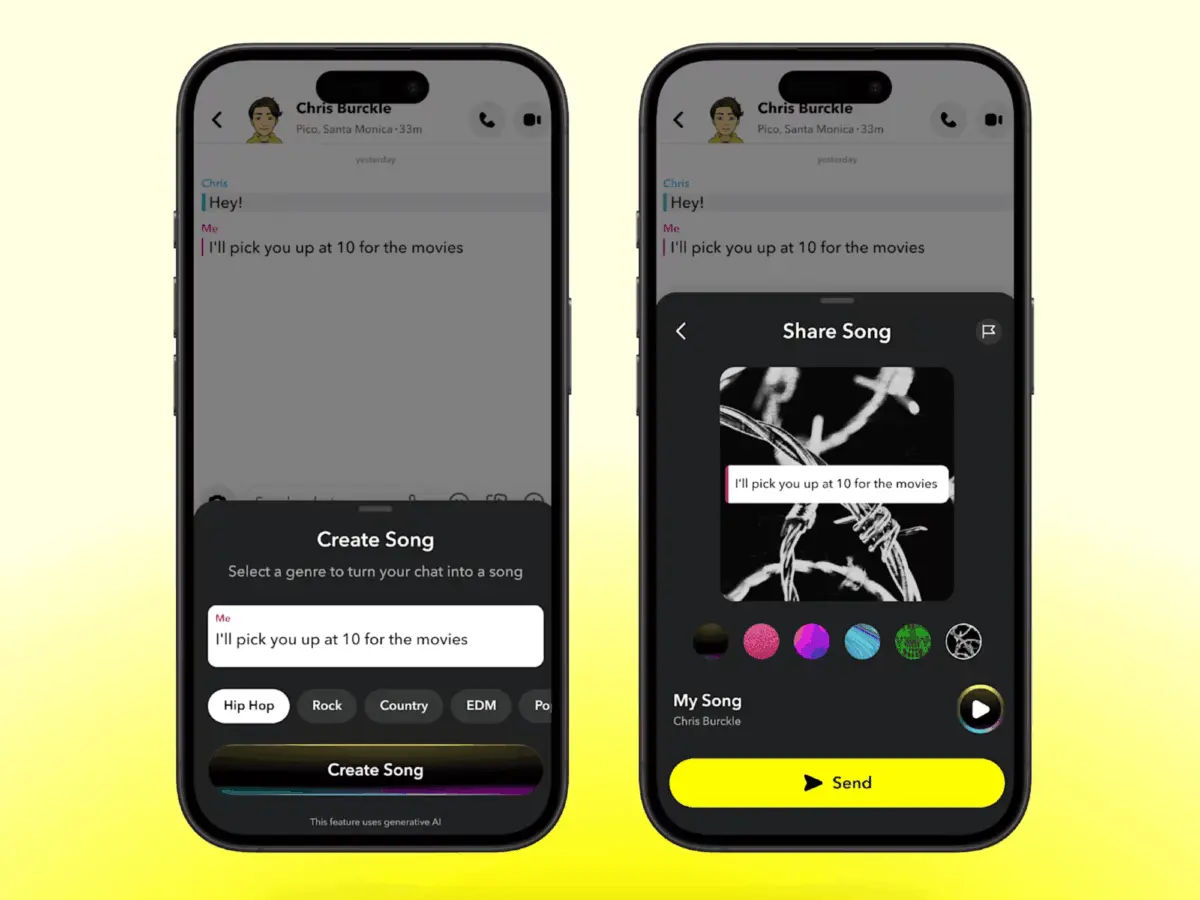
According to official documentation and product breakdowns provided by Snap, the mechanics of "Chat to Song" are designed for seamless, friction-free engagement. In a recent corporate blog post outlining the rollout of new Lens+ AI features, Snap described the process simply:
"Transform chat messages into short original songs. Simply press and hold a message in Chat, select Create Song, choose a musical genre to generate a version of your chat set to music."
Despite the apparent simplicity of the user experience, the underlying engineering and strategic constraints are noteworthy.
1. The Paywall and the Lens+ Ecosystem
At launch, "Chat to Song" is not being rolled out universally to Snapchat’s hundreds of millions of daily active users. Instead, it is locked behind the Lens+ subscription model. This decision reflects a broader industry trend where social media giants are attempting to offset the heavy computational costs of running generative AI models by charging power users a recurring monthly fee. By gating high-demand creative features behind a paywall, Snap can test the infrastructure under a controlled load while simultaneously incentivizing upgrades to its premium tier.
2. Transparency and Disclosures
In an era increasingly plagued by deepfakes, misinformation, and unauthorized synthetic media, platform accountability is under intense scrutiny. Snap has attempted to address this proactively within the interface design. When a user generates a song from a chat thread and sends it to a friend, the resulting audio file is explicitly marked. Promotional screenshots released by Snap reveal that these outputs feature an "AI Song" label alongside the signature sparkle logo—Snapchat’s universal visual shorthand for content generated or enhanced by artificial intelligence. This ensures recipients immediately know the track is a machine-generated interpretation rather than an actual human performance.
Official Statements and Unanswered Questions
While the feature is already making waves among Lens+ subscribers, the launch has raised more questions than answers among industry analysts, legal experts, and music industry stakeholders.
Major questions loom regarding the provenance of the technology itself. To date, Snap has remained notably tight-lipped about the architecture powering "Chat to Song":
- Proprietary vs. Third-Party: Is Snapchat utilizing its own in-house generative audio model, or has it quietly partnered with an external AI-music enterprise (such as Suno, Udio, or another entity)?
- Training Data Transparency: If a third-party model is being utilized—or even if Snap built the model internally—what specific catalog of music was used to train the algorithm?
- Copyright and Licensing: If the underlying model was trained on commercial sound recordings, compositions, or vocal styles, were appropriate licenses secured from music publishers, record labels, and performing rights organizations?
These inquiries are far from academic. The music industry has maintained an aggressive legal and rhetorical stance against generative AI companies that train their models on copyrighted works without explicit authorization or compensation. While generating a short, private comedic song based on a text message between two friends falls into a different category than commercial music distribution, the foundational ingestion of copyrighted audio data remains a major legal gray area. As of publication, Snap has not issued a clarifying statement regarding these copyright concerns.
Future Outlook: The Intersection of Generative Audio and Social Media
Snapchat’s introduction of "Chat to Song" is much more than a novelty feature for paying subscribers; it is a clear indicator of where social media communication is heading. Text is no longer static. As generative AI models become faster, cheaper, and more deeply integrated into consumer software, the boundary between text, audio, and video is blurring rapidly.
What Lies Ahead for Snapchat and Competitors?
- Democratization of the Feature: While "Chat to Song" is currently exclusive to Lens+ subscribers, it is highly probable that Snap will eventually roll out a freemium or ad-supported version to its broader user base once the underlying infrastructure costs stabilize and server capacities scale.
- Competitive Pressure on Rivals: Meta, TikTok, and other major social ecosystems will undoubtedly monitor the reception of Snapchat’s feature closely. If user engagement spikes significantly among Lens+ subscribers, expect competing platforms to fast-track their own native generative audio messaging tools.
- Escalating Legal and Regulatory Scrutiny: As AI-generated audio tools become standard features in consumer software, copyright holders and music industry trade groups will increase pressure on tech platforms to implement strict guardrails, transparent licensing frameworks, and fair compensation models for creators whose styles or works inform these AI models.
Ultimately, "Chat to Song" highlights the relentless drive of social platforms to turn everyday human expression into engaging, shareable media. Whether this feature sparks a lasting shift in how friends communicate digitally or simply serves as a momentary viral distraction remains to be seen. However, one thing is certain: the era of the text message as a purely textual medium has officially come to an end.