
By Ian DeNolfo, Executive Director of The Voice Foundation
Executive Overview
We stand today at a profound inflection point in the history of voice science. Artificial intelligence (AI) and machine learning are no longer theoretical curiosities on the periphery of medicine; they are fundamentally reshaping how researchers conduct investigations, how data is parsed, and how clinicians diagnose and care for patients. This digital transformation does not occur in a vacuum. It is built upon more than half a century of interdisciplinary collaboration, rigorous clinical inquiry, and a steadfast dedication to understanding the most intimate instrument of human expression: the voice.
For decades, the intersection of advanced computing and vocal physiology was largely uncharted territory. Yet, a retrospective look at the literature reveals that the foundational seeds of this revolution were planted much earlier than many realize. Today, as computational power matches the immense biological complexity of human speech, the convergence of AI and voice science has shifted from a slow burn into an exponential explosion. With over sixty percent of all AI-related literature in the premier peer-reviewed publication Journal of Voice appearing in just the last three years, the field is undergoing a massive paradigm shift. Voice is rapidly transitioning from a mere medium of communication into a sophisticated digital biomarker—a non-invasive, highly sensitive window into systemic neurological, psychological, and respiratory health.
A Legacy of Innovation: The Voice Foundation at 55
To understand the weight of the current technological revolution, one must trace the institutional roots that made it possible. In 1969, Dr. Wilbur James Gould founded The Voice Foundation in New York City. At a time when the interdisciplinary care of the human voice was virtually non-existent, Dr. Gould possessed the groundbreaking foresight to break down traditional academic and clinical silos. He brought together a diverse cohort of physicians, scientists, speech-language pathologists, performing artists, and educators to share their unique knowledge and expertise in caring for professional voice users.

Building on this momentum, the Foundation established its first Annual Symposium—Care of the Professional Voice—in 1972, followed by its inaugural Gala (later celebrated as the Voices of Summer) in 1973. For more than five decades, the organization has served as a vital bridge connecting art and science, the clinical examination room and the theatrical stage.
Since 1989, The Voice Foundation has flourished under the visionary leadership of Dr. Robert Thayer Sataloff, an internationally renowned otolaryngologist who is simultaneously a professional singer and conductor. Dr. Sataloff’s monumental academic output includes more than 1,200 publications and 79 textbooks. Under his guidance, the Foundation relocated its headquarters to Philadelphia and dramatically expanded its reach through international symposia and its flagship publication, the Journal of Voice. Today, the annual Philadelphia symposium draws hundreds of medical, scientific, academic, and speech-language professionals, as well as performing artists from across the globe, solidifying the Foundation’s status as the global epicenter of voice research and pedagogy.
Chronology of an AI Revolution: Thirty Years of Machine Learning in the Journal of Voice
While public consciousness of artificial intelligence largely traces back to the recent explosion of generative chat models, the Journal of Voice has been quietly pioneering the publication of AI and neural network research for over three decades.
The trajectory began thirty-one years ago, in 1994, when the journal published a seminal paper by Rihkanen and colleagues titled “Spectral Pattern Recognition of Improved Voice Quality.” Utilizing rudimentary neural networks to analyze voice signatures at a time when the World Wide Web was just entering the public lexicon, this work proved that computational models could identify acoustic patterns invisible to the human ear. The Journal of Voice was actively publishing AI research in voice science before the majority of the scientific community had ever sent an electronic mail message.
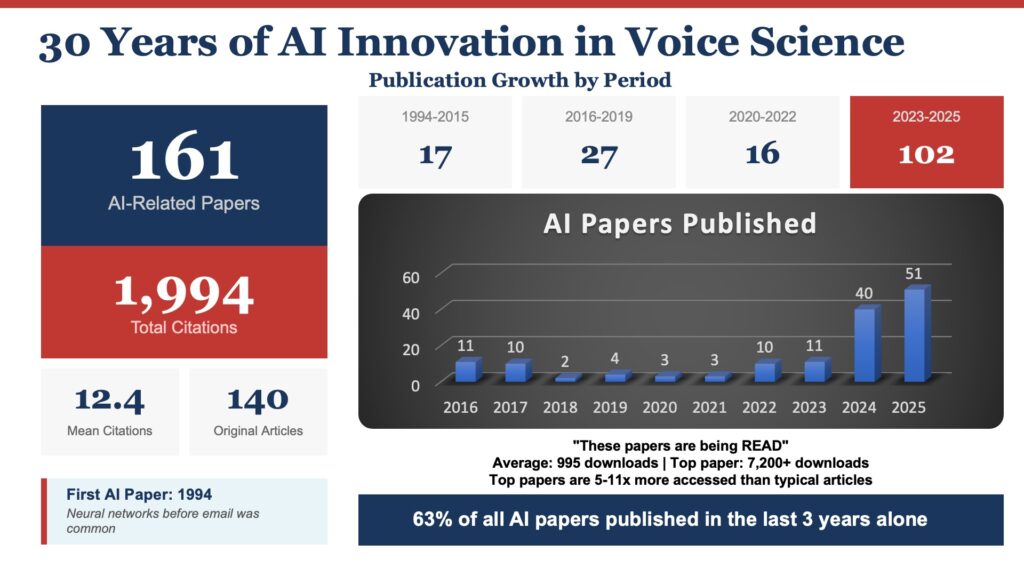
However, the subsequent timeline of publication reveals an unmistakable curve of exponential acceleration:
- 1994–2015: 17 papers
- 2016–2019: 27 papers
- 2020–2022: 16 papers
- 2023–2025: 102 papers
The inflection point is strikingly clear: 102 out of 161 total AI-related papers—representing an astonishing 63 percent—have been published in just the last three years. In the year 2025 alone, the journal published 51 AI-related papers, surpassing the total output of the entire first two decades combined. This is not mere incremental progress; it is an explosive, structural transformation of the discipline.
Supporting Context & Metrics: Beyond Citations to Real-World Impact
Academic output alone does not measure true clinical value. The impact of these computational studies is underscored by extraordinary usage statistics that demonstrate deep engagement from the global healthcare community.
The average AI-focused paper published in the Journal of Voice has been downloaded nearly 1,000 times. Outliers achieve staggering reach: a study exploring machine learning applications for COVID-19 detection surpassed 7,200 downloads, representing eleven times the median readership for articles in that specific issue.
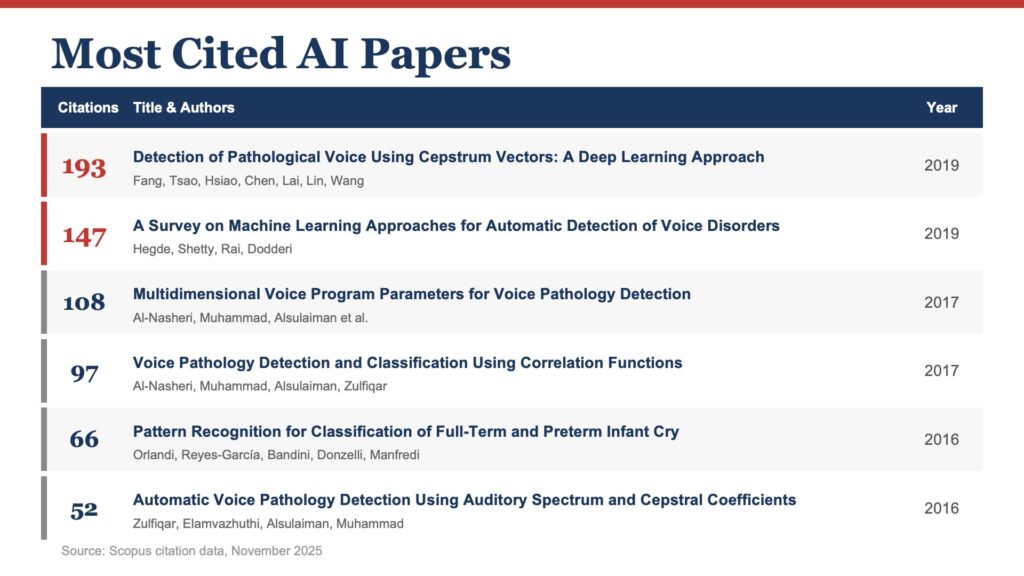
Similarly, the journal’s most-cited papers—such as Fang and colleagues’ deep learning study on pathology detection (193 citations) and Hegde’s machine learning survey (147 citations)—have each been downloaded nearly 5,000 times. Crucially, these high access figures are driven not merely by academic theorists seeking citation metrics, but by active clinicians, practicing speech-language pathologists, and medical researchers searching for pragmatic, real-world diagnostic tools to elevate patient outcomes.
Landmark Research Shaping the Clinical Landscape
Deep Learning for Voice Pathology Detection
Fang and colleagues’ 2019 study, “Detection of Pathological Voice Using Cepstrum Vectors: A Deep Learning Approach,” remains the crown jewel of the journal’s AI archive. By demonstrating that deep neural networks could detect vocal pathologies with extraordinary precision using acoustic parameters imperceptible to human hearing, the paper opened new frontiers in early diagnostics.
This work was supported by foundational reviews like Hegde’s survey on automatic voice disorder detection, alongside subsequent innovations by researchers utilizing one-dimensional convolutional neural networks (1D-CNNs) and deep neural networks for advanced laryngeal image and signal classification.
Voice as a Digital Biomarker
Perhaps the most paradigm-shifting development in recent literature is the conceptualization of the human voice as a digital biomarker—a non-invasive, continuous window into systemic somatic and mental health.

Groundbreaking studies published in the journal have validated the use of voice analysis for tracking the severity and progression of neurodegenerative conditions like Parkinson’s disease. Hemmerling and Wójcik-Pędziwiatr’s 2022 paper on predicting Parkinson’s severity via acoustic signals has rapidly accumulated citations, pushing automated diagnostic tools closer to mainstream clinical adoption.
Beyond neurology, recent systematic reviews have begun exploring vocal parameters as digital sentinels for mental health conditions, including clinical depression and bipolar disorder. The clinical implications are immense: routine, automated acoustic screening could soon flag psychological shifts long before overt clinical symptoms manifest, alleviating the crushing burdens placed on global mental health infrastructure. Similar breakthroughs have been charted in respiratory monitoring, proving that the human voice holds predictive signatures for acute systemic illnesses.
AI Chatbots in Clinical Decision-Making
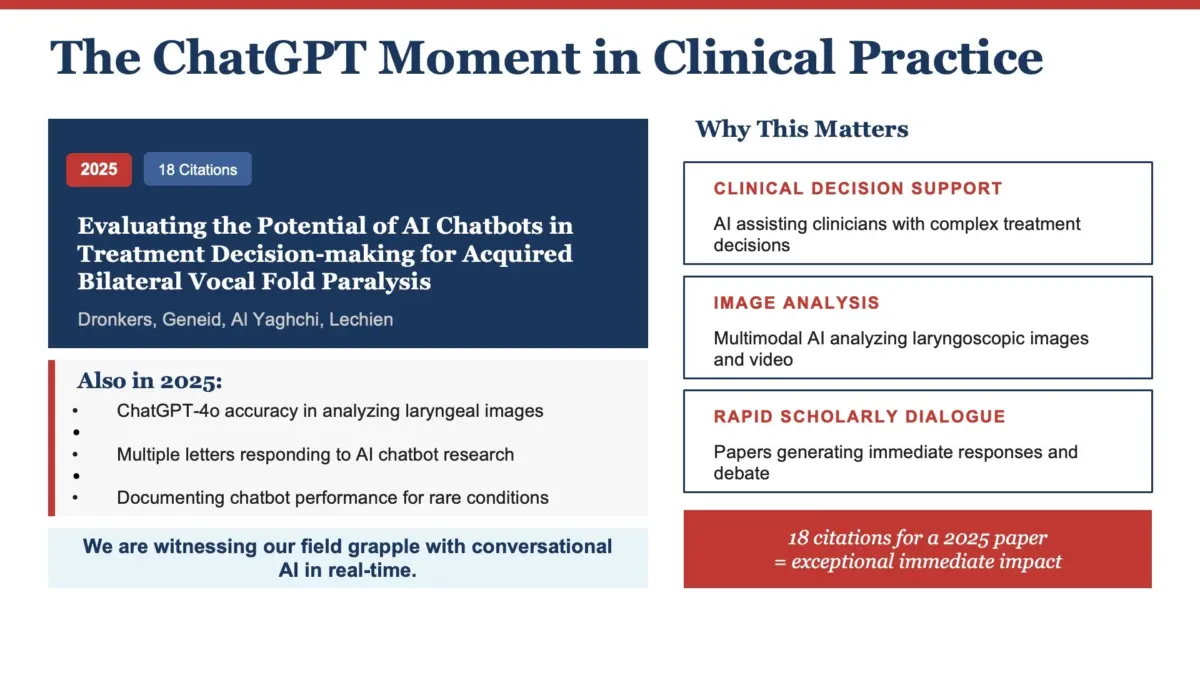
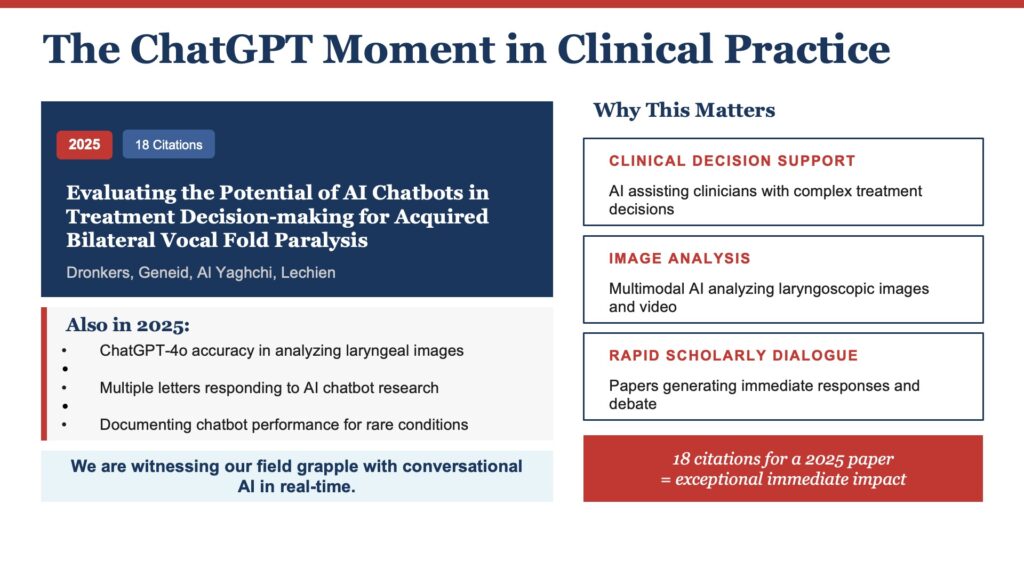
Reflecting the cutting edge of contemporary medicine, the journal recently expanded into evaluating conversational AI and large language models (LLMs) in clinical workflows. A 2025 paper by Dronkers and colleagues, “Evaluating the Potential of AI Chatbots in Treatment Decision-making for Acquired Bilateral Vocal Fold Paralysis,” rapidly accumulated significant scholarly engagement. Triggering rigorous academic discourse, letters to the editor, and subsequent evaluations of conversational agents like ChatGPT-4o in analyzing complex laryngeal imagery, the journal has positioned itself at the literal bleeding edge of medical informatics.
Expert Perspectives on AI in Voice Science
To unpack the human elements behind these computational breakthroughs, two prominent voices in the field offer critical insight into the opportunities and ethical responsibilities of this technological wave.
Dr. Mark Berardi: Managing Complexity and Synthetic Communication
Dr. Mark Berardi brings a unique, highly interdisciplinary perspective to voice science, grounded in physics and computational modeling. For Dr. Berardi, artificial intelligence is, at its core, a sophisticated mechanism for managing complexity.
"Machine learning and AI are tools to help with complexity, and communication is incredibly complex in its neurobiological and physiological processes. So I think the application is warranted," Dr. Berardi notes.
His current research targets voice-based digital biomarkers for human aging and depression. While noting that capturing vocal data has become remarkably straightforward, he emphasizes that the ultimate hurdle remains the inherent intricacy of human neurobiology—precisely the domain where machine learning excels.
On the advent of generative AI, Dr. Berardi maintains a pragmatic outlook. While generative models may not have entirely rewritten fundamental research methodologies overnight, they have successfully dismantled persistent operational bottlenecks. Tasks that once required intensive manual labor—such as bespoke code generation and complex data processing—can now be streamlined through natural-language prompts.
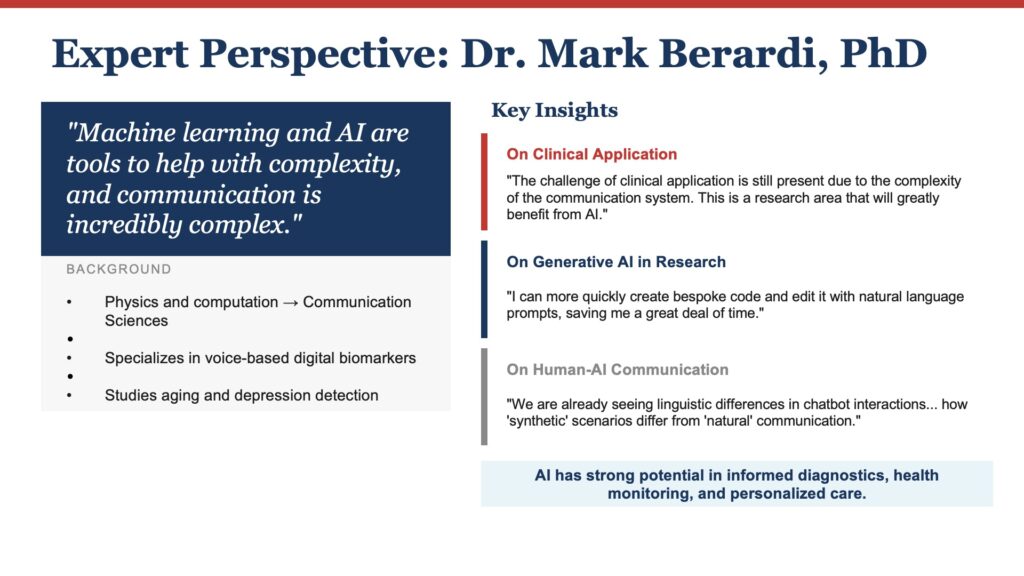
Intriguingly, Dr. Berardi’s work also extends into the emerging field of human-AI communication. He studies how human linguistic patterns shift when interacting with synthetic conversational agents compared to face-to-face dialogue, pointing out that routine digital interfaces like Zoom calls already elicit distinct linguistic adaptations. As society increasingly blurs the lines between human and synthetic interaction, voice science must expand its scope to analyze the human voice in conversation with machines.
Dr. Eric Hunter: Embracing Change with Ethical Clarity
Dr. Eric Hunter focuses heavily on the structural and institutional integrations of AI within academic and clinical workflows.
"These tools aren’t just novelties," Dr. Hunter observes. "They are rapidly becoming integrated into how we conduct literature reviews, organize data, extract themes from large bodies of text, and even summarize findings."
Dr. Hunter argues that large language models and AI-driven infrastructures are permanent additions to the academic ecosystem, seamlessly embedding themselves into collaborative writing, manuscript drafting, and peer review platforms. Rather than fighting a rearguard action against inevitable technological evolution, Dr. Hunter issues a definitive call to action: the scientific community must proactively establish clear, transparent guidance governing appropriate AI usage for both authors and reviewers.
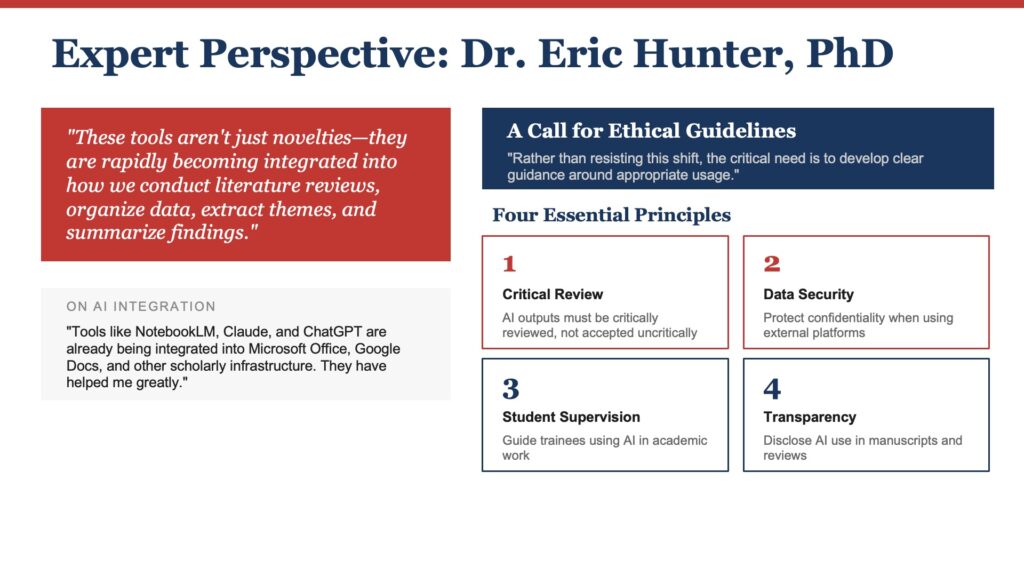
To secure a productive future, Dr. Hunter advocates for a unified framework built on transparency, data provenance, analytical verification, and human accountability. "Our field will benefit most," he concludes, "if we embrace the productivity these tools offer while also building a shared ethical framework for their responsible use."
A Global Research Community
The rapid evolution of AI-driven voice science is supported by a robust, highly collaborative global network. The pages of the Journal of Voice reflect contributions from pioneering labs and prolific researchers spanning every continent. Leading authors such as Jérôme René Lechien, Dimitar Deliyski, Stephanie Zacharias, Ahmed Yousef, Paavo Alku, Leonardo Wanderley Lopes, and Maryam Naghibolhosseini—alongside dozens of international collaborators—are redefining the boundaries of what machine learning can achieve in otolaryngology and speech-language pathology.
This collective enterprise proves that the digital transformation of voice science is not the isolated project of a few experimental computer labs, but rather a worldwide movement driven by shared curiosity and clinical dedication.
Future Outlook and the Path Forward
As the Journal of Voice steps into the future, its foundational mission remains unchanged: publishing rigorous, boundary-pushing research while maintaining uncompromising standards of scientific integrity. However, navigating this new frontier requires deliberate, collective action from the entire scientific community across three vital fronts:

- Thoughtful Engagement: Researchers and clinicians must master AI tools not as autonomous decision-makers, but as sophisticated amplifiers of human expertise designed to parse complexity without supplanting clinical judgment.
- Ethical Frameworks: The entire community must actively collaborate to establish standardized, transparent guidelines for AI utilization in research and publication, heeding calls for institutional responsibility.
- Continuous Knowledge Sharing: With 161 papers serving as a baseline, researchers must continue contributing their discoveries to the global literary corpus, ensuring that the fruits of computational innovation directly reach patient bedsides.
The human voice has served as our fundamental instrument of identity, emotion, and connection for hundreds of thousands of years. It carries the signature of our health and our humanity in ways no other physiological signal can replicate.
Now, for the first time in human history, we possess computational tools sophisticated enough to genuinely decode that complexity—tools that extend the diagnostic reach of expert clinicians, catch subtle pathologies before they manifest as critical illnesses, and democratize access to high-quality voice care across the globe.
We stand at an extraordinary juncture. With the Journal of Voice and The Voice Foundation anchoring this historic transition, the coming decade promises breakthroughs that will forever redefine the science of sound and the art of healing.