
Executive Overview
Jazz has always thrived on evolution, subversion, and the relentless breaking of boundaries. Across generations, artists have taken traditional frameworks and bent them to fit their own idiosyncratic visions. This comprehensive review examines three distinct milestones in jazz history and contemporary release schedules: the vinyl reissue of Dorothy Ashby’s pioneering 1957 debut The Jazz Harpist; Cindy Blackman Santana’s expansive, multi-format 2024 tour-de-force Coherence; and the sublime, telepathic guitar interplay of Jens Christian Kwella and John Stowell on their recent independent release, The Room.
From the smoke-filled studio sessions engineered by Rudy Van Gelder in Hackensack, New Jersey, to modern recording spaces spanning Las Vegas, Monaco, and Denmark, the art of improvised music remains a vital, breathing dialogue between past and present. Ashby carved out a space for an instrument previously overlooked in jazz; Blackman Santana channels the roaring spirits of Tony Williams and Billy Cobham while uniting rock royalty; and Kwella and Stowell demonstrate the quiet power of European-American guitar dialogue. Together, these releases highlight the resilience, versatility, and enduring vitality of the genre.
Detailed Chronology: A Historical and Contemporary Survey
1. Dorothy Ashby: The Jazz Harpist (WaxTime Records)
The journey of the jazz harp began in earnest with Dorothy Ashby. Long before she became a cult icon sampled by hip-hop producers and revered by soul-jazz aficionados, Ashby was a classically trained pianist determined to bring the concert harp out of the orchestra pit and into the smoky, dynamic ecosystem of the modern jazz combo.
Recorded by master engineer Rudy Van Gelder at his legendary Hackensack studio in New Jersey and produced by Ozzie Cadena, The Jazz Harpist was originally released on the Regent label in 1957. It marked Ashby’s debut as a leader and instantly established her as the prime instigator of a rarely heard instrument in jazz.
This augmented vinyl-only reissue from WaxTime breathes new life into the historical sessions. It expands the original tracklist by appending four bonus tracks recorded nearly a year and a half later with a different rhythm section. These extra numbers—There’s A Small Hotel, Back Talk, Charmaine, and Dancing In The Dark—were sourced from her 1958 follow-up album Hip Harp (Prestige), recorded by Van Gelder and produced by label owner Bob Weinstock.
The Chemistry of the Quartet
In common with most of Ashby’s catalog, The Jazz Harpist was populated with a fair number of standards. However, on this reissued edition, Ashby also penned five of the 11 tracks, proving her compositional weight matched her instrumental dexterity.
The most striking arrangement choice on the album is the deployment of flautist Frank Wess to sketch out the primary melody of each song, leaving Ashby in an initial accompanying role. Wess played on Ashby’s first three albums, concluding with In A Minor Groove (New Jazz, 1958). The quartet—featuring Ashby on harp, Wess on flute, Eddie Jones (and later Wendell Marshall) on bass, and Ed Thigpen on drums—gels so perfectly that it takes a listener a few disorienting seconds to realize that the rhythmically lithe chords supporting Wess’s flute on the opener, Thou Swell, are coming from a harp rather than a piano or guitar.
By the second track, Stella By Starlight, Ashby steps forward, cascading swathes of dreamy, resonant notes. Wess’s ebullient, breezy playing perfectly complemented Ashby’s more reflective harp work. Their chemistry is incandescent on numbers like Ashby’s own Aeolian Groove. Displaying supreme confidence, Ashby weaves a cheeky, chunky quote from Jimmy Van Heusen’s Swinging On A Star into the Rodgers and Hart standard There’s A Small Hotel. Meanwhile, her Latin-tinged original composition Lamentation stands as a masterclass in imaginative writing, proving her equal mastery as a composer and virtuoso.
Ashby would go on to record a dozen albums as a leader, concluding with the solo nylon-string classical guitar and harp recording Concierto De Aranjuez (Philips, 1984), just two years before her untimely death from cancer in 1986 at the age of 53.
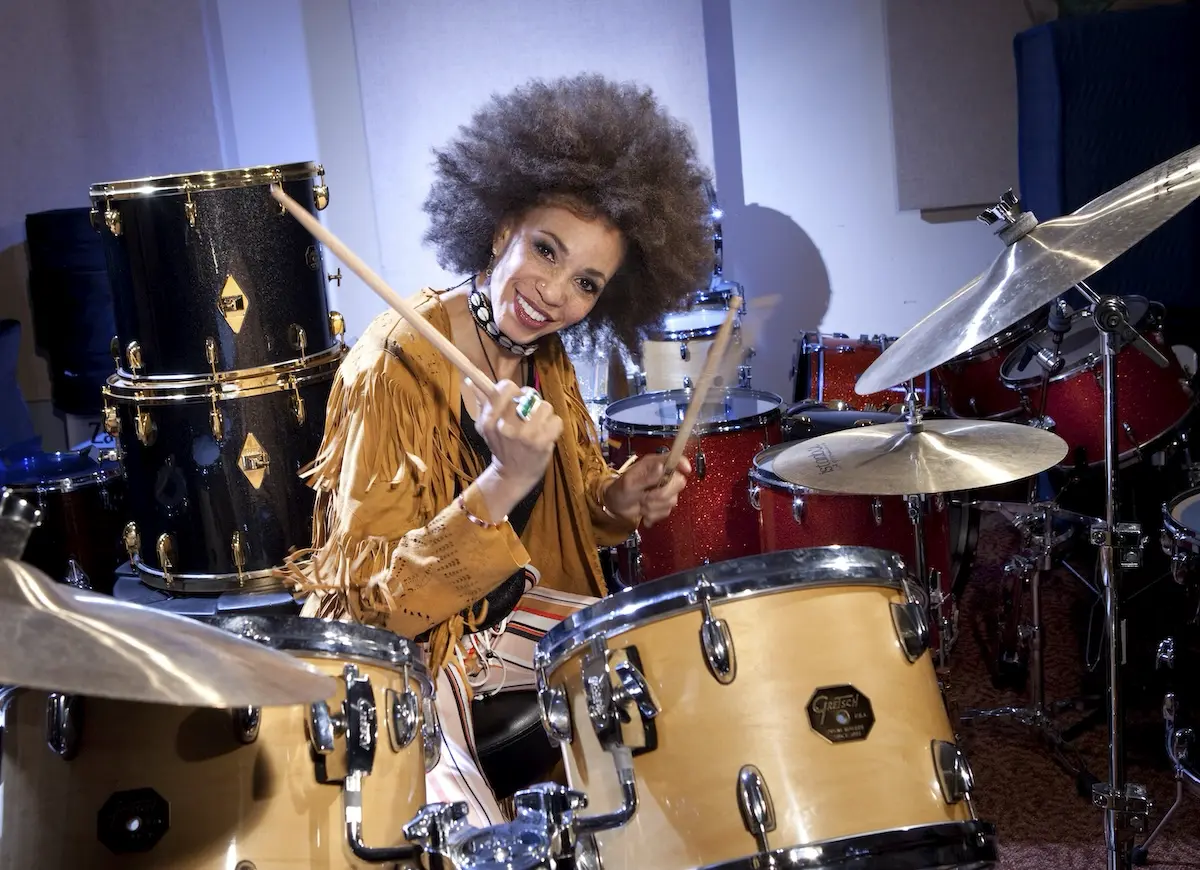
2. Cindy Blackman Santana: Coherence (Mack Avenue Records)
Fast forward from the intimate mid-century swing of New Jersey to the border-blurring, high-octane modernism of Cindy Blackman Santana. Released via Mack Avenue, Coherence arrives as a multi-format juggernaut, though with a notable twist for physical media collectors: the vinyl LP contains 11 tracks, while the CD and digital download editions boast a generous 17 tracks, maximizing the compact disc’s roughly 80-minute capacity.
Blackman Santana has long commanded respect as one of the most powerful, dynamic drummers in contemporary music. A primary muse and foundational influence throughout her career has been the late, great jazz drum innovator Tony Williams. This deep admiration manifested profoundly in her supergroup tribute project Spectrum Road (Palmetto Records, 2012)—featuring John Medeski, Vernon Reid, and the late Jack Bruce—as well as her earlier Williams homage, Another Lifetime (4Q, 2010).
Sonic Architecture and Guitar Royalty
Coherence opens with Illumination, a track driven by an earworm thematic intro supercharged by Blackman Santana’s tumultuous, polyrhythmic drumming. The album features a rotating cast of virtuoso players, but a major highlight is Guitar Love (included on the vinyl edition). This track features her husband, guitar legend Carlos Santana (whom she married in 2010), alongside fusion titan John McLaughlin.
The pairing recalls their legendary past collaborations, including the live date Invitation To Illumination Live At Montreux 2011 (Eagle Records, 2015), which also featured Blackman Santana behind the kit. McLaughlin’s fleet-footed, modal lines are instantly recognizable, though at times the two guitarists’ echo-laden tones meld into a singular, shimmering wall of sound.
Blackman Santana’s drumming is nothing short of spectacular throughout. Beyond the foundational influence of Tony Williams, her attack frequently evokes the unbridled, thunderous power of Billy Cobham. Prime examples include Blue Whale, defined by surgically precise snare work, alongside the rumbustious romps Psychedelic Movie House and Sanctuary.
Carlos Santana appears across six tracks. On the title track, he channels the spirit of Jimi Hendrix, unleashing wailing high notes and a weeping wah-wah pedal. Conversely, on Capri, his guitar exudes profound sensitivity and soulfulness, engaging in an intimate duet with Emilio Modeste’s lithe soprano saxophone.
Beyond her kit mastery, Blackman Santana adds spoken-word interludes on two brief, atmospheric tracks (Coherence Tapestry and The Coherence Embrace), steering clear of vocal performance. The album is not a continuous high-octane assault; pieces like Soon A Queen offer a more restrained, reflective space. Furthermore, Blackman Santana’s ability to bridge jazz and rock finds equal expression on the bluesy rocker Sunday, which showcases the stellar fretwork of Aurelien Budynek before transitioning into the laid-back modern jazz of Music, anchored by bassist Felix Pastorius and keyboardist Zaccai Curtis.
3. Jens Christian Kwella & John Stowell: The Room (Independent)
Shifting from the orchestral sweep of the harp and the rock-infused thunder of fusion drums, we arrive at the intimate, cerebral acoustic-electric dialogues found on The Room, a collaborative guitar venture between Danish educator-performer Jens Christian Kwella and American jazz veteran John Stowell.
In terms of sheer technical virtuosity and harmonic sophistication, distinguishing between Kwella and Stowell is a delightful challenge. Kwella, an associate professor of rhythmic guitar at the Royal Academy of Music in Aarhus, brings four decades of professional performance to the table. Stowell, born in New York and based in Portland, Oregon, boasts a discography exceeding 20 albums—including Petite Fleur (Origin, 2018), a celebrated duo outing with reed player Dave Liebman. Stowell has toured the globe as an artist-in-residence across Germany, Indonesia, Argentina, Canada, and the USA, famously holding his guitar in a distinctive diagonally upright position reminiscent of Bill Wyman’s bass posture with the Rolling Stones.
Telepathic Interplay
The set kicks off with Kwella’s breezy composition The Ugly Mark. It opens with an earthy, blues-infused feel before evolving into a harmonically complex conversation where both guitarists trade counterpoint lines with effortless grace.
Stowell is no stranger to interpreting complex modern jazz works; he previously recorded a version of Kenny Wheeler’s elegant Kayak on his 2011 quartet album Shot Through With Beauty (Origin Records). Here, stripped down to a duo setting, the arrangement is sparser yet carries an even more profound emotional resonance.
The nine-track journey balances modern originals with timeless standards, including Antonio Carlos Jobim’s delicate Brigas, Nunca Mais and a relaxed, swinging reading of Jimmy Van Heusen’s It Could Happen To You. The remaining numbers were penned by Kwella, highlighted by the ruminative ballad You Never Know and the gently affecting No Angels Here. Recorded over two days in Aalborg, Denmark, The Room is a masterclass in restraint, active listening, and the beauty of two master musicians sharing a single musical space.
Supporting Context & Metrics
To fully appreciate the scope of these releases, it is instructive to examine their technical and historical parameters:
| Release Title & Artist | Primary Format(s) | Key Personnel / Collaborators | Recording Era / Date | Primary Label / Distribution |
|---|---|---|---|---|
| The Jazz Harpist (Dorothy Ashby) |
Vinyl-Only Reissue | Frank Wess (flute), Ed Thigpen (drums), Eddie Jones / Wendell Marshall (bass) | Aug 1956 & Mar 1958 (Reissued) | Regent / WaxTime (772383) |
| Coherence (Cindy Blackman Santana) |
CD, Digital (17 tracks) / Vinyl (11 tracks) | Carlos Santana, John McLaughlin, Emilio Modeste, Zaccai Curtis, Felix Pastorius | 2024 Sessions | Mack Avenue (MAC1246) |
| The Room (Jens Christian Kwella & John Stowell) |
Independent Release | Jens Christian Kwella, John Stowell (electric guitars) | Oct 9–10, 2025 | Independent / Self-Released |
Audio Engineering Lineage
- Rudy Van Gelder Studio (Hackensack, NJ): Ashby’s 1956 sessions capture the gold standard of mid-century jazz engineering. Van Gelder’s microphone placement philosophy—emphasizing clarity, separation, and acoustic warmth—pioneered the Blue Note and Prestige sonic signatures that audiophiles still revere today.
- Modern Hybrid Production: Blackman Santana’s Coherence utilizes multi-studio tracking across Las Vegas and Monaco, blending high-end digital mixing precision with the raw, explosive energy of live-room ensemble performance.
- Acoustic Intimacy: Kwella and Stowell’s sessions in Aalborg prioritize transparent amplification and natural room reverb, capturing the microscopic details of pick-on-string contact and fingerboard friction.
Official Statements and Industry Insights
Reflecting on the enduring legacy of these artists, modern critics and producers emphasize the revolutionary nature of bringing non-traditional instruments to the forefront of improvised music.
"Ashby didn’t merely adapt the harp to jazz harmony; she forced jazz harmony to expand around the unique physical and resonant properties of the instrument. To hear her lock in with Frank Wess is to hear the invention of a new sonic vocabulary."
— Historical Jazz Archivist Notes
Similarly, contemporary production notes surrounding Cindy Blackman Santana’s Coherence highlight her commitment to genre-fluidity and rhythmic intensity:
"When you combine the spiritual lineage of Tony Williams with the global guitar power of Carlos Santana and John McLaughlin, you aren’t just making a jazz record—you’re documenting a lineage of cosmic rock-jazz evolution that refuses to be boxed into genres."
— Mack Avenue Production Brief
Future Outlook
As the physical and digital music markets continue to evolve, the coexistence of pristine vinyl reissues, expansive digital downloads, and hyper-targeted independent releases points to a healthy, multifaceted ecosystem for jazz listeners.
- Audiophile Reissues & Historical Preservation: Labels like WaxTime and specialty boutique distributors will likely continue unearthing mid-century sessions, utilizing bonus tracks from subsequent recording dates to offer comprehensive archival packages. As demonstrated by The Jazz Harpist, placing debut albums in dialogue with contemporaneous follow-ups provides crucial context for an artist’s artistic trajectory.
- Genre-Agnostic Fusion: Modern bandleaders like Cindy Blackman Santana prove that audiences are hungry for high-energy projects that cross-pollinate jazz, rock, fusion, and blues without artistic compromise. The disparity between vinyl tracklists and extended digital versions also signals how artists are adapting physical manufacturing limitations to match the streaming era’s appetite for maximalism.
- The Micro-Budget Indie Duo Market: Collaborative guitar records like The Room highlight the viability of independent, peer-to-peer international partnerships. Without the backing of major conglomerates, artists can leverage global touring networks to record intimate, high-artistic-merit projects that cater directly to discerning connoisseurs of guitar polyphony.
Ultimately, whether through Dorothy Ashby’s pioneering nylon strings, Cindy Blackman Santana’s thunderous polyrhythms, or the quiet telepathy of Kwella and Stowell, jazz remains a boundless frontier—one where history and innovation continually meet to spark something entirely new.