
Executive Overview
At the 150th-anniversary milestone of Richard Wagner’s monumental Der Ring des Nibelungen, the hallowed Bayreuth Festspielhaus became the crucible for one of the most polarizing experiments in modern operatic history. Titled Ring 10010110: From Myth to Code—with the binary digits representing the festival’s sesquicentennial—the production bypassed the traditional theater director entirely. Instead, it handed the helm of staged perception over to a collective of engineers, digital artists, and artificial intelligence systems.
Conceived by Marcus Lobbes and engineered through the collaborative technical wizardry of Nils Corte, Andri Hardmeier, Roman Senkl, and Phil Hagen Jungschlaeger, the production dissolved conventional stagecraft. In its place, they erected a holographic, data-driven environment. Over a thousand documents from the Festspielhaus’s historic archives were fed into neural networks to generate real-time, algorithmically driven visuals that enveloped the stage.
While the experiment drew sharp divisions among critics and provoked vocal dissent from traditionalists—resulting in the customary chorus of Bayreuth boos—it fundamentally challenged how opera interacts with time, memory, and technology. Paired with the peerless musical direction of Maestro Christian Thielemann, Ring 10010110 offered a breathtaking, if disquieting, glimpse into a future where human vocal mastery intersects with artificial intelligence. This synthesis forces us to confront uncomfortable questions regarding the boundaries of artistic creation and the preservation of human consciousness.
Detailed Chronology: The Mechanics of a Digital Rheingold
To understand the architecture of Ring 10010110, one must examine Das Rheingold as the foundational testing ground for the broader tetralogy’s visual and mechanical philosophy. The production’s methodology discarded the traditional duties of the stage director, dramaturg, and set designer, replacing them with "engineers of staged perception."
The Holographic Environment and Tracking Systems
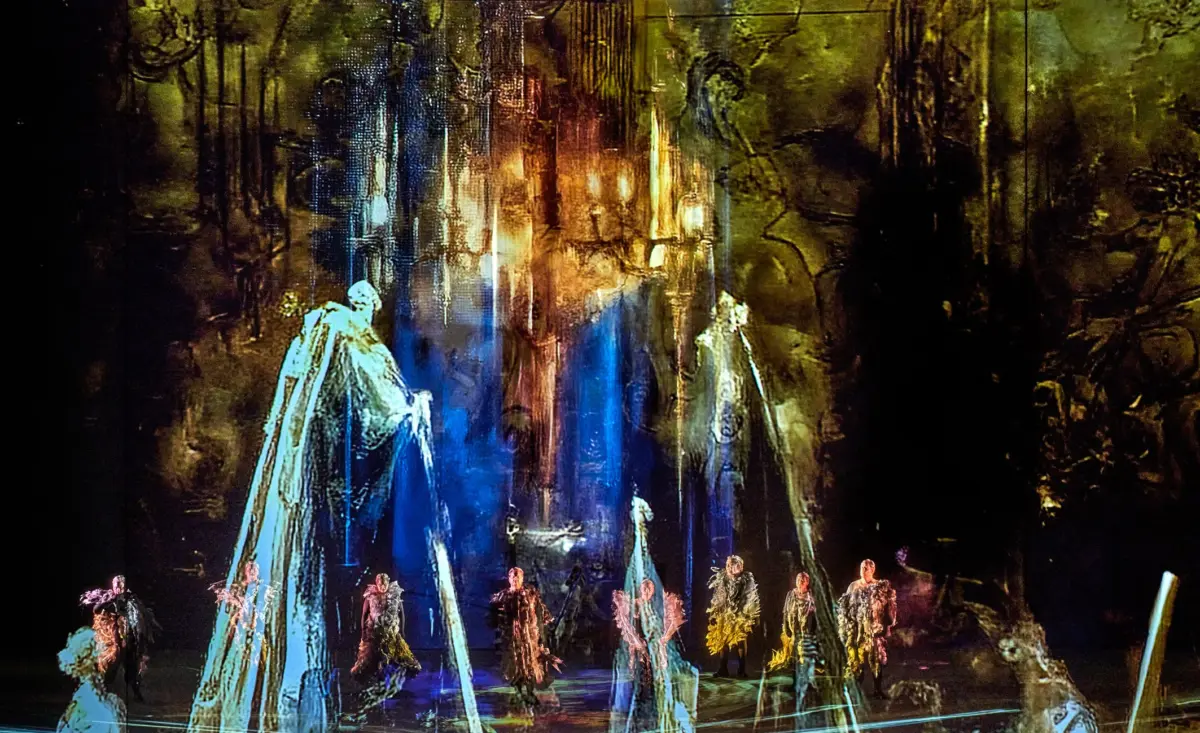
From the moment the legendary four-minute Prelude began—that primordial, lulling world-creation born of a half-dream on the Mediterranean—the Festspielhaus was transformed. Transparent tulle screens lined the stage, functioning as active surfaces for a relentless stream of cinematographic framing.
The stage was not merely decorated; it was entirely engulfed. Performers’ physical positions were tracked in real time, libretto texts were continuously analyzed, and the sound frequencies of both singers and orchestral instruments were absorbed into the system’s runtime parameters. The algorithmic apparatus selected and projected images from Bayreuth’s 150-year archive in a perpetual, round-robin loop.
This created a hypnotic, almost brain-washing cascade of visuals. Spectators reported a sensory overload of references to nature, dystopian industrial cities, and humanitarian figures flashing by at breakneck speeds. During intervals, audience members debated whether fleeting images were photographs, moving blurs, or dissolving masses.
Glitch Silhouette Art and Visual Sampling
A defining aesthetic of the production was Glitch Silhouette Art (or Pixelated Shape Distortion). This technique stripped away facial features, clothing textures, and lighting within the outlines of historical photographs, filling the remaining silhouettes with digitized artifacts.
A prime example occurred during the appearance of the giants Fafner and Fasolt. The system projected the hunched, balding, Cro-Magnon-esque outlines of the giants from Patrice Chéreau’s centennial Ring of 1976. Later, it sampled Harry Kupfer’s laser-outlined red cube for Brünnhilde’s "Magic Fire" scene from Die Walküre, as well as the lesser-known Kirschner-Rosalie standing-triangle sail.
These images did not merely decorate the background; they hung in space like production design sketches. They forced the audience to reckon with the Festival’s history through a distorting computational lens, bridging the gap between archival nostalgia and digital abstraction.
Supporting Context & Metrics: Philosophical, Psychological, and Musical Dimensions
The Metaphysics of Time and the Unconscious
Philosophically, Ring 10010110 operated within Henri Bergson’s metaphysics of illo tempore—the deep, qualitative experience of time. Just as a child viewing a video game stream taps into recurrent human archetypes, the Bayreuth audience was asked to experience images rather than merely analyze them.
Psychologically, the algorithmic glitches and shifting forms acted as externalizations of the unconscious impulses and tensions embedded in Wagner’s tetralogy. As anonymous aphorists note, “An abundance of new experiences or images may unsettle our realities; perception and intuition alone will bring us to surpassing their cosmic illusions.”
The "Parliament of Owls" Costuming
Physical staging was deliberately pared down. Costume designer Pia Maria Mackert outfitted the entire cast in nearly identical, dark grey, feathered garments that remained unchanged across the entire opera.
Rigid and somnambulistic, these outfits restricted natural movement, turning the performers downstage center into a living family portrait. To many, the performers resembled stocky, stiff owls. In zoological terms, a group of owls is known as a "Parliament"—a fitting metaphor for the men and gods of the Ring gathering to debate their doom in true Wagnerian fashion. While critics decried the costumes as indistinguishable and awkward, they successfully stripped away superficial theatrical realism, forcing the audience to project psychological motivations onto blank cinematic canvases.
Thielemann’s Musical Architecture
Musically, Maestro Christian Thielemann anchored the chaotic digital ecosystem with authoritative precision. Conducting with the stage curtain firmly closed during preludes, prologues, and scene changes—a refreshing rejection of modern directorial pantomimes—Thielemann embraced the Gesamtkunstwerk ideal.
Rather than letting the AI visuals lead the orchestra on a leash, Thielemann integrated electronic transitions into his musical phrasing. The orchestra achieved a chamber-opera lightness before swelling into opulent, Brucknerian climaxes. This musical mastery provided an emotional anchor, proving that the human core of the performance remained uncompromised by the surrounding digital machinery.
Official Statements and Artist Perspectives
The transition from human-led staging to algorithmic execution placed extraordinary demands on the cast. Behind-the-scenes accounts reveal a complex mix of liberation and exhaustion among the performers.
-
Michael Volle (Wotan):
One of today’s preeminent interpreters of Wotan praised the clarity of the production’s framework, reportedly telling Marcus Lobbes:"This is fantastic, the instructions are very clear: I stand here, I sing, I have a blast."
However, Volle also confessed to the physical and mental toll of the role, noting:
"I found it much more exhausting than I expected. It demands even greater concentration."
The prolonged immobility required by the staging forced singers to channel their dramatic energies entirely through vocal nuance and static physical presence.
-
The Creative Collective:
The artistic vision was driven by a multidisciplinary team:- Conception: Marcus Lobbes
- Technical & Visual Art Concepts: Nils Corte
- Dramaturgy: Andri Hardmeier
- Digital & AI Storytelling: Roman Senkl
- Creative Coding & Visuals: Phil Hagen Jungschlaeger and Nils Corte
- Scenery: Wolf Gutjahr
- Costumes: Pia Maria Mackert
In defense of their vision, the creative team argued that stripping away the traditional stage director opened up minds to perceive different realities of theatrical representation across time and space, bypassing the increasingly stale tropes of conventional Regietheater.
Future Outlook: The Horizon of Immersive Opera
Ring 10010110 leaves the opera world at a critical philosophical crossroads. The production forces us to ask whether artificial intelligence represents the dawn of a new theatrical paradigm or merely a sophisticated parlor trick destined to fade into memory.
When MIT staged an Augmented Reality (AR) production of Parsifal in 2023, critics similarly debated the viability of immersive technologies in classical music. Yet, three years later, that conversation had largely fizzled, reduced to QR codes printed in theater programs.
The ultimate warning of Bayreuth’s sesquicentennial experiment is profound: if computational algorithms begin to dictate the emotional and visual heavy lifting of art, humanity risks becoming the robot, outsourcing its hard-won individual expression to machines.
As audiences filed out of the Festspielhaus following Das Rheingold, the division was palpable. Some saw the production as an intellectual dead-end that stunted artistic imagination; others recognized it as the foundational stone for a radical new theatrical vocabulary. Ultimately, Valhalla cannot be illuminated by code alone. As Wagner’s sweeping orchestral universe flows forward into an uncertain technological age, it remains humanity—and humanity alone—that must continue to interpret the divine machinery of our own creation.