
Executive Overview
The landscape of modern jazz is a dynamic continuum, continually bridging its storied past with contemporary innovation. Recent archival releases and cutting-edge contemporary albums offer a profound look at this evolution, highlighting artists who have redefined the boundaries of rhythm, harmony, and instrumental orchestration. At the center of this musical dialogue are three distinct releases: a vinyl reissue of Dorothy Ashby’s pioneering 1957 debut, The Jazz Harpist; Cindy Blackman Santana’s expansive, high-octane 2024 contemporary masterwork, Coherence; and the sublime acoustic-electric guitar dialogue of Jens Christian Kwella and John Stowell on The Room.
Together, these recordings illustrate the expansive breadth of jazz aesthetics. Ashby’s work elevated a classical, underutilized instrument into a legitimate, swinging jazz voice. Blackman Santana channels the torrential energy of fusion legends like Tony Williams and Billy Cobham while forging a modern synthesis of rock, blues, and modal jazz alongside elite collaborators like Carlos Santana and John McLaughlin. Meanwhile, the transatlantic guitar partnership of Kwella and Stowell demonstrates the timeless power of subtle, intricate harmonic interplay. This report provides an exhaustive journalistic examination of these releases, tracing their historical chronologies, technical metrics, artistic statements, and future implications for the genre.
Detailed Chronology
The Mid-Century Vanguard: Dorothy Ashby’s 1957 Breakthrough
The historical timeline of jazz innovation features few moments as quietly revolutionary as the emergence of Dorothy Ashby. Recorded by legendary engineer Rudy Van Gelder at his Hackensack studio in New Jersey and produced by Ozzie Cadena, The Jazz Harpist (originally released on the Regent label in 1957) marked a watershed moment for the instrument. Historically, the harp was viewed as an exotic, ornamental texture in jazz—if it was utilized at all. Ashby not only claimed the instrument as a viable lead voice but established a standard of improvisational fluency that few have matched since.
The narrative of this seminal recording is further enriched by WaxTime’s vinyl-only reissue strategy, which appends four bonus tracks recorded nearly a year and a half later. Pulled from her 1958 Prestige follow-up, Hip Harp—produced by label owner Bob Weinstock and again captured by Van Gelder—these extra selections (There’s A Small Hotel, Back Talk, Charmaine, and Dancing In The Dark) chronicle Ashby’s rapid artistic maturation.
In her initial 1956 sessions with flautist Frank Wess, bassist Eddie Jones, and drummer Ed Thigpen (and later Wendell Marshall), Ashby brilliantly balanced accompaniment and melody. Wess’s ebullient flute sketched out primary melodies, allowing Ashby to lay down rich, cascading harmonic beds before stepping forward with confident, sparkling solos. Over the course of her twelve albums as a leader—culminating in her 1984 solo recording Concierto De Aranjuez shortly before her passing in 1986—Ashby cemented a legacy that continues to inform contemporary jazz arrangers.
The Fusion Continuum: Cindy Blackman Santana’s Coherence (2024)
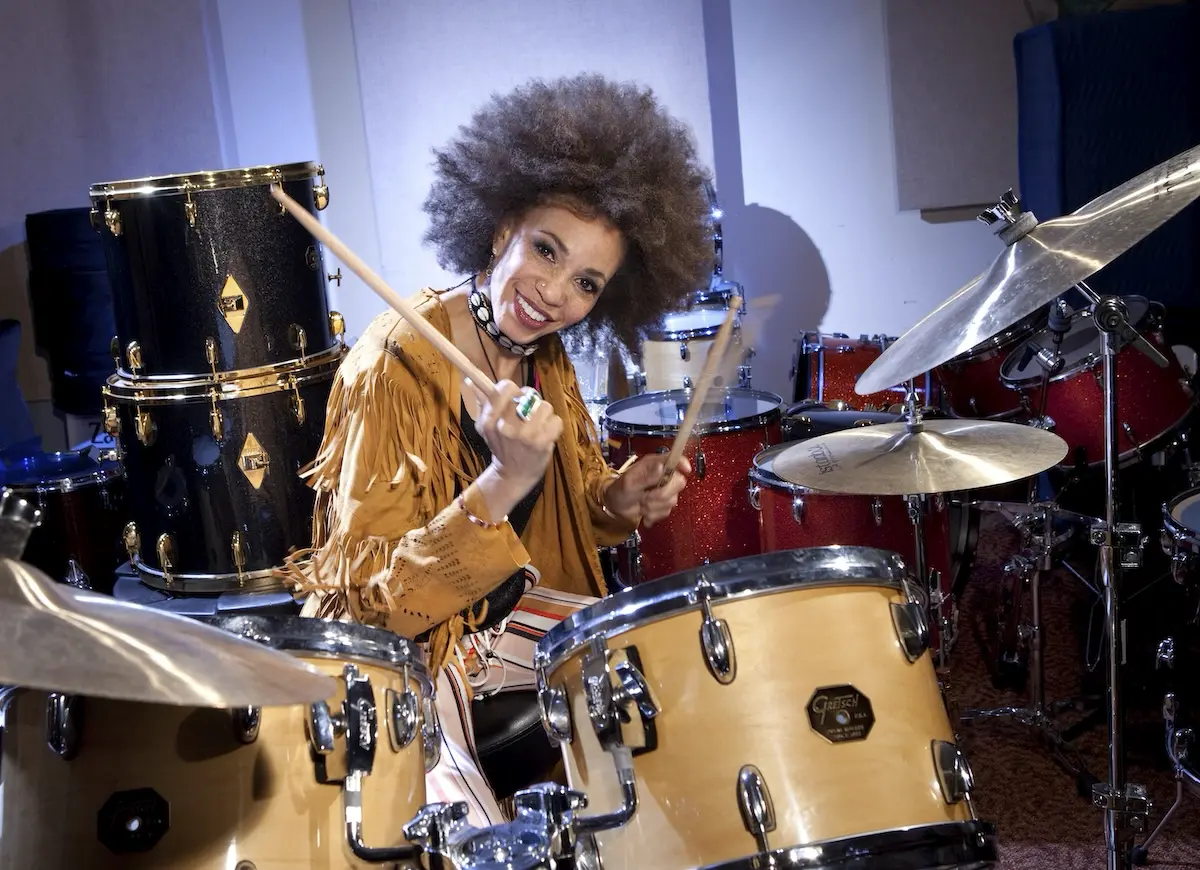
Fast-forwarding to the modern era, percussionist and composer Cindy Blackman Santana represents the lineage of high-energy, spiritually charged fusion pioneered by icons like Tony Williams and Billy Cobham. Blackman Santana’s artistic timeline includes pivotal homages to Williams, such as her work on Another Lifetime (2010) and the supergroup project Spectrum Road (2012) alongside John Medeski, Vernon Reid, and the late Jack Bruce.
These foundational projects directly informed the conceptual architecture of her 2024 release, Coherence (Mack Avenue). Released across multiple formats with notable variations in tracklists—the vinyl edition curates 11 tracks, while the CD and digital iterations expand to 17 tracks to maximize an 80-minute runtime—the album is a masterclass in stylistic versatility.
The chronological journey of Coherence moves from the earworm hooks and tumultuous drumming of the opener Illumination to fiery collaborations with guitar legends Carlos Santana (her husband, whom she married in 2010) and John McLaughlin. This reunion of sorts builds upon their prior collaborative history, most notably the 2011 Montreux jazz festival captured on Invitation To Illumination Live At Montreux 2015. Through tracks like Blue Whale, Psychedelic Movie House, and the blues-infused rocker Sunday featuring Aurelien Budynek, Blackman Santana bridges the gap between classic 1970s jazz-rock fusion and contemporary sonic adventurism.
The Transatlantic Acoustic Dialogue: Kwella & Stowell’s The Room (2025)
At the opposite end of the sonic spectrum in terms of volume, yet equally rich in historical context, is the guitar pairing of Denmark’s Jens Christian Kwella and American master John Stowell on The Room. Scheduled for release following their sessions in Aalborg, Denmark, in October 2025, this independent project represents decades of accumulated professional mastery.
Kwella brings four decades of professional experience and academic rigor as an associate professor of rhythmic guitar at the Royal Academy of Music in Aarhus. Stowell, a veteran of 20 albums—including notable collaborations with Dave Liebman such as 2018’s Petite Fleur—brings an international pedigree forged through artist-in-residence appointments across Indonesia, Argentina, Canada, Germany, and the United States.
The chronological trajectory of The Room is an exercise in dynamic contrast, opening with Kwella’s breezy, blues-inflected The Ugly Mark and moving through thoughtful interpretations of modern jazz compositions like Kenny Wheeler’s Kayak (previously explored by Stowell on his 2011 quartet album Shot Through With Beauty). Interspersing timeless standards like Antonio Carlos Jobim’s Brigas, Nunca Mais with originals like Kwella’s You Never Know, the album captures two master guitarists operating at the absolute peak of their communicative powers.
Supporting Context & Metrics
To fully appreciate the scope of these three releases, it is instructive to examine their technical specifications, production metrics, and personnel configurations.
| Release Title & Artist | Primary Format / Label | Recording Date / Location | Core Personnel & Instrumentation | Runtime / Track Distribution |
|---|---|---|---|---|
| The Jazz Harpist (Dorothy Ashby) |
Vinyl Reissue (WaxTime Records 772383) |
Aug 1956 & Mar 1958 Hackensack, New Jersey |
Dorothy Ashby (hp) Frank Wess (fl) Ed Thigpen (d) Eddie Jones / Wendell Marshall / Herman Wright (b) |
~49 minutes total (11 tracks on augmented reissue) |
| Coherence (Cindy Blackman Santana) |
Multi-format: Vinyl, CD, Digital (Mack Avenue MAC1246) |
2024 Las Vegas & Monaco |
Cindy Blackman Santana (d, v) Emilio Modeste (ts, ss) Zaccai Curtis (kyb) Carlos Santana, John McLaughlin, Aurelien Budynek (elg) Felix Pastorius (elb) |
79:56 (CD/Digital: 17 tracks) 11 tracks (Vinyl edition) |
| The Room (Kwella & Stowell) |
Independent Release | Oct 9–10, 2025 Aalborg, Denmark |
Jens Christian Kwella (elg) John Stowell (elg) |
45:19 (9 tracks) |
Production Engineering and Acoustic Signatures
A common thread uniting Ashby’s historical recordings and contemporary jazz masterworks is an uncompromising commitment to acoustic fidelity. Rudy Van Gelder’s engineering on Ashby’s 1956 and 1958 sessions captured the delicate transients of the harp without losing its warmth, ensuring that the instrument could sit comfortably alongside the reedy warmth of Frank Wess’s flute and the crisp snap of Ed Thigpen’s snare.
Similarly, Coherence employs pristine modern production techniques to balance the colossal, unbridled power of Blackman Santana’s drumming with the intricate multi-guitar textures of Carlos Santana, John McLaughlin, and Aurelien Budynek. Whether utilizing echo-laden soundscapes that meld the two veteran guitarists into a singular voice or capturing the surgically precise snare work on Blue Whale, the album’s engineering serves its vast dynamic range.
For Kwella and Stowell, the acoustic challenge was entirely different: capturing the intimate, conversational nuances of two electric guitars in an uncompressed setting. Recorded over two days in Denmark, The Room relies on spatial separation and transparent amplification to highlight the unique playing posture of Stowell—who holds his instrument in a diagonally upright position—and Kwella’s fluid harmonic phrasing.
Official Statements & Critical Perspectives
Dorothy Ashby: Breaking New Ground
Reflecting on the critical reception of Dorothy Ashby’s early work, jazz historians have long noted how her background in classical piano and harp informed her radical approach to improvisation. Writing on the chemistry between Ashby and Frank Wess, critics frequently highlight how Wess’s ebullient flute work acted as a foil for Ashby’s introspective, reflective harmonic structures.
As noted in contemporary retrospectives of The Jazz Harpist, Ashby’s confidence as a composer was equal to her technical virtuosity. Her ability to weave spontaneous melodic quotations—such as inserting a cheeky reference to Jimmy Van Heusen’s Swinging On A Star during Rodgers and Hart’s There’s A Small Hotel—proved that she viewed the jazz songbook as a living, breathing canvas rather than a rigid set of rules.
Cindy Blackman Santana: Channeling Fusion Royalty
Cindy Blackman Santana has frequently spoken about the profound influence of Tony Williams on her musical philosophy. In promotional statements surrounding Coherence, she emphasizes that rhythm is not merely a timekeeping device, but a vehicle for spiritual expression and narrative storytelling.
"When you play with the intensity and fire that Tony [Williams] modeled for us, you aren’t just playing beats; you are commanding an ensemble’s emotional trajectory," Blackman Santana has noted regarding her approach to rhythm.
Critics have lauded Coherence for successfully bridging generations of fusion greats. The interplay between Carlos Santana and John McLaughlin on tracks like Guitar Love has been praised by jazz journalists as a masterclass in telepathic communication, where decades of shared musical history culminate in effortless, high-velocity exchange. Furthermore, performances by younger virtuosos like bassist Felix Pastorius and saxophonist Emilio Modeste underscore Blackman Santana’s commitment to mentoring and elevating the next generation of jazz innovators.
Kwella & Stowell: The Art of the Duo
In statements regarding their collaborative philosophy, both Jens Christian Kwella and John Stowell emphasize active listening and structural minimalism. Playing in a chordal-melody guitar duo requires a delicate balancing act to avoid sonic overcrowding.
Stowell has often remarked on the pedagogical and artistic value of stripping arrangements down to their bare essentials. "When there are only two guitars, there is nowhere to hide," Stowell observes. "Every note, every chord voicing, and every moment of silence carries the weight of the entire arrangement." This philosophy is acutely evident on The Room, where standards like It Could Happen To You and originals like No Angels Here are treated with an exquisite, breathing vulnerability that showcases their shared commitment to harmonic depth.
Future Outlook
The release of these three diverse projects points to a vibrant, multifaceted future for jazz recording and performance. As physical media continues to experience a renaissance—evidenced by WaxTime’s vinyl-exclusive bonus tracks for Ashby, Mack Avenue’s multi-format rollout for Blackman Santana, and independent artist-led releases like Kwella and Stowell’s—audiences are demanding deeper archival preservation alongside forward-thinking contemporary statements.
- Archival Revaluation: The rediscovery of Dorothy Ashby’s catalog signals a broader industry trend toward re-evaluating pioneering female instrumentalists who were historically sidelined by mid-century genre gatekeeping. As younger harpists and string players look to Ashby as a foundational architect, labels are likely to dig deeper into broadcast transcriptions and unreleased live sessions.
- The Fusion Renaissance: Artists like Cindy Blackman Santana are proving that high-energy electric jazz-rock fusion remains a potent, evolving vehicle. By fluidly integrating rock guitar royalty with modern jazz improvisers, Blackman Santana points toward a borderless future where genre boundaries are porous and collaborative cross-pollination is paramount.
- Intimate Acoustic Collaborations: In an era dominated by maximalist digital production, the stripped-down, conversational aesthetic championed by Kwella and Stowell on The Room demonstrates a growing audience appetite for organic, acoustic intimacy. Masterclasses in listening and space will continue to find eager listeners among musicians and audiophiles alike.
Ultimately, whether through the sparkling harp cascades of 1957, the thunderous polyrhythms of 2024, or the delicate guitar dialogue of 2025, jazz continues to thrive on a delicate balance of reverence for its pioneers and an insatiable hunger for new horizons.