
Executive Overview
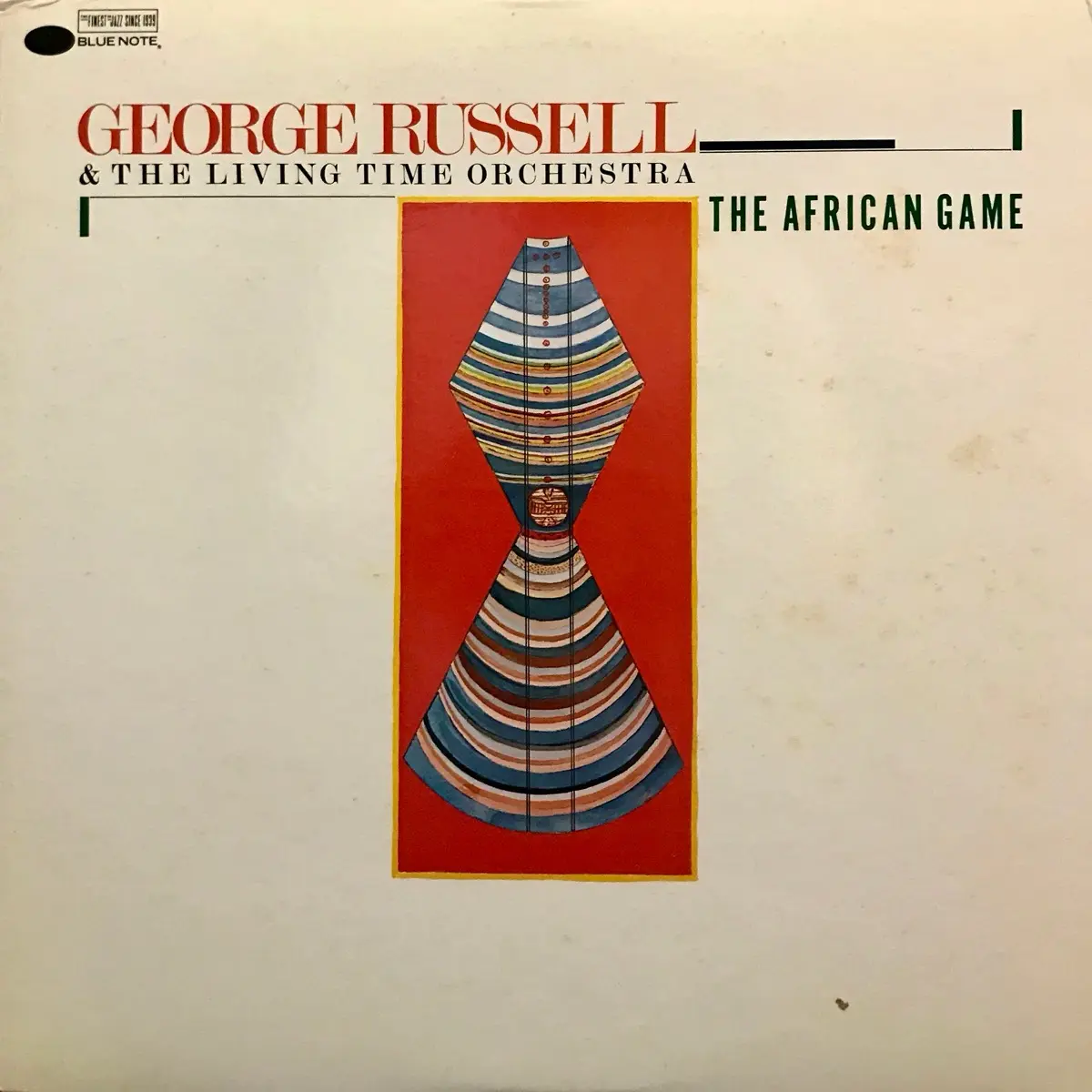
In the sprawling pantheon of twentieth-century modern music, few figures loom as intellectually formidable or compositionally daring as George Russell. Hailed by distinguished critics as the most impressive composer to grace the jazz genre since Duke Ellington, Russell’s towering reputation rests not merely on his execution as a performer or bandleader, but on his revolutionary theoretical frameworks—most notably his Lydian Chromatic Concept of Tonal Organization. Yet, even within a career defined by fearless iconoclasm, Russell’s ambitious 1983 live recording, The African Game (released on Blue Note Records, BT 85103), stands out as an exercise in monumental overreach and breathtaking artistic redemption.
Recorded live at the Emmanuel Church in Boston, Massachusetts, on June 18, 1983, The African Game is an unapologetically massive work. Scored for a sprawling 26-piece ensemble—incorporating a battery of keyboards, dual bassists, an expansive horn section, world percussion units including the Olu Bata, and even the bizarre sonic inclusion of electric pencil-sharpener choirs—the composition attempts to encapsulate nothing less than the entire evolutionary arc of humanity and its fraught ecological relationship with the natural world.
It is a brave, pretentious, and wildly ambitious artifact. Russell stretched the conceptual and musical boundaries of his craft so far that he was almost bound to topple under the weight of his own ambitions. Yet, through a combination of brilliant ensemble orchestration and moments of genuine improvisational fire, he manages to fall squarely on his feet.
This review-analysis explores the structural tensions of The African Game, dissecting the widening chasm between Russell’s naive philosophical concepts and the brilliant, muscular reality of his music. While the album’s programmatic framing often flirts with New Age dogma and heavy-handed didacticism, the underlying sonic architecture proves that great music can easily survive—and ultimately transcend—the crutches of its own specious aesthetic philosophy.
Detailed Chronology and Structural Anatomy of the Suite
The African Game is structured as a continuous, sweeping programmatic suite divided across two primary vinyl sides (comprising nine distinct "Events"). Each movement attempts to chart a monumental milestone in cosmic, biological, and human history, tracking the trajectory from primordial soup to an ambiguous, technologically saturated future.
+-----------------------------------------------------------------------------------+
|                           THE AFRICAN GAME: TIMELINE                              |
+-----------------------------------+-----------------------------------------------+
| SIDE A (Approx. 22:07)            | SIDE B (Approx. 23:13)                        |
+-----------------------------------+-----------------------------------------------+
| • Event I: Organic Life Begins    | • Event VI: African Empires                   |
| • Event II: The Paleolithic Game  | • Event VII: Cartesian Man                    |
| • Event VIII: The Mega-Minimalist |                                               |
| • Event III: Consciousness        | • Event IX: The Future?                       |
| • Event IV: The Survival Game     |                                               |
| • Event V: The Human Sensing...   |                                               |
+-----------------------------------+-----------------------------------------------+
Side A: From Primordial Ooze to Ecological Awakening
The suite opens with Event I: Organic Life On Earth Begins, setting a deliberately bizarre tone. Here, Russell deploys the ominous, whirring scrapings of a choir of electric pencil sharpeners. Intended to represent the chaotic stirring of organic life, this sonic experiment walks a dangerous tightrope between avant-garde sound art and high-concept gimmickry.
The mood shifts rapidly with Event II: The Paleolithic Game, which introduces a strutting, upright funk groove designed to illustrate the dawn of human existence. It is within this movement that the album achieves its first true artistic peak. Tenor saxophonist George Garzone steps forward, delivering a brawny, visceral solo that captures the raw, primal screams of early humanity.
As the suite progresses through Event III: Consciousness, Event IV: The Survival Game, and culminates in Event V: The Human Sensing Of Unity With Great Nature (clocking the suite’s first major movement block at 22:07), Russell attempts to map out an ecological reconciliation. However, the music here begins to strain against its programmatic constraints, occasionally trading subtlety for sweeping, cinematic orchestration that telegraphs its emotional beats far too loudly.
Side B: Empires, Rationalism, and the Machine Age
The second half of the suite (running 23:13) turns its gaze toward human civilization, exploring historical and philosophical epochs. Event VI: African Empires and Event VII: Cartesian Man lean heavily into rhythmic polyphony and modal tension, showcasing the remarkable elasticity of Russell’s 26-piece ensemble.
However, the conceptual wheels begin to wobble dangerously by Event VIII: The Mega-Minimalist Age (subtitled Style Over Substance, The Decline Of The Spirit). Here, listeners are confronted with a heavy-handed, lumbering rock beat. The disjunction between the subtitle’s intellectual lament over modern spiritual decay and the blunt-force execution of the rhythm section creates an interpretive puzzle: Is Russell offering a scathing critique of rock-and-roll’s corrupting influence on the modern musical spirit, or is he simply stumbling into pastiche?
The suite concludes with Event IX: The Future?, leaving the listener suspended in an unresolved state of existential and musical interrogation, perfectly capturing the anxieties of a technological age accelerating beyond human control.
Supporting Context & Philosophical Disconnects
To fully appreciate The African Game, one must confront the ideological scaffolding erected by its creator. In his original liner notes, "Professor" Russell adopts a philosophical stance that feels dangerously close to mid-seventies rock concept albums and New Age environmentalism. His central thesis hinges on an ecological détente between a wounded Mother Nature and her prodigal son, mankind.
The Fallacy of Anti-Technological Romanticism
The primary crack in Russell’s intellectual foundation lies in his naive assertion that technological advancement is inherently "against nature." This perspective is not only philosophically distorted; it smacks of a short-sighted conservatism that fails to withstand even casual scrutiny.
[Technology Emerges] ---> [Observed in Animal Life (Tool Use, Construction)]
                       ---> [A Product of Evolutionary Intelligence]
                       ---> [Conclusion: Technology IS Natural]
As evolutionary biology demonstrates, technological innovation—ranging from tool-making among primates and corvids to complex structural engineering in social insects—occurs across many levels of animal life. Given that technology is an activity generated by biological organisms, and that all living organisms are nature’s own creations, how could technology possibly be classified as "unnatural"? Russell’s romanticized dichotomy between pristine nature and corrupted human artifice creates a false narrative that undercuts the sophistication of his musical thesis.
The Title-Music Disconnect
Russell faces a secondary hurdle in trying to reconcile his grandiose titles and academic sub-titles with the raw audio output. Take, for instance, the sub-title of Event VIII: Style Over Substance, The Decline Of The Spirit. Trying to map this heavy-handed, angst-ridden diagnosis onto a stomping rock beat creates an awkward friction. At times, titles and themes seem to lock into place with cinematic precision; in the main, however, they float apart, proving that programmatic jazz often buckles when forced to carry too heavy an ideological freight.
Musical Analysis: Triumphs and Flat Spots in the Ensemble
Setting aside the ideological baggage and the labyrinthine liner notes, we arrive at the music—which remains, ultimately, the only metric that matters. On this front, The African Game largely triumphs, standing proudly on its own two feet without requiring the crutch of a specious aesthetic philosophy.
The Power of the 26-Piece Ensemble
Russell’s conducting and arranging for the 26-piece orchestra are nothing short of miraculous. The ensemble produces a volatile, dynamic, and frequently joyous sound. While the underlying intent is deadly serious, the resulting music is surprisingly accessible. This accessibility does not stem merely from its dip into populist rock and funk dialects, but from Russell’s masterful handling of tension and release.
Frequent incursions of rubato and acute dissonance are rarely overplayed. Instead, they resolve swiftly into more digestible, harmonically satisfying forms. The ensemble work throughout the live performance at Emmanuel Church is remarkably tight, balancing massive, wall-of-sound orchestration with nimble, breathing counterpoint.
Standout Performances and Soloist Highlights
Within the ranks of this massive orchestra sit several formidable soloists, yet one performance towers decisively above the rest. George Garzone delivers a masterclass in tenor saxophone performance on The Paleolithic Game. His playing is brawny, fierce, and entirely appropriate to the primordial themes of the movement, channeling raw emotional energy into every note.
+--------------------+---------------------------------------------------+
| Performer / Section| Contribution & Critique                           |
+--------------------+---------------------------------------------------+
| George Garzone     | Towering tenor sax solo on *The Paleolithic Game*; |
| (Tenor Saxophone)  | praised for brawny, primal, and visceral intensity.|
+--------------------+---------------------------------------------------+
| Rhythm Section     | Criticized for heavy-handed, unswinging rock      |
| (Drums/Electric B.)| beats ("piledrivers" replacing sledgehammers).    |
+--------------------+---------------------------------------------------+
| Mark White         | Delivers sub-Hendrix guitar solos that feel       |
| (Guitar)           | derivative and unconvincing within the mix.       |
+--------------------+---------------------------------------------------+
| Brass & Reeds      | Exceptional ensemble execution, handling complex  |
|                    | modal shifts and dynamic swells with precision.   |
+--------------------+---------------------------------------------------+
The "Piledriver" Rhythm Section and Guitar Missteps
Despite the brilliance of the horns and woodwinds, the album suffers from notable flat spots, primarily concentrated in its appropriation of rock idioms. The rhythm section occasionally lapses into lumpen, unswinging rock beats. As critics have wryly noted, if a famous jazz writer once complained of the "sledgehammer rhythms" of fusion groups like Steps Ahead, George Russell effectively rendered sledgehammers obsolete on this recording by deploying full-scale piledrivers in his rhythm section.
There is, of course, nothing inherently wrong with rock beats—when executed with rhythmic elasticity, they can swing fiercely. Similarly, there is nothing wrong with the electric guitar lexicon pioneered by Jimi Hendrix, who permanently redefined modern music. However, a severe aesthetic disconnect occurs when an audience is expected to swallow milky, ersatz versions of these idioms. Guitarist Mark White’s contributions, unfortunately, often fall into this trap, delivering derivative, sub-Hendrix solos that feel tacked-on rather than organically integrated into Russell’s sophisticated modal universe.
Personnel Roster and Archival Record
To understand the sheer logistical scale of this undertaking, one must examine the roster of musicians who gathered at Boston’s Emmanuel Church on June 18, 1983. Russell assembled an extraordinary cross-section of modern improvisers, classical players, and world percussion specialists:
- George Russell: Conductor, Composer, Visionary
- Keyboards: Marc Rossi, Bruce Barth
- Guitars: Mark White
- Basses: Bob Nieske (Upright Bass), Bill Urmson (Electric Bass)
- Drums & Percussion: Keith Copeland (Drums), Dave Hagedorn (Percussion)
- Saxes, Woodwinds & Flutes: George Garzone (Tenor/Soprano), Gary Joynes (Tenor/Soprano/Flute), Dave Mann (Alto/Soprano/Flute), Janus Steprans (Alto/Soprano/Flute), Brad Jones (Baritone/Bass Clarinet/Flute)
- Trumpets: Mike Peipman, Chris Passin, Roy Okutani, Mark Harvey
- Trombones: Peter Cirelli, Chip Kaner, Jeff Marsankas (Bass Trombone)
- French Horn: Marshall Sealy
- Olu Bata (World Percussion Unit): Joe Galeota, Lazaro Perez, Kuto Perez, Amaro Laria, Enrique Cardenas
- Special Effects: Various musicians operating electric pencil-sharpeners
Captured with the acoustics of a sacred architectural space, the live recording preserves the raw energy and occasional structural turbulence of a performance that refused to play it safe.
Future Outlook & Critical Legacy
Decades after its initial 1983 recording and subsequent release on Blue Note, The African Game occupies a fascinating, paradoxical space in jazz history. It is neither a spotless masterwork nor a catastrophic failure; rather, it is a monument to the necessity of artistic risk.
In an era where contemporary jazz often retreats into safe, neo-traditionalist repetition or sterile academic exercises, George Russell’s willingness to fall flat on his face in pursuit of the sublime looks more courageous than ever. His conceptual naivety regarding technology and nature can be forgiven, filed away as the eccentric philosophizing of an aging musical genius attempting to grapple with a rapidly modernizing world.
As jazz music continues to evolve in the twenty-first century, composers looking to bridge the gap between large-ensemble orchestration, world music polyrhythms, and philosophical inquiry would do well to study The African Game. It reminds us that even when a titan like Russell reaches too far, stumbles over conceptual hurdles, and deploys rhythmic piledrivers where a lighter touch might suffice, the sheer velocity of his imagination carries the day. Flawed, brilliant, pretentious, and vital—The African Game remains an essential chapter in the ongoing evolution of modern improvised music.