By Ian DeNolfo, Executive Director, The Voice Foundation
Today, the scientific study of the human voice stands at a defining historical crossroad. We are living through an inflection point where artificial intelligence (AI) and machine learning are fundamentally rewriting the parameters of medical research, data analysis, and patient care.
For hundreds of thousands of years, the human voice has served as our primary instrument of connection, emotion, and identity. It is an intricate tapestry of sound that carries the signatures of our neurological health, our psychological well-being, and our physical vitality in ways no other physiological signal can match. Yet, for most of human history, the profound complexity of vocal production and pathology remained beyond our technical capacity to fully decode.
Today, that is changing. Driven by advanced computational models, the medical and scientific communities are unlocking new frontiers in voice science. At the center of this revolution is The Voice Foundation and its premier peer-reviewed publication, the Journal of Voice. As the field accelerates at an unprecedented pace, examining how we arrived here—and where we are heading—offers a vital roadmap for the future of clinical medicine and vocal arts.
Executive Overview: A Paradigm Shift in Voice Science
The integration of artificial intelligence into voice science is no longer a futuristic speculation; it is an active, rapidly expanding reality. The publication metrics tell an astonishing story of exponential growth. Over the last three decades, the Journal of Voice has cataloged the evolution of computational voice analysis, tracking its transition from early, experimental neural networks to sophisticated, deep-learning models capable of diagnosing pathologies that remain entirely imperceptible to the human ear.
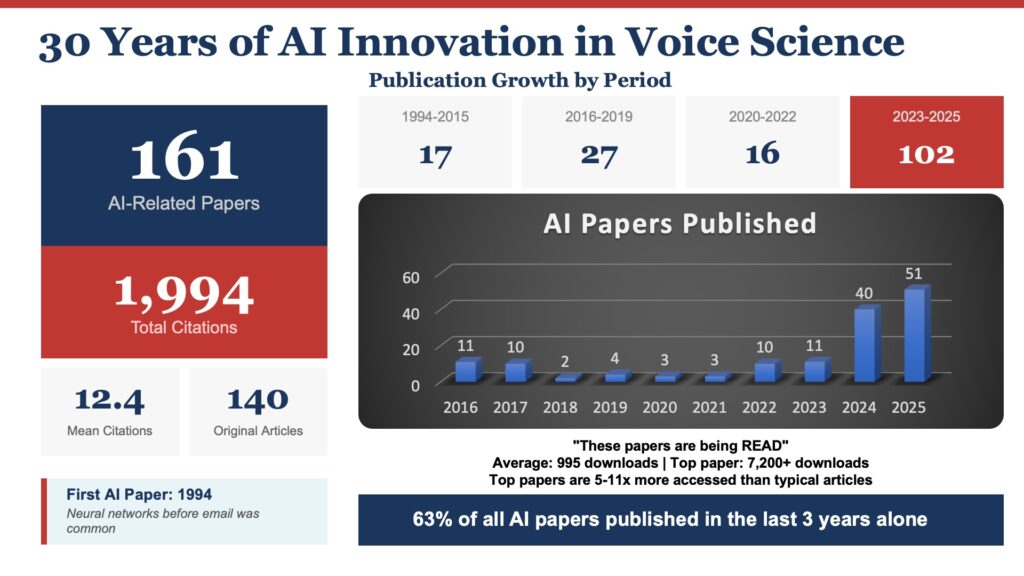
The most striking indicator of this current revolution is temporal: out of 161 foundational AI-related papers published in the journal’s history, an overwhelming 102 papers—63 percent—have been published in just the last three years (2023–2025). In the year 2025 alone, the journal published 51 AI-related studies—surpassing the total output of the first twenty years of digital voice research combined.
This is not a story of gradual academic iteration. It is an exponential transformation. By treating the human voice as a rich digital biomarker, researchers are discovering non-invasive pathways to detect neurological disorders, monitor mental health conditions, and evaluate respiratory illnesses like COVID-19. As artificial intelligence embeds itself deeper into academic and clinical workflows, it brings immense opportunities for precision medicine, alongside urgent ethical questions that require a unified global response.
Detailed Chronology: Three Decades of Pioneering Research
To understand the magnitude of today’s AI boom in voice science, one must look back to the origins of both the field and its foundational institutions.
The Legacy of Dr. Wilbur James Gould and The Voice Foundation
In 1969, Dr. Wilbur James Gould founded The Voice Foundation in New York City. At a time when interdisciplinary care for the human voice was virtually nonexistent, Dr. Gould possessed the groundbreaking foresight to bring together physicians, scientists, speech-language pathologists, performing artists, and vocal pedagogues. His mission was to bridge the gap between art and science, clinic and stage.
The Foundation established its landmark Annual Symposium—Care of the Professional Voice—in 1972, followed by its inaugural Gala (later known as Voices of Summer) in 1973. In 1989, leadership of the Foundation transitioned to Dr. Robert Thayer Sataloff, an internationally renowned otolaryngologist, professional singer, and conductor. Under Dr. Sataloff’s guidance, the Foundation relocated to Philadelphia, where it continues to anchor global voice research, supported by the Journal of Voice.
From Early Neural Networks to the Modern AI Era
While public consciousness caught up to artificial intelligence only recently with the advent of generative text models, voice scientists were exploring computational pattern recognition decades prior.
The 1990s (The Genesis): In 1994—thirty-one years ago, and the same year the World Wide Web was emerging into public awareness—the Journal of Voice published a paper by Rihkanen and colleagues titled "Spectral Pattern Recognition of Improved Voice Quality." Utilizing early neural networks to analyze acoustic parameters, this paper proved that machine intelligence could evaluate voice quality long before everyday users were even sending electronic mail.
The 2000s and Early 2010s (Cautious Exploration): Between 1994 and 2015, the field published 17 AI-related papers. These studies served as proof-of-concept trials, establishing baseline algorithms for feature extraction.
The Late 2010s (The Deep Learning Turn): From 2016 to 2019, output accelerated to 27 papers. This era marked the shift from traditional machine learning to deep neural networks capable of handling massive datasets and multi-dimensional voice profiles.
The 2020s (Exponential Acceleration): Between 2020 and 2022, 16 papers were published. Then came the modern explosion: 102 papers between 2023 and 2025, culminating in 51 papers published in 2025 alone.
Supporting Context & Metrics: Real-World Impact and Global Reach
The true measure of a scientific journal’s value lies not merely in its publication volume, but in how deeply its research penetrates clinical practice and academic discourse. Recent usage metrics for the Journal of Voice reveal an extraordinary global appetite for computational voice research.
Download and Citation Milestones
High Engagement: The average AI-focused paper published in the journal has been downloaded nearly 1,000 times—a high-water mark for specialized medical literature.
The Pandemic Sentinel: The single most-accessed AI paper in the journal’s history—focusing on machine learning applications for COVID-19 detection—has amassed over 7,200 downloads, eclipsing the median article traffic for its issue by elevenfold.
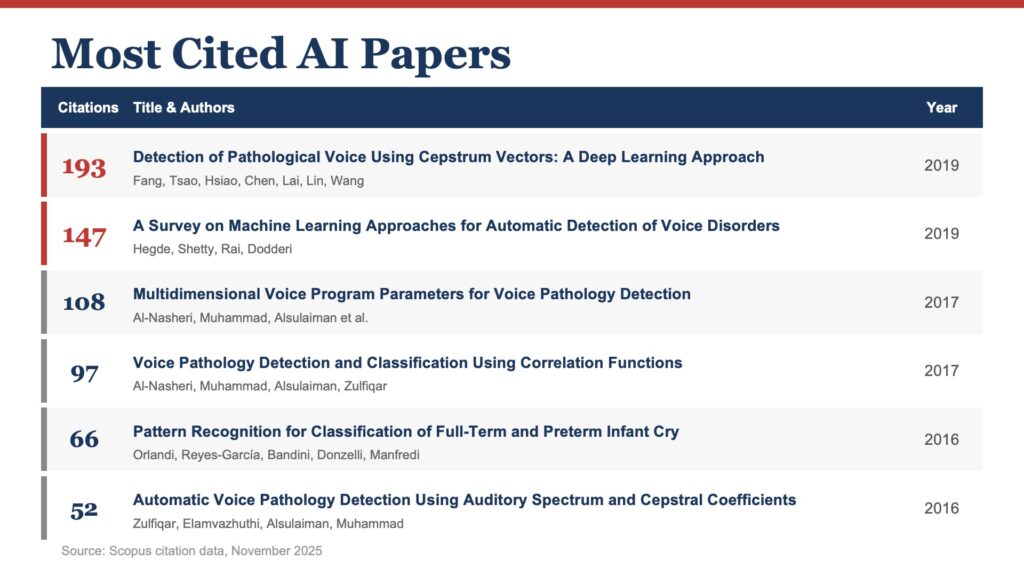
Pioneering Citations: The two most-cited papers in the journal’s computational archive are Fang and colleagues’ 2019 deep learning study on voice pathology (193 citations) and Hegde’s comprehensive machine learning survey (147 citations). Both articles have been downloaded nearly 5,000 times each, serving as foundational texts for clinicians and researchers worldwide.
Landmark Studies Reshaping the Field
Deep Learning for Pathology Detection: Fang et al. (2019) demonstrated that deep neural networks could identify pathological voices with remarkable precision using cepstrum vectors—acoustic features entirely imperceptible to the human ear.
Mapping the Landscape: Hegde and colleagues provided an indispensable roadmap of machine learning algorithms for detecting voice disorders, standardizing taxonomy across the discipline.
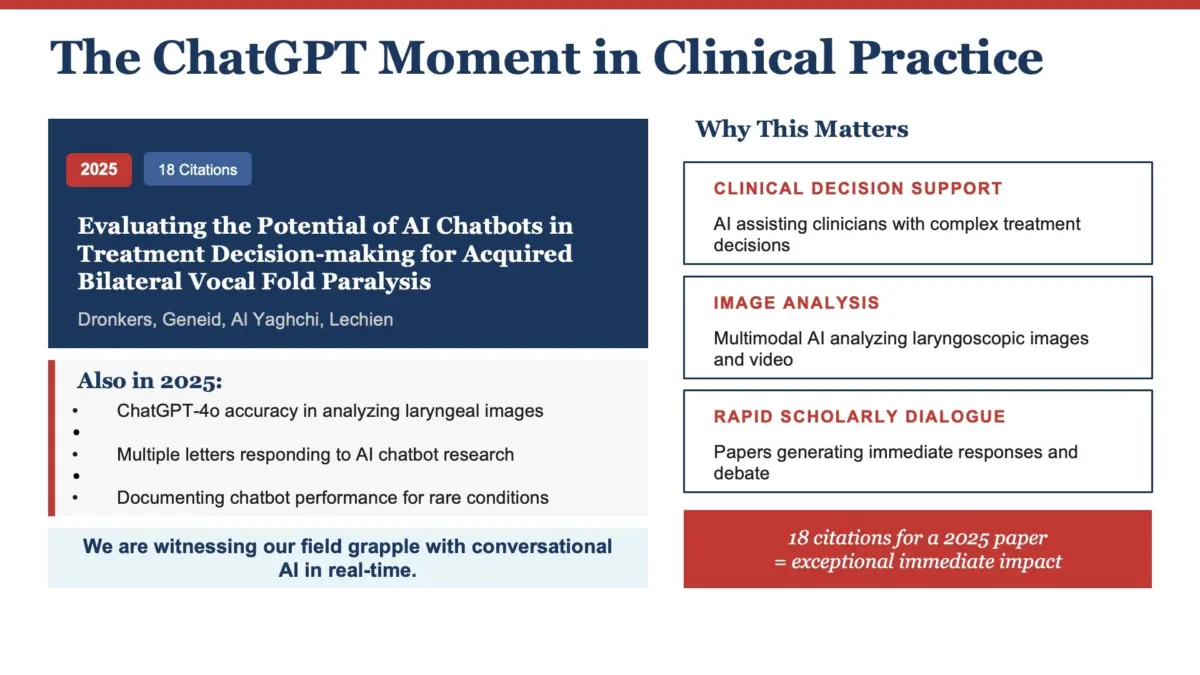
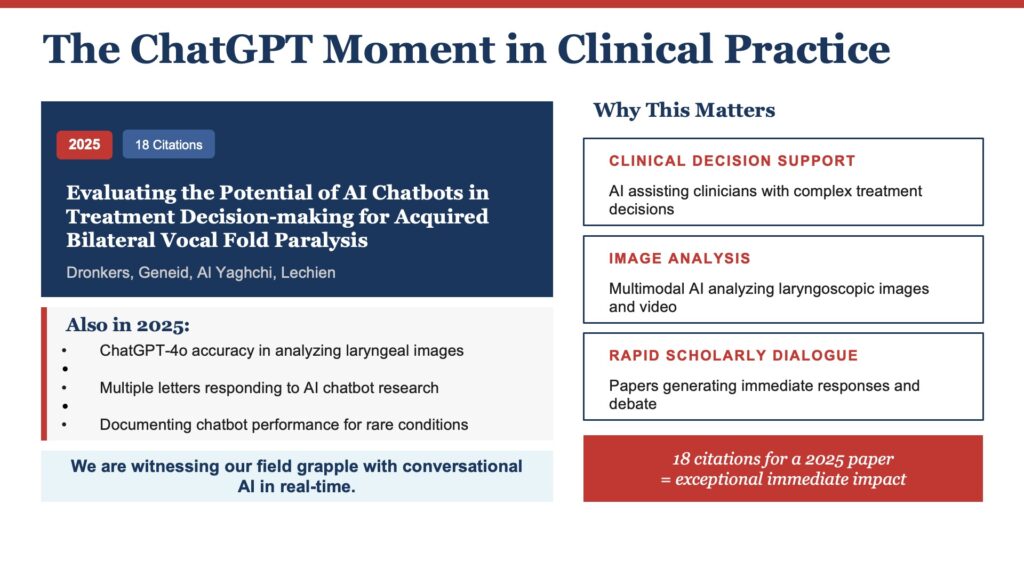
Clinical Decision-Making: Recent 2025 research by Dronkers and colleagues on evaluating AI chatbots for treatment decisions in acquired bilateral vocal fold paralysis garnered 18 citations almost immediately upon release, sparking robust scholarly debate and letters regarding the clinical safety of conversational AI tools like ChatGPT-4o.
The Voice as a Digital Biomarker
Perhaps the most transformative conceptual leap in recent years is the framing of the voice as a non-invasive digital biomarker for systemic health.
Neurological Monitoring: Hemmerling and Wójcik-Pędziwiatr (2022) published influential work predicting Parkinson’s disease severity from voice signals, inspiring a wave of subsequent clinical trials.
Mental Health Analytics: Emerging systematic reviews highlight the potential of voice analysis in tracking depressive and bipolar disorders. Routine acoustic screening could soon offer early warning signs for mental health crises, mitigating the strain on overextended healthcare systems.
Official Perspectives: Expert Insights on the AI Frontier
To navigate this rapid transition responsibly, the voice science community is engaging in deep self-reflection, balancing technological optimism with rigorous ethical standards.
Dr. Mark Berardi: Managing Complexity and Synthetic Communication
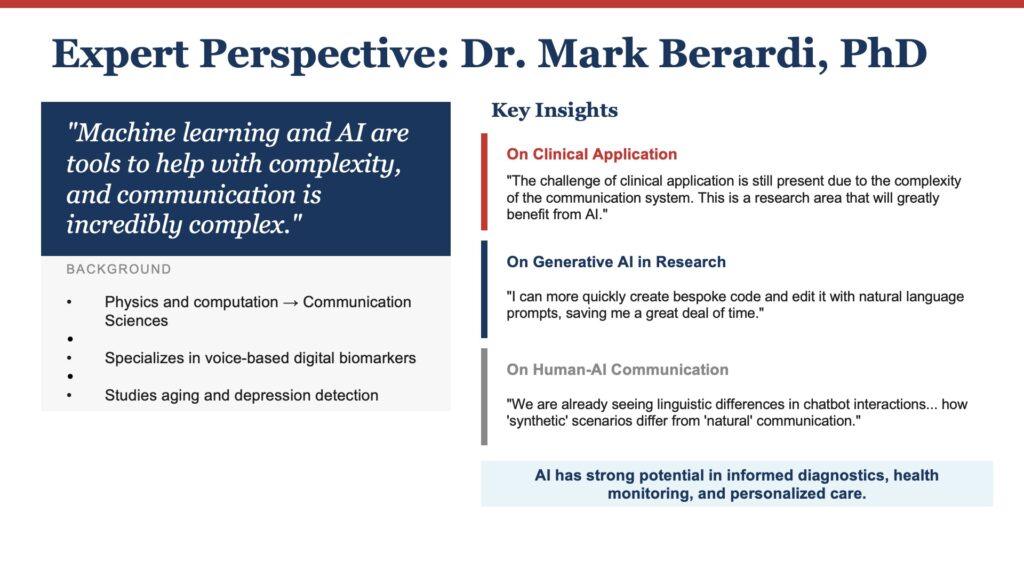
Drawing from a background in physics and computation, Dr. Mark Berardi views artificial intelligence primarily as an instrument for managing biological complexity.
"Machine learning and AI are tools to help with complexity, and communication is incredibly complex in its neurobiological and physiological processes. So I think the application is warranted," Dr. Berardi explains.
While acquiring speech and voice signals has become technically straightforward, the challenge remains the sheer intricacy of human neurophysiology. Furthermore, Dr. Berardi points out generative AI’s utility in breaking down research bottlenecks, noting that he can now easily write and refine bespoke data-processing code using natural language prompts.
Intriguingly, Dr. Berardi’s current work investigates human-AI communication itself—analyzing how human linguistic patterns shift when interacting with synthetic interfaces, virtual platforms (such as Zoom), and chatbots. As conversational AI becomes ubiquitous, voice scientists may soon need to decode human vocal adaptation in machine-driven environments.
Dr. Eric Hunter: Embracing Innovation with Ethical Clarity
Dr. Eric Hunter focuses heavily on the institutional and academic realities of the AI revolution. He stresses that modern computational tools are no longer passing novelties; they are integral components of contemporary academic workflows.
"These tools aren’t just novelties. They are rapidly becoming integrated into how we conduct literature reviews, organize data, extract themes from large bodies of text, and even summarize findings," observes Dr. Hunter.
With platforms like NotebookLM, Claude, and ChatGPT embedding directly into standard productivity and scholarly software suites, Dr. Hunter issues a clear call to action: rather than resisting automation, the academic community must establish transparent frameworks for appropriate usage. He outlines four essential operational tenets for authors and reviewers:
Absolute Transparency: Clear disclosure of where and how AI tools assist in manuscript preparation, coding, or data synthesis.
Human Accountability: Maintaining strict human responsibility for factual accuracy, data integrity, and analytical conclusions.
Intellectual Stewardship: Guarding against algorithmic bias and ensuring diverse representation in training datasets.
Peer Review Integrity: Establishing ethical boundaries for utilizing automated tools in manuscript evaluation.
"Our field will benefit most," Dr. Hunter concludes, "if we embrace the productivity these tools offer while also building a shared ethical framework for their responsible use."
A Global Collaborative Community
This momentum is sustained by a robust international network of researchers. Leading contributors to the Journal of Voice—including Jérôme René Lechien, Dimitar Deliyski, Stephanie Zacharias, Ahmed Yousef, Paavo Alku, Leonardo Wanderley Lopes, and Maryam Naghibolhosseini—alongside dozens of laboratories across every continent, demonstrate that this transformation is a collective, global endeavor.
Future Outlook: The Path Forward for Voice Science
As the Journal of Voice looks toward the next decade, its mission remains anchored in scientific rigor, clinical excellence, and interdisciplinary collaboration. However, the path forward requires addressing three critical imperatives:
Mindful Technological Engagement: Voice professionals must learn to view AI as an amplifier of human expertise rather than a replacement for clinical judgment. Understanding both the immense power and the inherent limitations of algorithms is paramount.
Collective Ethical Governance: No single institution or journal can draft the ethical guardrails for AI in medicine. The entire scientific community must collaborate to build transparent, equitable guidelines for algorithmic research and deployment.
Continuous Discovery: With over 161 AI papers published to date, the field has only scratched the surface. Clinicians, scientists, and educators are encouraged to share their insights, pushing the boundaries of what voice science can achieve.
Conclusion: An Extraordinary Moment in Time
For centuries, the human voice has captured the depth of human experience, serving as an emotional bridge between souls. Today, for the first time in history, we possess the technological sophistication required to truly decode its complexity.
From early neural network experiments in 1994 to the explosive growth of deep learning and digital biomarkers in 2025, The Voice Foundation and the Journal of Voice remain at the epicenter of this historic medical renaissance. By extending the reach of expert clinicians, democratizing global access to vocal healthcare, and detecting systemic diseases before symptoms manifest, artificial intelligence is empowering us to listen closer than ever before.
The next decade promises breakthroughs that we are only just beginning to imagine. The scientific community stands ready, listening intently to the future.
About the Author
Ian DeNolfo is Executive Director of The Voice Foundation, which publishes the peer-reviewed Journal of Voice. A graduate of The Juilliard School and The Curtis Institute of Music, he formerly performed as a leading tenor at major opera houses worldwide before transitioning to arts administration and scientific leadership.