
By Ian DeNolfo, Executive Director, The Voice Foundation
Executive Overview
We stand today at a profound inflection point in the scientific study of the human voice—an era where artificial intelligence (AI) and machine learning are fundamentally transforming how researchers conduct investigations, analyze multi-dimensional datasets, and deliver patient care. For centuries, the human voice has served as our primary vehicle for emotional expression, social connection, and personal identity. Yet, the physiological and neurobiological mechanisms governing speech are staggering in their complexity.
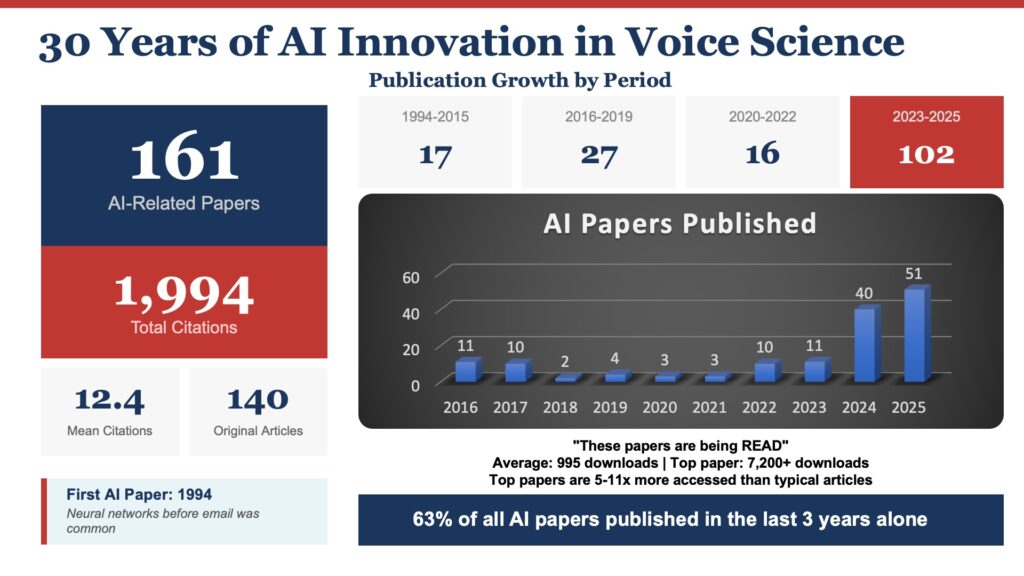
For over five decades, The Voice Foundation has stood at the vanguard of interdisciplinary voice care, bridging the gap between artistic performance and rigorous medical science. Today, this mission is accelerating at an unprecedented pace. Through the pages of its premier peer-reviewed publication, the Journal of Voice, the scientific community is witnessing an exponential surge in AI-driven research. More than 60 percent of all artificial intelligence papers published in the journal’s history have appeared within the last three years alone.
This article explores the historical trajectory of AI in voice science, examines landmark breakthroughs—from pathology detection to the revolutionary concept of the voice as a digital biomarker—and outlines the essential ethical frameworks required as we navigate this extraordinary technological frontier.

A Legacy of Interdisciplinary Innovation
To understand the magnitude of today’s AI-driven renaissance, one must look back to the foundational roots of modern voice care. In 1969, Dr. Wilbur James Gould founded The Voice Foundation in New York City. At a time when interdisciplinary care for the human voice was virtually nonexistent, Dr. Gould possessed the visionary foresight to bring together a diverse coalition of physicians, scientists, speech-language pathologists, performing artists, and vocal pedagogues. Their shared objective was clear: pool collective expertise to optimize the care of the professional voice user.
The Foundation inaugurated its Annual Symposium—Care of the Professional Voice—in 1972, followed by its inaugural Gala (subsequently named Voices of Summer) in 1973. These gatherings established a enduring bridge connecting clinical medicine with the performing arts.
Since 1989, The Voice Foundation has operated under the stewardship of Dr. Robert Thayer Sataloff, an internationally renowned otolaryngologist, professional singer, and conductor. Having authored more than 1,200 publications, including 79 textbooks, Dr. Sataloff steered the Foundation’s relocation to Philadelphia, where it has continued to expand our scientific understanding of vocal physiology and pathology through coordinated education and research.
Today, the Philadelphia Symposium draws hundreds of international medical, academic, and clinical professionals annually. Simultaneously, the Journal of Voice maintains its status as the definitive peer-reviewed publication dedicated exclusively to voice science and medicine.
Detailed Chronology: 30 Years of AI Research in Voice Science
A common misconception is that artificial intelligence in medicine is an entirely recent phenomenon born out of the modern generative AI boom. In reality, the Journal of Voice has been publishing peer-reviewed AI research for more than three decades.
In 1994—thirty-one years ago, during the infancy of the World Wide Web—the journal published a pioneering paper by Rihkanen and colleagues titled "Spectral Pattern Recognition of Improved Voice Quality." This foundational study utilized early neural networks to analyze acoustic parameters. The scientific community was publishing neural network research in voice science before mainstream society had ever sent an electronic mail message.
The Exponential Publication Curve
While early progress was methodical, recent years have witnessed an explosive acceleration in computational research:
- 1994–2015: 17 papers
- 2016–2019: 27 papers
- 2020–2022: 16 papers
- 2023–2025: 102 papers
To grasp the sheer velocity of this growth, consider the output for 2025 alone, which saw the publication of 51 AI-related papers. This single-year total surpasses the cumulative output of the journal’s entire first two decades combined. This is not incremental progress; it is an exponential transformation of the discipline.
Supporting Context & Metrics: Beyond Citations to Real-World Impact
Academic research is frequently evaluated through citation counts, but the true measure of a scientific publication lies in its practical application by frontline clinicians and researchers. Recent usage metrics for the Journal of Voice underscore the global reach of its computational corpus.
- High Download Rates: The average AI-focused paper published in the journal has been downloaded nearly 1,000 times.
- The COVID-19 Benchmark: The single most-accessed AI paper—an investigation into machine learning applications for COVID-19 detection via acoustic features—has surpassed 7,200 downloads, representing eleven times the median download rate for articles in its issue.
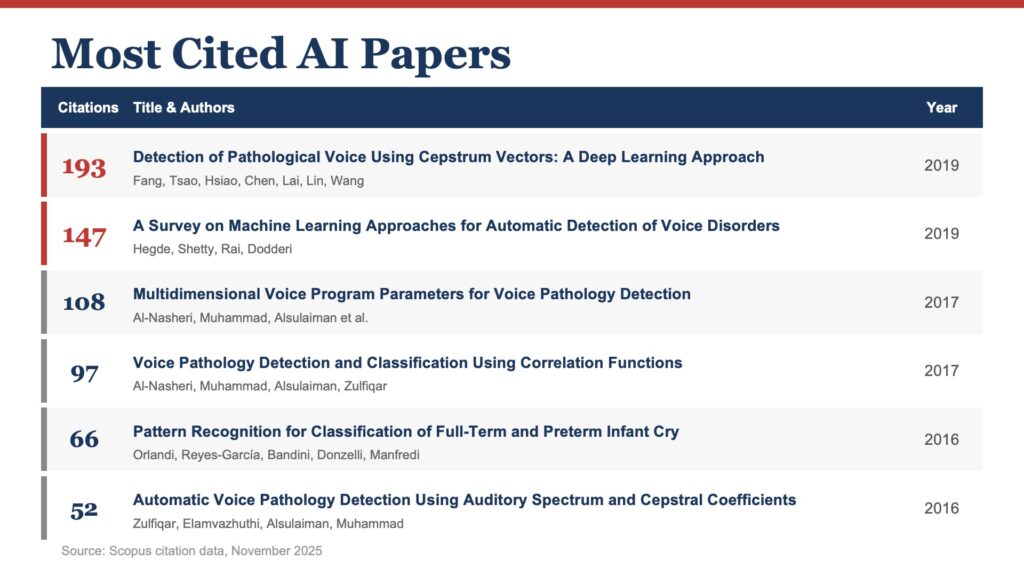
- Pioneering Scholarship: The two most-cited papers in this domain—Fang and colleagues’ deep learning study (193 citations) and Hegde’s machine learning survey (147 citations)—have each approached 5,000 downloads. Both were ranked among the top three most-accessed articles in their respective issues, serving as indispensable roadmaps for speech-language pathologists, otolaryngologists, and computer scientists alike.
Landmark Research Reshaping Clinical Horizons
Deep Learning for Voice Pathology Detection
Published in 2019, Fang and co-authors’ study, "Detection of Pathological Voice Using Cepstrum Vectors: A Deep Learning Approach," stands as the most-cited AI paper in the journal’s history. Their work proved conclusively that deep neural networks could detect pathological conditions in the human vocal tract with superior accuracy by evaluating acoustic characteristics imperceptible to the human ear.
This foundational work was complemented by Hegde’s comprehensive "Survey on Machine Learning Approaches for Automatic Detection of Voice Disorders," alongside twin contributions from Al-Nasheri et al. in 2017 examining Multidimensional Voice Program parameters and correlation functions. Over the ensuing years, the technical sophistication has escalated rapidly, encompassing Chen and Chen’s neural network voice classifications, Fujimura’s one-dimensional convolutional neural networks, and Cho and Choi’s comparative analyses of laryngoscopic imaging models.
Voice as a Digital Biomarker
Perhaps the most paradigm-shifting concept to emerge from contemporary research is the conceptualization of the human voice as a digital biomarker—a non-invasive, accessible window into systemic health.

Researchers have achieved groundbreaking results using vocal analysis to monitor neurodegenerative conditions such as Parkinson’s disease. Hemmerling and Wójcik-Pędziwiatr’s 2022 study predicting Parkinson’s severity from acoustic signals has garnered significant international attention, accelerating the path toward routine clinical integration.
Beyond neurology, systematic reviews have begun exploring vocal parameters as digital indicators for psychiatric conditions, including major depressive disorder and bipolar disorder. The societal implications are profound: routine, automated vocal screening could flag subtle mental health shifts early, facilitating timely clinical interventions and alleviating the immense burdens placed on global mental healthcare infrastructure. Furthermore, ongoing research applying machine learning to respiratory acoustics continues to position the voice as an invaluable sentinel for pulmonary health.
AI Chatbots in Clinical Practice
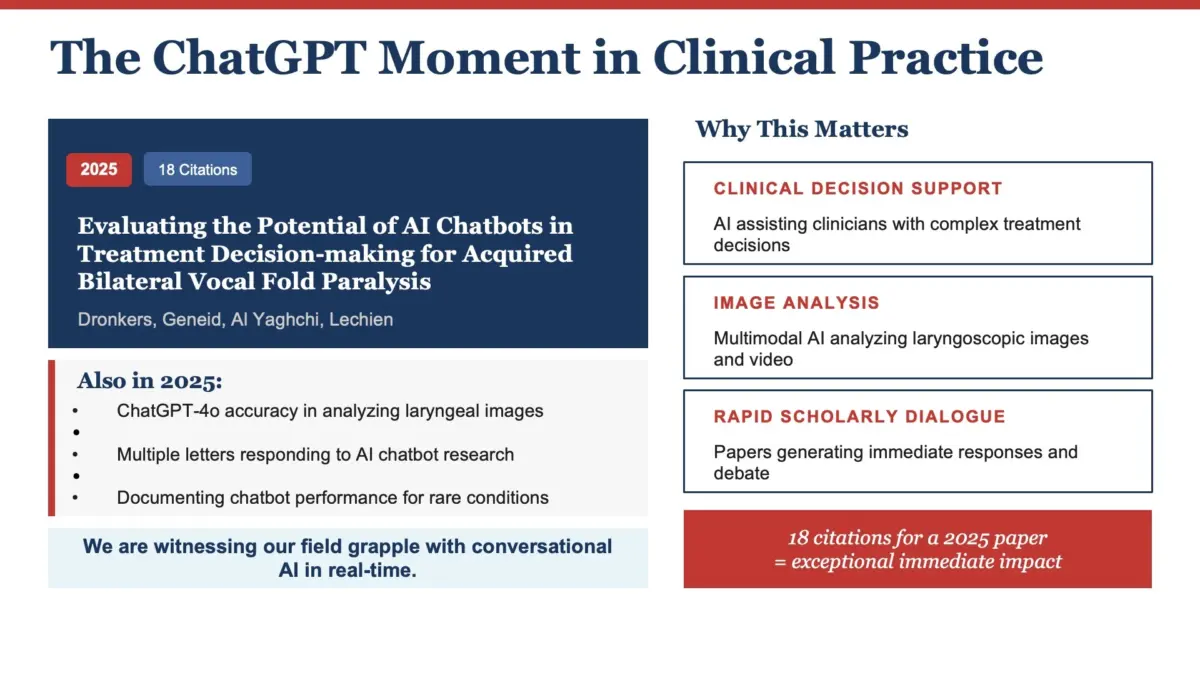
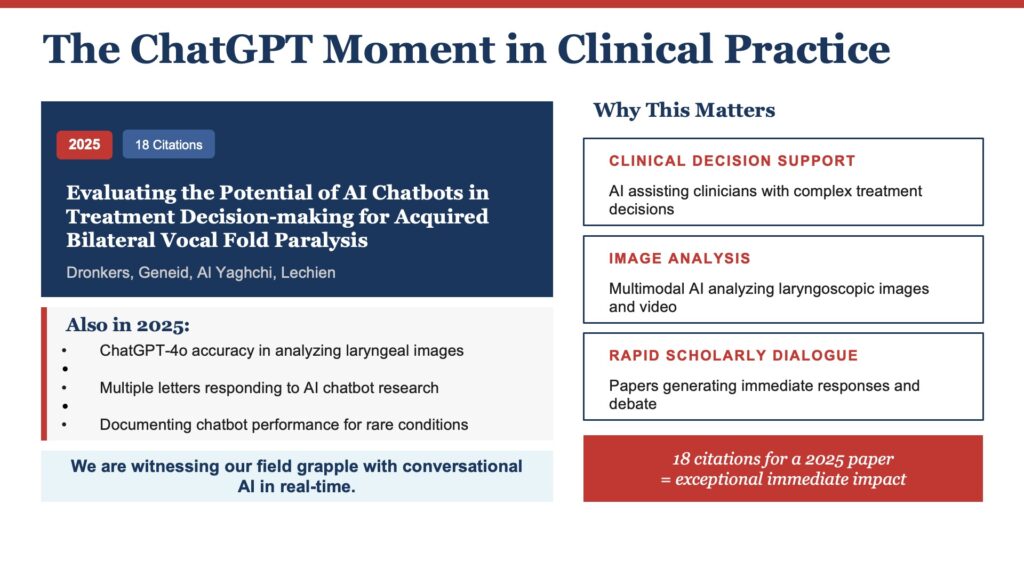
In 2025, the journal expanded its scope to evaluate conversational AI and large language models (LLMs) in clinical decision-making. Dronkers and colleagues’ paper, "Evaluating the Potential of AI Chatbots in Treatment Decision-making for Acquired Bilateral Vocal Fold Paralysis," accumulated 18 citations almost immediately upon publication. Accompanied by rigorous reader correspondence regarding ChatGPT-4o’s diagnostic accuracy in evaluating laryngeal imagery, the field is actively grappling with the real-world utility and limitations of conversational AI in medical settings.
Official Perspectives: Expert Insights on AI Integration
To navigate this technological transition responsibly, the voice science community must rely on the multidisciplinary wisdom of its leaders. Two prominent voices within the Foundation offer critical perspectives on the opportunities and obligations ahead.
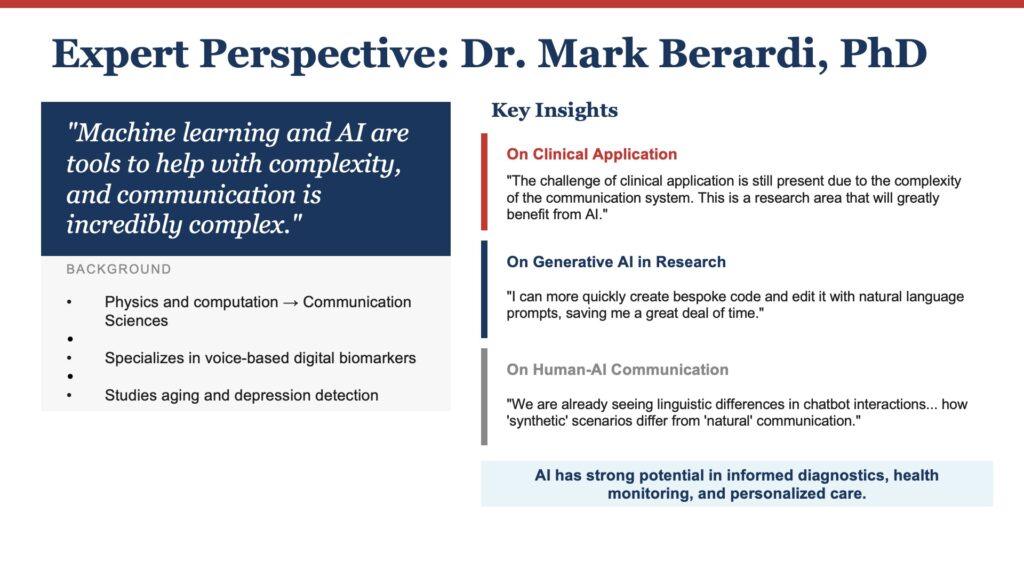
Dr. Mark Berardi: Managing Complexity and Synthetic Communication
Dr. Mark Berardi brings a unique computational and physical sciences perspective to voice research. He views artificial intelligence primarily as a sophisticated mechanism for managing complexity.
"Machine learning and AI are tools to help with complexity, and communication is incredibly complex in its neurobiological and physiological processes. So I think the application is warranted," notes Dr. Berardi.
While noting that generative AI has not yet completely upended theoretical research, he emphasizes its immediate utility in eliminating workflow bottlenecks—particularly in custom code generation and natural language data processing.
Intriguingly, Dr. Berardi’s current work investigates human-AI interaction itself: how human speech patterns adapt when conversing with synthetic entities versus human interlocutors, and how virtual communication environments (such as Zoom) alter linguistic delivery compared to face-to-face dialogue. As synthetic communication becomes ubiquitous, voice science must broaden its focus to analyze human vocal behavior in direct conversation with machines.
Dr. Eric Hunter: Embracing Change with Ethical Clarity
Dr. Eric Hunter focuses on the institutional and operational realities of integrating AI into scholarly workflows.
"These tools aren’t just novelties," Dr. Hunter observes. "They are rapidly becoming integrated into how we conduct literature reviews, organize data, extract themes from large bodies of text, and even summarize findings."
Dr. Hunter stresses that large language models and AI-driven platforms are permanently embedded within modern academic infrastructure—appearing in manuscript preparation, peer review, data analysis, and collaborative writing. Rather than resisting this technological shift, he issues a clear call to action for the establishment of transparent operational guidelines.
He outlines four foundational pillars for ethical AI utilization in academic publishing:
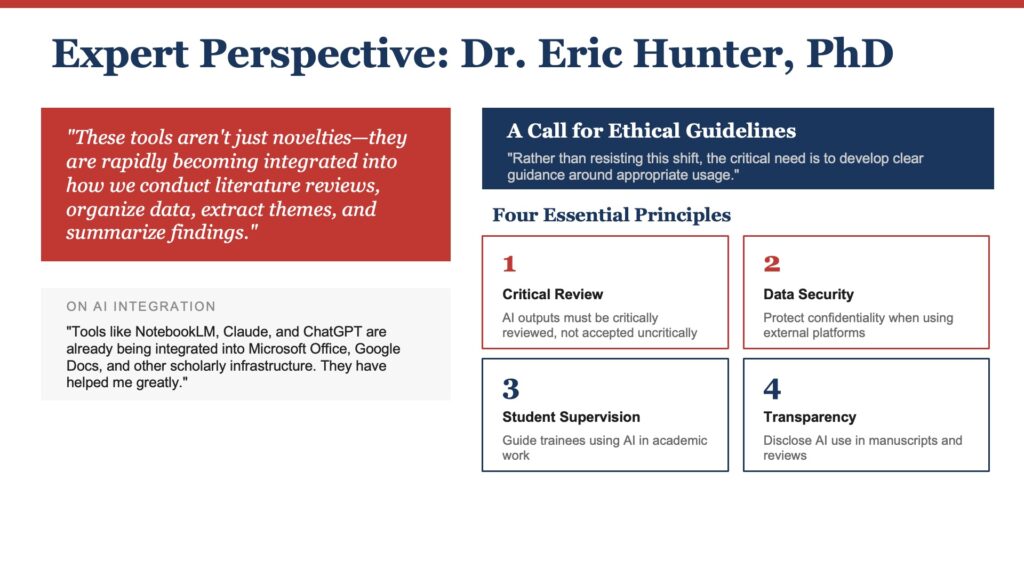
- Uncompromising Transparency: Authors must explicitly disclose if and how generative tools were utilized in manuscript preparation or data curation.
- Human Accountability: Researchers must maintain absolute responsibility for the factual accuracy, citations, and intellectual integrity of their work.
- Editorial Rigor: Reviewers and journal editors must deploy AI thoughtfully while guarding against algorithmic bias and hallucinated references.
- Equitable Access: The benefits of AI-enhanced research tools must be distributed globally to support investigators across diverse economic backgrounds.
"Our field will benefit most," Dr. Hunter concludes, "if we embrace the productivity these tools offer while also building a shared ethical framework for their responsible use."
A Global Research Community
The rapid acceleration of computational voice science is powered by an interconnected, international network of researchers. Leading contributors to the Journal of Voice span continents and disciplines. Scholars such as Jérôme René Lechien, Dimitar Deliyski, Stephanie Zacharias, Ahmed Yousef, Paavo Alku, Leonardo Wanderley Lopes, and Maryam Naghibolhosseini—alongside dozens of international collaborators—are actively defining the parameters of modern AI-assisted otolaryngology and speech science. This is not the isolated work of a single laboratory; it is a unified global enterprise committed to deciphering the mechanics of human vocalization.
Future Outlook and the Path Forward
As the Journal of Voice enters this new technological epoch, it remains dedicated to publishing peer-reviewed research that pushes scientific boundaries while upholding the highest standards of editorial and ethical integrity.
To successfully navigate the coming decade, the voice science community must commit to a three-pronged strategy:

- Thoughtful Engagement: Researchers and clinicians must view AI as an amplifier of human expertise rather than a replacement for clinical intuition, mastering both the power and the limitations of algorithmic tools.
- Collective Ethical Stewardship: Guided by frameworks such as those outlined by Dr. Hunter, the community must work collaboratively to establish universal standards for AI transparency in research and publication.
- Continued Scholarly Exchange: The 161 computational papers published in the journal to date represent merely the foundation. Clinicians, educators, and engineers must continue sharing empirical insights to expand our collective understanding.
An Extraordinary Moment in Human History
The human voice has served as our species’ ultimate instrument of connection, emotional expression, and identity for hundreds of thousands of years. It carries the nuances of our health, our psychological state, and our innermost experiences in a manner unmatched by any other biological signal.
Now, for the first time in history, we possess computational tools sophisticated enough to genuinely decode that complexity—tools capable of extending the reach of expert clinicians, detecting subtle pathophysiological shifts before clinical symptoms manifest, and democratizing access to high-quality voice care across the globe.
We stand at a truly extraordinary moment. With the Journal of Voice and The Foundation firmly positioned at the epicenter of this scientific renaissance, the coming decade promises discoveries that will forever alter our understanding of the human voice and its profound connection to overall health.
About the Author
Ian DeNolfo is Executive Director of The Voice Foundation, which publishes the peer-reviewed Journal of Voice. A graduate of The Juilliard School and The Curtis Institute of Music, he formerly performed as a leading tenor at premier opera houses worldwide before transitioning his expertise to institutional leadership in voice science and medicine.