By Ian DeNolfo, Executive Director, The Voice Foundation
Executive Overview
Today, we stand at a definitive inflection point in the interdisciplinary study of human vocal communication—a historic juncture where artificial intelligence (AI) and machine learning are fundamentally reshaping how researchers conduct investigations, analyze complex biomedical data, and deliver advanced patient care. While mainstream interest in artificial intelligence has exploded across global industries only within the last few years, the foundation for computational voice analysis was laid decades ago.
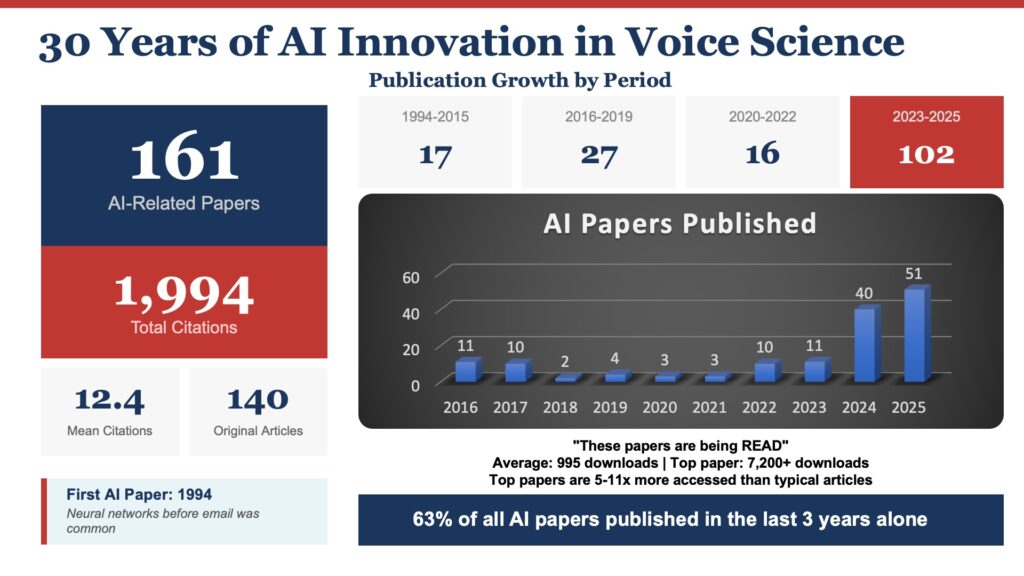
For more than half a century, The Voice Foundation and its flagship publication, the Journal of Voice, have served as the epicenter of this evolution. Far from being a recent bandwagon, our commitment to computational and neural network methodologies spans more than thirty years. Today, this legacy is accelerating at an unprecedented velocity. Over 60 percent of all artificial intelligence-related papers published in the Journal of Voice since its inception have appeared within the last three years alone, reflecting an exponential leap in both research productivity and clinical translation.
As voice is increasingly recognized not merely as a vehicle for speech, but as a sophisticated digital biomarker capable of signaling systemic health issues—from neurological decline to mood disorders and respiratory illnesses—the medical and scientific communities face both extraordinary opportunities and complex ethical challenges. Balancing computational innovation with rigorous scientific integrity is no longer optional; it is the defining mission of modern voice science.
A Legacy of Interdisciplinary Innovation
To understand the magnitude of today’s technological transformation, one must look back at the visionary roots of modern voice care. In 1969, Dr. Wilbur James Gould founded The Voice Foundation in New York City. At a time when the comprehensive, interdisciplinary care of the human voice was virtually nonexistent, Dr. Gould possessed the foresight to bridge disparate fields. He brought together otolaryngologists, vocal scientists, speech-language pathologists, performing artists, and master teachers to pool their unique expertise in service of the professional voice user.
The Foundation rapidly established vital institutions to cement this mission. In 1972, it hosted the inaugural Annual Symposium—Care of the Professional Voice—followed closely in 1973 by its premier Gala, later celebrated as Voices of Summer. For over five decades, these platforms have successfully bridged the gap between artistic expression and clinical science, between the high-stakes demands of the stage and the rigorous environment of the medical clinic.
Since 1989, the Foundation has been guided by Dr. Robert Thayer Sataloff, an internationally renowned otolaryngologist who is simultaneously a professional singer and conductor. Dr. Sataloff’s staggering academic output includes more than 1,200 publications and 79 textbooks. Under his steady leadership, the Foundation relocated its headquarters to Philadelphia and expanded its global footprint. Today, the annual Philadelphia Symposium draws hundreds of elite medical, scientific, academic, and artistic professionals from every corner of the globe, while the Journal of Voice maintains its status as the premier peer-reviewed journal dedicated exclusively to voice science and medicine.
Chronology of Computation: 30 Years of AI Research in Voice Science
The integration of artificial intelligence into voice research predates public awareness of modern computational milestones. In 1994—thirty-one years ago—the Journal of Voice published a pioneering paper by Rihkanen and colleagues titled "Spectral Pattern Recognition of Improved Voice Quality." Utilizing rudimentary neural networks to analyze voice signatures, that study appeared during the exact infancy of the World Wide Web, long before electronic mail had saturated standard professional workflows.
Despite this early entry, the timeline of AI publications in voice science reveals a dramatic, exponential acceleration:
1994–2015: 17 papers (The Foundational Era)
2016–2019: 27 papers (The Machine Learning Expansion)
2020–2022: 16 papers (The Pandemic and Remote Sensing Focus)
2023–2025: 102 papers (The Deep Learning Explosion)
The transformation is stark: in the year 2025 alone, the Journal of Voice published 51 AI-related papers—surpassing the total output of the Foundation’s first twenty years combined. This is not the steady, linear growth of a traditional scientific subfield; it is an exponential paradigm shift driven by massive computational power, superior algorithmic architecture, and widespread access to digital acoustic data.
Metrics and Real-World Impact: Beyond Academic Citations
The true value of this scholarly explosion is measured not merely in citation counts, but in practical, real-world utility among global healthcare practitioners. Usage statistics for AI-centric articles in the Journal of Voice illustrate extraordinary levels of engagement:
The median AI paper published in the journal has been downloaded nearly 1,000 times.
The most-accessed AI paper—a pioneering study examining machine learning applications for COVID-19 detection—has amassed over 7,200 downloads, a figure eleven times higher than the baseline median for articles in its respective issue.
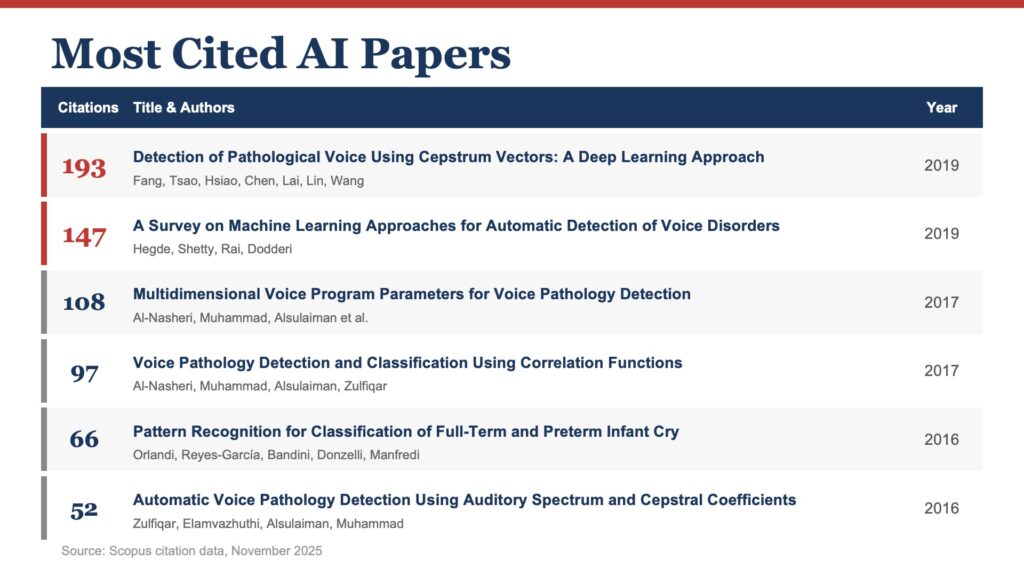
The two most-cited papers in the journal’s computational history, authored by Fang et al. (a deep learning study with 193 citations) and Hegde (a comprehensive machine learning survey with 147 citations), have each been downloaded nearly 5,000 times.
These staggering download metrics represent frontline clinicians, biomedical engineers, and speech-language pathologists actively seeking practical, reproducible diagnostic and therapeutic tools to elevate patient care.
Landmark Research: Reshaping Diagnostics and Therapeutics
Deep Learning for Voice Pathology Detection
The 2019 study by Fang and colleagues, "Detection of Pathological Voice Using Cepstrum Vectors: A Deep Learning Approach," remains a cornerstone of the field. By demonstrating that deep neural networks could isolate acoustic features imperceptible to the human ear, the study proved that algorithms could identify voice pathologies with unprecedented accuracy.
Complementing this, Hegde’s survey on automatic detection of voice disorders mapped the sprawling landscape of machine learning in otolaryngology, establishing an essential roadmap for incoming researchers. Subsequent works—such as Chen and Chen’s deep neural network classifications, Fujimura’s one-dimensional convolutional neural networks, and Cho and Choi’s convolutional model comparisons for laryngoscopic imaging—have systematically dismantled traditional diagnostic bottlenecks.
Voice as a Digital Biomarker
Perhaps the most profound philosophical and clinical shift in recent literature is the conceptualization of the human voice as a non-invasive digital biomarker—a continuous, accessible window into systemic physiological and neurological health.
Recent breakthroughs include predictive modeling for Parkinson’s disease severity. Hemmerling and Wójcik-Pędziwiatr’s 2022 study on extracting severity metrics from voice signals quickly garnered international attention, pushing clinical applications closer to routine point-of-care screening. Beyond neurology, systematic reviews now explore voice quality as a sentinel biomarker for major depressive disorder and bipolar disorder, offering the tantalizing prospect of continuous, objective mental health monitoring that bypasses overstretched clinical infrastructures.
AI Chatbots in Clinical Practice
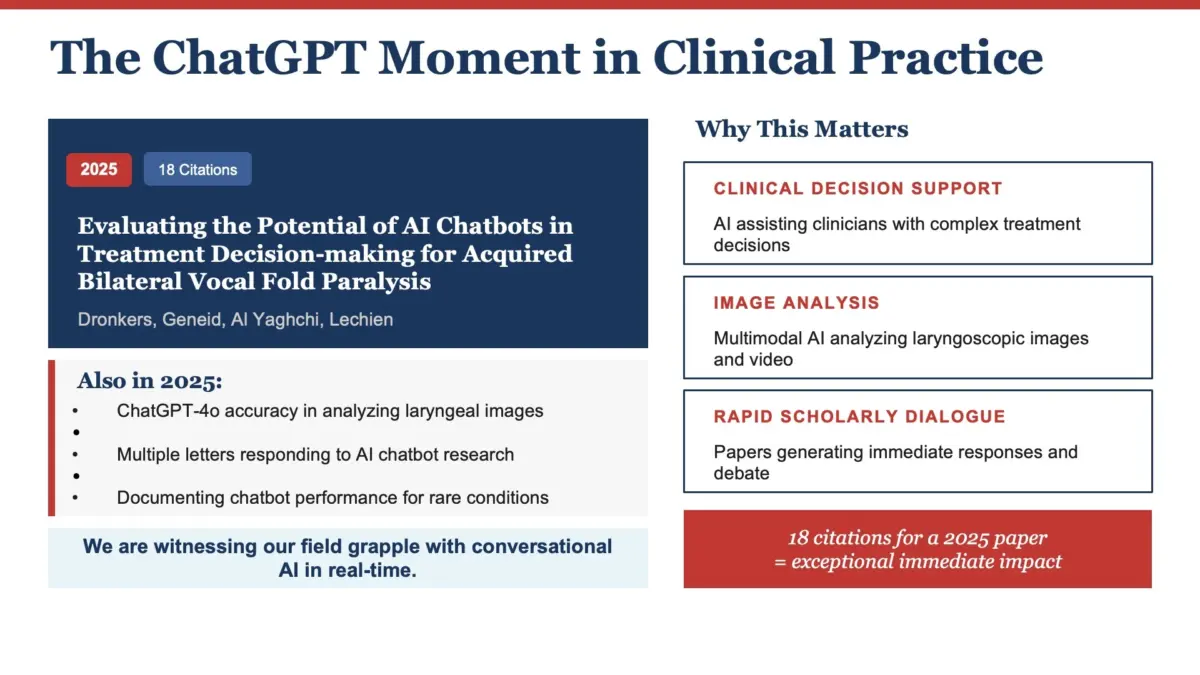
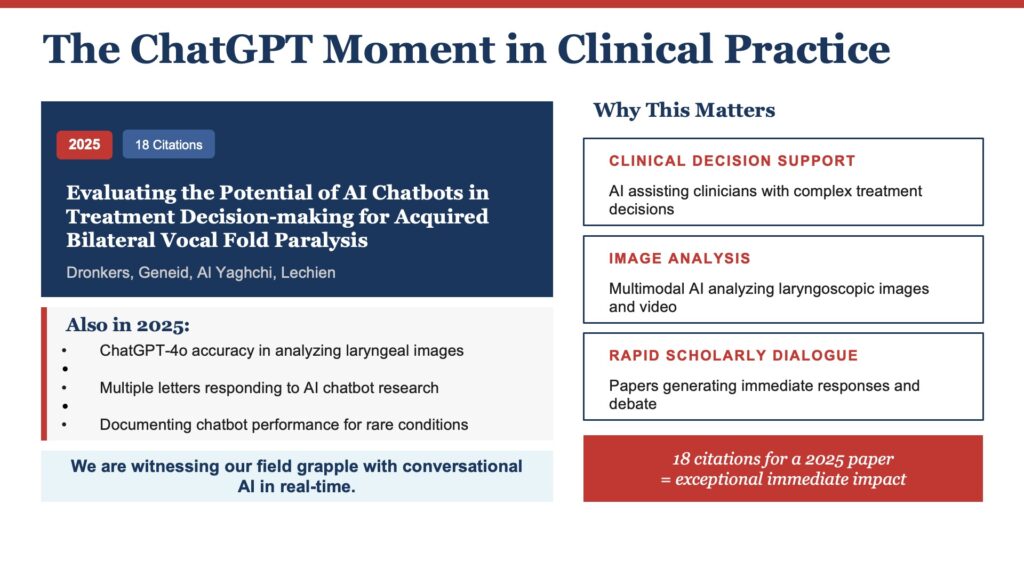
Entering uncharted territory, recent journal editions have evaluated the efficacy of conversational AI and large language models in direct clinical decision-making. Dronkers and colleagues’ 2025 study, "Evaluating the Potential of AI Chatbots in Treatment Decision-making for Acquired Bilateral Vocal Fold Paralysis," triggered immediate scholarly debate, accumulating 18 citations within months of publication alongside extensive peer correspondence regarding ChatGPT-4o’s accuracy in laryngeal image interpretation.
Expert Perspectives on the AI Horizon
To navigate this rapidly shifting landscape, the scientific community must listen closely to interdisciplinary leaders who span computation, clinical medicine, and institutional governance.
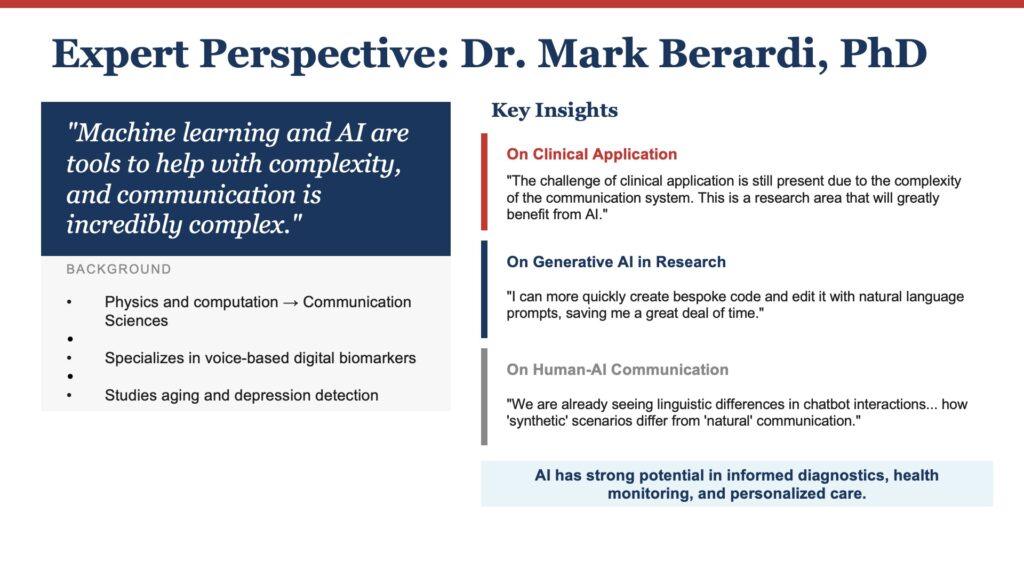
Dr. Mark Berardi: Managing Complexity and Synthetic Communication
Dr. Mark Berardi brings a rare dual perspective rooted in physics and computation. Viewing AI fundamentally as a mechanism for mastering complexity, he notes:
"Machine learning and AI are tools to help with complexity, and communication is incredibly complex in its neurobiological and physiological processes. So I think the application is warranted."
While Dr. Berardi notes that generative AI has not yet completely rewritten foundational research paradigms, he acknowledges its undeniable utility in solving technical bottlenecks—particularly in custom scriptwriting and data preprocessing via natural language prompts.
Intriguingly, Dr. Berardi’s current work investigates human-AI interaction itself. He observes measurable linguistic shifts when humans converse with chatbots or communicate via synthetic mediums like Zoom compared to traditional face-to-face exchanges:
"We are already seeing linguistic differences in chatbot interactions. The field may need to expand to understand not just human voice, but human voice in conversation with machines."
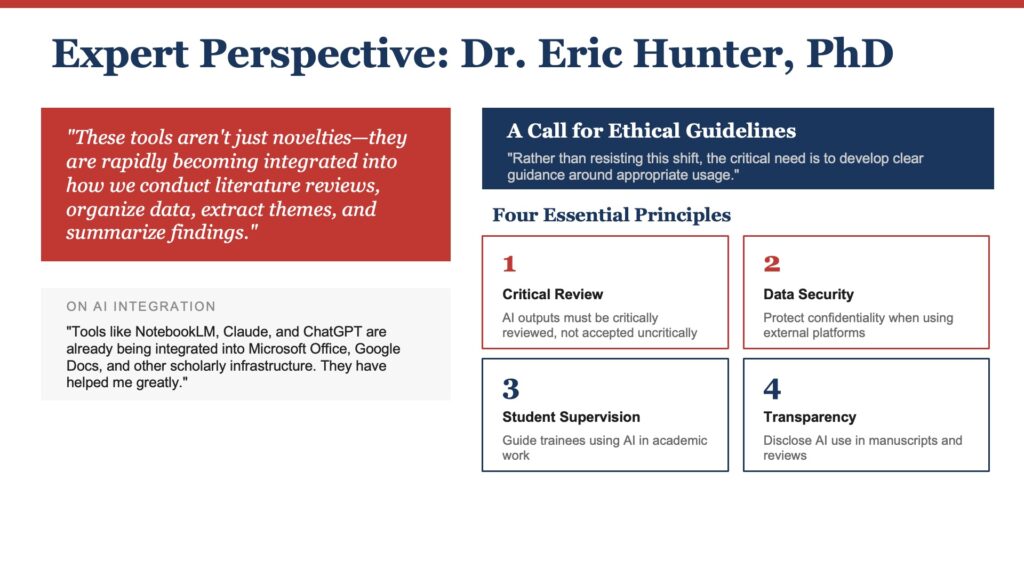
Dr. Eric Hunter: Embracing Change with Ethical Clarity
Dr. Eric Hunter focuses heavily on the institutional and academic integration of artificial intelligence. He asserts that modern AI tools are no longer passing novelties:
"These tools are rapidly becoming integrated into how we conduct literature reviews, organize data, extract themes from large bodies of text, and even summarize findings."
As platforms like NotebookLM, Claude, and ChatGPT weave themselves into standard academic software infrastructure, Dr. Hunter issues a definitive call to action. Rather than resisting technological evolution, the academic community must establish proactive, clear ethical guidelines for authors and reviewers. Dr. Hunter outlines four foundational pillars for responsible AI integration in scholarly publishing:
Transparency: Clear disclosure of AI tool utilization in data processing, literature synthesis, and manuscript drafting.
Human Accountability: Uncompromising insistence that human authors retain total responsibility for the scientific accuracy and integrity of published work.
Data Privacy: Rigorous protection of patient health information (PHI) when training or feeding algorithms clinical voice datasets.
Editorial Integrity: Establishing robust peer-review protocols to identify and mitigate algorithmic hallucination or bias.
"Our field will benefit most," Dr. Hunter concludes, "if we embrace the productivity these tools offer while also building a shared ethical framework for their responsible use."
A Global Research Community
The rapid ascent of computational voice science is powered by a truly borderless, collaborative network of investigators. Leading contributors to the Journal of Voice span the globe, including Jérôme René Lechien, Dimitar Deliyski, Stephanie Zacharias, Ahmed Yousef, Paavo Alku, Leonardo Wanderley Lopes, and Maryam Naghibolhosseini. Supported by dozens of international laboratories, this global community is united by a single objective: decoding the deepest mysteries of human vocalization through advanced computational mathematics.
The Path Forward: A Call for Collective Action
As the Journal of Voice enters this next decade, it reaffirms its dedication to publishing fearless, rigorous research that pushes the boundaries of medical science while upholding uncompromising standards of peer review.
However, realizing the full promise of artificial intelligence requires coordinated, collective action across three distinct fronts:
Thoughtful Engagement: We must learn the precise capabilities and inherent limitations of AI tools, utilizing them to amplify human clinical expertise rather than substitute for professional judgment.
Ethical Harmonization: The creation of a shared ethical framework cannot be accomplished by a single journal or institution; it demands a unified, cross-disciplinary consensus.
Open Collaboration: Researchers, clinicians, and educators must continue to share their findings openly, ensuring that the fruits of technological innovation are distributed equitably across global healthcare systems.
Conclusion: An Extraordinary Moment
For hundreds of thousands of years, the human voice has served as our primary instrument of connection, emotional resonance, and personal identity. It carries the subtle signatures of our health, our psychology, and our humanity in a format utterly unique to our species.
Now, for the first time in human history, we possess computational instruments sophisticated enough to truly decode that complexity—tools capable of extending the reach of expert clinicians, detecting pathological changes long before symptoms manifest, and democratizing access to elite voice care worldwide.
We stand at the absolute center of this historic transformation. The next decade promises even greater breakthroughs in our understanding of the human voice, and The Voice Foundation remains profoundly honored to lead the charge into this extraordinary sonic frontier.