
By Ian DeNolfo, Executive Director of The Voice Foundation
Published in partnership with the Journal of Voice
Executive Overview
Voice science stands at a monumental crossroads. Across the globe, artificial intelligence (AI) and machine learning (ML) are fundamentally rewriting the paradigms of how researchers conduct acoustic studies, how clinical data is parsed, and how patients receive multidisciplinary care. For over half a century, The Voice Foundation and its premier publication, the Journal of Voice, have served as the intellectual nucleus for this specialized domain—bridging the gap between the artistic stage and the rigorous demands of clinical medicine.
Today, this intersection of biology and computation is accelerating at an unprecedented pace. What began in the mid-1990s as experimental neural network applications has blossomed into an exponential technological movement. More than 63% of all AI-related papers in the Journal of Voice’s history have been published in just the last three years. In 2025 alone, the journal published 51 artificial intelligence papers—surpassing the cumulative total of the entire first two decades of digital voice computing combined.
This transformation is far more than a mere academic milestone. By treating the human voice as a sophisticated digital biomarker, modern researchers are unlocking non-invasive, highly sensitive windows into systemic health. From early-stage detection of neurological disorders like Parkinson’s disease and psychiatric conditions such as major depression, to evaluating the efficacy of conversational AI chatbots in clinical decision-making, the implications for global healthcare are profound. As we navigate this inflection point, the international voice science community must balance the extraordinary diagnostic power of these technologies with a unified commitment to transparency, ethical clarity, and methodological rigor.
A Legacy of Interdisciplinary Innovation
To understand the magnitude of today’s technological revolution, one must first look back at the visionary foundation upon which modern voice science was built. In 1969, Dr. Wilbur James Gould established The Voice Foundation in New York City during an era when comprehensive, interdisciplinary care for the human voice was virtually nonexistent. Dr. Gould possessed the remarkable foresight to bring together distinct, often siloed disciplines: physicians, scientists, speech-language pathologists, performing artists, and master vocal pedagogues. By pooling their collective expertise, they fundamentally altered how the professional voice user was treated and studied.
The momentum quickly catalyzed into public forums. The Foundation hosted its inaugural Annual Symposium—Care of the Professional Voice—in 1972, followed by its first Gala (later christened the Voices of Summer) in 1973. For over five decades, these gatherings have served as sacred bridges connecting the worlds of art and science, clinic and stage.
Since 1989, the Foundation has operated under the visionary leadership of Dr. Robert Thayer Sataloff, an internationally renowned otolaryngologist, professional singer, and conductor. Having authored more than 1,200 publications, including 79 textbooks, Dr. Sataloff guided the relocation of the Foundation to Philadelphia, cementing its status as an academic epicenter. Today, the Philadelphia Symposium draws hundreds of elite medical, scientific, academic, and artistic minds from across the globe, while the Journal of Voice stands unchallenged as the premier peer-reviewed journal dedicated exclusively to voice science and medicine.
Detailed Chronology: Thirty Years of AI Research in Voice Science
While mainstream society has only recently become captivated by generative AI and large language models, the readership of the Journal of Voice has been exploring computational voice analysis for over three decades.
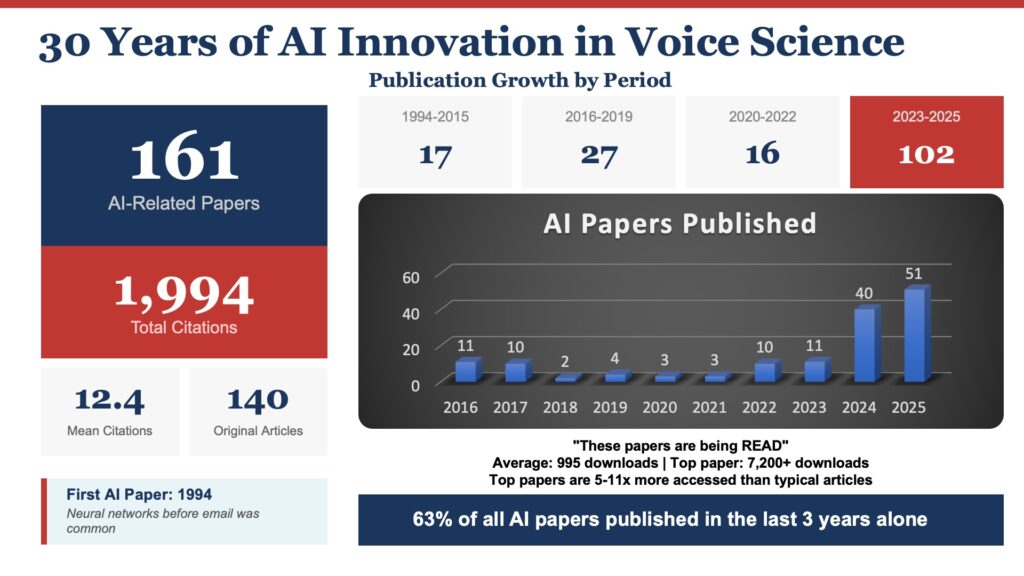
The timeline of AI integration in voice science unfolds in fascinating epochs:
- The Genesis (1994): In 1994—the exact same year the World Wide Web first emerged into public consciousness—the Journal of Voice published a pioneering paper by Rihkanen and colleagues titled "Spectral Pattern Recognition of Improved Voice Quality." Utilizing rudimentary neural networks to analyze acoustic parameters, this paper proved that machines could process vocal nuances long before email was ubiquitous in everyday life.
- The Formative Years (1995–2015): For the next two decades, AI research in voice science was a specialized, highly technical niche. A total of 17 papers were published during this 21-year stretch. Researchers laid foundational algorithmic groundwork, testing basic pattern recognition and signal processing techniques.
- The Acceleration Phase (2016–2019): As computing power scaled and machine learning frameworks matured, interest spiked. Between 2016 and 2019, 27 papers were published, expanding into automated voice disorder detection and vector analysis.
- The Plateau and Pandemic Pivot (2020–2022): Amid global disruptions, 16 papers were published from 2020 to 2022. Notably, this era saw an urgent pivot toward applying machine learning to respiratory health, including automated detection of COVID-19 indicators from vocal tracts and early neural network applications for laryngeal imaging.
- The Exponential Explosion (2023–2025): The current era represents an unprecedented surge. In just three years (2023–2025), a staggering 102 AI-related papers have been published. Culminating in 51 papers published in the year 2025 alone, this exponential trajectory reflects a field undergoing a complete structural metamorphosis.
Supporting Context & Metrics: Real-World Impact and Landmark Studies
The true value of these publications is measured not merely by algorithmic novelty, but by their real-world utility among clinicians, researchers, and speech-language pathologists. Usage statistics across global academic networks reveal an extraordinary hunger for computational insights.
On average, an AI-focused paper in the Journal of Voice is downloaded nearly 1,000 times. Outliers achieve staggering reach: a machine-learning study focusing on COVID-19 detection via acoustic analysis has been accessed over 7,200 times—eleven times the median readership for its corresponding issue. Similarly, top-tier review and research papers, such as Fang and colleagues’ deep learning study (193 citations) and Hegde’s machine learning survey (147 citations), have each been downloaded nearly 5,000 times. These figures underscore a clinical community actively seeking practical, technology-driven tools to elevate patient outcomes.
Landmark Research Shaping the Field
Several foundational studies have steered the trajectory of modern voice computation:
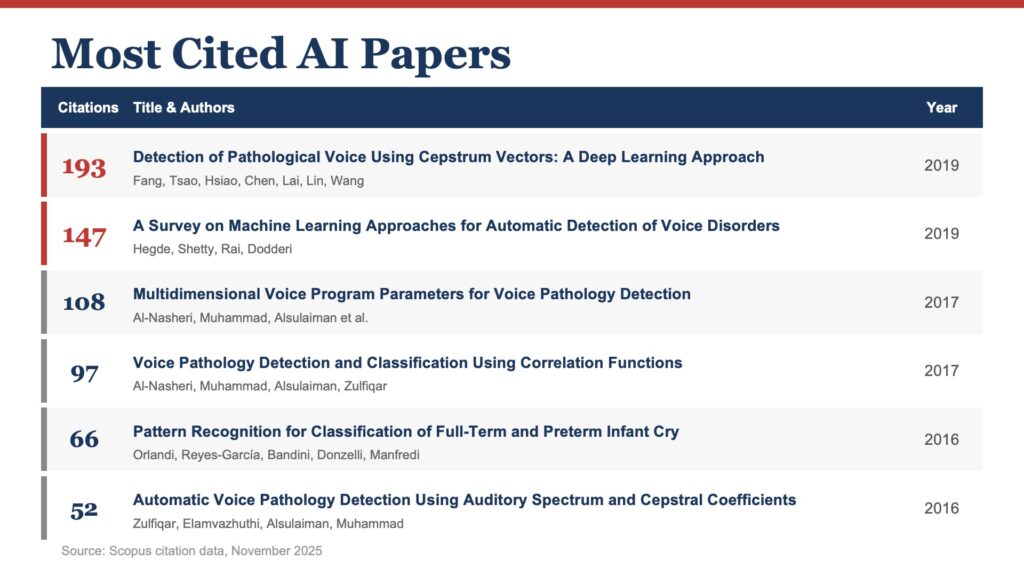
- Deep Learning for Voice Pathology Detection: Fang et al. (2019), in their landmark paper "Detection of Pathological Voice Using Cepstrum Vectors: A Deep Learning Approach" (193 citations), demonstrated that deep neural networks can diagnose vocal pathologies with astonishing precision—often detecting anomalies via acoustic features entirely imperceptible to the human ear.
- Comprehensive Frameworks: Hegde and colleagues’ comprehensive "Survey on Machine Learning Approaches for Automatic Detection of Voice Disorders" (147 citations) established an essential roadmap for newcomers to computational otolaryngology.
- Multidimensional Parameters: Al-Nasheri et al. (2017) contributed vital methodologies regarding Multidimensional Voice Program (MDVP) parameters (108 citations) and correlation functions (97 citations).
- Advanced Neural Architectures: More recent milestones include Chen and Chen (2022) on deep neural networks for voice classification, Fujimura’s exploration of 1D convolutional neural networks, and Cho and Choi’s comparative analyses of CNN models applied directly to laryngoscopic imagery.
The Voice as a Digital Biomarker
Perhaps the most clinically transformative concept to emerge from this data is the conceptualization of the human voice as a digital biomarker—a non-invasive, continuous window into systemic human health.
Breakthrough studies published in the journal have detailed how automated voice analysis can successfully track the severity and progression of neurodegenerative conditions like Parkinson’s disease. Hemmerling and Wójcik-Pędziwiatr’s 2022 paper on predicting Parkinson’s severity via voice signals has quickly accumulated 29 citations, paving the way for remote patient monitoring.
Furthermore, systematic reviews now explore vocal acoustics as digital biomarkers for mental health conditions, including major depressive disorder and bipolar disorder. By analyzing routine speech patterns for subtle psychomotor slowing or affective shifts, clinicians envision a future of earlier psychological interventions, significantly mitigating the strain on overstretched global mental health systems.
AI Chatbots in Clinical Decision-Making
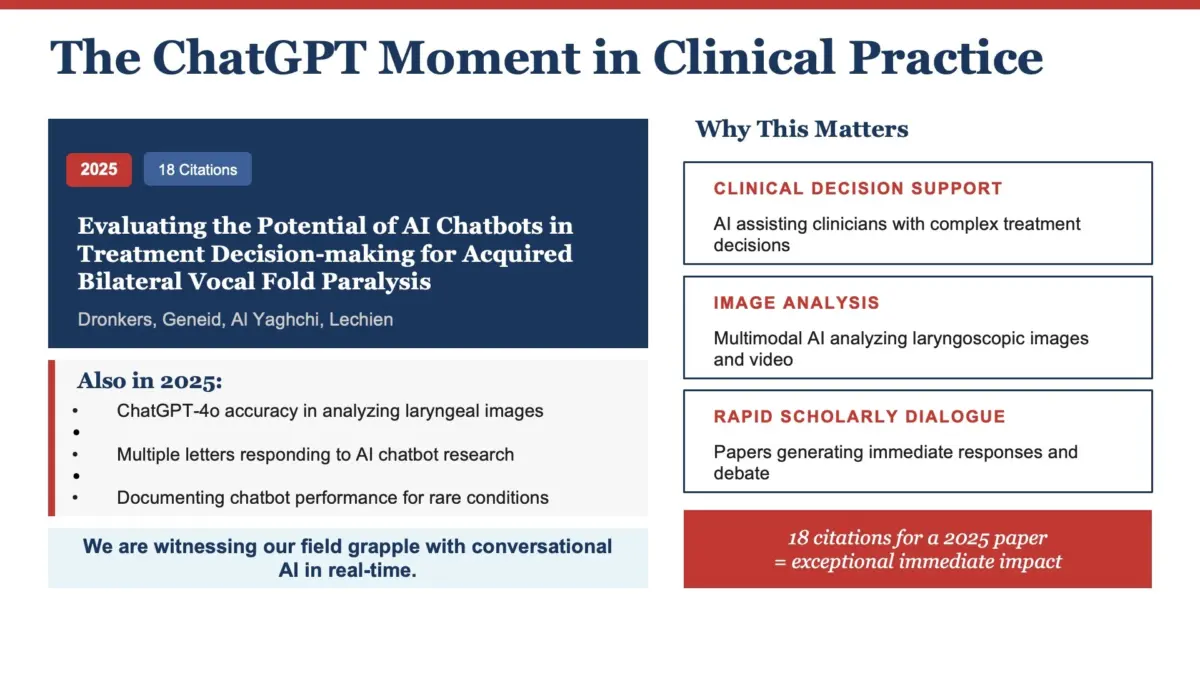
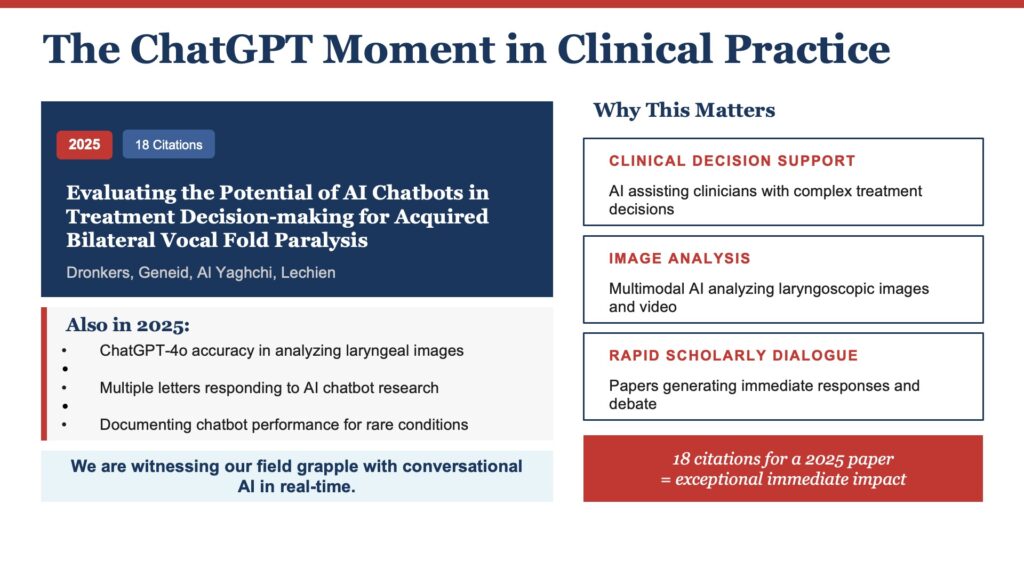
The integration of conversational artificial intelligence into medical frameworks reached a notable milestone in 2025. Dronkers and colleagues published pioneering research titled "Evaluating the Potential of AI Chatbots in Treatment Decision-making for Acquired Bilateral Vocal Fold Paralysis." Accumulating 18 citations almost immediately upon release, the paper sparked vibrant scholarly discourse, including companion letters and response studies evaluating the diagnostic accuracy of models like ChatGPT-4o in analyzing complex laryngeal images. The medical community is actively grappling, in real time, with the ethical and practical boundaries of conversational AI in clinical workflows.

Official Statements & Expert Perspectives
To contextualize these monumental shifts, leading minds within The Voice Foundation’s ecosystem offer profound insights into the opportunities and responsibilities of computational medicine.
Dr. Mark Berardi: AI as a Tool for Complexity
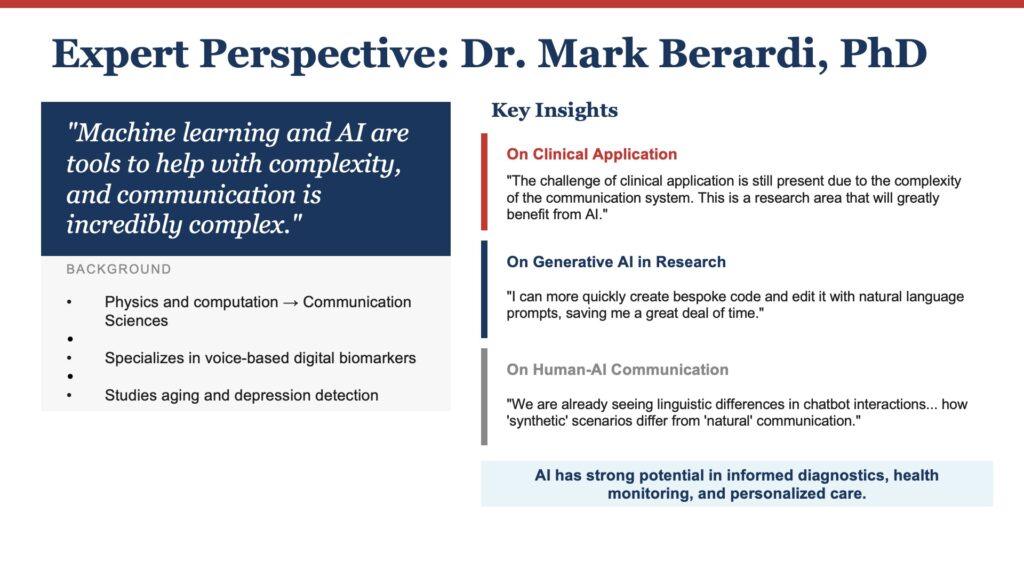
Drawing from a rich background in physics and computational science, Dr. Mark Berardi views artificial intelligence not as a replacement for human intellect, but as an indispensable tool for managing multidimensional biological complexity.
"Machine learning and AI are tools to help with complexity, and communication is incredibly complex in its neurobiological and physiological processes. So I think the application is warranted," Dr. Berardi notes.
Focusing his research on voice-based digital biomarkers for aging and depression, Dr. Berardi highlights the ease of acoustic data acquisition: "Acquiring speech and voice signals is relatively easy now, and we have shown potential for extracting meaningful health information. The challenge lies in the complexity of the communication system itself—but this is precisely where AI excels."
Addressing generative AI, he points out immediate efficiency gains in academic research, noting that researchers can now quickly write and iterate bespoke code using natural language prompts. Fascinatingly, Dr. Berardi’s current work extends to human-AI communication itself. By studying how humans dynamically alter their linguistic patterns when speaking to chatbots versus real humans—or how "synthetic" environments like Zoom calls alter vocal delivery—he suggests that voice science must expand to understand human vocalization in symbiotic relationship with machines.
Dr. Eric Hunter: Embracing Change with Ethical Clarity
Dr. Eric Hunter emphasizes that technological evolution demands immediate structural and institutional adaptation within academic publishing and clinical practice.
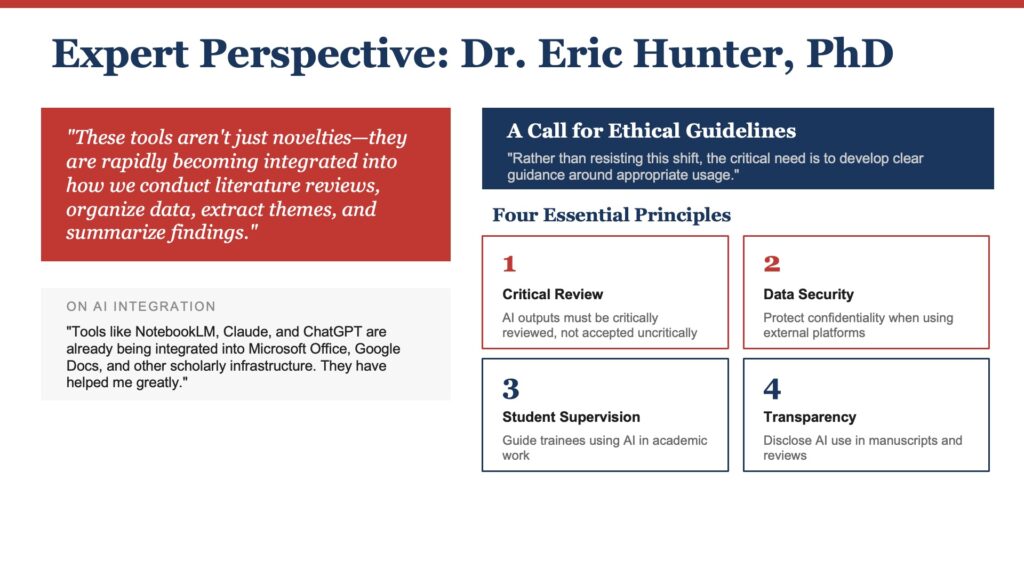
"These tools aren’t just novelties," Dr. Hunter observes. "They are rapidly becoming integrated into how we conduct literature reviews, organize data, extract themes from large bodies of text, and even summarize findings."
Acknowledging that large language models are permanently embedded within academic infrastructure (such as Microsoft Office, Google Docs, and dedicated research assistants like NotebookLM and Claude), Dr. Hunter issues a vital call to action. Rather than resisting the shift, the academic community must establish clear, transparent guardrails for authors and reviewers alike.
Dr. Hunter outlines four essential operational principles for ethical AI integration in scholarly publishing:
- Absolute Transparency: Full disclosure of any generative AI or algorithmic assistance utilized during drafting, coding, or data synthesis.
- Human Accountability: Authors must retain total, unwavering responsibility for the factual accuracy, intellectual integrity, and originality of their published work.
- Data Privacy and Security: Rigorous protection of patient voice samples and clinical datasets, ensuring compliance with global healthcare privacy regulations.
- Editorial Standardization: Collaborative development of unified peer-review guidelines to evaluate computational methodologies fairly and consistently.
"Our field will benefit most," Dr. Hunter concludes, "if we embrace the productivity these tools offer while also building a shared ethical framework for their responsible use."
A Global Research Community
This computational renaissance is driven by a vast, collaborative international network. Key contributors shaping the pages of the Journal of Voice include prolific scholars such as Jérôme René Lechien (6 papers), Dimitar Deliyski (5 papers), Stephanie Zacharias (5 papers), Ahmed Yousef (4 first-author papers), Paavo Alku, Leonardo Wanderley Lopes, and Maryam Naghibolhosseini. Hailing from institutions spanning every inhabited continent, these researchers prove that modern voice science is a borderless, unified collective.
Future Outlook: The Path Forward
As the Journal of Voice looks toward the next decade, its editorial mission remains resolute: to champion rigorous, boundary-pushing research while upholding the highest standards of scientific integrity and clinical safety.
However, realizing the full potential of AI in voice science requires addressing three collective imperatives:
- Mindful Engagement: Researchers and clinicians must approach AI tools with calibrated understanding. These technologies are designed to manage complexity and amplify human expertise—never to replace clinical judgment.
- Ethical Harmonization: The creation of a shared ethical framework cannot be accomplished by a single journal or laboratory. It demands ongoing, cross-disciplinary cooperation across global medical and computational societies.
- Continued Openness: The 161 AI papers published to date represent merely the dawn of a new era. Clinicians, educators, and engineers must continue sharing their discoveries, ensuring that technological progress directly benefits patients worldwide.
An Extraordinary Moment
For hundreds of thousands of years, the human voice has served as our primary instrument of connection, emotional expression, and personal identity. It carries our health, our vulnerabilities, and our very essence in ways that no other biological signal can replicate.
Now, for the first time in human history, we possess computational tools sophisticated enough to truly decode that complexity—translating what the voice reveals about our brains, our bodies, and our overall wellbeing. We stand equipped with innovations capable of extending the reach of expert clinicians, identifying subtle pathologies before they manifest as critical illnesses, and democratizing access to high-quality voice care across the globe.
This is an extraordinary moment in the history of medicine. With The Foundation and the Journal of Voice standing proudly at its center, the next decade of voice science promises discoveries that will forever transform human health and expression.