
LONDON — In a milestone development for the British classical music landscape, Sinfonia Smith Square has announced a substantial £200,000 capital grant awarded by the prestigious Wolfson Foundation. This pivotal funding injection will directly underwrite Doors Open: Transforming Lives Through Music, the most comprehensive and ambitious architectural overhaul of the Grade I listed Smith Square Hall since the historic London landmark was triumphantly converted into a world-class concert venue in 1969.
The initiative is designed to achieve a delicate balance: meticulously preserving the irreplaceable heritage of an architectural masterpiece while engineering a modern, inclusive, and technologically sophisticated hub for twenty-first-century music-making, community outreach, and professional orchestral training.
Executive Overview
At its core, the Doors Open project is a holistic reimagining of how a historic performance space can serve both art and society. For decades, Smith Square Hall—housed within the architectural splendor of the former St John’s Smith Square—has stood as an acoustic sanctuary in the heart of Westminster. However, the demands placed upon modern cultural venues have outstripped the building’s mid-twentieth-century infrastructure.
The £200,000 grant from the Wolfson Foundation acts as a powerful catalyst for a multi-million-pound capital campaign. This funding will facilitate vital structural conservation, erase critical maintenance backlogs, and pave the way for the venue’s removal from Historic England’s notorious Heritage at Risk Register. Beyond bricks and mortar, the project fundamentally expands the institution’s operational capacity. By reimagining underutilized spaces—most notably the historic crypt—Sinfonia Smith Square aims to democratize classical music, transforming a heritage asset into an engine for community development, educational enrichment, and the cultivation of the next generation of orchestral talent.
+--------------------------------------------------------------------------+
|                        PROJECT AT A GLANCE                               |
+--------------------------------------------------------------------------+
| Venue: Sinfonia Smith Square (Smith Square Hall, Westminster)            |
| Status: Grade I Listed Building                                          |
| Grant Award: £200,000 (The Wolfson Foundation)                           |
| Core Initiative: Doors Open: Transforming Lives Through Music            |
| Construction Phase: Late 2027 – 2029                                     |
| Target Annual Visitors: 90,000+                                          |
+--------------------------------------------------------------------------+
Detailed Chronology: From Baroque Masterpiece to Modern Cultural Hub
To understand the magnitude of the Doors Open redevelopment, one must examine the extraordinary timeline of the building itself, tracing its evolution from a house of worship to a contested architectural survivor, and finally to a beacon of contemporary classical music.
The Eighteenth-Century Genesis
Designed by the visionary architect Thomas Archer and constructed between 1713 and 1728, the building originally served as the parish church of St John the Evangelist. Characterized by its distinctive Baroque styling—including four iconic corner towers that led to its affectionate, if irreverent, local nickname as Queen Anne’s "footstool"—the structure was an architectural statement of its era. However, its history was fraught with misfortune from the outset. The building suffered significant damage from a devastating fire in 1742, requiring extensive interior reconstruction, and later endured the shifting demographics of a post-industrial London.
The Blitz and Near-Demolition
The darkest chapter in the building’s history unfolded during the Second World War. Direct hits from incendiary bombs during the Blitz in 1941 gutted the interior, leaving the monumental exterior shell standing as a hollow, fire-scarred monument to wartime destruction. For decades, the ruin languished, slated on multiple occasions for total demolition to clear space for modern real estate developments.
The 1969 Renaissance
Rescue came in the late 1960s through the tenacity of music lover Lady Parker of Waddington and a dedicated committee of preservationists. Following a meticulous, sensitive restoration led by architects Marshall Sisson, the building was triumphantly reborn in 1969 not as a parish church, but as an independent concert hall. Its unique elliptical interior and renowned acoustics quickly established it as a cherished venue for chamber orchestras, choral groups, and recitalists, operating for decades under the moniker St John’s Smith Square.
The Sinfonia Smith Square Era and the Path to Doors Open
In recent years, the venue entered a new chapter when it aligned closely with the orchestra formerly known as the Southbank Sinfonia, subsequently rebranding as Sinfonia Smith Square. This integration of a world-class professional training orchestra with a historic venue created unprecedented artistic vitality, but it also exposed the limitations of the 1960s infrastructure.
The announcement of the Wolfson Foundation grant marks the formal acceleration of the Doors Open campaign, setting the stage for a meticulous two-year closure period beginning in late 2027, culminating in a grand reopening slated for 2029.
Supporting Context & Metrics: Architecture, Access, and Impact
The Doors Open redevelopment is underpinned by rigorous planning, measurable community targets, and an unyielding commitment to heritage stewardship. The project addresses three interconnected imperatives: architectural conservation, accessibility, and educational outreach.
Architectural Conservation and Heritage Rescue
A primary driver of the capital project is the urgent need to address the structural vulnerabilities of a Grade I listed monument. Decades of urban pollution, shifting water tables, and natural weathering have taken a heavy toll on Archer’s Baroque masonry and internal timber structures. The funding secured through partners like the Wolfson Foundation will directly target the restoration of the building’s envelope, roof timbers, and stonework. Successful execution of these works will allow Historic England to officially remove Smith Square Hall from its Heritage at Risk Register, securing the building’s structural integrity for future generations.
Unlocking the Crypt: Education and Community
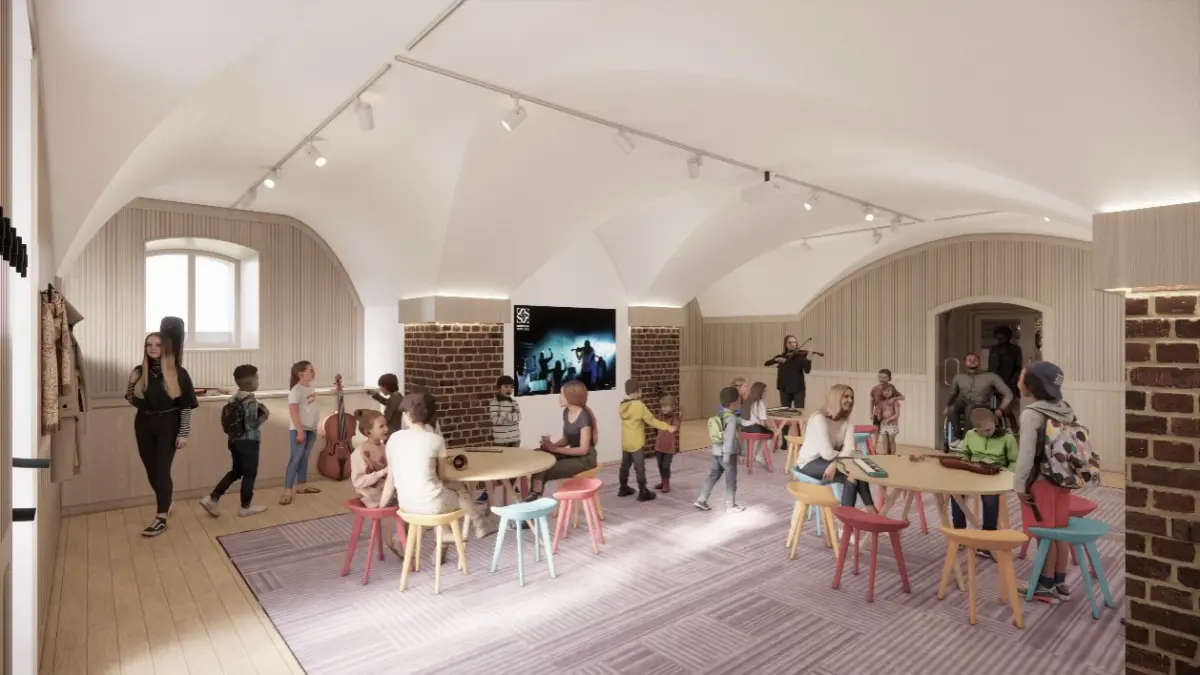
Perhaps the most transformative architectural intervention of the Doors Open project is the radical reimagining of the building’s subterranean crypt. Historically utilized primarily for storage and limited auxiliary functions, the crypt will be transformed into a state-of-the-art, multi-purpose learning and community space.
This new facility will host:
- Schools Programs: Bespoke educational workshops designed to introduce primary and secondary students to classical music, composition, and instrumental performance.
- Community Music Projects: Inclusive, participatory music-making sessions tailored for vulnerable and marginalized groups across Westminster and the wider London boroughs.
- Creative Workshops: Collaborative incubators for interdisciplinary arts, spoken word, and multimedia performance.
Bolstering the Orchestral Fellowship
At the heart of Sinfonia Smith Square’s identity is its renowned orchestral Fellowship program. Since its inception in 2002, the Fellowship has served as a critical bridge between conservatoire study and professional orchestral life, supporting more than 700 early-career musicians.
Despite its stellar track record, the Fellowship has long contended with constrained rehearsal and administrative spaces within the historic building. The redevelopment introduces vastly improved, acoustically treated rehearsal facilities. These upgraded spaces will allow the orchestra’s young professionals to hone their craft in conditions that mirror the world’s leading performance venues, ensuring they enter the global music market fully prepared for the rigors of professional performance.
+--------------------------------------------------------------------------+
|                        PROJECT IMPACT METRICS                            |
+--------------------------------------------------------------------------+
| Early-Career Musicians Supported (Since 2002): 700+                      |
| Projected Annual Visitors Post-Reopening: 90,000+                        |
| Target Reopening Date: 2029                                              |
| Heritage Status: Grade I Listed / Heritage at Risk Target                |
+--------------------------------------------------------------------------+
Accessibility and Audience Experience
In its current configuration, Smith Square Hall suffers from physical barriers that restrict full access for disabled performers, staff, and audience members—limitations common to eighteenth-century architecture. The Doors Open project incorporates modern accessibility audits directly into its blueprints. Improvements will include step-free access routes, upgraded lift facilities, modernized auditorium seating configurations, and enhanced acoustic-assistive technologies, ensuring that the venue is genuinely open to all members of society.
Official Statements and Institutional Vision
The announcement of the Wolfson Foundation grant has elicited widespread acclaim from cultural leaders, philanthropists, and orchestral management, highlighting the national significance of the undertaking.
Speaking on behalf of Sinfonia Smith Square, executive leadership emphasized the transformative nature of the partnership with the Wolfson Foundation:
"The generous support of the Wolfson Foundation marks a monumental turning point for Sinfonia Smith Square. Doors Open is not merely about repairing stone and updating infrastructure; it is about redefining what a historic concert hall can achieve in the twenty-first century. By breathing new life into our crypt, upgrading our rehearsal spaces for our Fellowship musicians, and removing our historic home from the Heritage at Risk Register, we are ensuring that Smith Square remains a vibrant, beating heart of British musical life for generations to come."
The Wolfson Foundation, known for its rigorous evaluation process and dedication to funding excellence in science, health, heritage, and the humanities, underscored the cultural value of the Westminster project:
"We are delighted to support Sinfonia Smith Square in this visionary redevelopment. The project brilliantly marries the preservation of a nationally important architectural masterpiece with a deep commitment to education, community engagement, and the professional development of young musicians. We look forward to seeing the profound impact Doors Open will have on London’s cultural landscape."
Future Outlook: A New Horizon for Westminster’s Musical Landmark
As Sinfonia Smith Square looks toward the commencement of construction in late 2027 and the anticipated grand reopening in 2029, the organization is poised to enter a new golden era.
The logistical challenges of a multi-year closure will be met with a robust strategy of nomadic programming, ensuring that the orchestra continues to perform, tour, and mentor its fellows across London and the UK while its spiritual home undergoes its metamorphosis.
Upon reopening in 2029, the revitalized Smith Square Hall is projected to welcome in excess of 90,000 visitors annually—a substantial increase over pre-redevelopment figures. By seamlessly fusing the austere elegance of Thomas Archer’s Baroque architecture with cutting-edge educational facilities, accessible design, and world-class rehearsal spaces, Doors Open will cement Sinfonia Smith Square’s status as a dynamic powerhouse of classical music.
In an era where cultural institutions face unprecedented financial and societal pressures, this ambitious undertaking stands as a bold, enduring testament to the power of music to transform lives, heal historic spaces, and unite communities.