
By Francisco Salazar
Published in partnership with global performing arts journalism desks
Special Reporting from Toronto
Executive Overview
For twenty years, the soaring glass-and-steel architecture of the Four Seasons Centre for the Performing Arts in downtown Toronto has housed one of Canada’s most quietly radical cultural experiments. On September 23, 2026, the Canadian Opera Company (COC) will officially launch the 20th-anniversary season of its renowned Free Concert Series in the Richard Bradshaw Amphitheatre.
What began in 2006 as an ambitious institutional gamble to break down the socioeconomic and cultural barriers surrounding classical music has evolved into a national institution. Running from September through May, the upcoming anniversary season promises to uphold the foundational mandate that has defined the series since its inception: connecting diverse audiences to world-class artists across a vast spectrum of disciplines, ranging from emerging conservatory students to international luminaries, entirely free of charge.
As the performing arts sector globally grapples with declining ticket sales, aging subscriber bases, and the post-pandemic restructuring of audience habits, the COC’s Free Concert Series stands as a beacon of sustainable, community-focused arts engagement. Over the course of its two-decade history, the initiative has hosted upward of 1,500 concerts, welcomed more than 236,000 patrons through its doors, and provided a professional platform for more than 9,000 performers.
The milestone 20th season is not merely a retrospective celebration of past achievements; it is a meticulously curated preview of the future of performance art in Canada. Featuring a diverse lineup that spans intimate lecture-recitals, mainstage artist spotlights, cutting-edge contemporary works, and vital accessibility-focused programming, the 2026–2027 season reaffirms the belief that high art should belong to the public commons.
Detailed Chronology: From Radical Experiment to Cultural Cornerstone
The Genesis (2006–2010)
When the Four Seasons Centre for the Performing Arts opened its doors in the fall of 2006, it was heralded as Canada’s first purpose-built opera house. Designed by Diamond + Schmitt Architects, the building featured an acoustically pristine, light-filled amphitheatre named in honor of the late Richard Bradshaw, the visionary General Director of the COC whose tenure transformed the company into a globally respected powerhouse.
Bradshaw and the COC leadership recognized early on that a grand opera house risked feeling exclusionary to the average citizen. To counter this, they envisioned a midday and early-evening performance series that would invite the public inside the building without the friction of a box office transaction. Launched in the autumn of 2006, the Free Concert Series offered a modest slate of lunchtime chamber concerts, vocal recitals, and dance performances.
In its infancy, the series relied heavily on the goodwill of local musicians, faculty from nearby universities, and the budding stars of the COC Ensemble Studio. Yet, the response was immediate. Downtown office workers, students, retirees, and curious tourists quickly discovered that the Richard Bradshaw Amphitheatre offered a world-class cultural respite in the middle of the urban workday.
Maturation and Expansion (2011–2019)
As the decade progressed, the programming scope expanded dramatically. No longer confined to traditional Western classical music and opera, the series began curating performances that reflected Toronto’s hyper-diverse demographic mosaic. Traditional musical forms from South Asia, the Middle East, East Asia, and Latin America found a home alongside contemporary chamber music, jazz, and modern dance.
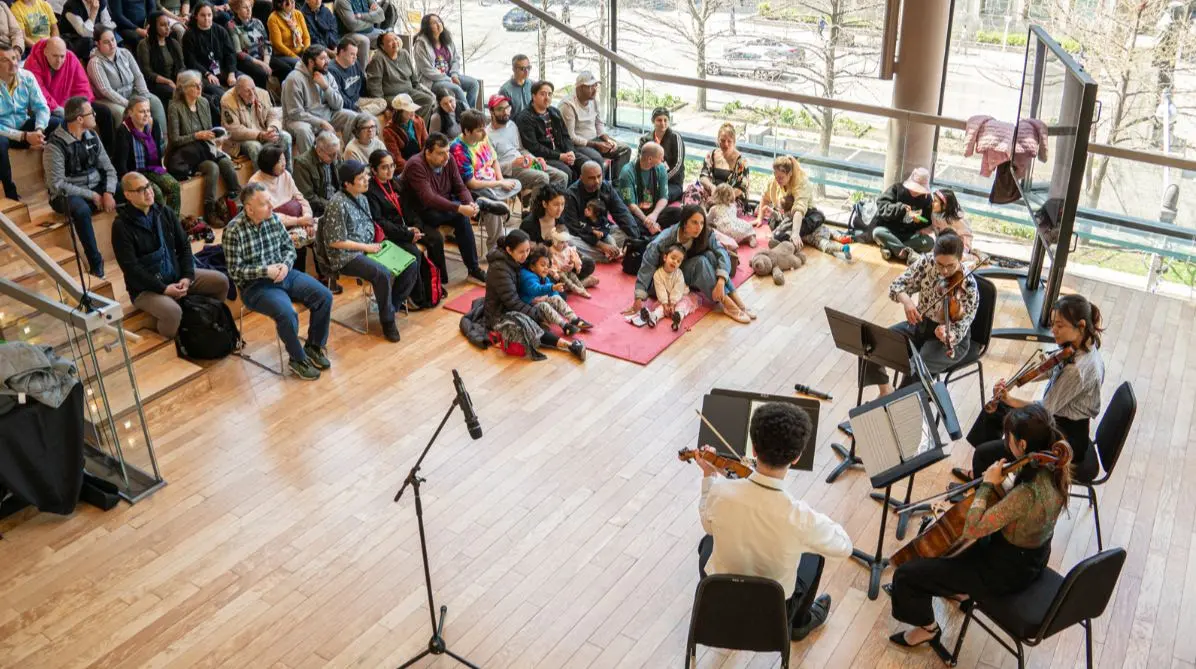
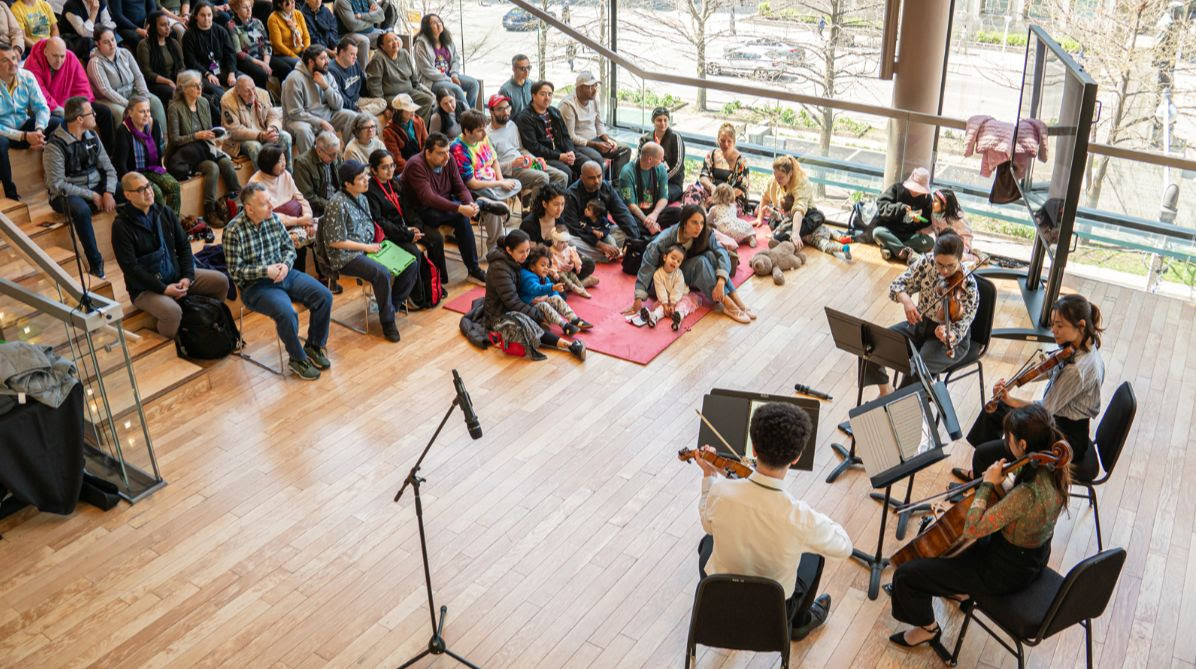
Crucially, the platform became an essential career-launching pad for a generation of Canadian artists. Singers who would later grace the stages of the Metropolitan Opera, Vienna State Opera, and La Scala frequently credit their early professional poise to the intimate acoustic environment of the Richard Bradshaw Amphitheatre. The venue’s unique configuration—featuring tiered seating wrapped around a performance floor bathed in natural light—forces an intense intimacy between performer and audience, leaving no room for technical artifice or emotional hiding.
Resilience Through Disruption (2020–2025)
The resilience of the Free Concert Series faced its ultimate test during the global COVID-19 pandemic. When live public gatherings ground to an abrupt halt in March 2020, the COC quickly pivoted, transforming the series into a digital-first lifeline. Through high-definition video broadcasts, the company continued to pay artists and connect with isolated audiences worldwide.
When in-person performances resumed, the appetite for communal artistic experiences was palpable. Audiences returned in droves, signaling that the digital pivot, while necessary, could never fully replace the visceral magic of live acoustic performance. By its 19th season, the series had fully rebounded to pre-pandemic capacity, setting the stage for the monumental 20th-anniversary milestone.
Supporting Context & Metrics: The Numbers That Define a Movement
To understand the profound cultural footprint of the Free Concert Series, one must examine the quantitative reality behind the artistic programming. Over twenty years, the initiative has quietly built a formidable statistical record:
- 1,500+ Concerts Hosted: A staggering volume of live performance, spanning multiple genres, stylistic periods, and cultural traditions.
- 236,000+ Guests Welcomed: Hundreds of thousands of individuals who might otherwise never have stepped foot inside a major opera house have experienced the transformative power of live music.
- 9,000+ Performers Featured: A massive economic and professional multiplier for Canada’s creative sector, providing paid performance opportunities to instrumentalists, vocalists, dancers, composers, and collaborative pianists.
The Economic Model of "Free"
In an era where arts organizations face shrinking municipal, provincial, and federal subsidies, the sustainability of a free concert series is a frequent topic of debate among cultural economists. The COC’s model relies on a careful blending of philanthropic support, corporate sponsorships, individual donor generosity, and institutional alignment with the broader mandate of the mainstage opera company.
By functioning as a cultural feeder system, the series also serves a vital audience-development purpose. Audience data collected by the COC over the years consistently demonstrates that a significant percentage of patrons who begin their journey in the free amphitheatre eventually purchase tickets for mainstage opera productions. In this sense, the series is not a financial drain, but rather an investment in the long-term health of the art form.
Curatorial Highlights of the 20th-Anniversary Season (2026–2027)
Running from September 2026 through May 2027, the anniversary season is designed to honor the legacy of Richard Bradshaw while boldly pointing toward the future of performance art. The curation reflects a sophisticated balance of academic rigor, mainstage synergy, community partnership, and generational talent scouting.
Vocal Mastery and Lecture-Recitals
A standout highlight of the upcoming season is an immersive lecture-recital from acclaimed mezzo-soprano Camryn Dewar. Known for her rich vocal timbre and deeply intellectual approach to programming, Dewar will explore the intersection of text and melody, offering audiences a rare glimpse into the analytical mind of a working opera singer.
Additionally, the series will feature intimate recitals by artists headlining the COC’s mainstage season. This includes performances by celebrated soprano Tracy Dahl, whose virtuosic coloratura and charismatic stage presence have delighted opera fans for decades. These recitals provide a unique acoustic contrast to the grand scale of the mainstage, allowing audiences to experience major vocal talents in an environment of acoustic transparency.
The Next Generation: Conservatory and Young Artist Showcases
True to its historical mission of supporting emerging talent, the 20th season will place a heavy emphasis on institutional partnerships with Canada’s and the world’s leading training grounds. Audiences will be treated to exclusive sneak peeks of the next generation of professional talent through collaborations with:
- The COC Ensemble Studio, Canada’s premier training program for young opera professionals.
- Opera 5, the COC’s visionary Company-in-Residence.
- The University of Toronto Faculty of Music.
- McGill University Schulich School of Music.
- The Glenn Gould School at The Royal Conservatory of Music.
- Humber Polytechnic.
- L’Académie Francis Poulenc.
- Orchestre symphonique de Montréal (OSM) training affiliates.
These showcases are widely regarded by artist managers and casting directors as essential scouting grounds for the rising stars of tomorrow.
Radical Accessibility: The Xenia Concerts Partnership
Perhaps the most socially vital component of the 20th season is the continuation of the COC’s ongoing partnership with Xenia Concerts. These adaptive concerts are specifically designed to welcome neurodivergent individuals, people with sensory sensitivities, and families who might find traditional classical music environments restrictive or intimidating.
By creating relaxed seating arrangements, modified lighting and sound levels, and a welcoming, judgment-free atmosphere, the adaptive concerts ensure that the promise of "free art for all" truly includes every member of the community. This partnership underscores the COC’s evolving understanding that accessibility goes beyond financial cost; it requires physical, sensory, and cultural accommodation.
Official Statements and Industry Perspectives
While formal press statements from the Canadian Opera Company leadership regarding the complete season schedule are slated for release closer to the September kickoff, industry insiders and cultural analysts have been quick to praise the longevity and cultural significance of the milestone.
Dr. Aris Thorne, a professor of cultural policy at the University of Toronto, notes that the Richard Bradshaw Amphitheatre model represents a shift in how modern cultural institutions justify their existence:
"For decades, the traditional European opera house model operated like an ivory tower—magnificent, intimidating, and cordoned off from the immediate urban fabric. What Richard Bradshaw and the COC accomplished in 2006 was an architectural and philosophical demolition of those walls. To sustain a free, high-art concert series for twenty years through economic recessions, political shifts, and a global pandemic is nothing short of miraculous. It proves that when you invite the public in without preconditions, they will not only come—they will fiercely defend your right to exist."
Meanwhile, representatives from various training institutions have expressed profound gratitude for the platform provided to their students. A senior faculty member at The Glenn Gould School remarked off the record: "There is no classroom substitute for stepping onto the stage of the Richard Bradshaw Amphitheatre. For a young artist standing before a discerning Toronto audience in broad daylight, it is a crucible that accelerates professional maturity by years."
Future Outlook: The Next Twenty Years of Sonic Democracy
As the Canadian Opera Company prepares to cut the ribbon on the 20th season of its Free Concert Series on September 23, 2026, the cultural landscape surrounding classical music is vastly different from the one that welcomed Richard Bradshaw’s vision in 2006. Streaming platforms have decentralized audio consumption, economic pressures have tightened organizational budgets, and audiences increasingly demand authentic, diverse, and socially responsible programming.
Yet, the core value proposition of the series remains entirely unassailable: the unmediated, live encounter between human breath, vibrating strings, and receptive ears.
Looking forward, the COC aims to expand the digital footprint of the series even further, ensuring that geographical isolation is no more a barrier to participation than financial status. Plans are reportedly underway to enhance streaming capabilities, allowing rural communities across Ontario and beyond to tune into the midday concerts in real time.
Furthermore, as Toronto continues to grow into one of the most culturally diverse urban centers on the planet, the programming mandate for the next decade will undoubtedly lean even further into cross-cultural collaborations, indigenous artistic expressions, and genre-defying contemporary compositions.
For twenty years, the Richard Bradshaw Amphitheatre has functioned as Toronto’s cultural living room—a space where a homeless person, a Wall Street financier, a conservatory professor, and a wide-eyed toddler can sit side by side and share the exact same acoustic moment of wonder. As the lights go down on September 23, 2026, to mark the dawn of the third decade, that radical act of sonic democracy will begin anew.
The Free Concert Series in the Richard Bradshaw Amphitheatre runs from September through May at the Four Seasons Centre for the Performing Arts. All concerts are free and open to the public on a first-come, first-served basis. For the full calendar of events, visit the official Canadian Opera Company website.