Virtual and augmented reality (VR/AR) have long occupied an awkward space within the music industry. Despite years of heavy capitalization, ambitious tech startups, and no shortage of creative experiments, immersive technologies have historically struggled to deliver game-changing revenue streams or sustainable commercial models for musicians. For much of the decade, the prevailing sentiment among music executives has been one of weary skepticism, viewing immersive audio-visual projects as costly marketing novelties rather than foundational business pillars.
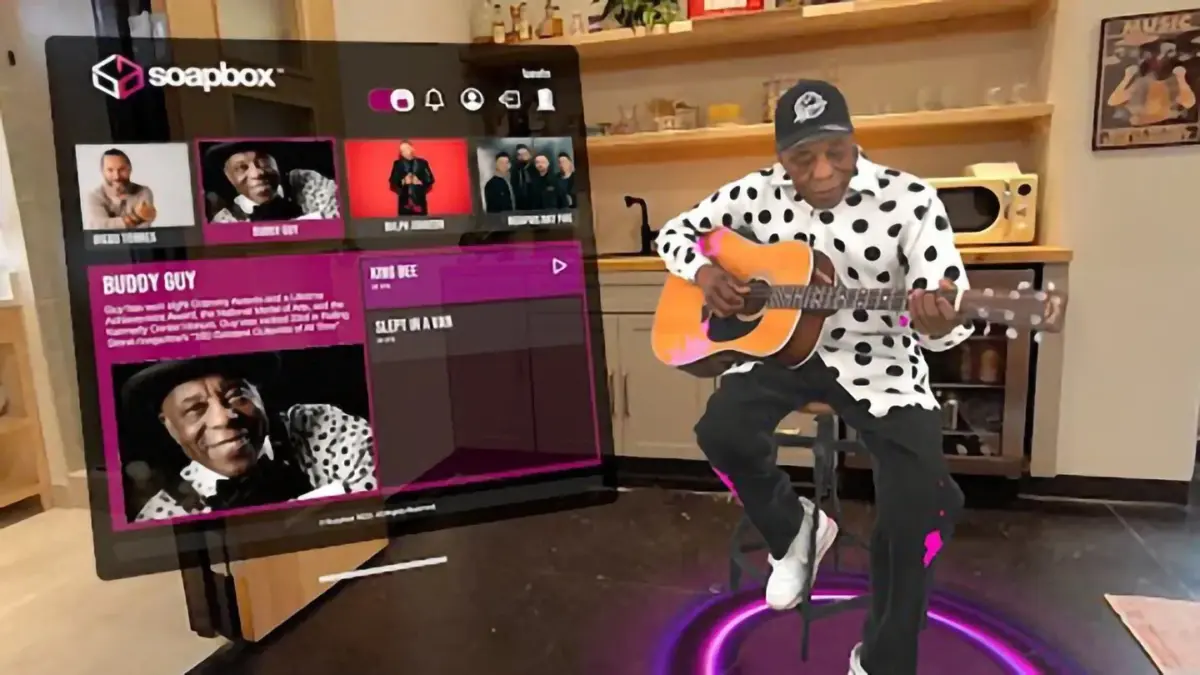
Yet, as the hardware ecosystem slowly matures, a quiet renaissance is brewing beneath the surface. Leading this charge is Soapbox, an innovative platform that captures high-fidelity volumetric video of musicians, translating raw performances into life-size, fully three-dimensional holograms that users can experience directly in their living rooms. Boasting partnerships with all three major record companies, global publishing umbrellas, and an initial catalog featuring over 140 iconic artists—including pop and R&B innovator T-Pain, hip-hop icon Waka Flocka Flame, and blues legend Buddy Guy—Soapbox is attempting where others have failed.
Rather than relying on computer-generated imagery (CGI) or synthetic avatars, Soapbox doubles down on human authenticity. By filming real artists in 3D, the company preserves legendary performances and intimate masterclasses—such as a front-row seat to drum drills with Earth, Wind & Fire percussionist Ralph Johnson—without a single pixel of generative AI.
As the company transitions from early virtual reality headset applications toward the impending wave of lightweight augmented reality glasses, it stands at the intersection of technological evolution and cultural preservation. This comprehensive report examines Soapbox’s genesis, its technical architecture, its educational footprint, and the broader industry implications of betting on a strictly human-centric, immersive future.
Detailed Chronology: From Atlanta Recording Studios to Immersive Tech
The story of Soapbox is rooted in a lifelong creative partnership between two brothers: Kevin and Ryan Sellors. Growing up playing in bands together, the siblings naturally gravitated toward the intersection of art and engineering, though their professional paths initially diverged into distinct industries.
Kevin carved out a successful career as a professional recording engineer, operating a couple of recording studios in Atlanta over the years. In that environment, he developed a front-row seat to the creative process.
"In the studio, you get the opportunity to work up-close with artists. You get a real unfiltered look at what makes artists special, their particular techniques, and everything else," Kevin explains. "Not many people get the opportunity to see that, so when I started understanding augmented reality, it clicked: we could offer that up-close, intimate experience to everyone."
Meanwhile, Ryan founded a thriving enterprise building technology for the construction sector. In the course of running his business, Ryan began exploring mixed and augmented reality technologies—innovations he was quick to share with his brother. What began as casual technical discussions gradually evolved into a singular obsession.
"After a few months of talking, I decided to go all-in," Kevin recalls. "I eventually convinced Ryan to pass off his other company and build with me. It’s been a wild ride since: one of those situations where you don’t understand the size of the mountain until you start climbing. But it’s a mountain worth climbing, I think, so we’re going all the way."
Merging Kevin’s deep industry relationships and acoustic expertise with Ryan’s enterprise-grade technical acumen, the brothers laid the foundations for Soapbox. They bypassed the traditional Silicon Valley playbook of algorithmic shortcuts, choosing instead to pioneer a proprietary volumetric capture process capable of turning high-end music performances into tangible, spatial assets. Securing buy-in from major record labels and publishers, the company built a robust operational infrastructure designed to bridge the gap between legacy music catalogs and next-generation consumer hardware.
Supporting Context & Metrics: Scaling the Human Element
While many immersive tech companies lean heavily into virtual worlds, fantasy avatars, and generative AI landscapes, Soapbox has intentionally moved in the opposite direction. The platform relies on a strict ethos of unvarnished realism.
The Anatomy of a Soapbox Capture
No Generative AI or CGI: Soapbox avoids synthetic generation entirely, capturing living, breathing human beings in three-dimensional space, complete with professional imperfections and raw emotion.
The Performance Philosophy: The company prioritizes stripped-down, intimate recordings. The raw performance highlights the visceral humanity of the artist, creating an illusion of physical presence that traditional two-dimensional video cannot replicate.
Interactive Education: Beyond concerts, Soapbox records masterclasses and instructional sessions. For instance, users can study rhythm alongside Ralph Johnson of Earth, Wind & Fire. Users can place a virtual chair inside Johnson’s hologram, align their limbs with his, and attempt to mirror his legendary percussion patterns.
Global Reach and Institutional Integration
Soapbox has rapidly evolved beyond a consumer-facing entertainment novelty, scaling across diverse commercial and educational verticals:
International Footprint: The platform boasts active users across more than 180 countries, driven by paid app downloads, tiered subscriptions, and in-app digital purchases.
Educational Adoption: The company’s pedagogical archives—comprising historical demonstrations, interviews, and technique breakdowns—are actively deployed in colleges and high schools across four U.S. states and at least one European nation.
Licensing Frameworks: Soapbox operates under formal blanket and umbrella agreements with major music publishers alongside direct licensing deals with the major record labels, ensuring that songwriters and rightsholders are properly compensated within this emerging ecosystem.
Official Statements: Navigating the Hardware Evolution
The broader adoption of immersive music experiences has historically been bottlenecked by hardware limitations. Early virtual reality headsets, while technologically capable, have largely functioned as niche gaming peripherals rather than mainstream cultural hubs. Kevin Sellors views this hardware transition through the historical lens of recorded music’s various formatting revolutions.
"The music business taught me the evolution of mediums," Sellors notes. "Audio recordings went from shellac records to vinyl, cassettes, 8-tracks, CDs, to streaming, with existing recordings adapting to each format. VR headsets are our shellac records; it will go to AR glasses—coming this year—to hologram projection, and beyond."
Sellors is candid about the current aesthetic and ergonomic hurdles facing the spatial computing market:
"The hardware is the limiting factor. There are tens of millions of VR headsets in use, but it’s a segment largely focused on gaming. The capabilities are already incredible, but it’s an aesthetics problem: no one wants a brick on their face. As soon as the devices look cool, they’re outta here. The glasses will change the game."
This transition arrives at a delicate moment for augmented reality hardware. Public perception of smart glasses has faced considerable friction, particularly concerning privacy concerns surrounding video-recording functionalities on competitor devices like Meta’s smart glasses. In some media circles, derogatory terms have emerged, casting a shadow of creepiness over wearable camera technology.
Addressing these optics, Sellors emphasizes that utility and creative intent will ultimately redefine consumer trust:
"With every tech advancement, there are bad actors, but the vast majority of people use things for good. We believe the proper use of technology is to bring people together in new ways, across continents and across generations. When defining the use of a new technology, I believe artists are a good place to start. Soapbox leverages glasses purely for playback of prerecorded artist holograms."
As generative artificial intelligence floods digital platforms with synthetic music, infinite audio generation, and deepfakes, Soapbox is positioning its human-first archive as an antidote to digital fatigue.
"We don’t use any generative AI or CGI. We film real humans in 3D, flaws and all," Sellors states. "With the current explosion in AI content, I believe there will be a resurgence in the desire for authentic human connection. Soapbox is exclusively human. As the music industry builds an AI future, it can also invest in a human future."
Future Outlook: Archiving Culture for the Next Century
Looking toward the horizon, Soapbox is positioning itself at the vanguard of cultural preservation and next-generation monetization. The company is actively developing broad collaborations with major technology corporations and music conglomerates, prepping dedicated mobile application rollouts, and engineering innovative micro-transaction models designed to maximize artist payouts.
The curation of talent remains deeply intentional. Rather than chasing fleeting internet viral moments, Soapbox focuses heavily on generational cultural architects whose contributions deserve permanent spatial archiving.
"We’re biased, but we really believe that artists are who drive culture forward and are uniquely positioned to drive the adoption of new technologies," Kevin reflects. "It’s an unprecedented way to archive history, and we believe preserving Smokey Robinson, Buddy Guy, Bobby Rush, and others in this format is important."
This archival imperative carries profound long-term implications. By converting living legends into volumetric assets, Soapbox is building a transgenerational educational library.
"If a kid 100 years from now is studying the blues, they’ll be able to have Buddy Guy standing in their bedroom showing them, and telling them what it was all about," Sellors concludes. "It’s a powerful tool to preserve and demonstrate any sort of human technique, and we have started exploring all sorts of avenues."
While the commercial path for augmented and virtual reality has been rocky, Soapbox’s disciplined execution suggests that immersive technology’s true breakthrough in the music industry will not arrive via algorithmic noise or dystopian virtual worlds. Instead, it will likely succeed by doing what music has always done best: bringing human beings closer to the artists who move them.