When George Balanchine’s Jewels debuted in the spring of 1967 at the New York State Theater, it instantly redefined the boundaries of classical choreography. Widely acknowledged as the world’s first full-length, plotless evening ballet, Jewels broke away from the traditional narrative tropes of nineteenth-century storytelling ballets like The Sleeping Beauty or Swan Lake. Instead, it offered audiences an entirely abstract, visually stunning, and emotionally resonant experience structured around the distinct aesthetic qualities of three precious gemstones: Emeralds, Rubies, and Diamonds.
The production was an immediate, resounding triumph. Clive Barnes, writing for The New York Times, captured the sheer scale of the achievement by declaring, “It is open to doubt whether even George Balanchine has ever created a work in which the inspiration was so sustained, the invention so imaginative or the concept so magnificent.” Meanwhile, New York City Ballet (NYCB) co-founder Lincoln Kirstein famously observed that “the very title sounded expensive before any step was taken.”
Beyond its dazzling theatricality, Jewels serves as an autobiographical map of Balanchine’s illustrious career and life journey. The three movements—set to music by Gabriel Fauré, Igor Stravinsky, and Pyotr Ilyich Tchaikovsky, respectively—pay direct homage to the three major cultural capitals that shaped the visionary choreographer: the elegance and romance of 19th-century France, the vibrant jazz-age energy of mid-century America, and the imperial majesty of St. Petersburg, Russia. Nearly six decades after its premiere, Jewels remains a cornerstone of the global ballet repertoire, celebrated for its structural ingenuity, its demanding technical mastery, and its enduring capacity to mesmerize audiences worldwide.
Detailed Chronology: From a Fifth Avenue Salon to the State Theater Stage
The genesis of Jewels is a storied chapter in dance history, reflecting Balanchine’s unique ability to blend avant-garde artistic innovation with commercial appeal. The foundational idea was first sparked in 1955 during an intimate dinner hosted by the world-renowned violinist and Russian émigré Nathan Milstein. Milstein had invited his close friend Balanchine and the prominent jeweler and businessman Claude Arpels, Jr., to dine together. Over the course of the evening, the conversation drifted toward gemstone mining, sparking a creative curiosity in the choreographer that would simmer for over a decade.
By the mid-1960s, the timing and physical environment for such a grand-scale project had finally aligned. Three years prior, the New York City Ballet had relocated to its new home at the New York State Theater (now the David H. Koch Theater) within Lincoln Center. The theater boasted a famously vast stage, offering expansive sightlines and ample space for large ensemble casts. Seizing upon this architectural opportunity, Balanchine visited the legendary Fifth Avenue salons of Van Cleef & Arpels. As Lincoln Kirstein noted in the original 1967 program notes:
"So impressed was Mr. Balanchine by the beauty of the jewels he saw there that he decided to try to capture it forever."
Balanchine conceptualized a ballet that would marry the brilliant, light-reflecting qualities of precious stones with expansive, virtuosic footwork. True to his pragmatic and often playful nature, however, Balanchine consistently resisted attempts by critics and audiences to over-intellectualize the production’s underlying meaning. He famously insisted, "The ballet had nothing to do with jewels. The dancers are just dressed like jewels." Despite this demurral, the thematic divisions of the triptych provided an intensely rich narrative framework without the burden of a literal plot.
Supporting Context & Metrics: Breaking Down the Triptych
Jewels is structured as a three-part triptych, with each movement maintaining its own distinct musical score, mood, choreography, and costume design. Together, they form a cohesive evening-length program that maps out Balanchine’s artistic lineage.
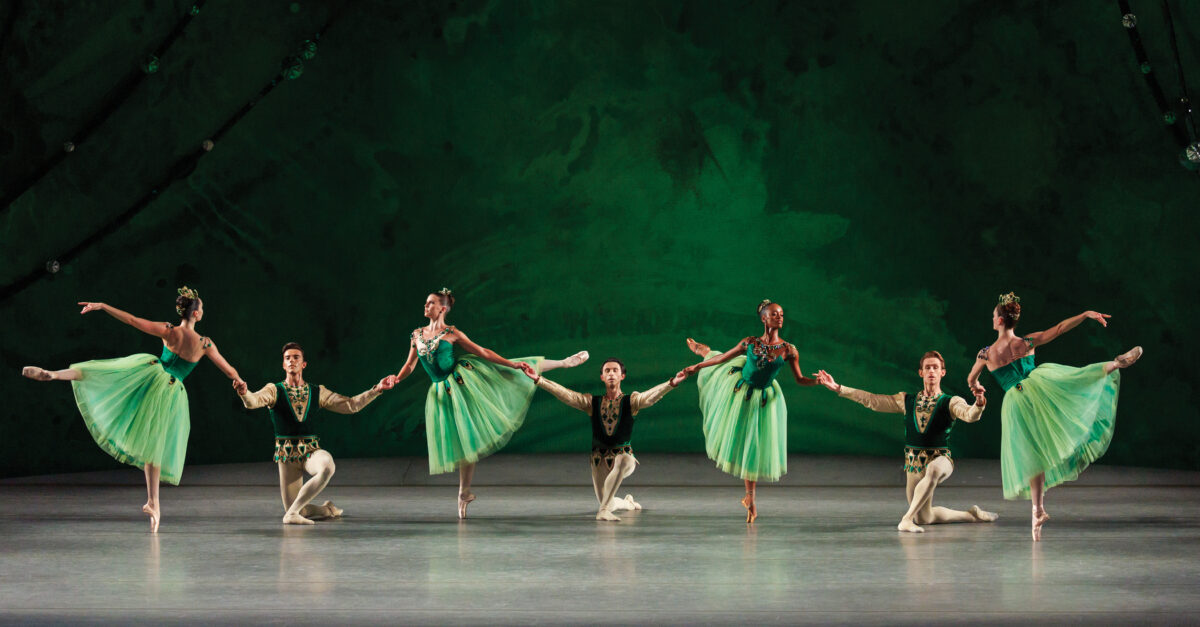
1. Emeralds: The Romance of France
The ballet opens with Emeralds, a nostalgic, highly refined tribute to the French school of dance. This was the country where Balanchine had previously danced and choreographed for the legendary Ballets Russes under the visionary impresario Serge Diaghilev, and where Lincoln Kirstein had first encountered Balanchine’s revolutionary work.
Musical Score: Balanchine selected excerpts from Gabriel Fauré’s incidental music for the 1898 Maurice Maeterlinck play Pelléas et Mélisande and Edmond Haraucourt’s 1889 play Shylock (adapted from William Shakespeare’s The Merchant of Venice). While Fauré never matched the massive popular acclaim of Claude Debussy—who succeeded him alongside the rise of musical Impressionism—Fauré’s noble, crystalline compositions evoke what Balanchine described as "the France of elegance, comfort, dress, perfume."
Choreography & Costumes: The choreography mirrors this sense of romantic reminiscence, utilizing languid footwork and expressive, lyrical arm movements that recall 19th-century French ballet traditions. The legendary costume designer Karinska complemented this aesthetic by turning to the Romantic era for the dancers’ soft, flowing attire.
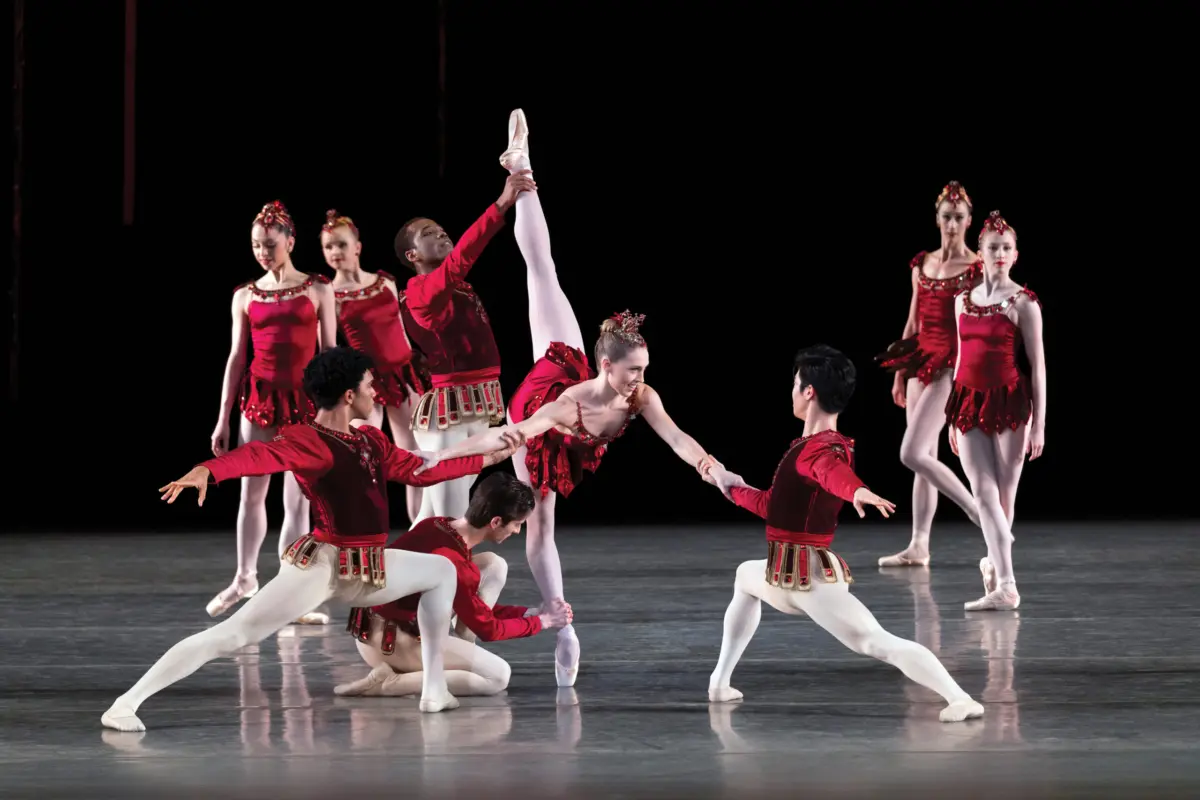
2. Rubies: The Jazz-Age Vibrancy of America
Following the ethereal calm of Emeralds, Rubies bursts onto the stage with the electric, syncopated rhythm of mid-century America.
Musical Score: Balanchine selected Igor Stravinsky’s 1929 Capriccio for Piano and Orchestra, a piece Kirstein praised as "one of the liveliest of [the composer’s] neo-classic works." Stravinsky had originally composed the piece as a solo vehicle for himself during his touring concert years, drawing upon 16th-century German theorist Michael Praetorius’s definition of a capriccio as "a fantasy with a freely organized form allowing flights of imagination." The resulting score is brimming with the playful swagger of American jazz, Broadway showtunes, and popular dance rhythms.
Collaboration & Costumes: By the time Rubies was created, Balanchine and Stravinsky enjoyed a deeply established creative partnership, having previously collaborated in America on landmark works like Orpheus (1948) and Agon (1957). Karinska translated this shared expat enthusiasm into snappy, flapper-inspired costumes complete with cheeky headdresses for the women that subtly echoed the crown of the Statue of Liberty.
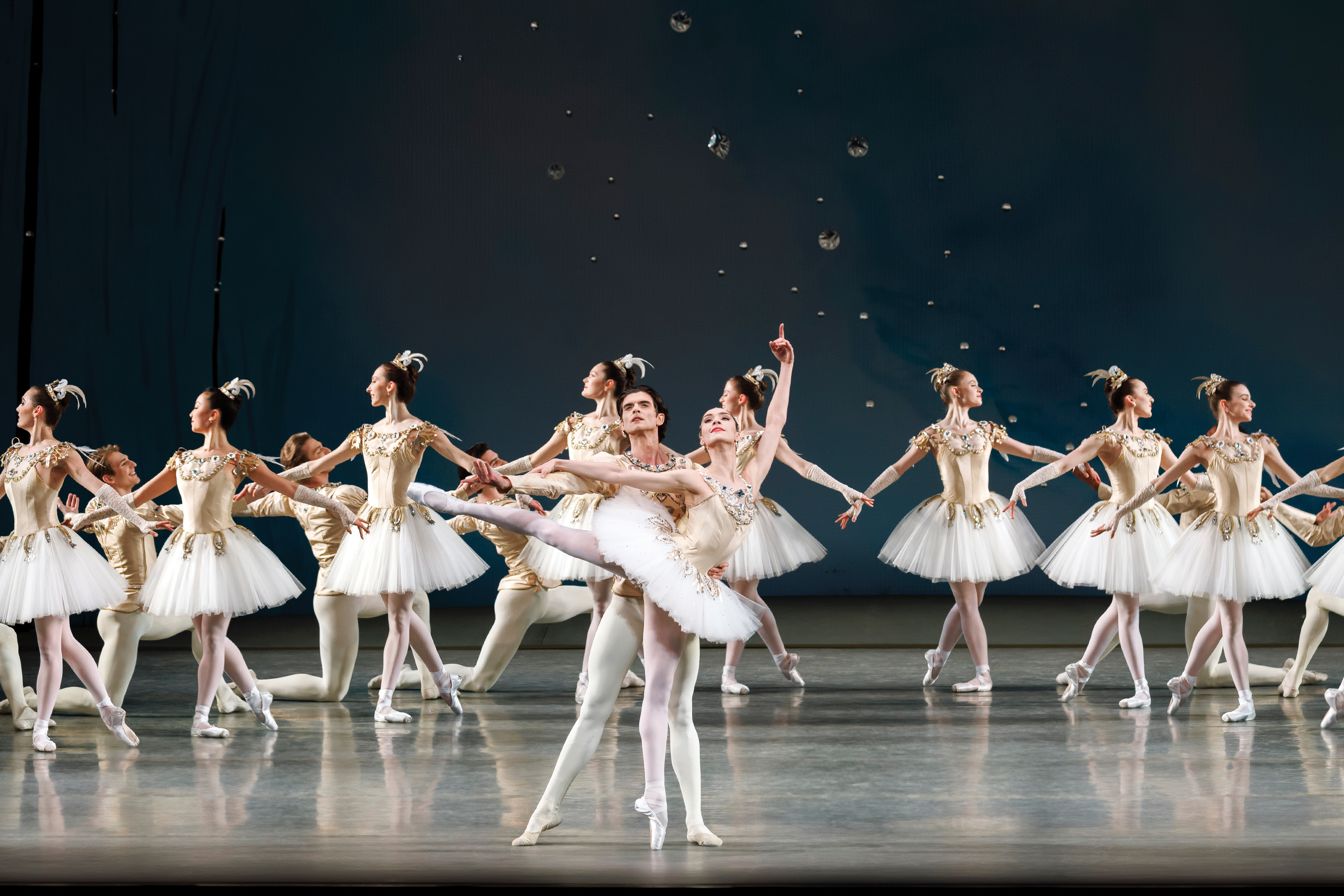
3. Diamonds: The Imperial Grandeur of Russia
The grand finale of the evening, Diamonds, transports the audience back to the foundational roots of Balanchine’s artistic life: St. Petersburg, the Mariinsky Theater, and the Imperial Ballet of his youth.
Musical Score: To capture this atmosphere of regal nostalgia, Balanchine turned to the ultimate Russian ballet composer, Pyotr Ilyich Tchaikovsky. Composed in 1875 around the same era as Swan Lake, Tchaikovsky’s Third Symphony was chosen because, as Kirstein observed, its "full-blown majesty and dominating melodies recommend it as music for the great panoply of the opera-house stage."
Design Innovation: For Diamonds, Karinska engineered the famous "powder puff" tutu—a brilliant innovation combining a shorter tulle skirt with a wired hoop underneath, granting the dancers an almost weightless, floating quality. This visual aesthetic encapsulates the dual nature of Diamonds, which simultaneously honors Balanchine’s personal past while pointing toward an ageless, universal future.
Official Statements and Critical Reception
The cultural resonance of Jewels has been analyzed, debated, and celebrated by dance historians and critics for decades. Rather than fading into the archives as a period piece, the ballet has continually revealed new layers of meaning with every revival.
In a landmark 1983 essay for The New Yorker, legendary dance critic Arlene Croce offered one of the most enduring definitions of the work’s place in dance history:
"Jewels is unsurpassed as a Balanchine primer, incorporating in a single evening every important article of faith to which this choreographer subscribed and a burst of heresy, too."
This dynamic tension—balancing the gleaming, polished exterior of traditional display with unbridled, avant-garde choreographic freedom—has cemented the ballet’s status as a masterwork.
Balanchine’s unique structural choices challenged the traditional expectations of ballet audiences who were accustomed to linear storytelling. By demonstrating that pure movement, space, and musicality could sustain an audience’s emotional engagement across a full evening, Jewels expanded the vocabulary of theatrical dance.
Future Outlook: A Legacy Beyond the Diamond Jubilee
As the New York City Ballet and the broader dance community look toward upcoming milestones—including the imminent approach of the ballet’s 60th anniversary—Jewels continues to occupy a vital, living place in the global repertory.
The physical nature of gemstones is fixed, hard-edged, and immutable. Yet, the true magic of Balanchine’s Jewels lies in its kinetic vitality and interpretive elasticity. Each new generation of dancers brings fresh breath, technical brilliance, and contemporary nuance to the roles originally crafted for icons like Violette Verdy, Patricia McBride, and Suzanne Farrell.
The ongoing stewardship of the George Balanchine Trust ensures that these foundational masterworks are transmitted with rigorous authenticity to companies worldwide, from Paris to Tokyo and San Francisco to London. As long as artists continue to push the boundaries of classical technique and audiences seek the transcendent thrill of pure movement set to magnificent music, Jewels will continue to cast its brilliant, multifaceted light across the international stage.
To explore upcoming performance dates, casting announcements, and ticket availability for the New York City Ballet’s current repertory seasons, please visit NYCBallet.com.