
Executive Overview
For centuries, Western classical and contemporary music education has maintained a glaring, unaddressed paradox: while music educators universally agree that sight-reading is the single most vital skill for a developing instrumentalist, the vast majority of pedagogical frameworks completely fail to teach it.
Consider the typical trajectory of a piano student. Years of private lessons are invested in mastering complex repertoire, yet when placed in front of an unfamiliar, entry-level grade-one score, many students freeze. They stumble through notes, hesitate at every barline, and experience a paralyzing cognitive overload.
This systemic failure recently took center stage in the global music education community following a compelling case study published by pianist, educator, and sight-reading advocate Lara Mirinjian. In her widely discussed curriculum review, Mirinjian exposed a startling personal truth: after more than ten years of rigorous piano lessons, she was still functionally incapable of reading fluidly from a basic, introductory-level book.
Her experience is far from unique. Empirical educational research confirms that Mirinjian’s plight is symptomatic of a broader institutional blind spot. Groundbreaking studies from institutions such as Dickinson State University reveal that traditional music method books largely omit explicit sight-reading instruction. Consequently, generations of students—and even many professional teachers—grapple with reading fluency as an insurmountable hurdle rather than a systematic, learnable skill.
This investigative report examines the root causes of the sight-reading crisis in music education, explores the core principles required to overcome it, outlines a step-by-step practical framework designed by Mirinjian, and projects the future outlook of digital and traditional music literacy training.
Detailed Chronology: The Evolution of a Pedagogical Blind Spot
To understand how a student can spend a decade studying an instrument without achieving basic reading fluency, one must retrace the historical evolution of modern music pedagogy.
The Era of Repertoire-Centric Teaching (Pre-20th Century to Modern Day)
Historically, keyboard pedagogy relied heavily on direct imitation and rote memorization, evolving later into heavy repertoire-driven method books. Throughout the 20th century, the proliferation of graded piano methods (such as those by Alfred, Bastien, and Faber) standardized music education. However, these systems prioritized the deep excavation of specific, masterwork pieces over the agile processing of transient musical text.
Students spent months perfecting three to five pieces for annual recitals. While this built deep technical proficiency and interpretative artistry in specific works, it inadvertently starved the brain of the varied, high-volume visual processing required to build instantaneous neural pathways between eye, brain, and hand.
The Realization of a Decade-Long Deficit
Lara Mirinjian’s personal awakening occurred after a decade of dedicated instruction. Despite her ability to perform intermediate-to-advanced repertoire through sheer repetition and muscle memory, her sight-reading remained stagnant.
- The Symptom: An inability to fluidly decode a basic level-one score on the first or second attempt.
- The Root Cause: A pedagogy that equated "learning to play the piano" with "learning specific pieces of music," treating sight-reading as an innate talent rather than a mechanical discipline.
The Pedagogical Turning Point
Mirinjian’s trajectory shifted permanently when she encountered an instructor who understood the mechanics of visual processing in music. Rather than assigning harder pieces, this teacher stripped back the curriculum to its barest components. By applying strict, uncompromising principles of pacing, restriction, and minimalism, Mirinjian experienced exponential growth—not just in her own playing, but eventually in the capabilities of her students. This methodology bypassed traditional rote learning, focusing instead on the cognitive architecture of reading.
Supporting Context & Metrics: The Scale of the Crisis
To gauge the magnitude of the sight-reading deficit in contemporary music instruction, industry analysts and academic researchers have surveyed educators across North America and Europe. The findings paint a sobering picture of systemic instructional gaps.
Academic Insights: Dr. Dianne Hardy’s Research
In a landmark study conducted by Dr. Dianne Hardy, Assistant Professor of Music Education and Piano at Dickinson State University, researchers investigated why sight-reading was so frequently neglected in private studio settings. The findings highlighted four primary reasons cited by instructors:

- Pedagogical Ignorance: The vast majority of surveyed teachers admitted that sight-reading was omitted from their lesson plans simply because they did not know how to teach it step-by-step.
- Method Book Omissions: Instructors noted that mainstream method book series provide virtually no structured, incremental guidance on teaching the cognitive mechanics of sight-reading.
- The "Repertoire Fallacy": Many educators failed to recognize sight-reading as a distinct, isolated skill set. They operated under the assumption that reading ability would naturally improve as a byproduct of learning increasingly difficult repertoire over years of lessons.
- The Teacher’s Own Insecurity: A notable subset of instructors confessed that they actively avoided teaching sight-reading because they considered themselves poor sight-readers.
The Cognitive Bottleneck
Why is sight-reading uniquely challenging, particularly for students with neurodivergent traits such as ADHD or processing disorders? Cognitive psychologists attribute the difficulty to the massive multi-tasking load required of the brain in real-time:
- Visual Decoding: Translating abstract spatial symbols on a staff into pitch and duration.
- Motor Mapping: Instantly translating those spatial symbols into specific physical geometries on the keyboard.
- Temporal Execution: Maintaining a steady, unyielding pulse while looking ahead in the score (chunking and predictive reading).
When students attempt this on complex music, cognitive overload occurs. The working memory crashes, leading to the familiar cycle of stopping, hesitating, and frustration.
Official Statements and Methodological Principles
Addressing the community through platforms like SightReadingMastery, Mirinjian emphasizes that conquering sight-reading requires abandoning random "methods" in favor of timeless principles.
As philosopher Ralph Waldo Emerson famously observed:
"As to methods there may be a million and then some, but principles are few. The man who grasps principles can successfully select his own methods. The man who tries methods, ignoring principles, is sure to have trouble."
The Core Principles of Sight-Reading Mastery
To build an indestructible foundation of musical fluency, students and teachers must strictly adhere to the following foundational tenets:

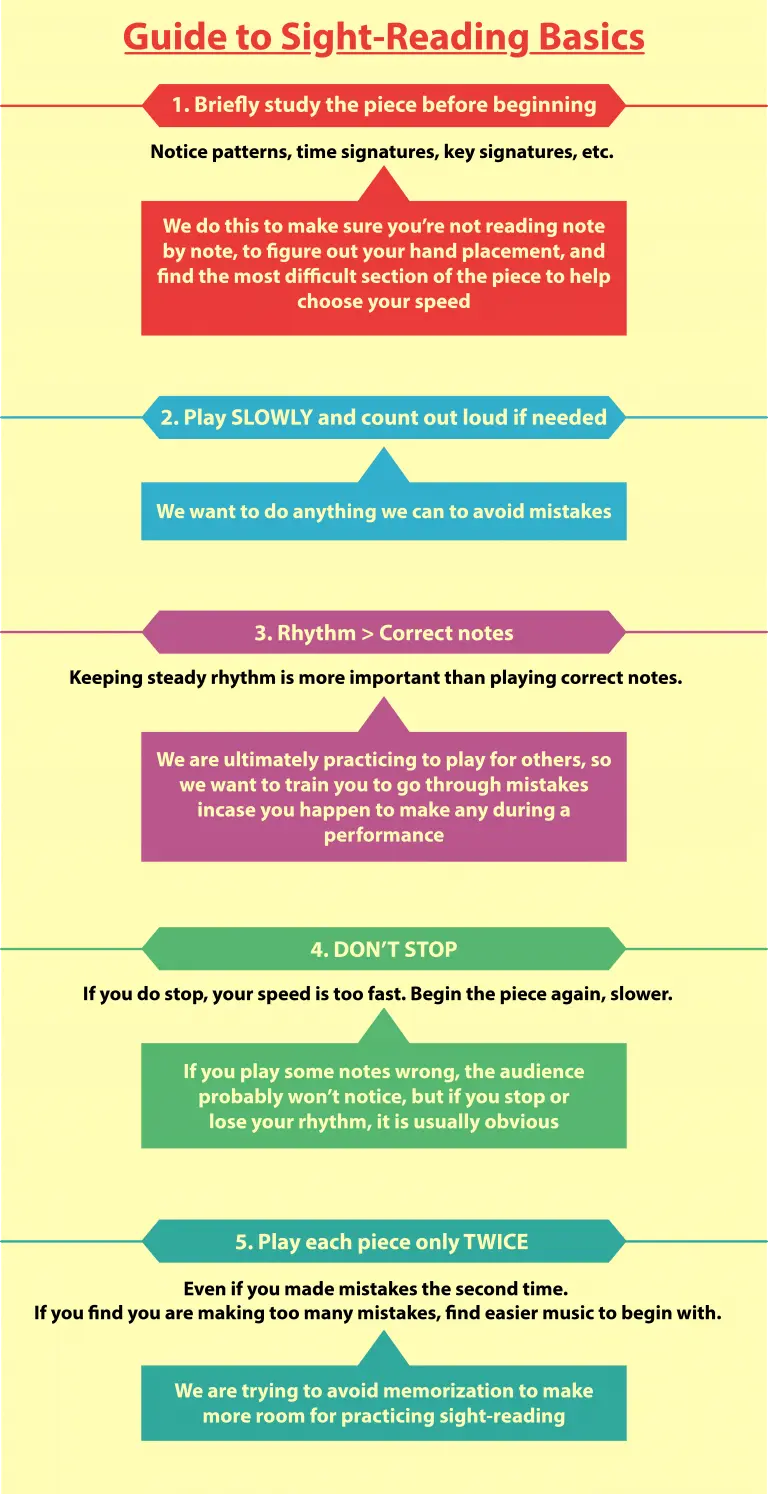
- Begin with Radically Simple Material: Even advanced pianists must drop down to primary-level music (such as single-note melodies or basic five-finger patterns). This frees up cognitive bandwidth to focus entirely on rhythm, pulse, and continuous forward motion.
- The "Two-Read" Rule: Each piece of sight-reading material must be read a maximum of two times. The first read exposes visual processing bottlenecks; the second read allows the brain to correct minor errors and consolidate the pattern. Sticking with a piece beyond two reads transforms sight-reading into standard repertoire learning.
- Prioritize Rhythm Over Absolute Note Perfection: A steady, unyielding pulse is the heartbeat of music. Stopping to correct a wrong note destroys the structural integrity of sight-reading.
- Never Stop Moving: The cardinal sin of sight-reading is halting mid-piece. If a reading error occurs, the student must keep the pulse alive, skipping the error if necessary, or returning to the beginning to try again at a vastly reduced tempo.
Actionable Framework: The Step-by-Step Practice Model
To bridge the gap between theory and execution, Mirinjian outlines a concrete, repeatable eight-step protocol that can be integrated into any daily practice routine.
[Step 1: Setup] ---> [Step 2: Pattern Scan] ---> [Step 3: Count Aloud] ---> [Step 4: Hand Placement]
                                                                                      |
[Step 8: Next Piece] <--- [Step 7: Second Read] <--- [Step 6: Play Ultra-Slow] <--- [Step 5: Prep to Play]- Step 1: Environmental Setup. Place the introductory score (e.g., a basic single-line exercise featuring middle C) on your music stand or digital tablet.
- Step 2: Visual Pattern Recognition. Before touching a single key, scan the piece. Identify structural patterns. For example: Does the note repeat? Does it step up or down? Recognizing musical chunks visually prevents sensory overload.
- Step 3: Establish the Metric Framework. Identify the time signature. Begin counting out loud in a steady, metronomic voice (e.g., "1, 2, 3, 4…").
- Step 4: Physical Positioning. Place your hand gently on the keyboard with your fingers resting passively over the target hand position (e.g., thumb on Middle C).
- Step 5: Mental Preparation. Internalize the golden rule: Under no circumstances are you permitted to stop. If the reading velocity becomes too demanding, the overarching tempo must be reduced, but the motion must never halt.
- Step 6: Execution at Micro-Tempo. Begin playing the piece at an exceptionally slow, deliberate pace. Synchronize every physical depression of a key with your vocalized counting.
- Step 7: The Refinement Read. Having successfully navigated the piece once without stopping, immediately perform the piece a second and final time. Apply the lessons learned from minor stumbles during the first run-through, maintaining absolute control over the tempo.
- Step 8: Progression. Rotate immediately to the next micro-piece and repeat the cycle.
For advanced players, Mirinjian issues a specific challenge: do not skip simple music. Instead, utilize ultra-easy material to elevate secondary metrics of musicality, such as nuanced micro-dynamics, articulation, phrasing, and stylistic touch.
Future Outlook: The Digital Transformation of Music Literacy
As the music education landscape enters the mid-2020s, the future of sight-reading instruction is undergoing a profound technological transformation.
Integration of Digital Tools and AI
The historical bottleneck of sight-reading instruction—the scarcity of appropriately leveled, fresh sight-reading material—is rapidly disappearing. Digital platforms, interactive applications, and algorithmic music generators are now capable of producing an infinite stream of custom sight-reading exercises tailored to a student’s exact technical proficiency level.
A Shift Toward Holistic Musicianship
Music academies and independent studios are increasingly recognizing that functional literacy must be front-loaded in early-childhood and adult music curricula. By shifting away from purely exam-driven, repertoire-heavy models, modern pedagogy is cultivating a generation of musicians who are not merely "human player-pianos" executing memorized motor tasks, but truly literate artists capable of navigating any score placed before them.
Conclusion: Reclaiming the Joy of Reading
Ultimately, Lara Mirinjian’s narrative serves as both a cautionary tale and an inspiring roadmap. It proves that no matter how many years have been lost to flawed methodologies, musical fluency is never out of reach. By stripping away ego, embracing radical simplicity, and respecting the immutable principles of cognitive processing, any pianist can unlock the true language of music and transform the terrifying blank slate of a new score into an invitation for creative exploration.