In the realm of vocal science and otolaryngology, few names resonate with the authority, breadth, and transformative impact of Dr. Robert Thayer Sataloff. Written into the annals of medical history through decades of pioneering research, surgical precision, and academic leadership, Dr. Sataloff’s contributions have fundamentally shaped how the professional and medical communities understand the human voice.
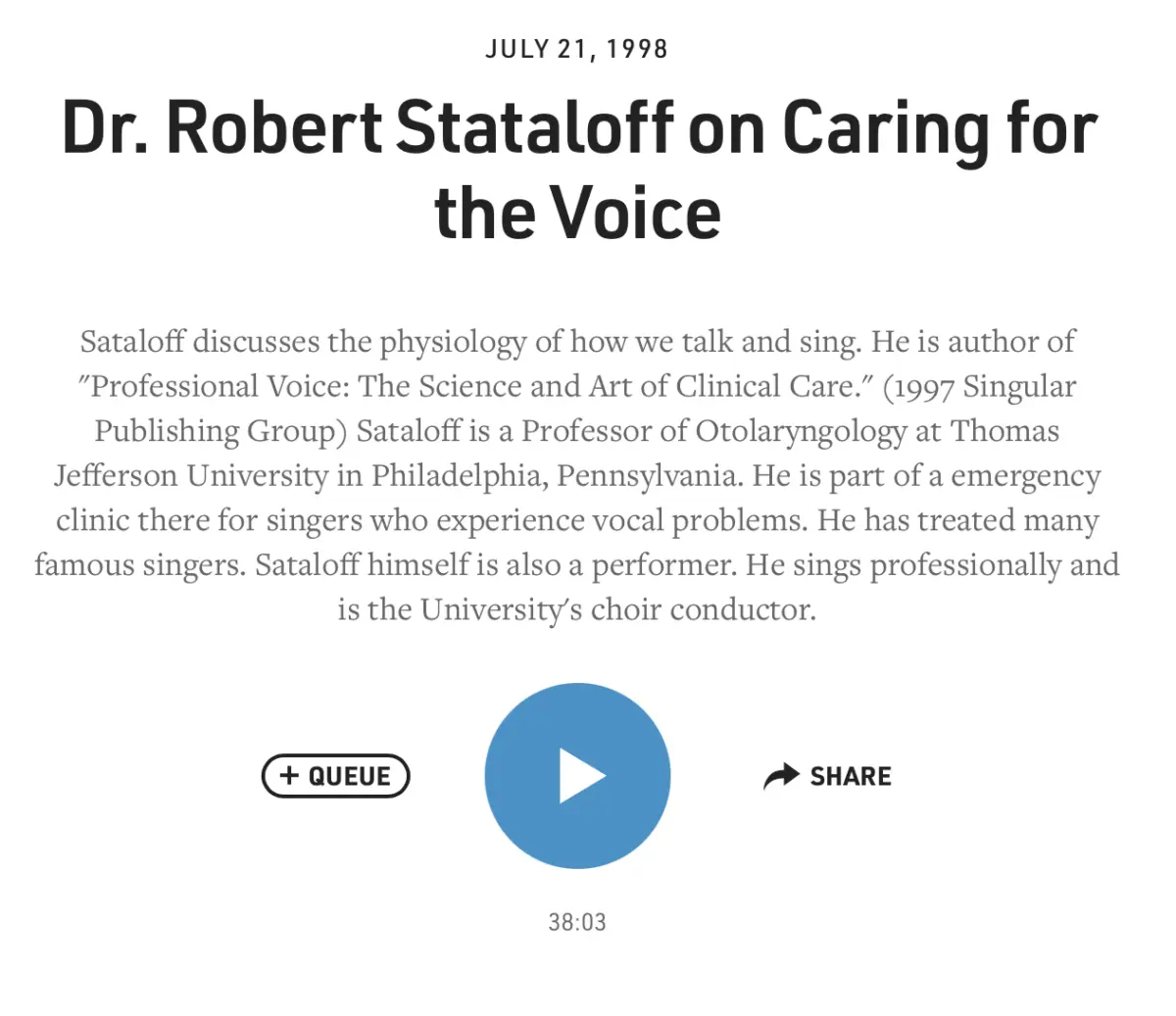
An archival gem from this extensive career is Dr. Sataloff’s classic 1998 appearance on Fresh Air, hosted by the renowned Terry Gross. Recently highlighted by the Voice Foundation and preserved within the Fresh Air Archive, this interview serves as a timeless masterclass in vocal physiology, the fragility of the human vocal mechanism, and the intersection of medicine and art.
This retrospective examines that iconic broadcast, exploring how a conversation recorded more than two decades ago continues to inform contemporary voice care. By breaking down the anatomy of the voice, the occupational hazards faced by professional performers, and the delicate balance between medical science and artistic expression, Dr. Sataloff’s dialogue with Terry Gross remains an essential touchstone for otolaryngologists, speech-language pathologists, vocal pedagogues, and performers alike.
Detailed Chronology: The Evolution of Voice Care and the 1998 Broadcast
To fully appreciate the significance of the 1998 interview, one must contextualize the state of laryngology and voice science at the turn of the millennium. For centuries, the human voice was treated as a black box. Singers, actors, and public speakers who lost their voices—or experienced chronic hoarseness—often faced mystical diagnoses, rudimentary vocal rest regimens, or invasive surgeries that frequently did more harm than good.
The Dawn of Laryngology (Pre-1990s)
Before the establishment of dedicated voice centers, general otolaryngologists managed vocal fold pathology with basic tools. The introduction of the rigid and flexible laryngostroboscopy in the latter half of the 20th century changed everything, allowing clinicians to visualize the mucosal wave of the vocal folds in slow motion. Dr. Sataloff was at the vanguard of this technological and clinical revolution, advocating for a multidisciplinary approach that combined medicine, surgery, voice science, and pedagogy.
The 1998 Fresh Air Encounter
By 1998, Dr. Sataloff was already a globally recognized authority, having authored numerous textbooks and served in leadership roles within major medical and musical organizations. When he sat down with Terry Gross on NPR’s Fresh Air, the cultural appetite for behind-the-scenes insights into elite performance was surging. Gross, known for her incisive, deeply researched interviewing style, guided Dr. Sataloff through a fascinating exploration of the vocal apparatus.
During the broadcast, the conversation traversed several critical milestones:
Demystifying the Instrument: Dr. Sataloff explained the physics of phonation in accessible terms, comparing the vocal folds to musical strings and wind instruments while emphasizing their biological complexity.
The Psychology of the Performer: The discussion addressed the intense psychological toll vocal injuries take on professional singers, whose identities and livelihoods are inextricably linked to their vocal cords.
Medical Breakthroughs: Dr. Sataloff detailed how advancements in microsurgery and stroboscopic imaging allowed physicians to operate on delicate vocal tissues with microscopic precision, preserving or even restoring professional-grade voices that would have previously been written off as permanently damaged.
Supporting Context & Metrics: The Anatomy and Vulnerability of the Voice
To understand why Dr. Sataloff’s insights captured the public imagination—and why they remain relevant today—one must examine the staggering physiological mechanics of the human voice.
The Physics of Phonation
The human vocal folds are two small bands of muscle and mucous membrane located within the larynx. During speech or singing, air expelled from the lungs passes through the trachea, causing the vocal folds to vibrate at astonishing speeds:
Frequency Ranges: A typical adult male speaks at a fundamental frequency of around 100 to 150 Hz (vibrations per second), while an adult female speaks around 200 to 250 Hz. Soprano opera singers can stretch these limits, with high notes requiring vocal fold vibrations exceeding 1,000 to 1,500 Hz.
Collision Force: During high-intensity singing or loud shouting, the vocal folds collide against one another hundreds of times per second. Over the course of a two-hour concert or a demanding theatrical performance, this equates to millions of high-impact cycles.
Common Pathologies in Professional Voice Users
Dr. Sataloff’s work has largely focused on diagnosing and treating the unique pathologies that afflict professional voice users. These include:
Vocal Nodules: Benign, callous-like growths caused by chronic vocal abuse or misuse. Often referred to as "singer’s nodes," they prevent the vocal folds from closing completely, leading to breathiness and fatigue.
Vocal Polyps: Fluid-filled lesions typically resulting from acute trauma (such as shouting loudly at a sporting event or concert).
Hemorrhage: The rupture of a blood vessel within the vocal fold lamina propria, requiring immediate and strict vocal rest to prevent permanent scarring.
Laryngopharyngeal Reflux (LPR): Stomach acid reaching the upper airway, causing irritation, inflammation, and chronic hoarseness.
According to epidemiological data from voice and swallowing institutes, professional voice users—including teachers, trial lawyers, singers, and actors—account for roughly 30% of the workforce. Among these, vocal injuries can lead to significant economic loss, psychological distress, and career termination if not managed by specialized medical teams. Dr. Sataloff’s advocacy for specialized "performing arts medicine" directly addressed this hidden healthcare crisis.
Official Statements and Archival Significance
The preservation of the 1998 interview by the Voice Foundation and its integration into the Fresh Air Archive highlights the enduring value of oral history in medical education.
In statements surrounding the archival release, educational coordinators emphasized the interview’s unique pedagogical value. While medical textbooks can outline the pathophysiology of a vocal fold hemorrhage or the layered structure of the lamina propria, Dr. Sataloff’s conversation with Terry Gross translates dense otolaryngologic science into a narrative format that resonates on a human level.
"Dr. Sataloff possesses that rare gift of bridging the gap between rigorous surgical science and the emotional reality of the artist," notes a retrospective briefing from the Voice Foundation. "His 1998 discussion with Terry Gross remains a masterclass in communicating complex medical concepts to a broad audience without sacrificing scientific integrity."
Gross herself navigated the interview with her characteristic blend of curiosity and precision, prompting Dr. Sataloff to explore topics ranging from the impact of aging on the voice to the dangers of smoking, chemical exposure, and improper vocal pedagogy. By treating the voice not merely as a biological tool, but as an intricate vehicle of human expression, the interview elevated public discourse surrounding vocal health.
Future Outlook: The Next Era of Voice Science and Medicine
As we look toward the future of laryngology, the foundational principles articulated by Dr. Sataloff in 1998 continue to guide new frontiers of research and clinical practice.
Regenerative Medicine and Stem Cell Therapy
One of the most promising areas in modern voice care is regenerative medicine. Historically, surgery on the vocal folds—even when successful—could leave microscopic scar tissue in the delicate lamina propria, altering flexibility and vocal timbre. Today, researchers are investigating the use of stem cells, bio-implants, and injectable hydrogels to regenerate damaged vocal fold tissue rather than simply excising pathology. This aligns directly with Dr. Sataloff’s lifelong quest for perfection in vocal preservation.
Artificial Intelligence and Diagnostic Imaging
The integration of artificial intelligence (AI) and machine learning into laryngeal stroboscopy is transforming early detection. Advanced optical coherence tomography (OCT) and high-speed digital imaging can now capture thousands of frames per second, allowing AI algorithms to detect minute asymmetries and stiffness patterns in the vocal folds long before they manifest as severe clinical symptoms.
Telemedicine and Global Access to Voice Care
The COVID-19 pandemic accelerated the adoption of telehealth in otolaryngology. While physical stroboscopy still requires in-person clinical visits, remote acoustic analysis, voice therapy sessions, and initial triage have expanded global access to specialized voice care. Performers in remote areas can now consult with voice specialists, reducing the risk of permanent injury from delayed treatment.
The Enduring Legacy of Dr. Sataloff
Decades after his conversation with Terry Gross first aired on NPR, Dr. Robert Thayer Sataloff’s philosophy remains clear: the human voice is a masterpiece of biological engineering that deserves the highest standard of multidisciplinary medical care. Whether through his extensive publications, his leadership in organizations like the Voice Foundation, or archival treasures like his 1998 Fresh Air interview, Dr. Sataloff’s impact on the world of vocal science will be felt for generations to come.