
Executive Overview
The contemporary jazz landscape is experiencing a period of extraordinary productivity, driven by a synthesis of spontaneous acoustic intimacy and sweeping, large-ensemble avant-garde vision. This journalistic deep-dive examines three monumental new releases that are shaping the genre’s current trajectory: London-based alto saxophonist Sam Braysher’s exquisite new international quartet album, A Sinner Kissed An Angel, and a formidable dual-album assault from the relentlessly prolific Japanese pianist and composer Satoko Fujii, comprising the newly unearthed archival gem Bunker Ulmenwall Orchestra and her visionary contemporary suite, After The Storm.
While Braysher’s project champions the timeless art of the small-group acoustic standard—recorded with minimal rehearsal and maximum intuitive synergy—Fujii’s orchestral undertakings represent the architectural heights of modern large-ensemble composition. Together, these releases encapsulate the duality of modern jazz: the preservation of swinging, unpretentious historical craft on one hand, and the urgent, politically conscious, and structurally complex expressions of post-pandemic collective consciousness on the other.
This report provides a granular examination of these recordings, exploring their historical contexts, production mechanics, personnel dynamics, and the broader artistic implications of their arrival in the global jazz market.
Detailed Chronology & Production Histories
Sam Braysher & Linus Eppinger: A Sinner Kissed An Angel
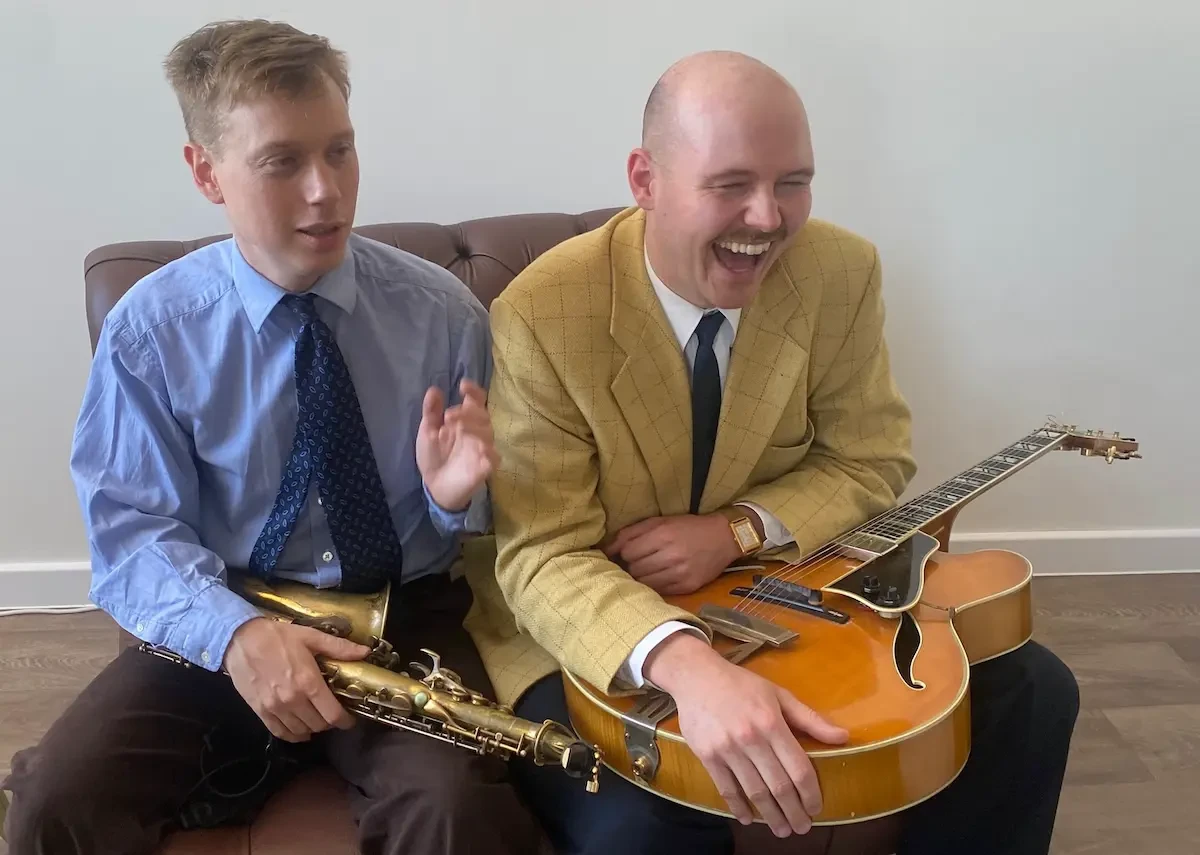
The genesis of A Sinner Kissed An Angel—released via Fresh Sounds Records (FSR-CD 514)—lies in a cross-border artistic alliance that prioritizes immediacy over over-preparation. London-based alto saxophonist Sam Braysher, marking his fourth album as a leader, elected to front a deliberately assembled international quartet. The line-up pairs him with his long-standing musical collaborator, the German-born, Amsterdam-based guitarist Linus Eppinger, alongside a rhythm section consisting of American-born, French-resident bassist Darryl Hall and veteran Dutch drumming luminary Eric Ineke.
Both Braysher and Eppinger brought prior working relationships with Ineke to the session, deeply admiring his historically informed, luminous cymbal work. Bassist Darryl Hall, however, was a wild card—familiar directly only to Eppinger. Despite this initial unfamiliarity, a brief run of live performances in Den Haag and Amsterdam acted as a crucible, forging the rhythm section into a unified front.
On just their third day of playing together, the quartet entered a studio in Utrecht, Netherlands. Constrained by a distinct lack of rehearsal time, the musicians could not tackle overly complex or heavily orchestrated material. Yet, this very limitation proved to be the album’s greatest asset, allowing the ensemble to capture the relaxed, lightning-in-a-bottle atmosphere of their live stage chemistry.
Satoko Fujii’s Bunker Ulmenwall Orchestra
To understand the sheer momentum of Satoko Fujii’s 2026 release schedule—of which the Bunker Ulmenwall Orchestra (Libra Records 218-083) is the first of five planned orchestral albums—one must look back a decade. Recorded live on November 22, 2014, at the Bunker Ulmenwall, a legendary jazz venue housed within a converted World War II air raid shelter in Bielefeld, northwest Germany, this archival recording was lost to time.
For over ten years, the master tapes sat forgotten in the private archives of concert promoter Wolfgang Gross. Gross had long championed Fujii’s music in Germany, but for this specific concert, he harbored a unique curatorial vision: rather than utilizing an exclusively professional touring ensemble, he wanted to integrate local music students directly into the orchestra, empowering these young practitioners to contribute original compositions and lead sections of the band.
When Gross finally rediscovered the tapes and sent them to Fujii, the Japanese pianist was profoundly struck by the document. She marveled at the unbridled energy and collective cohesion captured on that cold November evening. Now surfaced, the recording serves as a vital bridge between Fujii’s historical large-ensemble configurations and her modern compositional ethos.
Satoko Fujii Orchestra Kobe: After The Storm
Hot on the heels of the Bunker Ulmenwall excavation comes After The Storm (Libra Records 215-084), recorded live in Kobe, Japan, on February 5, 2026. Crucially, unlike the Bielefeld performance, this release was not captured before a live public audience; rather, it was executed in a live-performance environment designed explicitly from the ground up to generate pristine recorded material for this album.
This Kobe recording represents the tip of a massive geographical and creative spear. It is scheduled to be followed rapidly by three additional orchestral recordings originating from Berlin, Nagoya, and Tokyo by early November 2026, collectively serving as Fujii’s comprehensive artistic response to the global trauma of the COVID-19 pandemic.
Supporting Context & Musical Metrics
Micro-Analysis: A Sinner Kissed An Angel
Clocking in at 52 minutes and 4 seconds, Braysher’s album operates with a deceptive simplicity that yields immense rewards. The tracklist balances canonical American songbook standards with unexpected stylistic nods:
- "A Smooth One": Attributed alternately to Benny Goodman and Charlie Christian, the album’s opener establishes the group’s effortless rapport. Braysher’s oblique, witty phrasing is cleanly counterbalanced by Eppinger’s lilting guitar lines.
- "Spooky": A notable stylistic pivot, this groovy homage to pop icon Dusty Springfield injects a dose of soulful levity into the jazz record. Eppinger delivers blistering guitar passages, while Braysher captures the sultry vocal inflections characteristic of Springfield’s catalog.
- "Roundabout": Vernon Duke’s composition is rendered at a heart-wrenchingly deliberate, slow-burn tempo that highlights the emotive depth of the horns.
- "Route 608": Horace Silver’s classic hard-bop burner injects rhythmic velocity and classic 1950s-era momentum back into the session.
- Title Track ("A Sinner Kissed An Angel"): Originally popularized by a young Frank Sinatra accompanied by Tommy Dorsey’s Orchestra in 1941, this rendition treats the historical arrangement with profound reverence. Ineke’s brushwork functions as a delicate percussive caress beneath Braysher and Eppinger’s weeping lyricism.
- "Relaxing At Camarillo": A mid-tempo, guitar-led excursion that brings the album to an uplifting, self-assured close.
Stylistically, Braysher and Eppinger’s collaboration exists in a temporal vacuum. It is an album that resists easy dating; it could have been recorded at any point in the last half-century, making its classicism nearly flawless.
Macro-Analysis: Fujii’s Orchestral Masterworks
Satoko Fujii’s large-ensemble writing is an exercise in monumental sonic architecture.
The Bunker Ulmenwall Set (CD1 & CD2: 87 minutes total):
The first disc is entirely consumed by Shiki (46:47), one of the grandest compositions of Fujii’s career. Beginning with a quiet, hypnotic drone, the piece gradually accumulates acoustic mass. Fujii utilizes her position as conductor not as an absolute dictator, but as a live facilitator—cueing soloists, establishing structural waypoints, and allowing the orchestra members to act as co-creators. The piece features blistering drum duets, searing trumpet and saxophone exchanges, and a sparkling, kinetic piano solo by Matthias Klause.
The second disc shifts the curatorial weight to the orchestra’s internal voices:
- Andreas Kaling’s "Yamantaka": Dominated by heavy, interlocking bass-saxophone riffs, deep sonic drones, and a crushing, rock-inflected electric guitar solo by Lucy Liebe.
- Natsuki Tamura’s "Jasper": Restores an air of contemplative calm through unconventional, highly textured instrumental timbres.
- Luise Volkmann’s "Antischwarm": A restless, shape-shifting piece that hustles through fragmented, variable time signatures.
- Satoko Fujii’s "Gen Himmel": A serene, celestial conclusion that grounds the tumultuous sonic journey in spiritual resolve.
The Kobe Suite (After The Storm, 57:17):
Written in four distinct parts, After The Storm serves as Fujii’s conceptual map of a post-pandemic world.
- Part 1: Opens with a stately, resonant solo-bass theme, blossoming into a glowing statement from trombonist Yuichiro Tamagaki before exploding into a harsh, full-throated tenor saxophone solo by Tsutomu Takei, anchored by guitarist Takumi Seino.
- Part 2: Embraces pure improvisation. Individual soloists detach from the orchestral collective, engage in frantic dialogue, and seamlessly re-integrate, establishing a spontaneous, abrasive, yet compelling narrative.
- Part 3: Evolves into an imposing, luminous wall of sound, anchored by trumpeter Natsuki Tamura’s molten, liquid-metal horn lines.
- Part 4: Breaks violently into a jaunty, upbeat movement, culminating in a high-voltage, shredding guitar solo and a brilliant, star-burst ensemble finale.
Official Statements & Artistic Intentions
The underlying philosophy guiding these releases reveals artists acutely conscious of historical legacy and current geopolitical instability.
Reflecting on the unexpected rediscovery of her 2014 live concert, Satoko Fujii expressed utter astonishment:
"I was amazed at how beautifully we played, and with so much energy."
Her curation of the youth-integrated orchestra in Bielefeld underscores her lifelong commitment to mentorship and breaking down hierarchical barriers within experimental jazz.
Regarding the deeply conceptual framework of her Kobe suite, Fujii offered a poignant window into her psychological and creative state during the global health crisis. She noted that After The Storm was born out of a desperate idealistic vision:
"I was dreaming that the world would finally find complete peace after the pandemic… I was dreaming we would have no war, no weapons, no violence."
Although geopolitical realities failed to match her utopian dreams, Fujii firmly maintained that the message of optimism, communal healing, and human resilience encoded within the music remained profoundly necessary for public consumption.
Similarly, Sam Braysher’s collaborative ethos reflects an intentional rejection of over-commercialized, hyper-produced studio environments. By relying on historical jazz repertoires, intuitive dialogue, and spontaneous group chemistry, Braysher’s camp champions the notion that jazz remains, at its core, a conversation between kindred spirits who trust one another implicitly on the bandstand.
Future Outlook & Market Impact
The simultaneous release of these recordings signals a vibrant, bifurcated future for the global jazz genre.
On one side, projects like Sam Braysher and Linus Eppinger’s A Sinner Kissed An Angel prove that the acoustic small-group tradition is far from exhausted. By embracing the aesthetics of mid-century jazz—elegance, restraint, swing, and unpretentious execution—artists can carve out a lucrative and critically revered niche that appeals to purists and casual listeners alike. Fresh Sounds Records’ curation of this session establishes a high benchmark for acoustic releases in the latter half of the decade.
On the other side, Satoko Fujii’s unprecedented 2026 orchestral blitz—kicked off by the archival resurrection from Bunker Ulmenwall and the burning intensity of After The Storm, with Berlin, Nagoya, and Tokyo editions looming—demonstrates the sheer, inexhaustible stamina of the global avant-garde. Fujii is not merely releasing albums; she is constructing a massive, multi-city sonic monument to human survival, artistic collaboration, and sociopolitical aspiration.
As the jazz market absorbs these masterworks, listeners are reminded of the breadth of the genre’s emotional and structural vocabulary. Whether through the quiet, mid-tempo high of a guitar-led blues in Utrecht or the towering, post-pandemic walls of sound erected in Kobe and Bielefeld, jazz in 2026 remains a vital, breathing chronicle of the human condition.