
Executive Overview
Ten years after the bright lights of Madison Square Garden flickered on August 28, 2016, the MTV Video Music Awards (VMAs) of that year remain an unmatched cultural touchstone. Looking back through the lens of Billboard’s Greatest Pop Stars podcast—hosted by Andrew Unterberger and featuring deputy digital editor Katie Atkinson—the 2016 ceremony is analyzed not merely as an awards show, but as the glittering, complex culmination of a bygone pop epoch.
It was an evening defined by monumental career peaks, highly publicized interpersonal drama, and an assembly of A-list talent that has rarely, if ever, been replicated since. From Beyoncé’s blistering, genre-redefining Lemonade medley to Rihanna’s multi-part Michael Jackson Video Vanguard Award triumph—complete with the cultural shockwave of Drake’s ill-fated public declaration of love—the night felt entirely like the undisputed center of the pop universe.
Yet, looking back a decade later, the 2016 VMAs serve a dual purpose in music history. They represent both the absolute zenith of the traditional, star-studded televised music award show and the twilight of that very format. In the years following 2016, shifts in digital consumption, the fracturing of monoculture, and the sheer logistical impossibility of corralling so many global superstars under one roof at the same time have rendered the modern VMA landscape unrecognizable. This retrospective explores the lingering mysteries, iconic moments, and structural industry changes that cement the 2016 VMAs as the final hurrah of peak twenty-first-century pop stardom.
Detailed Chronology: A Night of Triumphs and Turning Points
To understand why the 2016 VMAs hold such a mythic status, one must retrace the precise sequence of events that unfolded over the course of that humid August evening in New York City. The night was structured around a series of high-stakes performances and appearances that pushed artists to their absolute limits.
The Reign of Queen Bey: The Lemonade Medley
The most towering achievement of the evening belonged indisputably to Beyoncé. Fresh off the earth-shattering release of her visual album Lemonade, she delivered a career-defining, 16-minute medley that traversed "Pray You Catch Me," "Hold Up," "Sorry," "Don’t Hurt Yourself," and "Formation."
Operating at the absolute peak of her artistic powers, Beyoncé transformed the VMA stage into an immersive, politically charged, and visually stunning landscape. The performance was not just a collection of songs; it was a masterclass in staging, live vocal execution, and command over the medium of television. It raised the bar so high for award-show performances that critics and fans alike have spent the subsequent decade asking a persistent question: Has any artist—or Beyoncé herself—ever managed to surpass the sheer cultural gravity of that 16-minute block?
Rihanna’s Vanguard Crown and the Drake Phenomenon
While Beyoncé owned the performance space, Rihanna was honored with the Michael Jackson Video Vanguard Award, a tribute split strategically across four distinct medleys throughout the broadcast. Moving seamlessly through her catalog of dancehall, R&B, and pop anthems, Rihanna solidified her status as a generational icon who operated outside the traditional pop machinery.
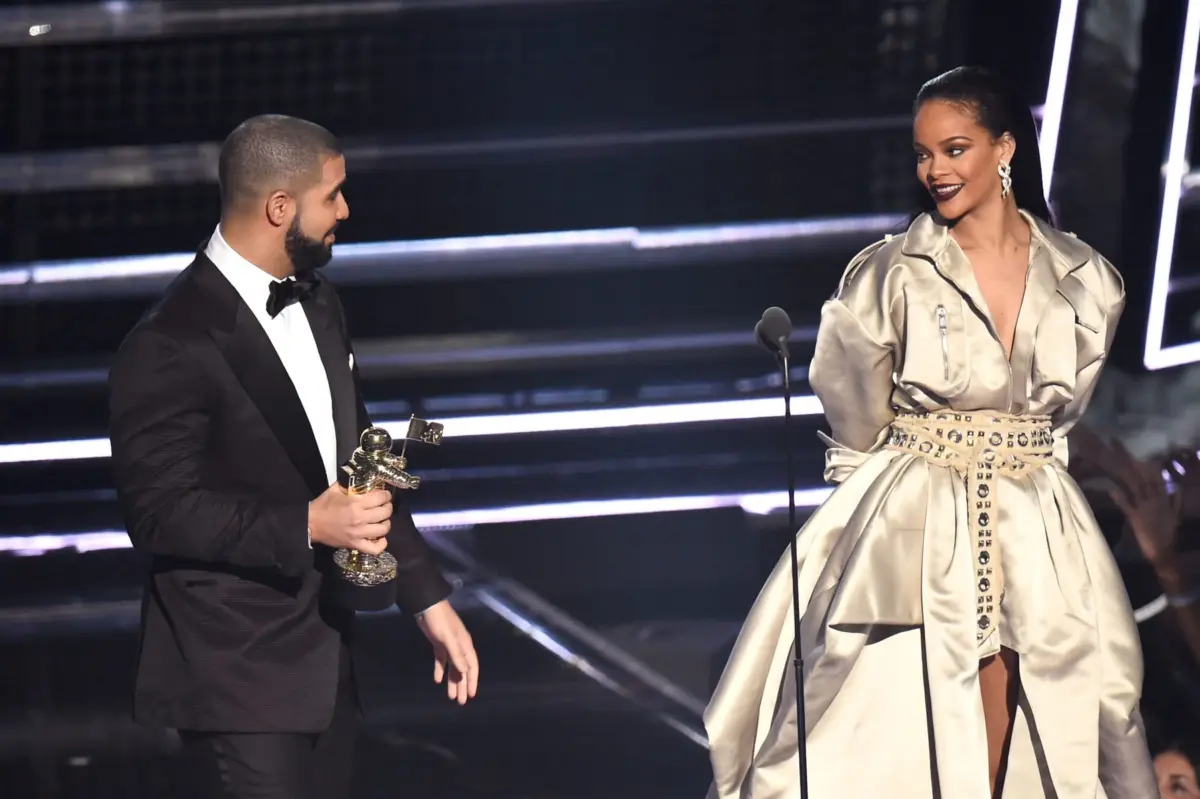
However, the defining talking point of her coronation came when Drake stepped onto the stage to present her with the award. In a globally broadcasted moment of unguarded vulnerability—or calculated theater, depending on who you ask—Drake confessed his enduring love for her, declaring, "She’s someone I’ve been in love with since I was 22 years old." As he leaned in for a celebratory kiss, Rihanna executed a subtle, expertly timed head-turn that effectively deflected his advance, greeting his gesture with a polite cheek-kiss instead.
Ten years later, the "Rihanna curve" remains a masterclass in boundary-setting and myth-making. It captured the complex parasocial dynamics between two of the era’s biggest hitmakers and became an instantaneous meme, permanently etching itself into internet folklore.
The Complicated Realities of Comebacks and Collaborations
Not every moment on the 2016 VMA stage achieved the frictionless brilliance of Beyoncé and Rihanna. The night also featured attempts by legacy acts to reclaim their cultural standing, yielding mixed results.
Britney Spears returned to the VMA stage for the first time since her disastrous 2007 performance, stepping out to perform "Make Me…" alongside rapper G-Eazy. While Spears looked energetic and physically poised, the performance suffered from a palpable lack of chemistry and an over-reliance on backing tracks, leaving fans to wonder how much G-Eazy’s inclusion weighed down the momentum of what was supposed to be a triumphant comeback.
Similarly, pop chamelon Nick Jonas took to the subterranean spaces of New York City to perform his upbeat track "Bacon" alongside Ty Dolla $ign. Despite boasting an infectious groove and a clever live-cooking staging concept, the performance was largely overshadowed by the heavier cultural heavyweights of the night, leading many pop historians to argue that "Bacon" ultimately received a raw deal from both critics and the viewing public.
Supporting Context & Metrics: The End of the Monoculture
The 2016 VMAs did not happen in a vacuum; they occurred at a critical inflection point in the music industry’s transition from physical/digital sales and traditional broadcast media to the streaming era.
The A-List Convergence
One of the most pressing questions revisited in the Greatest Pop Stars retrospective is simple: How did MTV manage to get virtually every major A-lister in the same room at the same time?
In 2016, the monoculture was still sufficiently intact that a marquee television event held immense career capital. Artists like Kanye West (who used his mandatory four-minute unfiltered microphone slot to premiere the music video for "Fade" and muse on fame, art, and his cultural rivals), Ariana Grande, Nicki Minaj, Britney Spears, and Future all treated the VMAs as a mandatory stop.
The Streaming Shift and the Fracturing of the Room
In the decade since 2016, the music industry has undergone a radical decentralization. The rise of TikTok, algorithmic playlisting, and globalized niche micro-genres means that today’s pop stars often live in entirely different cultural ecosystems.
Furthermore, the logistics of modern celebrity have changed drastically. High security, exorbitant insurance costs, tightly guarded brand partnerships, and the instantaneous nature of social media backlash have made artists increasingly reluctant to sit through a three-hour televised ceremony when they can directly broadcast to hundreds of millions of followers from their own smartphones. The 2016 VMAs, therefore, stand as the last great gathering of the pop aristocracy—an era when physical attendance at an award show still felt like the ultimate validation of global dominance.
Official Industry Reflections
Reflecting on the legacy of the 2016 ceremony, music critics and industry insiders have increasingly categorized the event as a watershed moment.
In their discussion on the Greatest Pop Stars podcast, host Andrew Unterberger and Billboard deputy digital editor Katie Atkinson highlighted the bittersweet nature of looking back at the footage:
"When you watch the 2016 VMAs today, you aren’t just watching great performances; you are watching an industry that operated on a completely different scale of centralized power," notes the retrospective analysis. "It was a night where pop stars still felt larger-than-life, untouchable, and unified under a single cultural umbrella. Trying to replicate that lineup today is an exercise in impossibility."
Industry analysts have similarly pointed out that the 2016 show marked the peak of MTV’s ability to leverage live television for water-cooler moments. While subsequent years have seen attempts to recapture that lightning in a bottle through altered voting structures and genre-fluid lineup additions, the sheer gravitational pull of the 2016 room has never been equaled.
Future Outlook: Can the VMAs—or Award Shows—Ever Recover?
As the music industry marches further into the digital age, the traditional televised award show faces an existential crisis. Ratings for linear television broadcasts continue to face downward pressure, and younger demographics increasingly consume music milestones through vertical, bite-sized clips on platforms like TikTok and YouTube Shorts rather than watching multi-hour broadcasts.
The legacy of the 2016 VMAs offers both a cautionary tale and a blueprint. It demonstrates that when an award show commits to high-risk, high-reward artistic statements—such as Beyoncé’s uninterrupted cultural thesis or Rihanna’s career-spanning celebration—it can create moments that resonate for decades. However, it also highlights the reality that such alignments of star power require a specific cultural ecosystem—one defined by shared media consumption and a unified pop monoculture—that may never fully return.
Ultimately, the 2016 MTV Video Music Awards will be remembered not just as a great night for pop music, but as the glittering sunset of an era. Whether future generations of artists will ever share a single room with that level of unbridled star power remains one of the most compelling unanswered questions in modern entertainment history.
Supporting Trans Rights and Community Care
In alignment with the ethos of community support championed by the Greatest Pop Stars podcast, readers with the means to do so are encouraged to support organizations fighting for trans rights and healthcare access:
- Transgender Law Center – The largest national trans-led organization advocating for self-determination and justice.
- Trans Lifeline – A grassroots hotline and microgrants organization offering direct emotional and financial support to trans people in crisis.
- Destination Tomorrow – Providing vital LGBTQ+ services and support in the Bronx and beyond.
- Gender-Affirming Care Fundraising on GoFundMe – Direct financial assistance for individuals seeking life-affirming medical care.
- Human Rights Campaign (Local Chapters) – Mobilizing grassroots advocacy for LGBTQ+ civil rights across the United States.
You can also make your voice heard by contacting your local representatives in support of trans rights using the tools available at 5Calls.org.