
Executive Overview
There are masterworks of the lyric stage that merely survive their historical moment, serving as polite museum pieces for the operatic canon, and then there are those rare creations that actively grow into their eras with chilling prescience. Aribert Reimann’s Lear, which received its thunderous world premiere at the Bavarian State Opera in Munich in 1978, belongs emphatically to the latter category.
Nearly half a century later, Reimann’s score has lost none of its ferocious capacity to destabilize audiences. If anything, the work reads with heightened urgency today: a monumental study of power casually relinquished, desperately reclaimed, and ultimately annihilated.
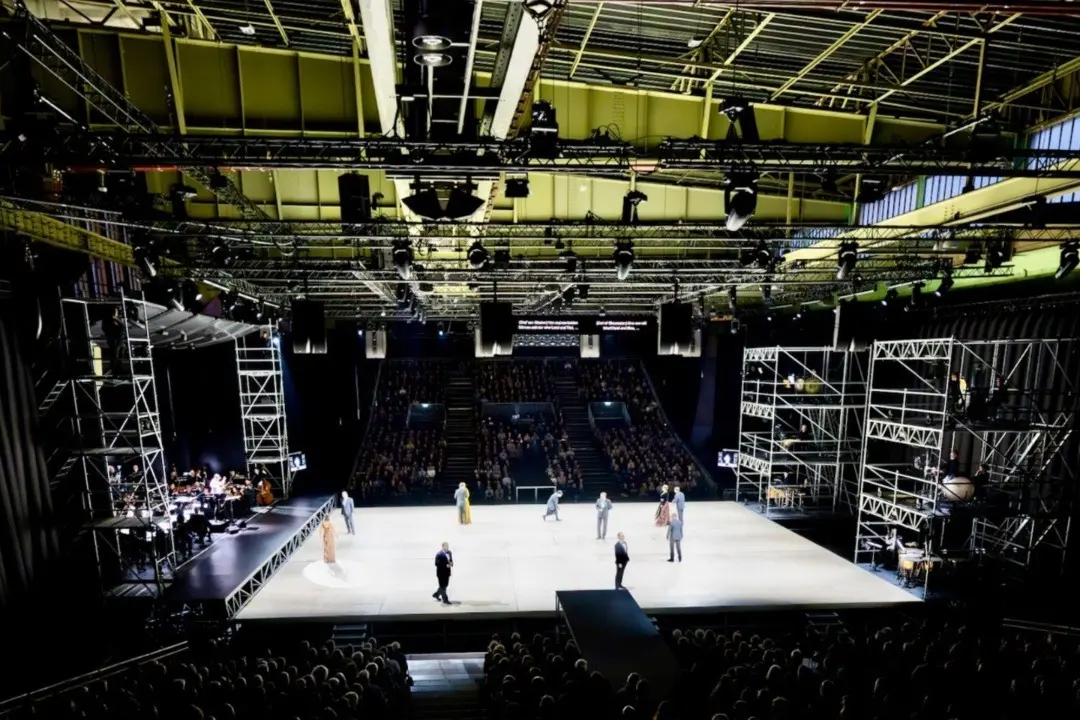
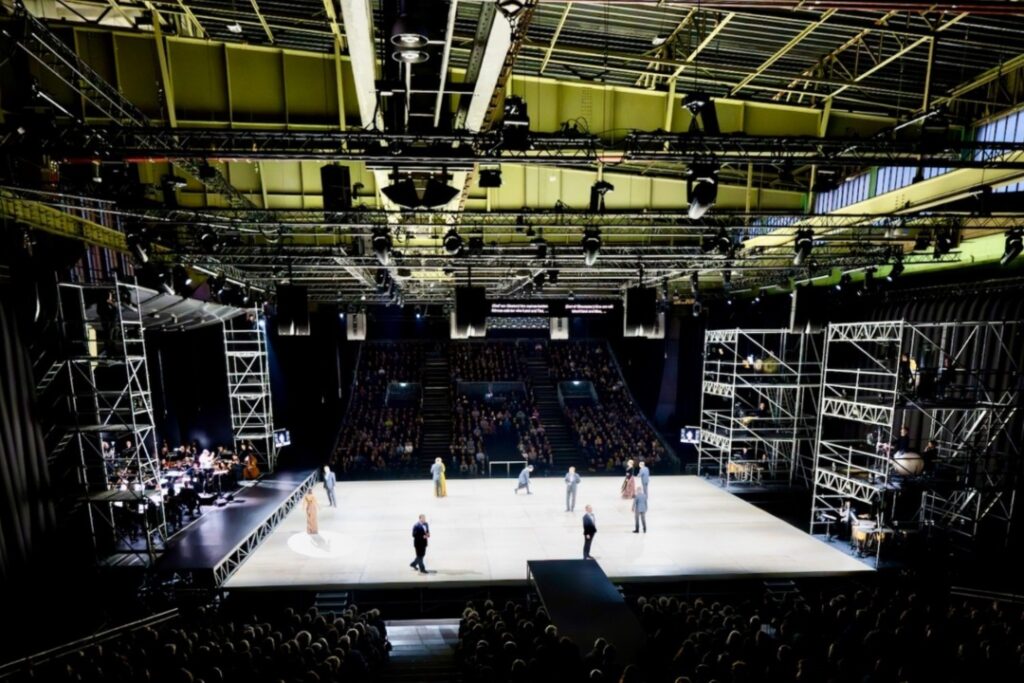
For its bold season-opening production, the Komische Oper Berlin returned to the cavernous expanse of Hangar 4 at the historic Tempelhof Airport—marking the company’s fourth major undertaking in this unorthodox industrial venue. Stripped of the architectural comforts of a traditional opera house, the cavernous space required the construction of an entire theater from the ground up, including grandstands for roughly 3,000 spectators, a central performance square, dedicated orchestra zones, and complex lighting and sound infrastructures.
Yet, under the visionary guidance of director Barrie Kosky and set designer Rebecca Ringst, the technical hurdles of the former airport hangar were transformed into brilliant theatrical assets. By utilizing spatial dispersion, acoustic amplification, and radical minimalism, the production plunged the audience directly into the sensory tempest of Shakespeare’s tragedy, filtered through Reimann’s uncompromising musical lens.
Detailed Chronology: Staging Chaos at Tempelhof
Spatial Geometries and the Destruction of Order
Transforming Hangar 4 into a site for Shakespearian and operatic devastation demanded spatial radicalism. Kosky and Ringst anchored the massive room with a vast, pristine white square at its center. Flanked on either side by grandstands, the seating arrangement forced the 3,000-strong audience into a confrontational, assembly-like configuration. At one end sat the orchestra, while two towering scaffolding structures at the opposite end housed Reimann’s formidable, extended percussion battery.
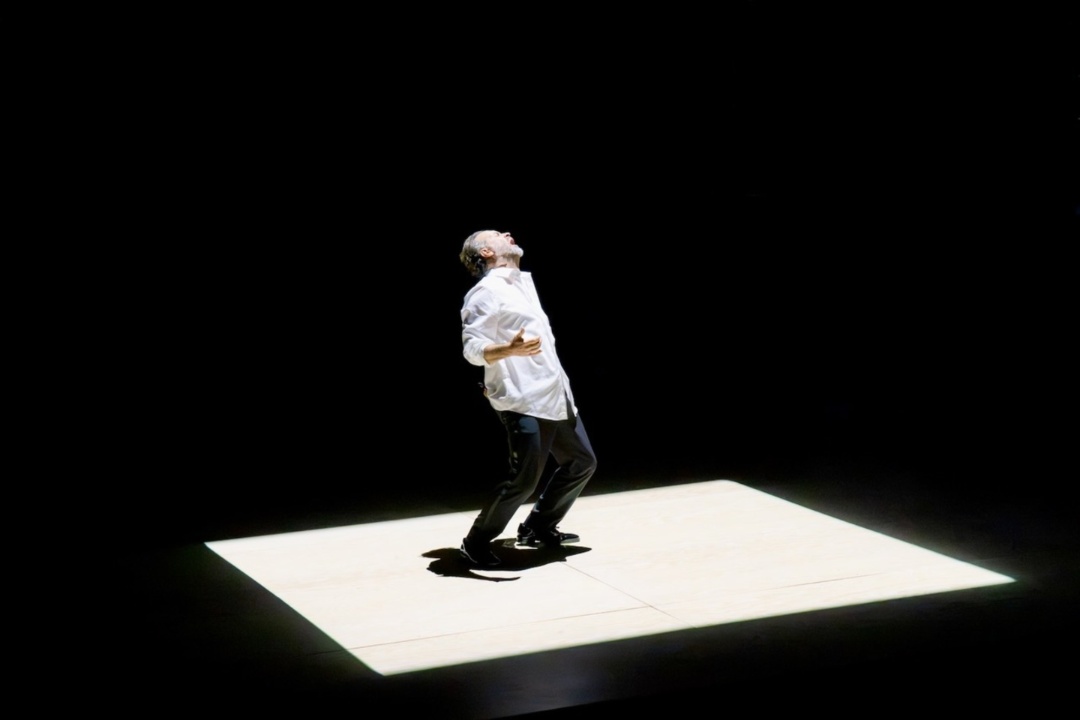
As Kosky notes in the production’s program book, this setup deliberately implicated the spectators. Lear does not rail against some abstract, imaginary court; he addresses the public assembly directly.
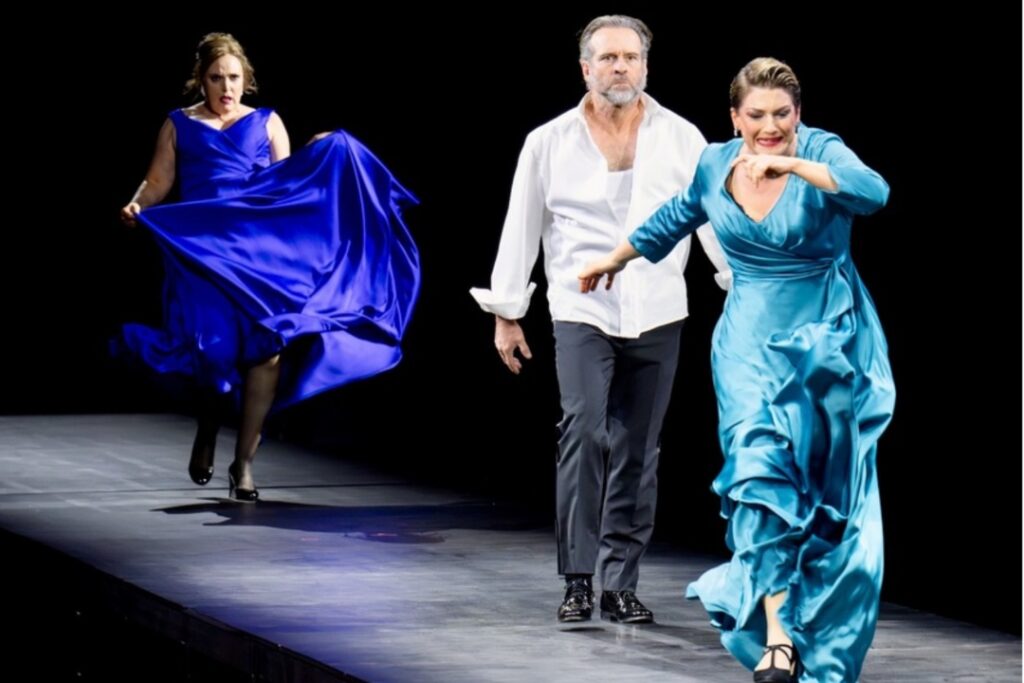
The stage design was starkly economical. Ringst provided little more than chairs and movable catwalks that doubled as tables, pathways, barriers, and pedestals as the drama required. Costume designer Klaus Bruns anchored the production in contemporary modernity. The royal family initially emerged in the polished, high-status black-tie uniforms of corporate executives. By the final acts, however, this evening wear devolved into gritty military garb, mirroring Lear’s own physical trajectory from immaculate administrative authority to filthy, near-naked exposure.
The drama unfolded through precise spatial choreography. Initially, each daughter occupied her own isolated corner of the white square, illustrating how Lear had preemptively converted familial bonds into territorial real estate. This geometric symmetry was unnervingly orderly—until Cordelia uttered her catastrophic "Nothing."
The Fissure of "Nothing"
That single word serves as the fault line that shatters the entire evening. Kosky describes Cordelia’s refusal not merely as an act of disobedience, but as a destructive force tearing a hole in the wall of Lear’s constructed reality. Once Cordelia rejected her father’s grotesque public auction of affection, the pristine white geometry began to fracture. Territorial lines, familial loyalties, and emotional sanity collapsed simultaneously.
Scott Hendricks portrayed Lear not as a frail, doddering monarch staggering blindly toward his grave, but as a vibrant, aggressive corporate tycoon in his 50s or 60s. Having accumulated massive wealth and power, he attempts to divide his enterprise simply to retire in comfort, expecting the perks of absolute authority to remain intact without the administrative burden. Paired with Dagmar Manzel’s brilliantly physicalized Court Fool—whose acute body language highlighted the tragic absurdity of Lear’s vanity—Hendricks framed the king’s undoing as a failure of arrogance rather than senility.
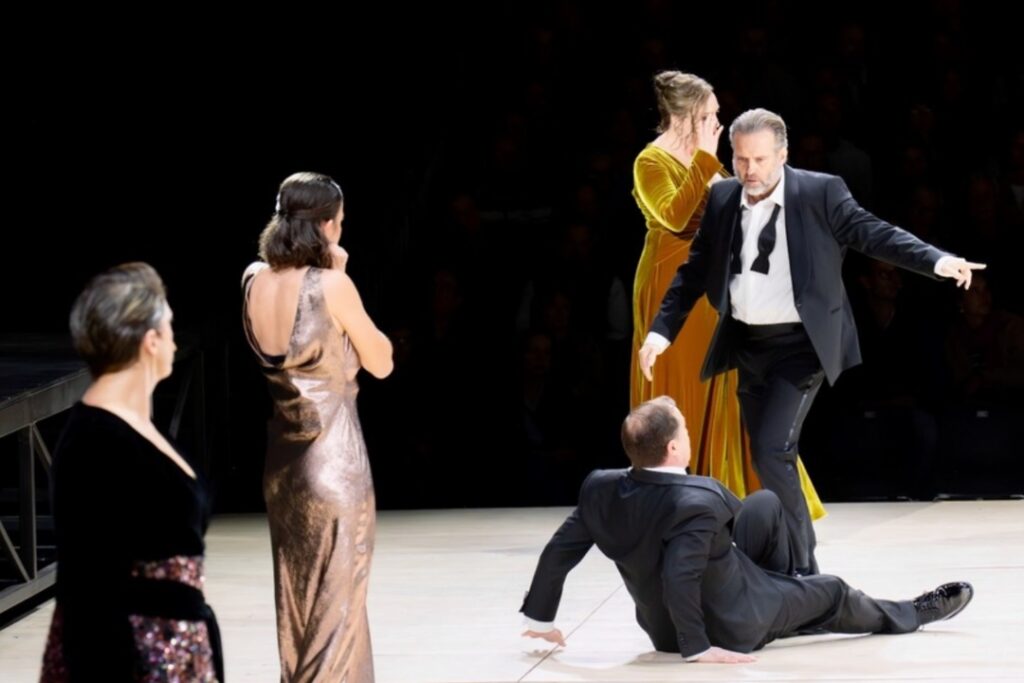
The supporting cast matched this psychological intensity. Rosie Aldridge (Goneril) and Nicole Chevalier (Regan) portrayed the elder sisters not as cardboard fairy-tale villains, but as distinct psychological profiles: Goneril as the cold, calculating inheritor, and Regan as a volatile, sadistic antagonist. Penny Sofroniadou’s Cordelia provided an unyielding moral counterweight, her absolute honesty mistaken by Lear for dangerous insubordination.
Meanwhile, the male principals delivered powerhouse performances. Aryeh Nussbaum Cohen injected startling vocal agility and dramatic abandon into Edgar’s harrowing transformation into "Poor Tom," carving moments of soaring lyricism out of Reimann’s violent orchestral textures. Brenton Ryan presented a restless, calculating, and febrile Edmund, while Günter Papendell imbued Gloster with a stately baritone that heartbreakingly dissolved into raw, vulnerable humanity following his blinding.
Supporting Context & Metrics: Reimann’s Sonic Architecture
The Orchestra as Protagonist
Working alongside librettist Claus H. Henneberg, Reimann compressed Shakespeare’s sprawling text into 11 tightly wound scenes, preserving the play’s structural skeleton while delegating its emotional weight entirely to the pit.
Reimann’s musical language eschews conventional melodicism in favor of an expressive idiom that translates raw emotional states—fury, humiliation, terror, and vengeance—into aggressive instrumental gestures. Kosky elevates this further, positioning the orchestra as a living character, a manifestation of the indifferent forces of nature filling the psychological void left by the absence of maternal figures in Shakespeare’s text.
Conductor Nicholas Carter exercised masterclass control over this massive musical apparatus, maintaining tight synchronization despite the physical distances separating the singers, orchestra, and percussion towers. That percussion battery was a marvel in its own right, comprising bongos, tom-toms, wood and temple blocks, slit drums, gongs, tam-tams, bronze plates, metal foil, and an array of bass drums.
The Storm at Tempelhof
During the central storm sequence, this arsenal transcended mere orchestration to become a visceral, meteorological event. Reimann constructs the scene as an unrelenting crescendo where the boundary between external weather and Lear’s internal psychological collapse vanishes entirely.
In Hangar 4, with percussion booming from elevated towers and artificial fog billowing across the stage and grandstands, the spatial acoustics justified the venue’s eccentricities entirely. The audience did not merely listen to the storm; they were trapped inside it.
Official Statements and Artistic Visionary Insights
Reflecting on the unique challenges of mounting Lear in a former aviation hub, the creative team emphasized the necessity of stripping away traditional theatrical artifice to expose the raw core of Reimann’s work.
"Reimann did not merely set Shakespeare to music," production notes emphasize. "He found a musical language for the terrible distance between power and love—and for the moment when a man who believed he possessed everything finally understands what his possession has cost him."
Director Barrie Kosky noted that the historical resonance of Tempelhof Airport—a monument carrying its own heavy legacy of state power, militarism, and systemic collapse—required no heavy-handed scenic decoration. Instead, the architecture was allowed to speak through emptiness, contrasted sharply against the fragile, splintering psyche of the protagonist.
Conductor Nicholas Carter highlighted the structural interdependence of the musical forces within the hangar space: "The storm takes place as much inside Lear’s head as outside it. The acoustic environment of Hangar 4 forced the sound to envelope every spectator, dissolving the barrier between the stage fiction and the theatrical house."
Future Outlook: Lear Secures Its Place in the Repertoire
Forty-eight years after its triumphant debut in Munich, Aribert Reimann’s Lear has decisively shed the defensive classification of "contemporary opera." It has achieved a status reserved for very few late-20th-century stage works: it is now undisputed repertoire.
The Komische Oper Berlin’s audacious staging at Tempelhof Airport proves that the opera possesses infinite malleability, able to scale up to industrial dimensions without losing its devastating intimacy. As the final notes of the score ebbed away into a desolate pianissimo, leaving Lear dissolving into the shadows rather than marching toward a neat conclusion, the production delivered a definitive verdict.
By wedding Reimann’s abrasive, brilliant score to a staging of profound visual economy and architectural daring, Berlin has delivered a landmark theatrical event. Lear stands today not merely as a monument of modern operatic composition, but as an essential mirror for a world still grappling with the catastrophic costs of power, hubris, and love recognized far too late.