
Executive Overview
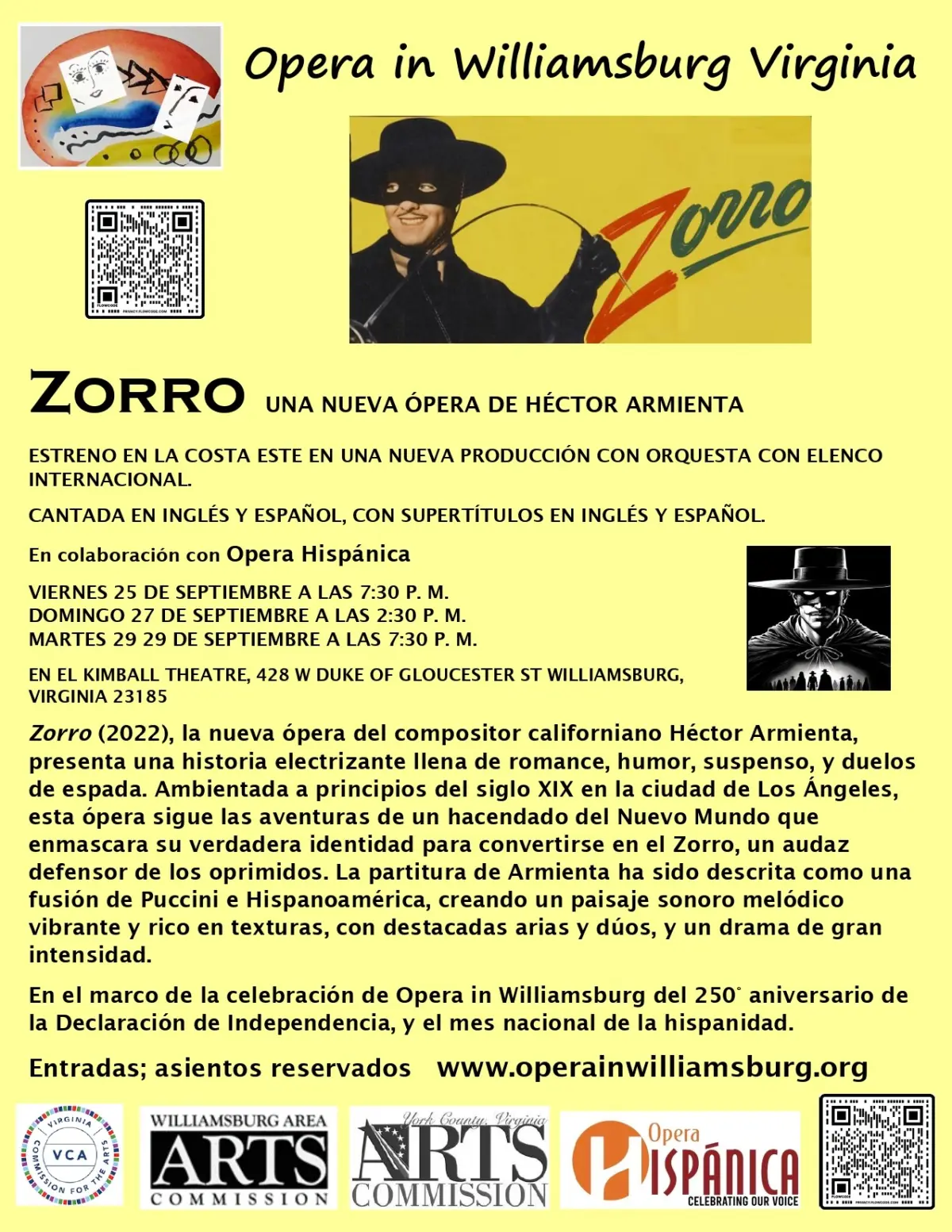
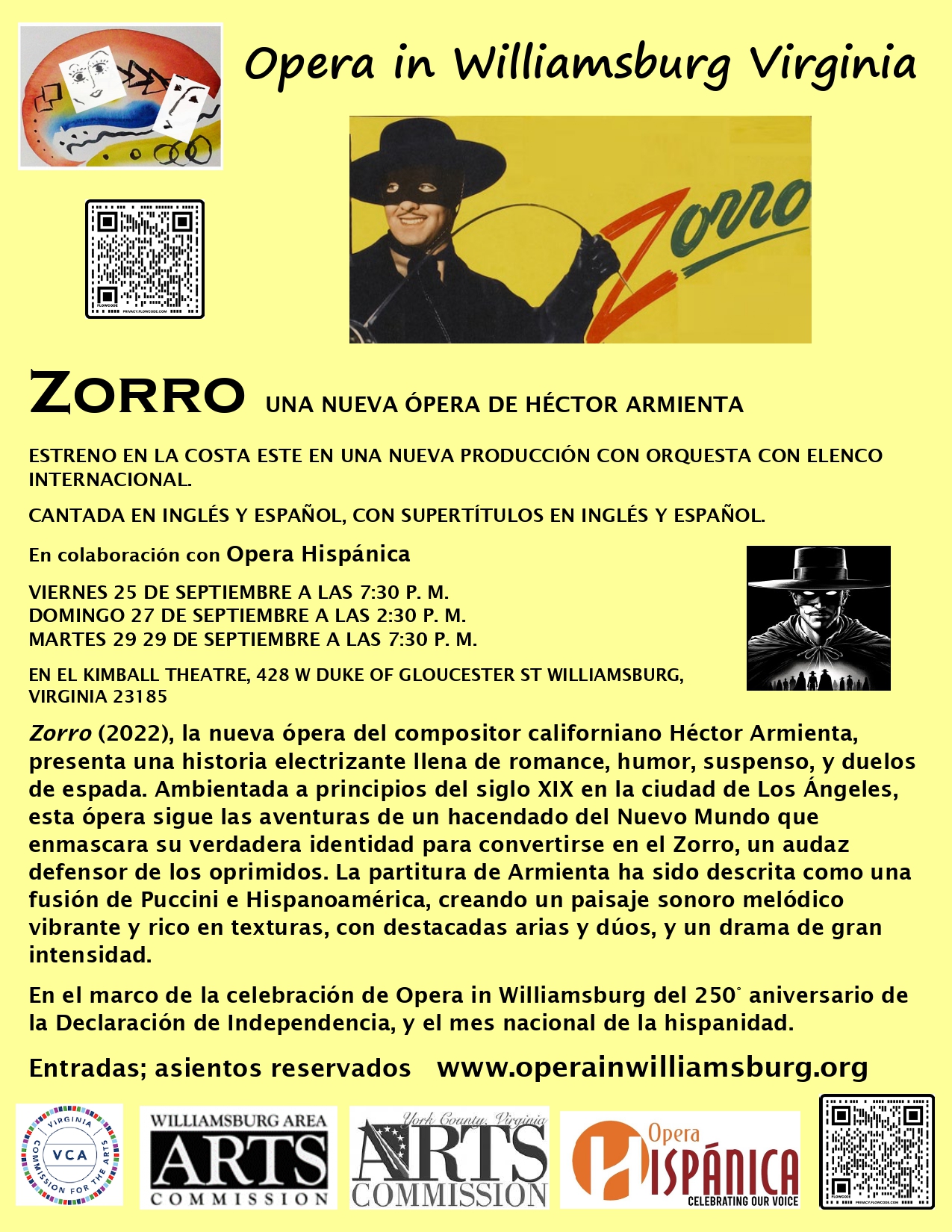
In a landmark cultural pairing of artistic innovation and historical commemoration, Opera in Williamsburg has announced that it will present the highly anticipated East Coast premiere of Hector Armienta’s acclaimed contemporary opera, Zorro. Scheduled to open on September 25, 2026, at the historic Kimball Theatre in Williamsburg, Virginia, this upcoming production is mounted in strategic collaboration with Opera Hispánica, a leading national advocate for Hispanic contributions to the classical music canon.
Set against the turbulent backdrop of early 19th-century California—where local rebels fought valiantly against oppressive Spanish colonial rule—Zorro brings a fresh, vibrant, and culturally rich perspective to the traditional operatic landscape. Originally premiering in 2022 to critical acclaim, Armienta’s work infuses the legendary tale of the masked vigilante with powerful themes of liberty, revolution, and identity.
To ensure maximum accessibility and to honor its bilingual roots, the production will be performed in both English and Spanish, accompanied by comprehensive English and Spanish supertitles. This artistic choice bridges cultural divides and amplifies the narrative’s emotional resonance. Furthermore, the staging of Zorro serves a dual commemorative purpose: it marks Opera in Williamsburg’s major contribution to America’s upcoming 250th-anniversary celebrations (Semiquincentennial) and coincides with National Hispanic Heritage Month.
Behind this monumental production is an all-star creative and artistic team. Stage director Michelle Cuizon and conductor Jorge Parodi lead a powerhouse cast featuring Xavier Prado in the iconic title role, alongside Meryl Domínguez as Ana María, Lisa Chavez as Carlota, Eugene Brancoveanu as Moncada, Suchan Kim as Gómez, Melisa Bonetti Luna as Toypurina, Ethel Trujillo as Luisa, and Branch Fields as Zazueta. The visual and physical production values are equally robust, featuring lighting design by Christina Schwinn and specialized stage combat choreography by Miguel Girona Jr.
Performances are slated for September 25, 27, and 29, 2026. This extensive feature explores the genesis of the production, the historical context of Armienta’s composition, the rigorous artistic vision driving the staging, and the broader implications of bringing a Hispanic-focused American opera to the historic heart of colonial Virginia.
Detailed Chronology: From 1800s California to the 2026 Williamsburg Stage
The Historical Genesis of the Narrative
The narrative roots of Zorro plunge deep into the geopolitics of Alta California during the early decades of the 19th century. This era was characterized by profound socio-political friction. The indigenous populations, Spanish settlers, and local Californios increasingly chafed under the rigid, extractive governance of the Spanish colonial authorities. It was a time ripe for folklore, resistance, and the birth of a legend—the masked swordsman who championed the marginalized against tyranny.
Composer Hector Armienta recognized the operatic potential in this rich historical epoch. Rather than relying solely on the pulp-fiction tropes popularized by Johnston McCulley in his 1919 story The Curse of Capistrano, Armienta integrated historical realities into his libretto. The inclusion of characters like Toypurina—a real historical figure, the indigenous medicine woman who led a revolt against the San Gabriel Mission in 1785—infuses the opera with an authentic gravity that elevates it far beyond a simple swashbuckling adventure.
The 2022 World Premiere and Evolution
Zorro made its world premiere in 2022, capturing the attention of contemporary opera critics and regional houses seeking to diversify their repertoires with stories reflective of America’s multifaceted past. The opera proved that contemporary American works could successfully fuse classical vocal traditions with Latin-infused rhythmic idioms, theatrical staging, and culturally specific storytelling.
Following its initial success, the opera entered a phase of national discovery. Regional companies began recognizing the work’s immense theatrical viability. However, bringing a work of this scale—requiring a nuanced understanding of both historical Spanish-colonial dynamics and contemporary operatic demands—to the East Coast required a specialized partnership. Enter Opera in Williamsburg and Opera Hispánica.
The 2026 Roadmap to Opening Night
The announcement of the East Coast premiere sets in motion a meticulously planned multi-year production timeline leading up to September 2026:
- Phase 1: Conceptual Alignment and Partnership Formalization (2024–2025): Opera in Williamsburg, under the artistic leadership of Naama Zahavi-Ely, began seeking a work that could speak to America’s upcoming 250th anniversary. The collaboration with Opera Hispánica was forged to ensure cultural authenticity, casting precision, and marketing reach within Hispanic communities.
- Phase 2: Casting and Design Finalization (Late 2025): Director Michelle Cuizon and conductor Jorge Parodi finalized the principal cast, securing premier vocal talent adept at navigating Armienta’s demanding score. Concurrently, lighting designer Christina Schwinn and fight choreographer Miguel Girona Jr. began mapping out the visual and physical language of the production, balancing dramatic tension with historical aesthetics.
- Phase 3: Rehearsal and Technical Integration (Summer 2026): The creative team will convene in Williamsburg weeks prior to the September 25 opening. Because Zorro features intricate swordplay, rapid scene transitions, and bilingual supertitles, the technical rehearsals at the Kimball Theatre will be rigorous and complex.
- Phase 4: Premiere and Run (September 25, 27, and 29, 2026): The three-performance run at the Kimball Theatre will serve as the crowning achievement of Opera in Williamsburg’s 2026 season, drawing operagoers, historians, and cultural critics from across the Mid-Atlantic region.
Supporting Context & Metrics: Cultural Significance and Artistic Personnel
Recontextualizing the American Opera Canon
For decades, regional American opera companies struggled with a narrow definition of "Americana." Mainstream repertoires frequently gravitated toward works dealing with British-American colonial themes, Appalachian folklore, or 20th-century political dramas. While these stories are vital threads in the national tapestry, they historically underrepresented the Hispanic, indigenous, and Spanish-colonial narratives that form an equally foundational pillar of North American history.
By selecting Zorro, Opera in Williamsburg is actively participating in a broader, necessary evolution within the American classical music industry. This production challenges audiences to expand their definitions of national heritage. It demonstrates that the struggle for liberty, civil rights, and self-determination—values deeply embedded in the American ethos—was fought not only in the snowy valleys of New England or the legislative halls of Philadelphia, but also under the blazing sun of Alta California.
Key Production Personnel and Creative Force
The success of any contemporary opera hinges on the synergy between its creative visionaries and its interpreters. The production team assembled for the East Coast premiere of Zorro boasts an impressive array of talent:
- Naama Zahavi-Ely (Artistic and General Director, Opera in Williamsburg): The visionary driving force behind the Kimball Theatre production. Zahavi-Ely’s strategic foresight in identifying Zorro as a parallel narrative to the traditional American revolution has positioned her company at the cutting edge of modern programming.
- Hector Armienta (Composer): A celebrated contemporary American composer known for his ability to weave rich orchestral textures with cultural storytelling. Armienta’s works often explore Latino history, folklore, and identity through a classical lens.
- Michelle Cuizon (Stage Director): Tasked with steering the dramatic arc of the production, Cuizon brings a reputation for visceral, character-driven staging that balances high-stakes action with intimate human drama.
- Jorge Parodi (Conductor): A dynamic maestro with extensive experience in both traditional and contemporary operatic repertoires. Parodi’s leadership on the podium will ensure that Armienta’s score—bursting with Spanish-colonial and romantic motifs—is delivered with precision and emotional depth.
- The Principal Cast:
- Xavier Prado steps into the demanding title role of Zorro, requiring both formidable vocal stamina and athletic stage presence.
- Meryl Domínguez portrays Ana María, bringing lyrical brilliance and emotional complexity to the supporting romantic and dramatic lines.
- Lisa Chavez (Carlota) and Eugene Brancoveanu (Moncada) add dramatic gravity and vocal power, anchoring the antagonist and social-elite dynamics of the story.
- Suchan Kim (Gómez), Melisa Bonetti Luna (Toypurina), Ethel Trujillo (Luisa), and Branch Fields (Zazueta) round out an ensemble specifically selected for their vocal agility and capacity to handle bilingual performance demands.
- Design and Movement: Christina Schwinn crafts the atmospheric lighting design necessary to transition between the sun-drenched plazas of California and the shadowy secrecy of the rebellion. Meanwhile, fight choreographer Miguel Girona Jr. ensures that the iconic sword fights are executed with theatrical safety, dramatic intensity, and historical verisimilitude.
Official Statements: The Vision Behind the Production
The journey of bringing Zorro to Williamsburg is rooted in deep artistic reflection. In an official press release detailing the programming decision, Naama Zahavi-Ely, Artistic and General Director of Opera in Williamsburg, shed light on the creative process that led to the selection of Armienta’s work:
"I kept going in my mind over American operas that I knew, some were too large for us, others revolved around subject matter that seemed unrelated, and then I suddenly realized that the opera ‘Zorro’ was also an American opera and in fact was related to the topic of revolution and liberty, though with a Hispanic rather than a British flair."
This realization struck at the heart of what Opera in Williamsburg aimed to achieve as the United States approaches its 250th anniversary. While many regional institutions across the original thirteen colonies are naturally focusing on Anglo-centric narratives of the American Revolution, Zahavi-Ely recognized an opportunity to broaden the geographic and cultural scope of the commemoration. By acknowledging that the quest for liberty was a continental phenomenon—encompassing Spanish-colonial territories, indigenous struggles, and diverse linguistic communities—the company is offering its audiences a richer, more inclusive historical mirror.
Furthermore, the partnership with Opera Hispánica underscores a shared institutional commitment to expanding the footprint of Hispanic narratives in classical music. Opera Hispánica has long championed works that celebrate Latino culture, providing platforms for composers, singers, and directors who might otherwise be sidelined in traditional euro-centric operatic programming. The collaboration ensures that Zorro is presented not as a novelty, but as a central masterwork of contemporary American lyric theater.
Future Outlook: A New Paradigm for Regional Opera
As the classical music industry continues to navigate post-pandemic audience recovery, shifts in donor demographics, and a cultural imperative for greater inclusivity, the strategy employed by Opera in Williamsburg serves as a compelling blueprint for regional opera companies nationwide.
Redefining Regional Relevance
For smaller-to-mid-sized regional opera houses, mounting massive, traditional grand operas (such as Verdi’s Aida or Puccini’s Turandot) is frequently cost-prohibitive and artistically redundant. Audiences increasingly demand works that feel relevant to their lived experiences, their communities, and their historical curiosity. By selecting a contemporary American opera that addresses themes of justice, rebellion, and cultural identity, Opera in Williamsburg has positioned itself as a dynamic cultural hub rather than a museum of 19th-century European art.
The Impact of Bilingual Programming
The decision to present Zorro in English and Spanish, complete with dual-language supertitles, points toward the future of American opera. As demographic shifts transform communities across the United States, arts organizations must proactively lower linguistic and cultural barriers. Bilingual productions do not alienate traditional audiences; rather, they expand the tent, welcoming new generations of operagoers who value linguistic diversity and cultural representation on the lyric stage.
Looking Beyond 2026
While the immediate focus of the company remains firmly fixed on the September 2026 performances at the Kimball Theatre, the ripples of this East Coast premiere will likely extend far beyond Virginia. Successful regional premieres of contemporary works frequently spark national tours, subsequent productions by other regional houses, and increased institutional support for the composer and creative team.
Should the production achieve the critical and popular acclaim anticipated by its organizers, Armienta’s Zorro could well cement its place as a staple of the modern American operatic repertoire—proving that the masked hero of California can capture the imaginations of East Coast audiences just as powerfully as he captured the folklore of the American West.
Performance Details & Ticket Information
- Production: Zorro (East Coast Premiere)
- Composer: Hector Armienta
- Presenting Companies: Opera in Williamsburg in collaboration with Opera Hispánica
- Venue: The Kimball Theatre, Williamsburg, Virginia
- Dates: September 25, 27, and 29, 2026
- Language: Sung in English and Spanish, with English and Spanish supertitles
- Creative Team: Michelle Cuizon (Director), Jorge Parodi (Conductor), Christina Schwinn (Lighting Designer), Miguel Girona Jr. (Fight Choreographer)
- Principal Cast: Xavier Prado (Zorro), Meryl Domínguez (Ana María), Lisa Chavez (Carlota), Eugene Brancoveanu (Moncada), Suchan Kim (Gómez), Melisa Bonetti Luna (Toypurina), Ethel Trujillo (Luisa), Branch Fields (Zazueta)
For further updates, ticketing information, and community outreach programming related to the upcoming 2026 production, audiences are encouraged to visit the official websites of Opera in Williamsburg and Opera Hispánica.