
Executive Overview
In an era where houses of worship continually strive to expand their reach and deepen their community impact, one critical demographic is frequently underserved: individuals experiencing hearing loss. Modern sanctuary design often prioritizes large-scale acoustic experiences, dynamic musical arrangements, and immersive architectural aesthetics. However, these environments can inadvertently present severe communication barriers for congregants with auditory impairments. Bridging this gap requires more than simply raising the master volume; it demands a strategic, highly intentional integration of Assistive Listening Systems (ALS).
Implementing an ALS is not merely an exercise in technical audio engineering or regulatory compliance—it is a profound pastoral initiative. When a church invests in assistive listening technology, it sends an unequivocal message of radical hospitality, ensuring that every member of the congregation can fully absorb the spoken word, share in the emotional cadence of a sermon, and participate in communal prayer without frustration.
Despite the clear benefits, church leadership often hesitates due to perceived complexities surrounding budgeting, technology selection, staff training, and community outreach. This comprehensive report outlines a definitive, four-step framework designed to demystify the implementation process. Drawing upon insights from audio technology specialists such as CCI Solutions and Listen Technologies, this article provides worship leaders, technical directors, and facility managers with an authoritative roadmap to assess congregational needs, evaluate technical solutions, train operational personnel, and foster widespread community awareness. By following this structured approach, houses of worship can transform their acoustic environments into spaces of absolute inclusion.
Detailed Chronology: The Four-Step Implementation Roadmap
Successfully deploying an Assistive Listening System requires a methodical, step-by-step approach. Transitioning from an inaccessible sanctuary to an acoustically inclusive worship space involves distinct phases of discovery, financial planning, operational readiness, and promotion.
Phase 1: Understanding and Quantifying Congregational Needs
The foundational error many facilities make is purchasing audio hardware based purely on square footage or generalized manufacturer recommendations without assessing the specific demographics of their attendees. The implementation journey must always begin with a rigorous, data-driven assessment of congregational needs.
- Deploying Comprehensive Surveys: Church leadership should distribute a targeted survey to the congregation—both physically in worship bulletins and digitally via email newsletters and church apps. This survey must go beyond a simple "Do you have trouble hearing?" inquiry.
- Targeted Data Collection: Questions should focus on the specific experiences of congregants during standard services. Do they struggle to differentiate speech from background music and reverberation? Do they utilize hearing aids? Crucially, administrators must ask whether those hearing aids are equipped with telecoils (t-coils), as this dictates whether a room-wide loop system (Induction Loop) or portable receivers (RF, Infrared, or Wi-Fi) will be most effective.
- Analyzing the Feedback: Once the data is compiled, leadership will possess a clear statistical profile of the audience. This profile identifies not only the scale of the hearing impairment within the community but also the specific age brackets and tech-literacy levels of those who require assistance, informing the subsequent selection of hardware.
Phase 2: Evaluating Technical Options and Financial Logistics
With a clear understanding of congregational needs, the focus shifts to hardware selection and fiscal planning. The modern assistive listening market offers diverse solutions, ranging from Radio Frequency (RF) systems and Infrared (IR) transmitters to advanced Wi-Fi streaming architectures and direct-to-hearing-aid Induction Loops.
- Cost Estimation and Budgeting: Estimating the financial commitment required for an ALS involves evaluating hardware costs, transmitter units, individual receivers, charging stations, and signage. Because every sanctuary’s acoustic footprint is unique, partnering with specialized audio integrators—such as CCI Solutions—is invaluable. These organizations frequently offer free consultations to help ministries navigate pricing models, evaluate spatial requirements, and align equipment choices with strict budgetary constraints.
- Funding and Capital Campaigns: For many congregations, purchasing enterprise-grade assistive listening technology requires creative financial planning. Churches can incorporate ALS funding into broader capital improvement campaigns, apply for specialized accessibility grants, or engage in targeted fundraising drives. Framing the purchase as a vital ministry of inclusion rather than a mere technical upgrade consistently inspires generous donor participation.
Phase 3: Operational Readiness and Staff Training
Even the most advanced assistive listening technology will fail if the church staff, welcome teams, and audio-visual (AV) volunteers do not know how to operate, maintain, and distribute the devices. Seamless execution is paramount.
- Appointing "Assisted Listening Ambassadors": Ushers, greeters, and welcome desk personnel should be designated as specialized ambassadors for the ALS program. Their demeanor should be welcoming, proactive, and knowledgeable.
- Standardized Check-Out Procedures: When a congregant requests a device, staff members should take a moment to provide a friendly, patient demonstration of the hardware. Explaining how to adjust volume, secure comfortable earpieces, or sync with t-coils prevents user frustration before the service even begins.
- Creating Operational Collateral: To ensure consistency despite volunteer turnover, leadership should place a laminated "Frequently Asked Questions" (FAQ) guide and troubleshooting sheet directly at the distribution desk. This empowers any team member to resolve common issues instantly.
Phase 4: Cultivating Awareness and Community Outreach
An exceptional ALS program yields no fruit if the congregation and the surrounding community remain unaware of its existence. Strategic marketing and communication are vital to adoption.
- Signage and Wayfinding: Clear, universally recognized international symbols for accessibility should be prominently displayed at building entrances, welcome desks, and sanctuary doors. These signs must inform attendees that Assistive Listening Devices are available and direct them precisely where to acquire them.
- Multi-Channel Promotion: Reminders should be woven into weekly print bulletins, digital newsletters, and pre-service screen loops.
- Live Demonstrations and Community Advertising: Hosting a dedicated post-service training session allows curious congregants to test the technology firsthand without pressure. Furthermore, extending this marketing outward—letting the broader local community know that the church is fully equipped for accessibility—fosters an influx of visitors who have long felt excluded from traditional worship environments.
Supporting Context & Metrics: The Imperative of Auditory Accessibility
To fully appreciate the urgency of deploying Assistive Listening Systems, one must examine the broader socio-medical landscape of hearing loss and its profound psychological impact on social integration.
The Scope of Age-Related and Acquired Hearing Loss
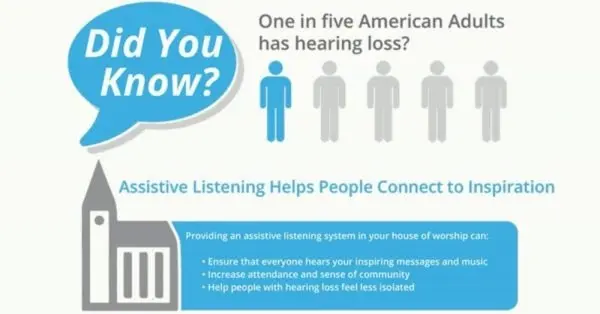
According to epidemiological data from organizations such as the World Health Organization (WHO) and the Hearing Loss Association of America (HLAA), unmanaged hearing loss is one of the most prevalent chronic conditions affecting adults. While it is strongly correlated with aging—affecting a significant percentage of adults over the age of 65—hearing impairment frequently impacts younger demographics due to occupational noise exposure, genetic factors, and the ubiquitous use of personal listening devices.
In a worship setting, these statistics translate directly into empty seats and silent disengagement. When an individual can no longer decipher spoken sermons over reverberant sanctuary acoustics, they rarely complain; instead, they quietly stop attending. This self-isolation erodes the core communal fabric of the church.
The Psychology of Inclusions vs. Isolation
Communication is the lifeblood of spiritual community. The inability to comprehend spoken liturgy, scripture readings, and pastoral messaging breeds feelings of alienation, embarrassment, and loneliness. Congregants with hearing loss often report expending immense cognitive energy simply trying to piece together fragmented audio, leaving them mentally exhausted rather than spiritually renewed by the service.

By installing an ALS, a church directly combats this isolation. Providing equitable access to audio signals affirms the inherent dignity of every attendee. It acknowledges that physical barriers should never be permitted to erect spiritual walls.
Economic and Technological Realities
Modern audio standards have evolved past clunky, static-prone analog systems of the past. Today’s hardware leverages pristine digital transmission, ensuring zero dropouts, crystal-clear frequency responses, and seamless integration with modern hearing aids and cochlear implants via Bluetooth or telecoil infrastructure. While upfront costs require thoughtful budgeting, the long-term return on investment—measured in retained membership, enhanced community reputation, and deepened spiritual engagement—vastly outweighs the financial outlay.
Official Statements and Expert Insights
Industry leaders, accessibility advocates, and architectural acousticians consistently emphasize that accessibility is a theological imperative rather than an optional technical luxury.
"Reaching out to those who feel disconnected from your community due to hearing loss is central to sharing the message of inclusion. Genuinely compassionate service involves being aware of and caring for the needs of everyone, especially those dealing with impairments. Make sure they are able to hear the beauty and emotion of the spoken word in your church by providing them with the equipment they need to stay connected."
— Audio Accessibility Working Group Commentary
Furthermore, technical specialists underscore the importance of comprehensive educational resources. Organizations like Listen Technologies have developed specialized guides—such as the Listen Technologies Church Assistive Listening Toolkit—to bridge the gap between complex audio engineering and everyday church administration. These toolkits provide invaluable, ready-to-use assets including:
- Standardized sample surveys for assessing congregational needs.
- High-contrast, ADA-compliant signage templates.
- Pre-written bulletin announcements and script templates for pastoral teams.
Technical partners like CCI Solutions echo these sentiments, noting that proactive budgeting and early integration during sanctuary renovations or sound system upgrades dramatically reduce friction and long-term costs.
Future Outlook: The Evolution of Accessible Worship Spaces
As we look toward the future of house of worship design and administration, the integration of assistive technologies will only deepen, driven by rapid advancements in digital signal processing, wireless communication, and universal design principles.
The Convergence of Wi-Fi Streaming and Personal Devices
Historically, assistive listening relied exclusively on dedicated, church-owned receivers handed out at the door. While these hardware receivers remain essential—particularly for elderly demographics or those unfamiliar with smartphone technology—the future increasingly belongs to Bring Your Own Device (BYOD) architectures. Modern Wi-Fi-based assistive listening systems allow congregants to stream pristine, zero-latency church audio directly to their personal smartphones, tablets, or wireless earbuds via downloadable apps. This reduces hardware management overhead for church volunteers while offering a discreet, highly personalized listening experience.
Integration with Smart Building and AI-Driven Acoustics
Looking further ahead, smart acoustic monitoring systems powered by artificial intelligence will begin to dynamically adjust sanctuary soundscapes in real-time, optimizing speech intelligibility for specific seating zones. When paired with advanced induction loops and localized beamforming microphones, houses of worship will be capable of virtually eliminating room reverberation for impaired listeners entirely at the hardware level.
The Permanent Paradigm Shift Toward Universal Design
Ultimately, the future of church accessibility lies in the philosophy of universal design—the concept that environments should be inherently accessible to all people, to the greatest extent possible, without the need for adaptation or specialized design. While assistive listening devices will remain a cornerstone of compliance and care for the foreseeable future, the broader cultural shift within modern ministries is unmistakable: accessibility is moving from an afterthought to a foundational pillar of architectural and operational planning.
Churches that embrace this evolution today will not only ensure compliance with evolving accessibility standards; they will cultivate vibrant, deeply connected communities where every voice is heard, and every soul is welcomed.