
Executive Overview
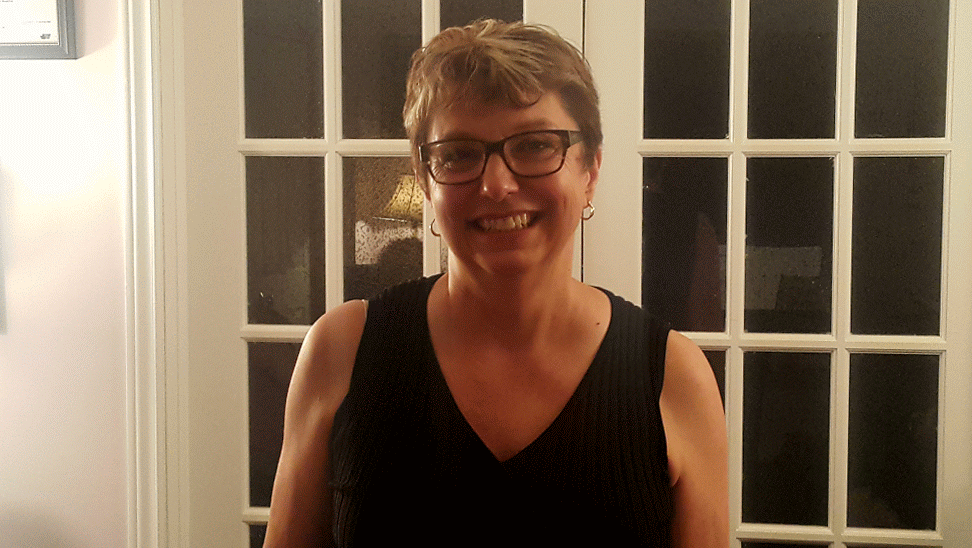
For individuals whose professional or personal lives depend on the power, clarity, and endurance of their voice, the onset of vocal cord pathology represents a profound crisis. For Mary-Ellen Stoll, a retired professional with a background in the biological sciences hailing from the Ottawa/Kingston region of Ontario, a routine medical intervention snowballed into a thirty-year vocal struggle.
More than three decades ago, Stoll underwent surgery to remove nodules from her vocal cords—a common yet delicate procedure often necessitated by vocal strain, misuse, or chronic abuse of the voice. While the surgery successfully removed the pathological tissue, it left behind a fragile vocal apparatus. Compounded by the relentless demands of raising a family and managing a heavy workload, Stoll’s vocal recovery took a back seat. Over the ensuing years, her voice became an unreliable instrument. It fatigued rapidly, failed her under pressure, and succumbed to recurring episodes of complete laryngitis multiple times a year.
Upon reaching retirement, Stoll sought to reclaim a long-abandoned passion: singing. She set her sights on joining a local ladies’ barbershop chorus. However, her return to vocal performance was met with immediate obstacles. The chorus director expressed deep-seated concerns that Stoll would permanently damage her vocal cords, and Stoll herself experienced alarming physical pain and soreness following standard two-hour rehearsals.
Desperate for a viable solution, Stoll turned to Diana Yekinny (known professionally as Diana) and the proprietary Vocal Science™ methodology. Following an intensive 20-hour immersion program, Stoll experienced a dramatic transformation. This case study explores Stoll’s journey through the lens of professional voice repair, examining the mechanics of the Vocal Science™ technique, the integration of holistic herbal remedies from a scientific perspective, and the broader implications for vocal rehabilitation practitioners worldwide.
Detailed Chronology: From Surgery to Salvation
The Three-Decade Vocal Drought
To fully appreciate the scope of Stoll’s recovery, one must examine the cascading effects of vocal cord surgery coupled with chronic vocal neglect. Vocal cord nodules are benign growths that develop on the vocal folds due to repeated friction and impact, typically caused by speaking or singing with incorrect technique. While surgical removal eliminates the physical obstruction, the underlying behavioral patterns—such as glottal attacks, improper breath support, and excessive muscular tension—frequently remain unaddressed.
For Stoll, the post-surgical era was characterized by compromise. With her time entirely consumed by career and family obligations, she lacked the bandwidth to seek specialized rehabilitation. Consequently, her voice adapted poorly to stress.
- Rapid Fatigue: Speaking for extended periods drained her vocal energy, making professional and social communication exhausting.
- Unreliability: Under stress or fatigue, her voice would crack, fade, or give out entirely.
- Seasonal Laryngitis: She suffered from complete loss of voice multiple times per year, signaling a chronic inflammatory state within her laryngeal tissues.
The Barbershop Catalyst
Retirement offered Stoll the gift of time, prompting her to pursue her latent dream of choral singing. Barbershop music, known for its rigorous acoustic demands, close four-part harmonies, and the requirement for a bright, resonant timbre without microphones, acts as a rigorous stress test for any singer’s vocal health.
Upon auditioning and participating in rehearsals, the reality of her vocal limitations crashed down. The chorus director, attuned to the physical strain in Stoll’s voice, voiced legitimate fears regarding potential re-injury. Furthermore, after two-hour rehearsal blocks, Stoll experienced tangible laryngeal pain. The dream of harmonious retirement singing was on the verge of collapsing under the weight of her physiological reality.
Discovering the Vocal Science™ Method
Recognizing that conventional speech therapy or standard vocal lessons were inadequate for her complex history, Stoll cast a wide net for specialized intervention. Her search led her to Diana Yekinny and the Vocal Science™ studio, an institution renowned for handling complex, seemingly hopeless voice repair cases.
Stoll enrolled in an intensive 20-hour program spread across several weeks. Rather than engaging in traditional, repetitive vocalizing, Stoll was introduced to a revolutionary holistic paradigm. This method treats the human voice not as an isolated muscular valve, but as the product of an integrated, whole-body kinetic chain.
[Traditional Approach] -> Isolate Vocal Cords -> Repetitive Drill -> Marginal/Temporary Relief
[Vocal Science™ Method] -> Whole-Body Kinematic Alignment -> Facial Resonance / Muscular Re-education -> Permanent Structural Shift
As Stoll noted during her rehabilitation, the primary physical sensation shifted away from her delicate vocal folds entirely. Instead of feeling strain in her throat, she felt it in her facial muscles—specifically her cheeks. By shifting the workload away from the laryngeal tissues and distributing acoustic amplification throughout the facial mask (resonators), Stoll began producing sound safely and efficiently.
Supporting Context & Metrics: The Science of Voice Repair
Anatomy and Biomechanics of Vocal Recovery
To understand why Stoll experienced such rapid relief, we must look at the biomechanics of voice production. When vocal cords are compromised by past surgery or scarring, their ability to close efficiently (glottal closure) without excessive muscular compression is severely impaired.
Traditional vocal training often focuses on "pushing" air through the larynx, which increases the collision force between the vocal folds. For a patient with a history of nodules, this is catastrophic. The Vocal Science™ methodology flips this dynamic by emphasizing:
- Extreme Body-Voice Integration: Correct posture, core engagement, and spinal alignment to support the breath column.
- Resonator Amplification: Utilizing the facial bones, hard palate, and cranial cavities to amplify sound acoustically, thereby reducing the mechanical burden on the vocal folds.
- Continuous Real-Time Biofeedback: Utilizing acute auditory and visual observation to instantly correct micro-tensions before they reach the laryngeal area.
The Skeptic Turned Believer: Herbal Interventions
One of the most fascinating facets of Stoll’s testimonial is her reconciliation with holistic medicine. Having spent her entire life immersed in the rigorous, empirical framework of the biological sciences, Stoll initially approached herbal treatments with healthy skepticism.
However, under Diana’s guidance, she incorporated targeted herbal formulations designed to reduce systemic inflammation, soothe upper respiratory mucosa, and enhance tissue recovery. In vocal pathology, micro-swelling of the vocal folds can drastically alter phonation thresholds. By utilizing natural anti-inflammatories and demulcents, patients often experience accelerated healing of irritated laryngeal membranes. Stoll observed firsthand that these botanical interventions played a crucial supporting role alongside her mechanical vocal training.
Quantitative Breakdown of the Intensive Program
- Total Immersion Hours: 20 hours over several weeks.
- Target Areas: Speaking voice mechanics, singing technique, respiratory support, and muscular re-education.
- Physical Shift: Relocation of muscular exertion from the laryngeal sphincter to the facial musculature (cheek engagement).
- Acoustic Yield: Immediate transformation in volume, clarity, sustained pitch stability, and projection without vocal fatigue.
Official Statements and Testimonial Analysis
In her detailed reference letter written for future clients, Mary-Ellen Stoll did not mince words regarding her experience, the financial investment required, and the level of personal dedication demanded by the program.
"Diana has spent over 30 years of her life creating and fine-tuning her techniques and it shows. She is dedicated to your improvement, but in a taskmaster sort of way. You have to dedicate yourself as well."
This statement underscores the philosophy of the Vocal Science™ approach. It is not a passive medical treatment where a patient receives a pill or a quick adjustment; it is an active educational and rehabilitative process. The practitioner acts as a rigorous guide—a "taskmaster"—while the client must invest intense mental and physical focus to rewire decades of entrenched, maladaptive vocal habits.
Stoll also addressed the financial aspect of the program with refreshing transparency:
"As for the cost — it is not insignificant. You WILL get results and I would do it all again with Diana. I wish I had looked for and found her about 20 years ago. It would have saved me years of frustration with my voice."
In the realm of specialized health services, high-cost interventions are often scrutinized. However, when weighed against thirty years of chronic vocal fatigue, recurring laryngitis, social isolation from musical groups, and the emotional toll of a failing voice, Stoll’s investment yielded an invaluable return: her voice, her confidence, and her retirement dream.
Future Outlook: Implications for Vocal Health and Community Integration
Mary-Ellen Stoll’s successful rehabilitation serves as a powerful beacon for aging adults, performers, and professionals struggling with chronic vocal dysfunction. As life expectancies rise and retirees increasingly seek to remain active in community arts, sports, and social organizations, the demand for specialized, non-invasive voice repair will only escalate.
Broader Takeaways for the Voice Industry
- The Limits of Conventional Therapy: Traditional speech-language pathology often focuses on clinical maintenance rather than artistic performance restoration. Methods like Vocal Science™ bridge the gap between clinical rehabilitation and high-level vocal performance.
- The Power of Early Intervention: As Stoll noted, finding the right technique decades earlier would have spared her a lifetime of frustration. Public awareness campaigns regarding safe vocal production are critical to preventing long-term damage.
- Integrative Healing: The successful synthesis of rigorous physical mechanics, posture training, and targeted herbal remedies points toward a more holistic, multi-disciplinary future for voice therapy.
Stoll’s Current Status
Today, Mary-Ellen Stoll stands as a testament to the resilience of the human voice when paired with expert, uncompromising guidance. No longer plagued by post-rehearsal pain or the looming threat of sudden laryngitis, she actively participates in her local ladies’ barbershop chorus. She produces sound with a volume, clarity, and pitch stability that once seemed permanently out of reach.
For future clients hesitating at the threshold of their own vocal recovery journey, Stoll offers a clear, reassuring, and empirically tested conclusion:
"All the testimonials you read on the Vocal Science and Repair Your Voice website are accurate… You WILL get results."