
Executive Overview
In a stunning display of artistic vision, budgetary efficiency, and profound emotional resonance, the Teatro Grande di Brescia inaugurated its 2026–27 Opera and Ballet season with a breathtaking production of Benjamin Britten’s final operatic masterpiece, Death in Venice. Marking the opera’s historic debut on the Brescia stage, this ambitious mounting is a collaborative triumph shared by the OperaLombardia association and several esteemed partner theaters across Emilia-Romagna.
At a time when opera houses frequently struggle to balance avant-garde concepts with audience accessibility, this production—skillfully directed by Rodula Gaitanou and musically helmed by conductor Daniel Smith—emerged as a masterclass in collaborative stagecraft. Relying on a modest financial footprint yet prioritizing raw artistic talent, interpretive depth, and visual clarity, the creative team delivered what critics and patrons are already hailing as OperaLombardia’s finest production of the past half-decade. Anchored by world-class performances from tenor Toby Spence as Gustav von Aschenbach and baritone Dominic Sedgwick in a grueling multi-role tour de force, the opening night culminated in a roaring, sustained standing ovation. As the production prepares to transfer to regional stages in Como, Pavia, and Cremona, it leaves behind an indelible mark on the Italian operatic landscape.
Detailed Chronology and Production Genesis
The Personal Stakes of a Musical Swan Song
To fully comprehend the magnitude of this production, one must examine the deeply personal genesis of Benjamin Britten’s Death in Venice. Premiered posthumously in 1973 and based on Thomas Mann’s celebrated novella Der Tod in Venedig, the opera chronicles the introspective psychological unraveling of aging author Gustav von Aschenbach. Traveling to a plague-stricken Venice, Aschenbach experiences a profound, silent awakening concerning beauty, desire, and his own mortality as he fixates on Tadzio, a pristine, youthful Polish adolescent.
Britten’s identification with Aschenbach was absolute. Composing the score amidst rapidly deteriorating health, the British composer recognized the chilling parallels between the fictional writer’s physical decline and his own failing heart. Crucially, Britten wrote the grueling, almost monodramatic role of Aschenbach specifically for his life partner, tenor Peter Pears, tailoring the vocal lines to the aging and fragile state of Pears’s voice.
Furthermore, the opera’s creation was bound up in the oppressive legal realities of mid-century Britain. Until the passage of the Sexual Offences Act in 1967, homosexuality was officially classified as a criminal offense in the United Kingdom. Britten and Pears lived their personal lives with a quiet defiance, treating their partnership as natural, yet Britten’s scores frequently pushed boundaries by exploring complex, coded, or transgressive sexual themes—from the hints of incest in Peter Grimes to the undisguised homoeroticism of Billy Budd and the explicit violence of The Rape of Lucretia. Death in Venice, however, approached the subject with a quiet, devastating psychological vulnerability.
Britten’s commitment to his artistic testament was absolute: he actively postponed a critical, life-saving heart operation until the final notes of the score were committed to paper in March 1973. Complications from that surgery and a protracted recovery ultimately prevented him from attending the world premiere.
Bringing Venice to Brescia: The Gaitanou-Takis Vision
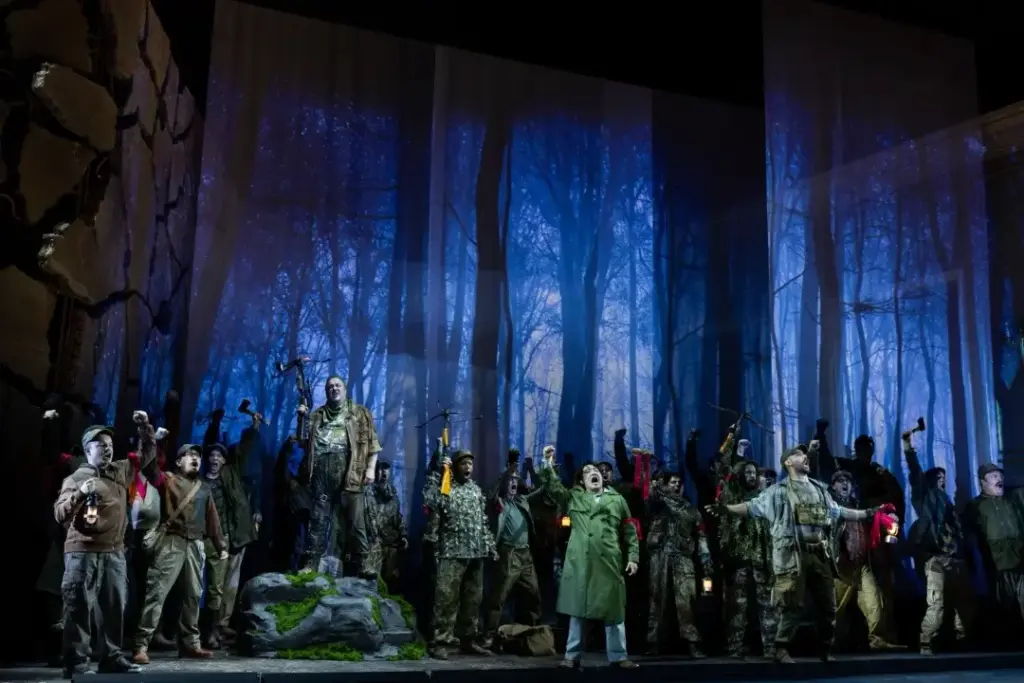
When the curtain rose at the Teatro Grande di Brescia, it unveiled a scenic landscape conceived by stage director Rodula Gaitanou and designer Takis that defied the constraints of a modest budget. Recognizing that artistic impact stems from resourcefulness rather than excess, Gaitanou shaped a dark, atmospheric, and claustrophobic Venice that mirrored the psychological entrapment of the protagonist.
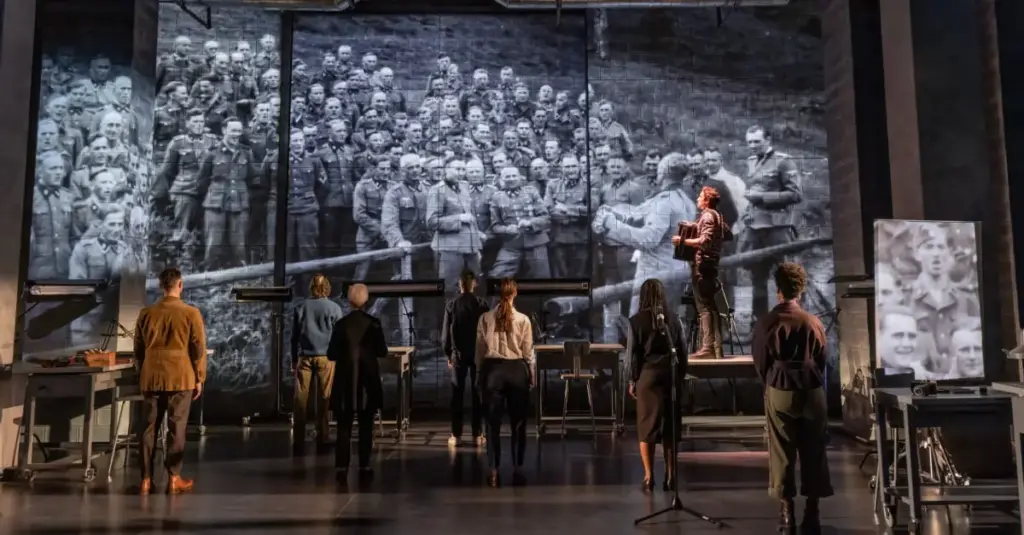
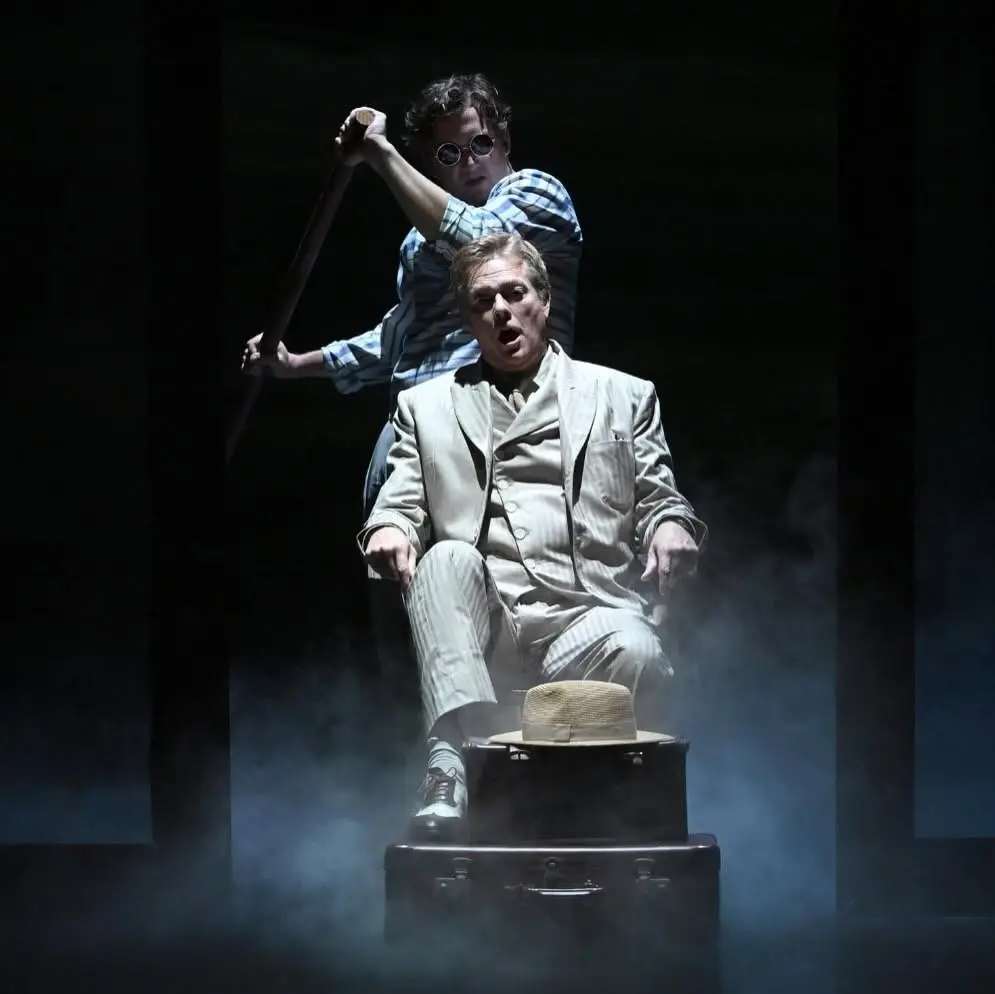
Takis utilized a stark, minimalist visual vocabulary. The stage was dominated by a shadowy, chiaroscuro palette where a handful of carefully selected props—a solitary chair, functional office desks, a barber’s chair, ticking clocks, and the sleek wooden oars of gondolas—did the heavy lifting of scene-setting. Costumes, meticulously tailored and inspired by early 20th-century fashion, placed the action securely in its historical era, contrasting the heavy, formal woolen suits of the bourgeois gentlemen with the lightweight, nostalgic bathing suits worn by the beach-dwelling youths.
Visual storytelling was further elevated by Dick Straker’s evocative video projections and Fiammetta Baldiserri’s razor-sharp lighting design. Baldiserri achieved a brilliant optical hierarchy, using discreet, localized illumination to isolate Tadzio from the surrounding ensemble. This lighting choice successfully mirrored Aschenbach’s subjective gaze: to the rest of the world, Tadzio was merely one of many vacationers; to the infatuated author, he was a singular, blazing apparition of perfection.
Environmental texture was enhanced through ingenious practical effects. A low-lying haze of white smoke crept across the floor, catching the sideways angles of Baldiserri’s lighting to simulate the damp, shifting canals of Venice. Behind this atmospheric fog, moving projections created a dynamic, breathing backdrop that blurred the line between physical reality and psychological hallucination.
Supporting Context & Metrics
The Artistic Ensemble and Regional Impact
While the visual and dramatic framing set a high standard, the musical execution matched it step-for-step. Daniel Smith commanded the pit, leading I Pomeriggi Musicali Orchestra with analytical rigor, crisp phrasing, and profound emotional empathy for Britten’s idiosyncratic musical architecture. Smith’s adherence to nuanced tempi and transparent textures allowed the score’s underlying melancholy to breathe, supported dynamically by a percussion section that effectively conjured the heavy, oppressive atmosphere of a decaying lagoon city.
The vocal performances were anchored by a rigorous rehearsal process supervised by Gaitanou, ensuring that every physical gesture, sideways glance, and choral movement served the overarching dramatic arc. Diego Maccagnola’s OperaLombardia Chorus delivered disciplined, unified vocalism that anchored the larger ensemble numbers.
Production Metrics at a Glance
- Premiere Date: Opening night of the 2026–27 Opera and Ballet Season
- Venue: Teatro Grande di Brescia (with subsequent regional tours to Como, Pavia, and Cremona)
- Production Origin: Co-production between OperaLombardia and associated theaters in Emilia-Romagna
- Stage Direction: Rodula Gaitanou
- Set & Costume Design: Takis
- Lighting Design: Fiammetta Baldiserri
- Video Design: Dick Straker
- Conductor: Daniel Smith
- Orchestra: I Pomeriggi Musicali Orchestra
- Chorus Master: Diego Maccagnola
Official Statements and Critical Reception
The unanimous acclaim from regional critics and the thunderous, minutes-long standing ovation from the Brescia audience underscored the production’s profound cultural resonance. In post-premiere statements, theater administrators highlighted the importance of regional collaboration in mounting complex contemporary works without compromising artistic integrity.
"To open our season with Death in Venice was a bold statement of intent," noted a representative from the Teatro Grande management. "This opera is not an easy evening in the theater; it confronts audiences with uncomfortable psychological truths, aging, desire, and mortality. Yet, thanks to Rodula Gaitanou’s crystalline vision and an extraordinary cast, the production has resonated deeply with our patrons, proving that regional Italian opera houses can produce world-class, intellectually rigorous art on a sustainable budget."
Conductor Daniel Smith reflected on the unique challenges of interpreting Britten’s score: "Britten’s musical language in this opera is intensely personal and structurally transparent. Every note carries weight. Working with I Pomeriggi Musicali was a masterclass in listening and responsiveness; the orchestra understood that silence and space are just as important as fortissimo passages when exploring Aschenbach’s internal collapse."
Director Rodula Gaitanou emphasized the timelessness of the opera’s central themes, stripping away the sensationalism often attached to the narrative: "We were not interested in staging a superficial scandal. The story is about an artist confronting the limits of his own intellect, the terror of aging, and the overwhelming, terrifying power of idealized beauty. By stripping away excess set design and focusing entirely on the actors’ interior lives, we allowed Britten’s genius to speak directly to the audience."
Future Outlook
With the curtain safely brought down on its triumphant Brescia run, Death in Venice is poised to become the most discussed and celebrated regional opera event of the season. The production’s tight logistical framework, masterminded by OperaLombardia, ensures that its intricate physical staging, lighting plots, and demanding musical forces can seamlessly transition across regional performance spaces.
Upcoming engagements will take the production to historic houses in Como, Pavia, and Cremona, where audiences eagerly await the chance to experience what is already being heralded as a watershed moment for Italian interpretations of 20th-century British opera. For Toby Spence, Dominic Sedgwick, and the entire creative team, the challenge will now be maintaining the electrifying intensity of opening night on the road.
As ticket sales surge for the remaining regional dates, this production of Death in Venice stands as a shining testament to the power of collaborative arts funding, visionary stage direction, and fearless programming. It proves conclusively that when regional opera institutions pool their resources and trust their creative teams, they can deliver work that rivals the greatest stages of Europe—leaving audiences transformed, reflective, and deeply moved.