Voice science stands at a monumental crossroads. For over five decades, the interdisciplinary study of the human voice has navigated the delicate intersection of art, medicine, physics, and communication. Today, however, that landscape is undergoing a profound, accelerated metamorphosis driven by artificial intelligence (AI) and machine learning (ML). Far from being a recent bandwagon, the integration of computational intelligence into voice analysis has a surprisingly deep pedigree. As documented through the decades-long archives of the Journal of Voice, the field has quietly evolved from foundational neural network experiments in the mid-1990s into a booming, high-impact digital revolution that is fundamentally reshaping clinical diagnostics, therapeutic interventions, and systemic healthcare.
This transformation is not merely technological; it is deeply paradigm-shifting. AI models are now routinely utilized to decode acoustic features imperceptible to the human ear, transforming vocal cords into non-invasive diagnostic powerhouses. From detecting early-stage neurological disorders like Parkinson’s disease to mapping biomarkers for mental health conditions such as depression, and evaluating the diagnostic utility of clinical conversational AI, researchers across the globe are leveraging machine learning to unravel the profound neurobiological complexities of human speech.
Yet, this rapid acceleration brings urgent challenges. As publication numbers spike exponentially—with more AI-focused papers published in the last three years than in the preceding three decades combined—the global scientific community faces critical questions regarding ethical frameworks, methodological transparency, and the delicate balance between technological efficiency and clinical judgment. Led by foundational institutions like The Voice Foundation, researchers, physicians, and speech-language pathologists are charting a course that embraces computational power while fiercely preserving scientific integrity.
Detailed Chronology: A Three-Decade Evolution in AI Voice Science
To understand the current explosion of artificial intelligence in voice research, one must look backward to recognize that the foundation was laid long before modern deep learning captured mainstream public consciousness.
The Pioneering Era (1994–2015)
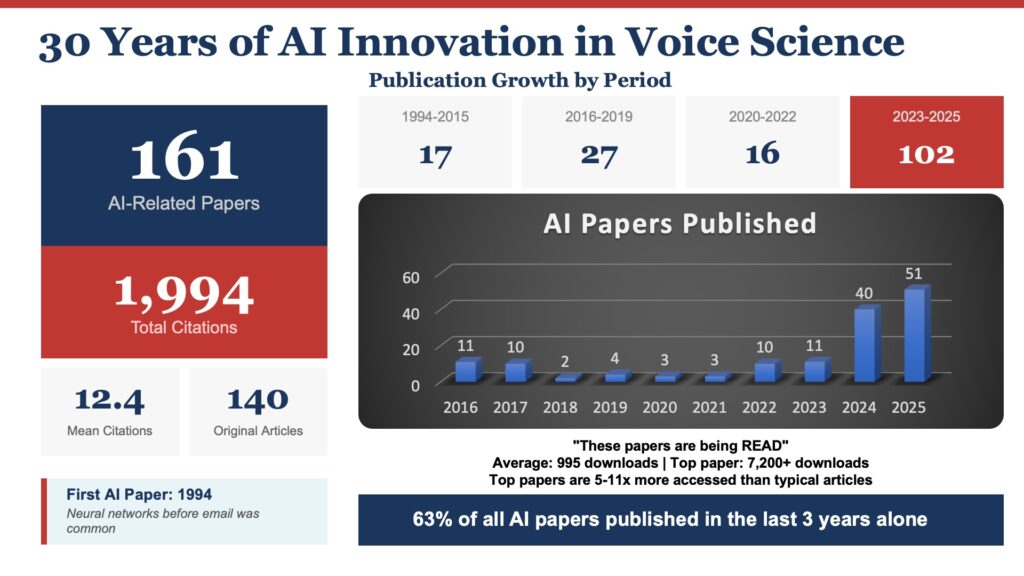
The journey of AI in voice science began quietly in an era when dial-up internet was a novelty and the World Wide Web was just finding its footing. In 1994, the Journal of Voice—the premier peer-reviewed publication dedicated to voice science and medicine—published a landmark paper by Rihkanen and colleagues entitled "Spectral Pattern Recognition of Improved Voice Quality." Utilizing nascent neural network architecture to analyze vocal acoustics, this study planted a flag for computational diagnostics in a field traditionally dominated by subjective auditory-perceptual evaluation.
Despite this early vision, growth during the first two decades was measured and incremental. Between 1994 and 2015, the journal published a modest 17 AI-related papers. Researchers were constrained by computing power, limited datasets, and algorithms that lacked the robust pattern-recognition capabilities of modern deep learning. Nevertheless, these foundational years established the vital taxonomy, feature extraction methods (such as cepstrum vectors), and digital signal processing standards that modern AI models rely on today.
The Acceleration Phase (2016–2022)
As computational power surged, cloud infrastructure matured, and machine learning transitioned into practical data science, publication velocity began to climb. Between 2016 and 2019, the Journal of Voice published 27 AI-focused studies. This period marked a transition from exploratory models to sophisticated machine-learning applications, highlighted by foundational survey papers and deep learning frameworks for automated voice pathology detection.
Between 2020 and 2022, despite global disruptions caused by the COVID-19 pandemic, an additional 16 papers were published. During this window, the scope of research broadened significantly. Scholars began exploring not just localized vocal cord pathologies, but the broader systemic implications of voice analysis—including early investigations into vocal biomarkers for systemic diseases and respiratory viral infections.
The Exponential Explosion (2023–2025)
The last three years represent a tectonic shift in the discipline. Between 2023 and 2025, an astonishing 102 AI-related papers were published in the Journal of Voice, accounting for roughly 63 percent of the journal’s total historical output in the artificial intelligence domain.
The year 2025 alone witnessed 51 AI-related publications—surpassing the total output of the journal’s first twenty years combined. This exponential curve reflects a broader technological revolution: the widespread accessibility of advanced neural network frameworks, large language models (LLMs), and expansive multimodal datasets. The field has moved past the question of whether AI has a place in voice science, diving headfirst into how it can be optimized, validated, and safely deployed in clinical settings.
Supporting Context and Metrics: The Real-World Impact of Voice AI
Numbers alone do not tell the full story of academic output; true impact is measured by how deeply research permeates clinical practice, inspires subsequent investigation, and drives real-world utility. The metric footprint of AI research within the Journal of Voice reveals extraordinary global engagement.
Readership and Download Metrics
On average, an AI-focused paper published in the journal is downloaded nearly 1,000 times—a testament to the high demand for actionable computational tools among clinicians and researchers.
The most-accessed papers cross academic boundaries entirely, serving as vital manuals for medical professionals seeking practical applications. For instance, a seminal study investigating machine learning approaches for COVID-19 detection via voice characteristics has been downloaded over 7,200 times—more than eleven times the median download rate for articles within its respective issue.
Similarly, top-cited foundational works have achieved legendary status within the community:
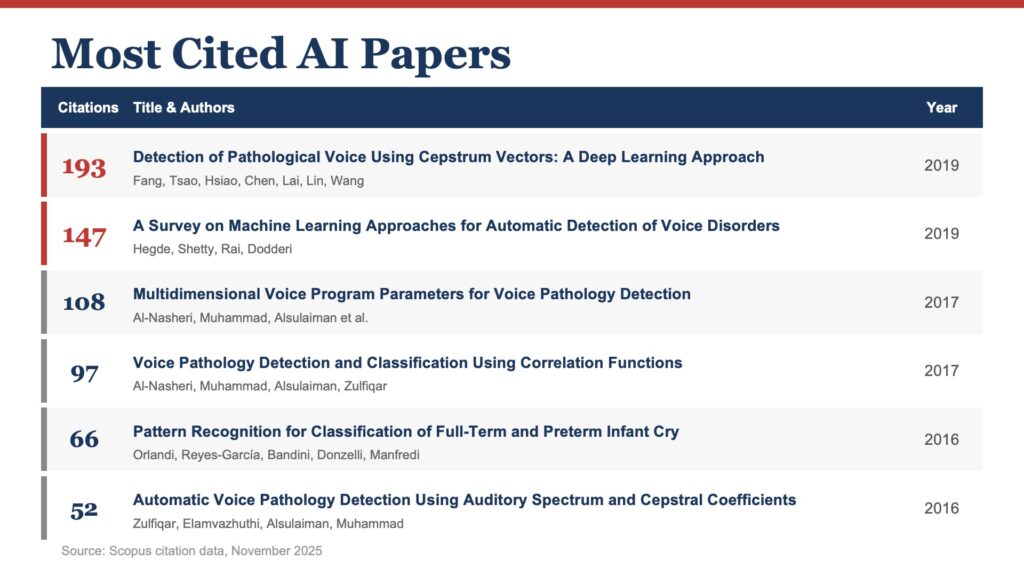
Fang and colleagues (2019): A deep learning study detailing cepstrum vector analysis for pathological voice detection has garnered 193 citations and nearly 5,000 downloads.
Hegde and colleagues: A comprehensive survey on machine learning approaches for automatic detection of voice disorders has secured 147 citations and a comparable download footprint.
These figures illustrate that modern otolaryngologists, speech-language pathologists, and biomedical engineers are not merely viewing AI as theoretical mathematics; they are actively reading, citing, and deploying these studies to upgrade patient care standards.
Landmark Research Shaping the Field
The technical sophistication of these papers has evolved in tandem with their readership. Landmark studies have systematically pushed the boundaries of diagnostic precision:
Pathology Detection Beyond Human Perception: Fang’s 2019 work proved that deep neural networks could identify pathological conditions using acoustic features completely imperceptible to the human ear. Subsequent works by researchers like Chen and Chen (2022) on deep neural networks for voice classification, Fujimura on one-dimensional convolutional neural networks, and Cho and Choi on laryngoscopic image categorization have systematically expanded the diagnostic toolkit.
The Voice as a Digital Biomarker: Perhaps the most radical paradigm shift is the recognition of the voice as a non-invasive digital biomarker—a persistent acoustic window into systemic health. Groundbreaking studies, such as Hemmerling and Wójcik-Pędziwiatr’s 2022 research on predicting the severity of Parkinson’s disease from voice signals, have unlocked new frontiers in neurological monitoring. Recent systematic reviews have further extended this logic to mental health, exploring how voice quality can act as an early sentinel for depression and bipolar disorder.
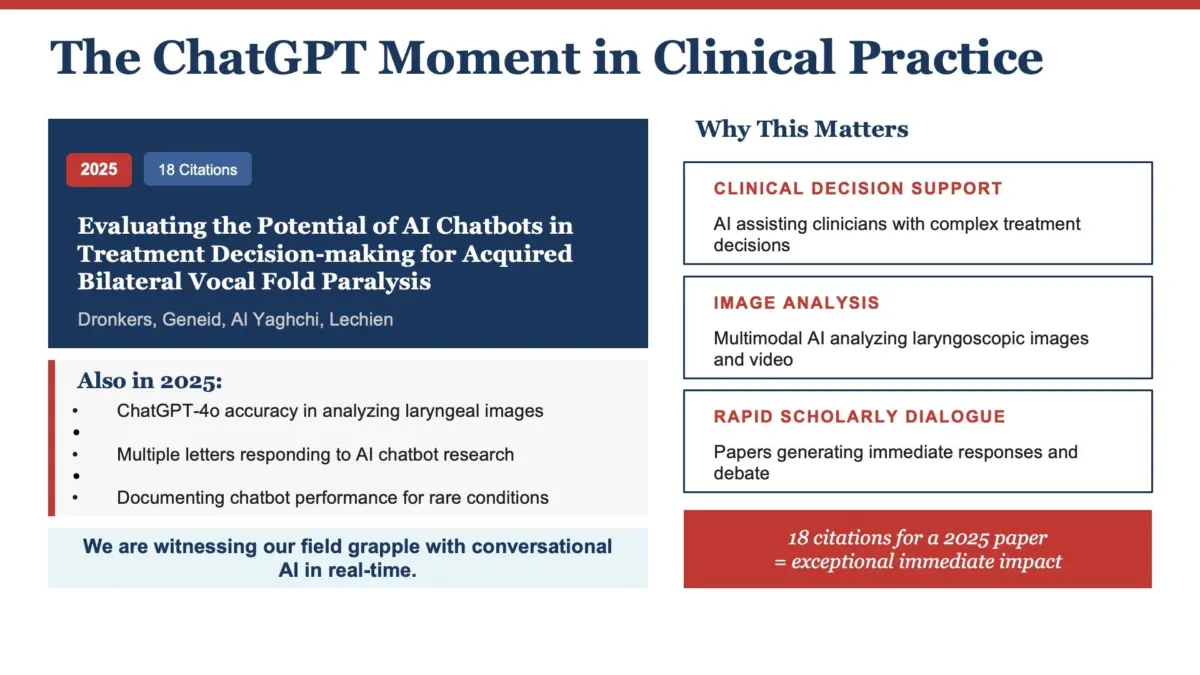
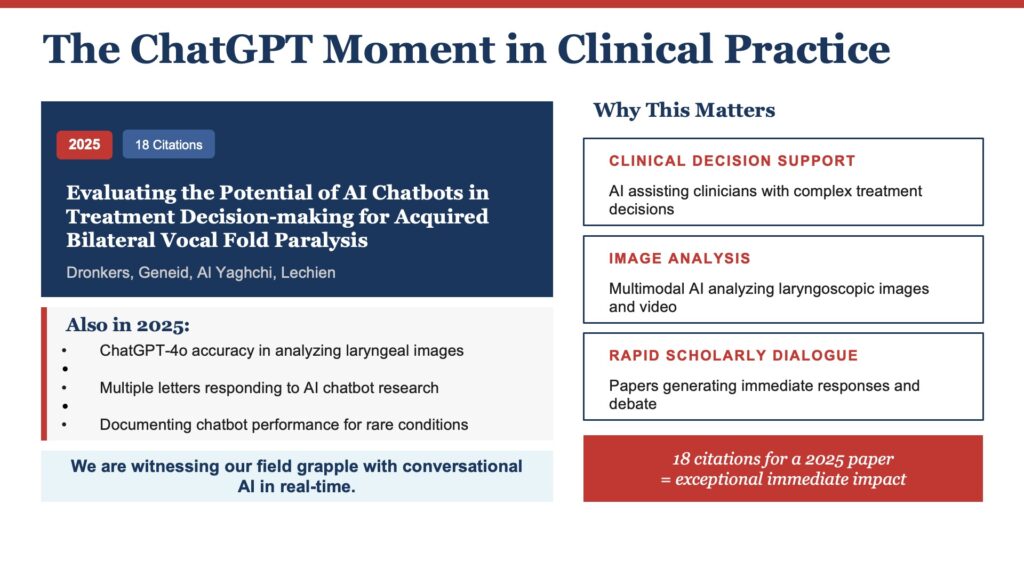
Clinical Chatbots and Decision Support: Most recently, 2025 publications have plunged into conversational AI and large language models. Papers evaluating the potential of AI chatbots in treatment decision-making for complex conditions—such as acquired bilateral vocal fold paralysis—have generated immediate scholarly engagement, sparking fierce debates, response letters, and ancillary studies regarding the diagnostic accuracy of platforms like ChatGPT-4o in analyzing laryngeal imagery.
Official Statements and Expert Perspectives
To capture the philosophical and institutional dimensions of this technological wave, leading voices within the global scientific community offer critical perspectives on both the promise and the peril of AI integration.
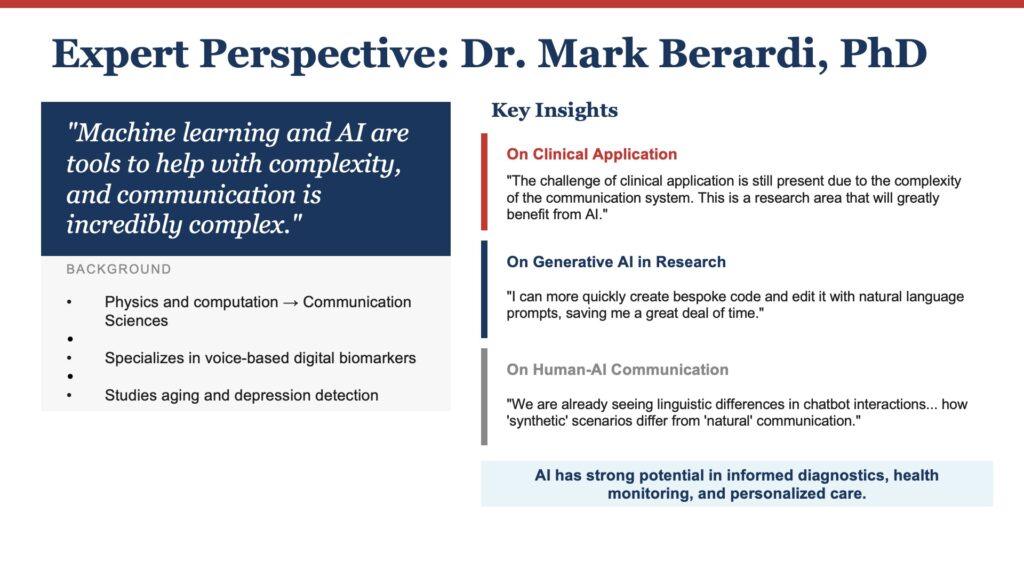
Dr. Mark Berardi: Managing Neurobiological Complexity
Dr. Mark Berardi, whose academic background bridges physics, computation, and voice science, views machine learning not as a replacement for human intellect, but as an essential engine for managing profound biological complexity.
"Machine learning and AI are tools to help with complexity, and communication is incredibly complex in its neurobiological and physiological processes. So I think the application is warranted," Dr. Berardi notes.
Focusing his current research on voice-based digital biomarkers for aging and depression, Dr. Berardi emphasizes that while acquiring speech signals has become remarkably frictionless, the true hurdle remains the intricate nature of human communication itself.
Addressing generative AI, he offers a pragmatic, nuanced assessment. While everyday generative models may not have rewritten the core rules of basic research overnight, they have successfully dismantled persistent operational bottlenecks. Researchers can now rapidly prototype bespoke code and refine data processing pipelines using natural language prompts.
Intriguingly, Dr. Berardi is also pioneering research into direct human-AI communication. As humans increasingly converse with automated systems, linguistic adaptations emerge. Zoom calls, synthetic interfaces, and chatbot interactions reveal subtle communicative divergences that suggest voice science must expand its scope: we must study not only the human voice in isolation, but the human voice in active conversation with machines.
Dr. Eric Hunter: Embracing Change with Ethical Clarity
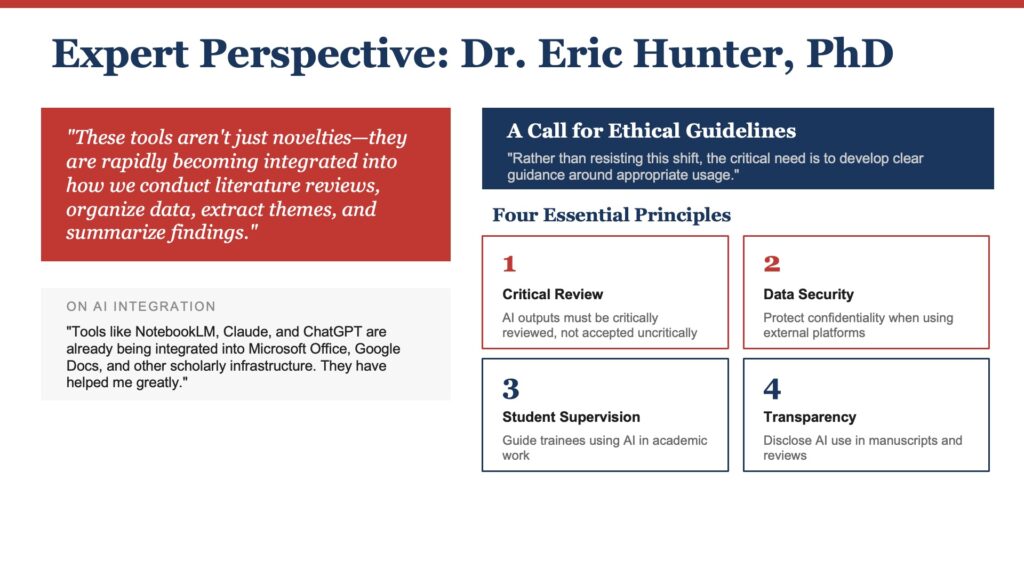
Dr. Eric Hunter approaches the AI revolution through an institutional and systemic lens, urging the academic community to acknowledge that computational platforms are permanent fixtures of the modern scholarly ecosystem.
"These tools aren’t just novelties," Dr. Hunter observes. "They are rapidly becoming integrated into how we conduct literature reviews, organize data, extract themes from large bodies of text, and even summarize findings."
As large language models bake into foundational academic infrastructure—ranging from Microsoft Office and Google Docs to automated manuscript review systems—Dr. Hunter warns against futile resistance. Instead, he issues an urgent call to action for the establishment of transparent operational guidelines.
To safeguard academic integrity, Dr. Hunter outlines four essential principles for responsible AI integration in research and publishing:
Uncompromising Transparency: Authors must explicitly disclose if and how AI tools were utilized during literature synthesis, data analysis, or manuscript drafting.
Human Accountability: Artificial intelligence can draft, summarize, and compute, but human researchers must retain absolute legal and moral accountability for the final scholarly output.
Algorithmic Literacy: Reviewers and editors must develop baseline literacy regarding machine learning methodologies to accurately evaluate computational claims.
Data Privacy and Ethics: Strict guardrails must govern the collection, anonymization, and training usage of sensitive patient voice data.
"Our field will benefit most," Dr. Hunter concludes, "if we embrace the productivity these tools offer while also building a shared ethical framework for their responsible use."
Future Outlook: A Global Community at the Center of Discovery
The momentum behind this digital transformation is sustained by an extensive, highly collaborative global research community. Visionary scholars spanning every continent have driven this progress. Prolific contributors such as Jérôme René Lechien, Dimitar Deliyski, Stephanie Zacharias, Ahmed Yousef, Paavo Alku, Leonardo Wanderley Lopes, and Maryam Naghibolhosseini—alongside dozens of international research groups—have positioned artificial intelligence at the vanguard of modern otolaryngology and speech-language pathology.
Looking toward the horizon, the path forward for the Journal of Voice and the broader scientific community hinges on three critical mandates:
Thoughtful Engagement with Complexity: Researchers and clinicians must view AI as an amplifier of human expertise rather than an infallible oracle. Understanding both computational capacities and algorithmic limitations is paramount.
Collective Ethical Governance: Establishing a shared ethical framework cannot be accomplished by a single lab or journal. It requires a concerted, multidisciplinary pact among clinicians, engineers, ethicists, and patients.
Continuous Knowledge Sharing: As the 161 published AI papers represent merely the opening chapter of this evolution, the scientific community must continue to publish, debate, and share clinical insights openly.
The Voice Foundation: Bridging Art and Science for Over Half a Century
This forward-looking ethos is deeply embedded in the DNA of The Voice Foundation. Founded in New York City in 1969 by Dr. Wilbur James Gould—a visionary otolaryngologist who recognized the vital necessity of bringing together physicians, scientists, speech-language pathologists, performers, and teachers—the Foundation has spent over five decades building bridges between art and science, clinic and stage.
Since 1989, under the leadership of Dr. Robert Thayer Sataloff—an internationally renowned otolaryngologist, professional singer, conductor, and author of over 1,200 publications and 79 textbooks—the Foundation has expanded its global footprint from its home base in Philadelphia. Through its prestigious annual Symposium and the stewardship of the Journal of Voice, the organization remains the intellectual epicenter of global voice care.
An Extraordinary Moment in Human History
The human voice is our most intimate instrument of connection, expression, and identity. For hundreds of thousands of years, it has carried our emotions, our cultural heritage, and the subtle signatures of our physical health in ways no other human signal can replicate.
Now, for the first time in history, humanity possesses computational tools sophisticated enough to truly decode that complexity. We stand on the cusp of an era where routine voice analysis can detect pathological conditions before symptoms manifest, extend the reach of expert clinicians to remote corners of the globe, and democratize access to preventative healthcare.
The Voice Foundation and the Journal of Voice stand proudly at the center of this historic inflection point. As the next decade unfolds, the intersection of human vocal artistry and artificial intelligence promises discoveries that will forever alter our understanding of the human body and mind.