
Executive Overview
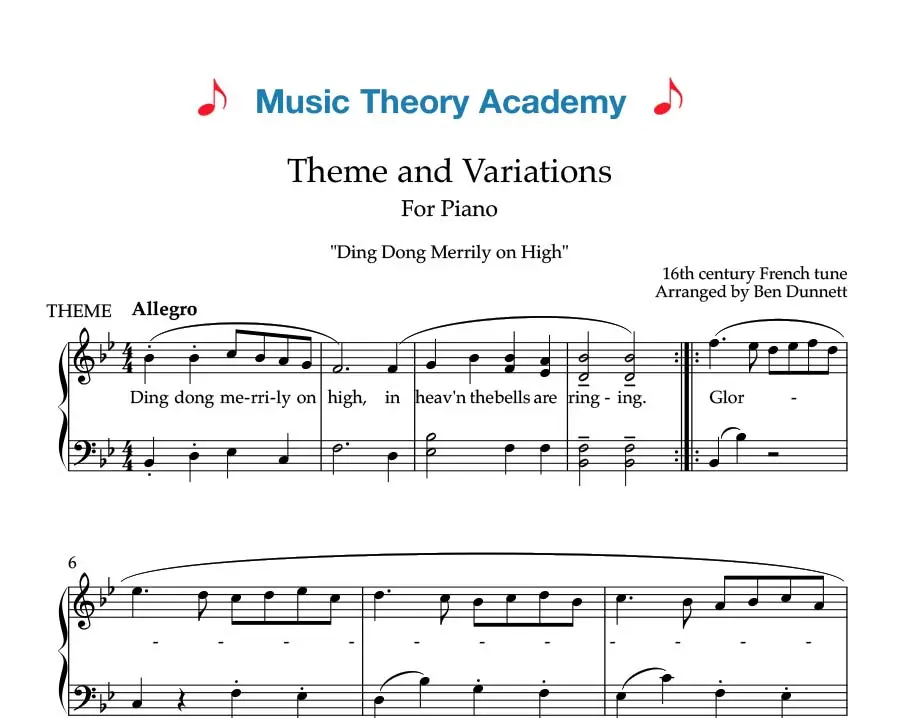
The holiday season unfurls a rich tapestry of musical traditions, few as enduring or delightfully intricate as the timeless Christmas carol "Ding Dong Merrily on High." While millions worldwide recognize the festive strains echoing from church steeples, shopping arcades, and family living rooms during December, the architecture behind its performance remains a masterclass in musicianship. Recently, Ben Dunnett LRSM—founder of the Music Theory Academy, seasoned composer, educator, and pianist with over two decades of experience in music education—released an advanced, beautifully crafted piano arrangement of this holiday classic. Utilizing a sophisticated theme and variations framework, this arrangement breathes new life into a 16th-century secular French dance tune, transforming it into a demanding contemporary piano piece.
This comprehensive feature explores Dunnett’s newly published arrangement, analyzing its pedagogical value, technical hurdles, historical roots, and the creative genius required to bridge a Renaissance dance melody with a 20th-century lyrical masterpiece. Designed for intermediate to advanced pianists looking to elevate their holiday repertoire, this piece challenges performers with brisk tempos, intricate key signatures, articulation nuances, and rapid-fire scalar passages. By examining the structural mechanics of the score, the historical evolution of the text, and essential practice strategies, this article serves as the definitive guide to mastering one of the season’s most sparkling musical offerings.
Detailed Chronology: From Renaissance Dance to 20th-Century Choral Staple
To fully appreciate the technical demands of Dunnett’s contemporary piano arrangement, one must trace the winding historical lineage of "Ding Dong Merrily on High." The journey of this beloved melody is a fascinating study in cultural metamorphosis, spanning centuries, artistic mediums, and shifting geographic contexts.
The 16th Century: The Secular Origins of "Branle de l’Official"
The story begins not in a cathedral, but on the dance floors of 16th-century France. The iconic melody that underpins the carol was originally a secular dance tune known as "Branle de l’Official." The bransle (or branle) was a popular French Renaissance dance characterized by side-to-side steps, danced by couples in a circle or line.
The tune was first documented in 1588 by the French cleric, composer, and dance historian Thoinot Arbeau (the pen name of Jehan Tabourot) in his seminal treatise Orchesography. Arbeau’s text is one of our most vital surviving historical sources regarding Renaissance social dance and its musical accompaniment. Originally, "Branle de l’Official" had nothing to do with Christmas, the church, or the nativity; it was purely a lively, secular instrumental tune designed to prompt rhythmic movement, merriment, and communal celebration. For over three centuries, the melody circulated primarily within historical dance and early music spheres, maintaining its infectious, buoyant rhythm while waiting for the right lyricist to unlock its sacred potential.
The Early 20th Century: The Birth of a Carol
The transformation of the sprightly French dance tune into a staple of the English Christmas choral tradition occurred in the early 20th century. Enter the Reverend George Ratcliffe Woodward (1848–1934), an English Anglican priest, composer, and enthusiastic hymnologist. Woodward was captivated by archaic folk tunes and Renaissance melodies, frequently scouring historical archives to pair them with new sacred texts.
In 1924, Woodward published the lyrics we know today, masterfully matching the galloping, energetic meter of Arbeau’s 16th-century dance tune with playful, archaic English verse. Woodward’s text captures the joyful pealing of church bells and the celestial jubilation of angels. To complete the artistic vision, the celebrated English composer Charles Wood (1866–1926) harmonized the tune, cementing its status as an essential fixture of Anglican choral evensong and lessons-and-carols services worldwide.
The Modern Era: Dunnett’s Piano Transcription and Variation Form
Fast-forward nearly a century to the present day, where modern pedagogues continue to reinvent the carol for new instruments and skill levels. Ben Dunnett’s recent arrangement takes Woodward and Arbeau’s historic collaboration and repurposes it for the solo pianist using the theme and variations form—a compositional structure popularized by classical masters such as Mozart, Beethoven, and Brahms.
By taking the iconic melody, presenting it cleanly in its original form, and subsequently fracturing, embellishing, and recontextualizing it across multiple distinct variations, Dunnett bridges centuries of music history. The result is a sophisticated concert piece that honors the Renaissance dance roots of the tune while testing the mettle of modern pianistic technique.
Supporting Context & Metrics: Technical Breakdown of the Piano Arrangement
Pianists eager to dive into Dunnett’s arrangement will quickly discover that this is no simplified holiday medley. The piece demands precise technical execution, acute rhythmic awareness, and a high degree of digital dexterity. Below is an exhaustive structural and technical analysis of the sheet music, accompanied by essential practice methodologies.
The Structural Blueprint: Theme and Variations
In music theory, a theme and variations structure begins with the presentation of a recognizable musical subject (the theme). Subsequent sections (the variations) alter, decorate, transpose, or rhythmically mutate that theme while retaining its underlying harmonic or melodic DNA.
- The Statement of the Theme: The piece opens with a clear, direct presentation of the iconic melody. This serves as the anchor for the listener, establishing the buoyant, dance-like character of the work before the variations begin to deconstruct and rebuild the material.
- The Variations: As the piece progresses through its variations, Dunnett introduces textural shifts, altered accompaniments, register changes, and rhythmic displacements. This keeps the listener engaged while challenging the performer to maintain clarity and stylistic consistency across shifting landscapes.
Key Signature and Harmonic Hurdles
Dunnett’s arrangement is set in B flat major, a key featuring two flats (B♭ and E♭). While B-flat major sits comfortably under the fingers for scalar work due to its black-key topography, it presents distinct challenges for developing pianists:
- Tactile Geography: The reliance on B♭ and E♭ requires the hand to maintain a specific structural arch, particularly when navigating mixed passages of white and black keys.
- Harmonic Color: B-flat major provides a warm, resonant acoustic profile on the piano, perfectly suited to capturing the bell-like resonance ("Ding-dong! Merrily on high") envisioned by Woodward’s lyrics.
Mastering the Left Hand: Rhythmic Stability and Flow
One of the most notable pedagogical notes from the author concerns the left-hand movement. In many variations, the left hand is tasked with maintaining a driving, rhythmic accompaniment that simulates the chiming of heavy church bells or the steady pulse of a Renaissance dance.

- The Challenge: Rushing or dragging the left hand disrupts the overarching momentum of the piece, causing the variations to feel disjointed.
- The Solution: Dunnett strongly recommends slow practice of the left-hand movement. Practicing the left-hand part in isolation at a greatly reduced tempo allows the nervous system to map out spatial distances across the keyboard. Once ingrained, the left hand acts as an unyielding metronomic anchor, freeing the right hand to sing out the melodic lines.
Right-Hand Scalic Runs and the "Gloria" Motif
In the traditional vocal carol, every verse culminates in the exuberant, soaring refrain: “Gloria, hosanna in excelsis!” In Dunnett’s piano arrangement, these moments translate into brilliant, right-hand scalic runs that cascade up and down the keyboard.
- The Challenge: These runs require absolute fleetness of finger, yet they must not sound dry, mechanical, or rushed. The goal is to evoke the image of angels singing and bells ringing across the sky.
- The Solution: Performers should practice these scalic runs slowly, focusing on finger independence, even tone production, and supple wrist movement. Gradually increase the metronome speed only while maintaining a seamless legato line. The overarching objective is to create a profound sense of flow in the melodic line, ensuring that rapid notes sing rather than clatter.
Articulation and Phrasing: The Power of Staccato
A defining characteristic of Dunnett’s arrangement is its meticulous use of articulation and phrasing marks. Playing Renaissance dance music on a modern, heavy-action grand piano presents the perpetual danger of a muddy, overly sustained sound.
- The Role of Staccato: The sheet music features frequent staccato markings. These are not merely decorative; they are crucial to providing the light touch required throughout the piece.
- Stylistic Authenticity: By employing crisp, well-placed staccatos, the pianist mimics the plucked strings of early Renaissance instruments or the bright, crisp overtones of actual church bells. Balancing legato melodic arches with sparkling staccato accompaniment figures is the ultimate key to a polished performance.
Official Statements & Pedagogical Insights
To provide a deeper, authoritative perspective on the creation and philosophy behind this arrangement, we turn to insights from the composer himself, Ben Dunnett LRSM. With more than twenty years on the front lines of music education as a teacher, examiner, and composer, Dunnett approaches piano arrangement through a uniquely balanced lens of artistic expression and technical accessibility.
The Philosophy of Accessible Complexity
In discussing the genesis of holiday arrangements, Dunnett emphasizes that Christmas music offers a unique gateway for pianists to tackle advanced concepts without losing enthusiasm.
"When working with material as historically rich as ‘Ding Dong Merrily on High,’ the arranger’s duty is twofold," notes Dunnett. "You must respect the inherent joy and historical resonance of the original tune while pushing the performer to expand their technical vocabulary. The theme and variations format is ideal for this because it allows the player to master the core melody early on, before tackling the increasingly intricate variations that demand strict finger independence and rhythmic discipline."
Navigating the Pedagogical Hurdles
Addressing teachers and independent learners alike, Dunnett highlights the importance of patient, methodical practice routines when confronting challenging contemporary arrangements:
"Pianists often make the mistake of trying to play brisk, celebratory pieces at performance speed from day one. In a piece like this—set in B-flat major with rapid scalic runs and demanding left-hand accompaniment figures—that approach leads straight to tension and fatigue. Slow practice isn’t just a recommendation; it is the absolute foundation of velocity. By isolating the left hand and breaking down the right-hand ‘Gloria’ runs into micro-rhythms, students unlock a level of physical ease and musical flow that makes the performance truly sparkle."
Future Outlook: The Resurgence of Classical Piano Pedagogy in Digital Spaces
As we look toward the future of music education, resources like Ben Dunnett’s Music Theory Academy represent a profound shift in how pedagogical materials are created, distributed, and consumed. The traditional model—where students relied solely on bulky, expensive printed anthology books—is increasingly being complemented by digital ecosystems that offer integrated video demonstrations, downloadable PDF scores, and direct access to master composers and educators.
The Hybrid Learning Model
The inclusion of high-definition video embeds alongside traditional sheet music downloads signals a vital evolution in modern music pedagogy. For a piece as rhythmically nuanced and texturally complex as Dunnett’s "Ding Dong Merrily on High," audio-visual aids bridge the gap between abstract notation and physical execution. Students can watch hand placements, observe wrist rotations during staccato passages, and hear the intended tempo and dynamic shaping before attempting the piece themselves.
Preserving Historical Repertoire Through Modern Innovation
Furthermore, the continued adaptation of Renaissance and Baroque source material for modern instruments ensures that centuries-old musical traditions remain vibrant and relevant. By stripping away the dust of historical archives and repackaging masterworks into engaging, contemporary formats, educators ensure that future generations of pianists remain connected to the deep roots of Western classical music.
Final Takeaways for the Practicing Pianist
For any pianist seeking to enrich their holiday repertoire this season, Dunnett’s arrangement of "Ding Dong Merrily on High" offers an exceptional artistic challenge. Success with this piece requires patience, a respect for historical performance practice, and diligent technical execution:
- Embrace Slow Practice: Dedicate the initial weeks of learning strictly to slow, deliberate execution of both hands in isolation.
- Honor the Articulation: Pay strict attention to the interplay between legato lines and crisp staccato touches.
- Drive the Rhythm: Let the left-hand accompaniment maintain the steady, joyful pulse of a 16th-century French dance, while the right hand soars upward with the triumphant energy of angelic bells.
By combining rigorous technical preparation with an understanding of the piece’s rich historical lineage, performers can deliver a rendition of "Ding Dong Merrily on High" that is as intellectually satisfying as it is audibly breathtaking.