
Executive Overview
Two millennia ago, the Romans engineered public bathing into an intricate architecture of socialization and wellness—an enduring cultural footprint. Yet, in a northern European nation the legions of the Roman Empire never reached, this ancient lineage of continuous public bathing finds its most vibrant, modern-day sanctuary: the Finnish sauna. For modern Finns, stepping into the intense, communal heat of an overcrowded lakeside steam room, such as the iconic Kaupinojan Sauna, is as ritualistic as the British Friday-night pub pilgrimage. It is a cleansing, centering reset.
It was precisely this atmospheric blend of primordial calm and sensory intensity that framed the 45th anniversary of the Tampere Jazz Happening (TJH). Held against the crisp backdrop of late autumn from October 29 to November 1, this landmark edition of the festival marked a pivotal turning point in its storied history. Following the retirement of long-serving visionary Juhamatti Kauppinen last year, the curatorial reins were handed over for the first time to Martyna van Nieuwland. Stepping into the role of artistic director, van Nieuwland inherited a festival deeply rooted in Nordic soil yet globally expansive in its sonic aspirations.
Over four days, Tampere transformed once again into an international epicenter of improvised music, bridging the gap between local traditions and cutting-edge global jazz. From the roaring waters of the Tammerkoski rapids to the historic industrial brickwork of the Pakkahuone customs house and the cozy, bohemian confines of the Telakka venue, the 45th TJH proved that jazz—much like the alternating shock of hot sauna steam and freezing lake water—thrives on dynamic contrast, endurance, and deep emotional resonance.
Detailed Chronology: A Weekend of Sonic Exploration
Day One: The Pre-Game Ritual and Opening Salvos
In Finland, preparation is everything. Before the first note of jazz echoed through the city, festival-goers and artists alike sought out the ritualistic sweat of Kaupinojan Sauna, located right on the edge of Lake Näsijärvi. This pre-concert cleansing set a contemplative, highly receptive tone for a long evening of performances ahead.
The festival officially kicked off at the recently renovated Pakkahuone—a magnificent former customs house situated conveniently close to the Tampere railway station. The evening began with a moment of national pride: the presentation of the prestigious Yrjö Award to multi-instrumentalist Pauli Lyytinen. Immediately following the ceremony, Lyytinen took to the stage alongside master drummer Markku Ounaskari. Together, this intense, telepathic duo delivered an opening performance that set a remarkably high bar for the weekend, balancing structural intricacy with visceral emotional delivery.
For audiences eager to plunge deeper into the contemporary Finnish scene, a brisk, picturesque walk between Pakkahuone and the historic Telakka venue offered an instant reward. Telakka hosted a triple-bill before a packed, deeply appreciative house. Among them was vocalist Anna Dantchev leading her Dantchev Domain quartet. Stripping away the traditional double bass—so often the reliable anchor for a jazz vocalist—Dantchev opted for an unusual, highly textured instrumentation featuring a trombone, a tuba, and drums, creating a rich, brass-heavy sonic landscape that challenged conventional genre boundaries.
Day Two: Global Dialogues and Miraculous Replacements
As local Finns engaged in philosophical discussions amidst the rising steam of the sauna, international artists at the festival engaged in an equally intense musical dialogue. Foremost among these was Cosmic Ear, featuring Goran and his fellow collaborators. The group demonstrated a rare telepathic synergy, with the trumpet and double bass locked in a visual and sonic confrontation before ultimately dissolving their differences into breathtaking unison lines. While occasional splashes of modern electronic soundscapes added an extra layer of color to their palette, the raw, unyielding spirit of free-flowing jazz remained the beating heart of their performance.
Equally compelling was the cross-generational, Don Cherry-inspired collective featuring saxophonist Mats Gustafsson and bass clarinetist Christer Bothén. The sonic friction between Gustafsson’s searing, volcanic saxophone attacks and Bothén’s deep, restrained, and woody bass clarinet tones was a masterclass in dynamic tension. True multi-instrumentalists, these artists moved fluidly between bass clarinet, piano, percussion, and the esoteric six-string n’goni.
In fact, the n’goni very nearly didn’t make the trip; strict airline luggage restrictions left the delicate instrument stranded at the departure airport. In true festival-production miracle fashion, however, the TJH organizers scrambled behind the scenes, managing to source a replacement n’goni and secure its place on stage just in time for the performance.
Day Three: Chambers, Rivers, and Centennial Celebrations
In the country of a thousand lakes, pianist and composer Aruán Ortiz unveiled his ambitious new project, aptly titled I’ve Known Rivers. Given the setting, it might just as well have been baptized I’ve Known Lakes. The title pays homage to the seminal 1920 poem by Langston Hughes, while also nodding to an experimental chamber-jazz concept originally conceived in the 1980s by pianist Anthony Davis, flutist James Newton, and cellist Abdul Wadud.
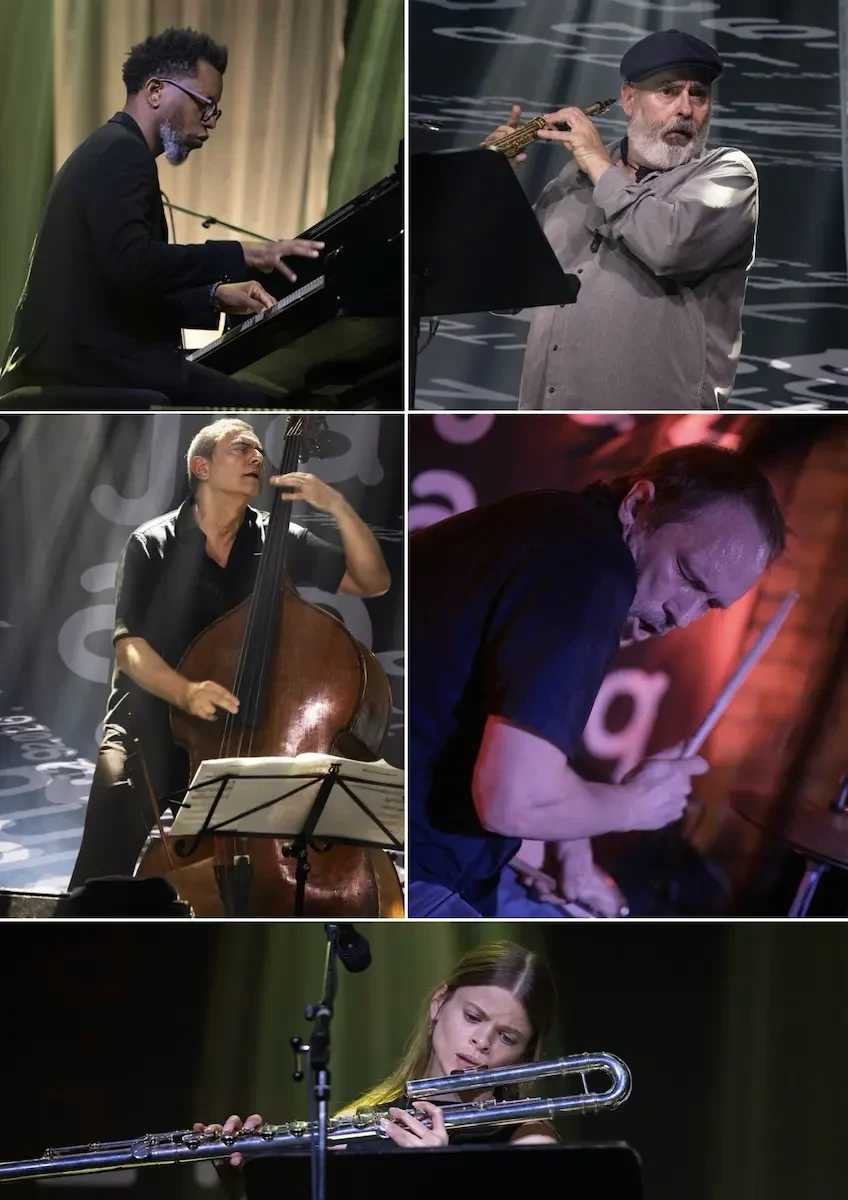
Assembling an exceptional trio alongside flutist Laura Cocks and cellist Jeremy Harman, Ortiz delivered a performance that mirrored the natural geography of Tampere itself. The city was built upon the roaring Tammerkoski rapids—a rushing waterway that birthed the city’s industrial might and continues to generate hydroelectric power to this day. Starting from a subdued, introspective chamber-music aesthetic, Ortiz’s ensemble gradually built in momentum, unleashing a powerful, cascading current that reminded the audience of the immense, untamed force water holds.
The festival also took a vital moment to look backward in order to move forward. Exactly one century ago, a steamship carrying a group of enterprising jazz musicians from New York docked in Helsinki, introducing syncopated rhythms to the Finnish population and laying the foundation for the nation’s jazz lineage. To celebrate this centenary, saxophonist Mikko Innanen curated an extraordinary octet on the Pakkahuone stage, gathering some of Finland’s absolute finest improvisers. The resulting performance breathed vibrant, modern life into classic Finnish jazz compositions, wrapping historical reverence in bold, contemporary arrangements.
Day Four: Free Jazz Heat and Transatlantic Interplay
Over at Telakka, the temperature soared as uncompromising free jazz took center stage. The afternoon kicked off with an incendiary duo performance by saxophonist Camila Nebbia and guitarist Jukka Kääriäinen, whose textural interplay explored the absolute outer limits of acoustic and amplified sound.
They were followed by guitarist Raoul Björkenheim and drummer Paal Nilssen-Love, celebrating their first-ever duo album, Ping. Having known and collaborated with one another for over 25 years, their musical communication was telepathic, fierce, and relentless. The sheer physical energy of their set left the packed room sweating—almost rivaling the heat of a traditional Finnish smoke sauna.
Shifting gears entirely, Pakkahuone hosted Dutch alto saxophonist Benjamin Herman and his Tokyo Sessions project. Having spent considerable time performing and absorbing the music scene in Japan, Herman introduced his special guest, Tokyo-based tenor saxophonist Tomoaki Baba. The front-line interplay between Herman’s sharp, swinging phrasing and Baba’s muscular, emotive tenor lines was nothing short of phenomenal, propped up seamlessly by an ironclad rhythm section.
As the festival drew toward its grand finale on Sunday, French bassist Claude Tchamitchian emerged as an undisputed highlight. Wielding a very special instrument inherited from the legendary Jean-François Jenny-Clarke, Tchamitchian returned to Tampere—following a successful string of solo concerts and masterclasses across the Baltic states—fronting his Poetic Power trio. Accompanied by drummer Eric Echampard and the brilliantly versatile Christophe Monniot on saxophones, Tchamitchian delivered a performance of staggering depth, emotional weight, and technical mastery.
Right before them, the Sunday program was opened by Beiggja, an ensemble comprising an almost entirely Norwegian lineup—with the sole delightful exception of Dutch saxophonist Kika Sprangers. Their performance served as an auditory postcard, transporting the audience from the industrial brick walls of Pakkahuone into the serene, mist-shrouded majesty of the Scandinavian fjords.
Supporting Context & Metrics: The Scale of the Happening
To understand the cultural and economic significance of the Tampere Jazz Happening, one must examine its position within the broader European festival ecosystem. Now in its 45th year, TJH stands as one of the continent’s longest-running continuous jazz festivals, acting as a vital anchor for Nordic creative music.
- Duration: 4 intensive days of programming (October 29 – November 1).
- Venues: Anchored primarily by the historic Pakkahuone (capacity ~800) and the intimate, community-driven Telakka cultural center.
- Geographic Reach: Artists represented hailed from Finland, France, Norway, Argentina, the Netherlands, and Japan, reflecting artistic director Martyna van Nieuwland’s commitment to truly global dialogue.
- Local Economic Impact: The festival consistently draws thousands of music tourists to Tampere, boosting hospitality, hotel occupancy, and local gastronomy during the traditionally quiet shoulder season between autumn and the winter freeze.
Official Statements & Curatorial Vision
Transitioning leadership of a historic festival is rarely a frictionless endeavor, yet the 45th edition proved that the Tampere Jazz Happening is in exceptionally capable hands. Speaking on her inaugural year as artistic director, Martyna van Nieuwland emphasized the importance of continuity paired with bold, forward-thinking curation:
"Tampere has a very distinct sonic identity—one that mirrors its industrial heritage and its surrounding geography of water, stone, and forest. Coming into this role, my goal was not to rewrite the DNA of the festival, but to open the windows wider. We wanted to invite artists who treat improvisation not just as a technical exercise, but as a living, breathing conversation across borders, generations, and genres."
Reflecting on the milestone 45th anniversary, festival management noted that honoring the past—such as celebrating the centenary of jazz arriving on Finnish shores—while investing in boundary-pushing avant-garde acts like Aruán Ortiz and Camila Nebbia ensures the festival remains culturally vital for decades to come.
Future Outlook: Looking Ahead to the 46th Edition
As the final notes of Claude Tchamitchian’s bass faded into the crisp autumn air of Tampere, and festival-goers packed away their winter coats, thoughts immediately turned toward the horizon.
While Finland may famously lack the dramatic, towering fjords of its western neighbor, its countless inland lakes offer an unmatched brand of quiet, melancholic tranquility. For the fortunate few who own a lakeside cabin, the ritualistic juxtaposition of searing sauna heat and bracing winter swimming remains an elite, restorative luxury that city dwellers can only dream of during the demanding workweek.
Yet, come late October next year, those same city dwellers—alongside an international pilgrimage of journalists, die-hard jazz aficionados, and curious first-timers—will inevitably find their way back to the banks of the Tammerkoski rapids. The Tampere Jazz Happening has already officially confirmed its return for its 46th edition, promising another unmissable weekend where the fires of improvisation burn just as hot as the Finnish steam.
Event Details:
- What: Tampere Jazz Happening (46th Edition)
- When: Late October / Early November (Dates to be announced)
- Where: Tampere, Finland (Venues: Pakkahuone, Telakka, and surrounding cultural spaces)